The online journal of Luke Dockery

Category: Youth Ministry (Page 19 of 24)

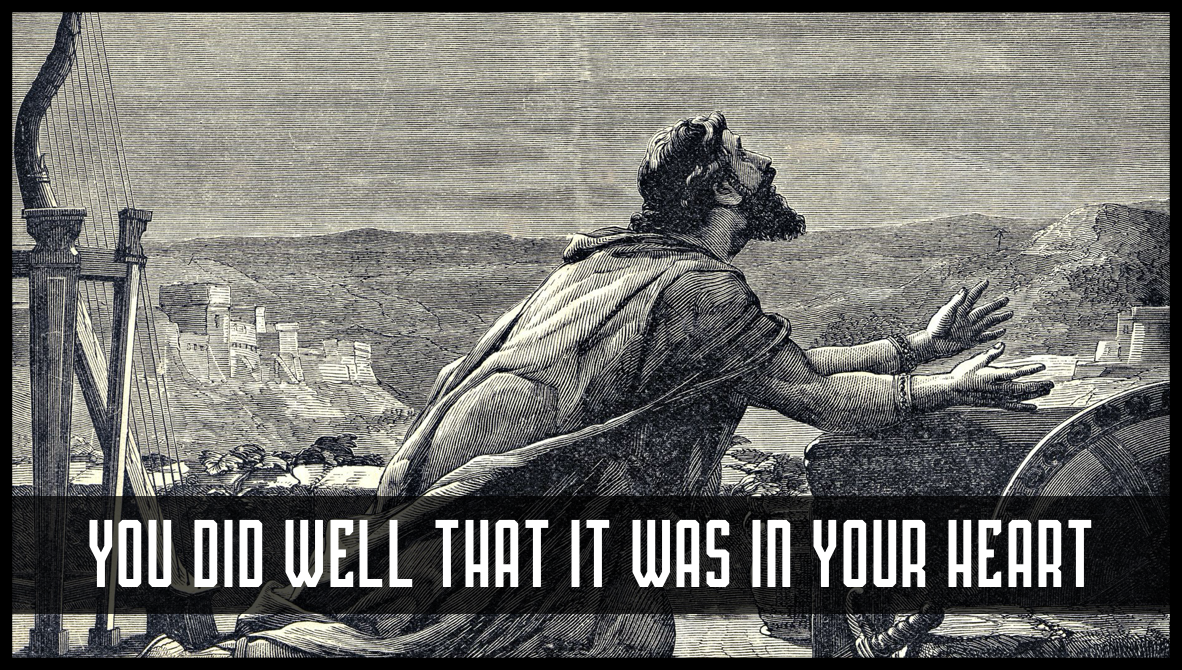
“You Did Well That It Was In Your Heart”

After the death of King Saul, there is a struggle between David and Saul’s son, Ish-bosheth, for the throne of Israel. With God’s support, David eventually wins out, things settle down, and everything seems to be okay.

But David isn’t happy. He isn’t happy because he realizes that while he lives in a nice, comfortable house made of cedar, the Ark of God is kept in a tent!

This doesn’t seem right to David, so he determines that he wants to build a temple for the Ark to be housed in. That sounds like a good idea, but God rejects his offer in 1 Chronicles 22.8-10:

“But the word of the Lord came to me, saying, ‘You have shed much blood and have waged great wars; you shall not build a house to My name, because you have shed so much blood on the earth before Me. Behold a son will be born to you, who shall be a man of rest; and I will give him rest from all his enemies on every side; for his name shall be Solomon, and I will give peace and quiet to Israel in his days. He shall build a house for My name, and he shall be My son and I will be his father; and I will establish the throne of his kingdom over Israel forever.’”

Later, Solomon talks about his father’s desire to build a temple for God in 1 Kings 8.17-19:

“Now it was in the heart of my father David to build a house for the name of the Lord, the God of Israel. But the Lord said to my father David, ‘Because it was in your heart to build a house for My name, you did well that it was in your heart. Nevertheless you shall not build the house, but your son who will be born to you, he will build the house for My name.’”

Did you catch that? God tells David, “You did well that it was in your heart.”

Even though David wasn’t going to be able to accomplish his goal of building the temple, God still appreciated and honored David’s intentions. Because he had been a man of war, David was told that he would not be the one to build a temple for the Lord—but God still appreciated that David had the desire to do so.

“It’s the thought that counts” is a common saying that we tend to throw around when we receive a gift we don’t like. It’s somewhat of an ironic saying since often the reason we receive bad gifts is specifically because very little thought was put into it, but I think it’s still a true statement, and it’s basically what God tells David in this story: “It’s the thought that counts.”

By extension, this passage means that God cares about our intentions as well. And to me, as a Christian and as a minister, that is incredibly encouraging—while our actions certainly matter, the thoughts behind our actions matter as well. We can’t always control how things turn out, but we can control our intentions.

When we try to do something big for God, as David did, and we fail and our plans don’t pan out, I’m thankful to know that we have a God who says, “You did well that it was in your heart!”

I don’t know what your exact situation is…

  • Maybe you try to help a friend with a problem like substance abuse or financial or marital difficulties, but your assistance is refused…God looks at your “failure” and says, “You did well that it was in your heart!”
  • Maybe you try to influence others for good and try to be salt and light in the world, but your influence is ignored and they continue to embrace darkness…You did well that it was in your heart!
  • Maybe you’re a youth minister and you’ve got that teen who you’ve poured yourself into— teaching, going to athletic events, modeling the Christian life, praying for them and lying awake at night worrying about them—but they choose to follow the world…You did well that it was in your heart!
  • Maybe you try to share your faith with someone, perhaps a family member or close friend, but it simply falls on deaf ears…You did well that it was in your heart!

Realize that you are going to fail in life. Your results won’t always match up with your intentions and your plans. But our God is someone who sees our hearts and appreciates our best efforts. With that in mind, let us attempt great things for Him!

The Last Pictures

This past weekend, our youth group went to Ponca, Arkansas to float on the Buffalo River. It was a great trip and we had a ton of fun.

I wanted to document the trip with pictures, but was concerned about water damaging my nice camera, so I brought my old camera instead and carefully kept it wrapped inside a double layer of ziplock bags.

Unfortunately, when we went to hike to Hemmed-In-Hollow, I slipped on a rock and fell, jacking up my back and breaking the LCD display on my camera (once again causing me to reflect on the benefits and limitations of planning ahead).

Still, I was able to get some pictures of our trip. A few of them are posted below (you should be able to click on the pictures and see larger versions).

Obligatory group photo in front of and on 1940s fire truck.

The part of the Buffalo we were floating was bordered by bluffs that were hundreds of feet tall.

Several from our group enjoyed jumping off of bluffs.

Hemmed-In-Hollow Falls, the highest waterfall between the Rockies and Appalachians (209 feet). My own fall took place just after taking this picture.

A closer look at the tops of some of the bluffs.

We had a great weekend! It was great to spend time in such beautiful country, and I was reminded yet again that, “The heavens declare the glory of God, and the sky above proclaims his handiwork” (Psalm 19.1).

Football Teams and Church Commitment

More good stuff from Mark DeVries’ Family-Based Youth Ministry, Rev. Ed., pp. 148-49 (emphasis added):

“I have often wondered what would happen if football coaches approached their work like most youth ministers are expected to. For example, I wonder what would happen if, when a player was too busy to show up for practice, the understanding coach simply said, “We’ll miss you. I hope you’ll be able to make it next week sometime. ” Imagine the players leaving practice and hearing the smiling coach say, “Thanks for coming. I hope you’ll come back tomorrow.”

If a football team operated like a typical youth ministry, we might expect concerned parents to call the coach, saying, “Can you tell me what’s been going on in practice? My son says it’s boring, and he doesn’t want to come anymore. I was wondering, could you make it a little more fun for them? And by the way, you might want to talk to the coach at the school across town. He seems to have the right idea.” The coach might send out quarterly questionnaires about what the players would like to change about the team. (I can just imagine the answers: “shorter practices,” “more winning”).

Responding like a typical youth minister, this coach might first feel guilty that the practices were not meeting the boy’s needs, and he would try to adjust his program to suit this boy (and every other boy who complained). Between trying to keep everybody happy and giving every student a good experience, the coach would squeeze in a little football practice. And what kind of season would this coach have? It’s a safe bet that the coach wouldn’t be the only one who felt like a loser.

But this is the very way that most churches expect to run their youth ministries. To expect that youth be committed to the church with the same level of commitment that would be expected of them on an athletic team would draw the charge of legalism and insensitivity. Our culture has been so carried away by the current of religious individualism that the expectation of commitment to the church has become implausible to most Christians in our culture. Because the god of individualism pressures us to program to the lowest common denominator, we seldom raise the expectations high enough for teenagers to experience real community.

Real community means real responsibility for each other. It means a commitment to be there for each other even when the schedule is tight and the motivation is low. But the typical Christian adult in our culture knows little about commitment to community.”

How true this is! I would love to be able to count on the same sort of commitment that a football coach expects. An unfortunate by-product of the extreme individualization of Christianity is a de-emphasis on the importance of Christian community, specifically in the context of the local church body.

The Christian life was never meant to be lived in isolation.

Destroying the Works of Satan

A couple of weeks ago I had the opportunity to speak at a youth rally and my topic was the purpose of the church. I talked about how the church is God’s vehicle for saving the world today (through the preaching of the gospel), for influencing the world and trying to make it a better place (through service), and equipping Christians for those first two tasks (through education and discipleship).

And those are all pretty standard ideas—we hear about those things a lot when we talk about what the church should do. But the church has another important purpose that is often neglected in such discussions: the mission of the church is to oppose and destroy the works of Satan.

In 1 John 3.8, John said that Jesus came to earth so that “He might destroy the works of the devil.” In Ephesians 6.12, Paul says that our struggle as Christians is not against flesh and blood, but against the forces of darkness.

These verses make it clear that as the church, we are a part of a spiritual battle against Satan and his influence. Moral corruption and sin are the works of the Devil (and we focus on things like that a lot),  but so are things like disease, starvation, poverty, terrorism, and racism.

When you look at all the sad and messed up stuff that happens in our world—do you think God likes that stuff? Of course not! Children starving to death in the developing world, or innocent people being killed because of racial wars, or bombs going off at marathon finish lines—those are works of Satan, and when we take part in efforts to fight against those things, we are fulfilling the purpose of the church in opposing and destroying the works of the Devil.

To me, realizing that when we fight against evil, we’re part of a cosmic struggle and are fighting against Satan himself gives us a whole new level of motivation for doing it. The decisions we make each and every day are important because we have the opportunity to stand up against evil.

A cosmic struggle against evil: think about that the next time one of your friends tells a racist joke—are you going to sit there and laugh at the works of Satan, or realizing that God loves all people regardless of race and that racism comes from Satan, are you going to speak up and put a stop to it?

Or the next time you have an opportunity to give to people, maybe people living on the other side of the world who have less than you do—are you going to be willing to use what you have to fight against the works of Satan like poverty and starvation, or are you going to hold onto those things so you can continue to pursue the idolatry of the “American dream”?

Studies show that a whole bunch of teens leave the church after high school, and I think a big reason for that is because it just doesn’t seem like the work of the church is all that important. After all, if we narrow down what church is to only a couple hours of activity a week, of course its importance is going to be diminished. But when we realize the cosmic nature of the struggle we are involved in—saving the world, serving the world, training Christians to do those things, and opposing the works of Satan—we see that the church is absolutely a cause worth giving our lives to.

The ARK 2013: Fast Forward

This past weekend was our ARK Retreat, which is an event that I have written about before. Once again, it was a weekend that required a lot of planning, and once again, all the planning was worth it. We had teens from six different congregations represented, and it was a great time of studying God’s Word, building relationships, and having a lot of fun.

This year our retreat theme was Fast Forward from Hashtag Media, and on the whole I was a big fan of it. In years past, I felt like we tended to have a bunch of good lessons, but that sometimes they were lacking in practicality: how should the teens use the lessons they had learned to make an impact in their lives? Sometimes we didn’t do a great job of emphasizing this aspect, and as a result, the lessons were less helpful than they could have been.

The Fast Forward theme was different. The entire weekend was based on the concept that there are things Jesus has already done, and as a result of Jesus’ completed work, there are certain things we are called to do as Christians. The four lessons (Jesus Created, I Will Create; Jesus Built, I Will Build; Jesus Forgave, I Will Forgive; Jesus Rose, I Will Rise) were all highly practical, and included specific times for reflection and discussion on how to apply the material to the lives of the students. Hopefully this will lead to effects that are longer-lasting than the retreat weekend itself.

It was a great weekend and a great theme! If you’re looking for material for a retreat or a summer camp, I would definitely recommend it!

« Older posts Newer posts »

© 2026 The Doc File

Theme by Anders Noren — Up ↑