The online journal of Luke Dockery

Category: Youth Ministry (Page 5 of 24)

The Doc File Updates

I haven’t been able to write as much in this space over the last few weeks as I’d like to (summer youth ministry grind), but I have been working to update content here on The Doc File in other, less obvious, ways:

  • There is now a Books page in the navigation bar at the top of the site, where you easily read short descriptions of the books I have written in one place, along with links to purchase them.
  • If you are a podcast person, there is also an Interviews page where you can listen to some guest appearances I have made on several podcasts, talking about biblical interpretation, youth ministry, and other projects.
  • I’ve also updated the Free Resources page with several Lord’s Supper meditations that can be used for leading the congregation in preparation for taking communion, or for private reflection. I hope to add more of these as time goes on.

As always, thanks for your reading and support!

“Your Labor Is Not in Vain”

First Corinthians 15 stands as one of the great chapters of Scripture. Paul begins the chapter by talking of the resurrection of Christ as being “of first importance” to the Christian faith.

He moves from that to the theme of general resurrection that the followers of Jesus will experience. Paul argues that these two events—the resurrection of Christ and the resurrection of Christ’s followers—are inextricably linked. If Jesus was not raised from the dead, then neither will His followers be, and they are of all people to be most pitied. But if Jesus was raised, then He is the firstfruits of resurrection, and His followers will be raised as well.

From there, He progresses to discuss the nature of the resurrection body that believers will enjoy. This is no immaterial existence, but rather, a bodily resurrection. The body that was sown (buried) was perishable, but is raised imperishable; sown in dishonor, but raised in glory; sown in weakness, but raised in power; sown a natural body, but raised a spiritual body.

And then, at the end of the chapter, there is this rousing statement. Because resurrection is the Christian hope, and because it signifies victory over death and the removal of its sting:

Therefore, my beloved brothers, be steadfast, immovable, always abounding in the work of the Lord, knowing that in the Lord your labor is not in vain.

(1 Corinthians 15.58)

Though often overlooked, I think this is one of the great promises of Scripture: In the Lord, your labor is not in vain. Ever since I heard a sermon on this text at a Harding Lectureship, it has been a stirring passage for me, but it was more recently as I studied for our youth retreat on resurrection that I discovered an additional meaningful connection.

Earlier in the chapter, Paul had stated that “if Christ has not been raised, then our preaching is in vain and your faith is in vain” (1 Corinthians 15.14). The word translated as “vain” is the Greek word κενος, which means “empty, foolish, worthless.” If Christ is still in the tomb, faith in Him is foolish and worthless.

Paul subtly reverses this idea in the final verse of the chapter with his great promise. This promise does not occur in a vacuum; it is directly tied to what has come before. Therefore—because of the resurrection of Jesus and the resurrection that Christians anticipate as well, we can be steadfast in our work for the Lord, knowing that in the Lord, our labor is not in…vain. Again, we have the Greek word κενος—because we live and work in light of the resurrection of Jesus Christ, our labor is not foolish or worthless.

These are profound, empowering, and encouraging words, and I confess: at times, they are hard for me to believe. So often, it can seem that our labor in the Lord isn’t worth much. Here are some of my experiences; see if you can relate:

  • I spend years investing in teenagers and teaching them about Jesus, only to see some of them turn away from Him as they grow older.
  • I see marriages of couples that I have loved and worked with disintegrate in bitterness and unfaithfulness.
  • I invest countless hours in creating a church ministry or set of procedures only to see them carelessly ignored or laid aside.
  • I witness people I regarded as dear friends in Christ choose a different path in life and then want nothing to do with me anymore.
  • I labor to build unity in the church or greater knowledge in people I teach but seem to make no progress.

Honestly, all of these efforts can feel…worthless. And if Christ was not raised, then all my labor would be worthless. But Christ has been raised. And I will be raised too.

And somehow, empowered by the same Spirit that brought new life to Christ’s broken body, my labor for the Lord is not in vain! Instead, in a way that I don’t fully understand and seems quite mysterious to me, my efforts for the Lord—which seem paltry and unsuccessful from my perspective—are enveloped in the trajectory of new creation and used by King Jesus in the building and expansion of His kingdom.

What a promise! Praise God for His glorious assurance that, in light of the resurrection of His Son by the power of His Spirit, our labor is not in vain!

Do not grow weary in your labor for the Lord. Because resurrection has changed the universe, it always matters.

Do not grow weary in your labor for the Lord. Because resurrection has changed the universe, it always matters. Share on X

In this loose series of Scripture Reflections, I am sharing brief thoughts spurred on by my Bible reading. By way of reminder, my goal for these brief posts is two-fold:

(1) To remark on aspects of the biblical text that I find to be of interest that the reader may or may not have thought about previously.

(2) When possible, to point to the work and person of Jesus Christ. I believe the Bible is a unified story that points to Jesus, which means that He is frequently alluded to or foreshadowed in some way throughout the biblical canon.

Youth Ministry & Gen Z

I have been working in youth ministry for quite a while now (over 20 years if we include summer internships in college). All of those years “in the trenches” bring a certain amount of experience and expertise, but the reality is that I am always learning. That is partially true because there are always areas in which I can improve (I can teach better, I can plan better, I can recruit and train volunteers better, etc.), but it is also true because, in some significant ways, teens today are quite a bit different than they were back when I started in the early 2000s.

In fact, the students I work with now are actually from a different generational cohort (Generation Z) than those I first worked with (Millennials). Now, I think generational studies can be somewhat overstated:

  • It is important to remember that generational research points to general findings, not universal truths.
  • Furthermore, the dividing lines between generations tend not to be neat, clean breaks: those born near the end of one generation or the start of another tend to bear characteristics of both.
  • Finally, the dynamics of individual families are also important: what if a Gen Z kid grows up in a family with two older siblings who are Millennials? Likely the Gen Z kid will look more millennial-ish than he would otherwise.

Still, there are trends that develop with different generations, and studying these can help us to better understand the challenges and opportunities that come with working with today’s students. The Barna Research Group has done extensive research on this generational cohort and released its findings in two volumes.[1] First, it might be helpful to begin with some quick generational definitions. Barna breaks down generations as follows (other, common generational definitions are included in parentheses).

  • Gen Z: 1999-2015 (1997-2012)
  • Millennials: 1984-1998 (1981-1996)
  • Gen X: 1965-1983 (1965-1980)
  • Boomers: 1946-1964
  • Elders: Before 1946


Major Characteristics of Gen Z Students

Again, what follows are general characteristics, not universal truths, but here are some of the major trends among Generation Z students, according to the Barna research:

(1) They are Screenagers.

Members of Generation Z cannot remember a time before the Internet; they are digital natives (Another common name for this generation is “iGen”). There is significant research on the effects of this: Gen Z teens are physically safer than ever, but they are psychologically more vulnerable:

  • Teens today are less likely to leave their homes, drink alcohol, or get pregnant.
  • On the other hand, rates of teen suicide and depression have skyrocketed.
  • Research shows that more time with screen activities is consistently linked to less happiness, but Gen Z students spend more time on screens than anyone despite the fact that half (51%) strongly agree that “happiness is my ultimate goal in life.”[2] 
  • Generally speaking, the higher a teen or young adult’s screen time, the more likely he or she is to report feelings of isolation, insecurity, and self-criticism.[3] This increases for young adults (18-21) over teens (13-17), and especially so for girls. Thus, young women are most likely to have negative feelings associated with screen time (and especially social media).[4]
Generally speaking, the higher a teen or young adult’s screen time, the more likely he or she is to report feelings of isolation, insecurity, and self-criticism. Share on X

There is evidence that both the amount of time spent viewing screens and the thoughtfulness about what we are viewing are both related to digital health.[5] Generally speaking, it is better to spend less time on screens rather than more, and to use screens for specific reasons (like to check in with a friend or “like” someone’s baby picture) rather than doom-scrolling through a social media feed or mindlessly watching a string of videos fed to you by YouTube’s algorithms).

This pervasive use of screens from a young age is also having cognitive effects on this generation, as Gen Z’s “capacity for linear thinking has been replaced by a new mode of thinking, in which they need to take in and dish out information in a fast, disjointed, overlapping manner.”[6] This has significant implications for a world that is still significantly based on linear thinking: research papers, logical argumentation, business plans, algebra, computer coding, legal briefs, etc.

(2) Their Worldview is Post-Christian.[7]

This is an example of how some of this generational research can get frustrating because Barna makes a big deal about this: only 4% of Gen Z have a “biblical worldview.” But two things to keep in mind about this alarming statistic:

  • First, Barna has a list of factors that they collectively define as a “biblical worldview” and if you disagree with one of those factors, then you don’t have a biblical worldview according to the Barna research. The list is pretty good, but there are a couple of items on there that make me pause and say, “What do you mean by that?” And in a survey where you can’t ask follow-up questions and simply have to check yes/no boxes, that is problematic. I am confident that there are a lot of people who deeply believe that they have a biblical worldview who would struggle with some of these questions.
  • Also, it’s not like this is suddenly a problem with Gen Z, where previous generations were all deeply biblical in their views and perspectives until that suddenly shifted with the current generation. Boomers (10%), Gen X (7%), and Millennials (6%) all had very low numbers that passed the Barna test. So it’s not that Gen Z is so significantly different from the generations that have come before them. Rather, it’s that we live in a post-Christian culture where the influence and practice of Christianity has diminished over the last 70 years, and Gen Z students are growing up further down the path than the generations before them.

Nevertheless, it is worth pointing out that there is a shift going on here:

  • If you remember a previous post about the Faith of American Teenagers according to the National Study of Youth and Religion, it suggested that 3/4 of American teens identified as Christian. But that research was done with Millennials; now, with Gen Z, it’s about 3/5 (58%). That is a significant drop of over 15% in one generation. The 58% of Gen Z students who identify as Christian can be further categorized:
    • 9% are Engaged Christians, which means they are actively involved in their churches, know what their churches believe and teach, and are in alignment with those beliefs.
    • 33% are Church Christians, which means they regularly attend their churches.
    • 16% are Unchurched Christians, which means they claim the descriptor “Christian”, but don’t really belong to a church community and may not attend at all beyond special holidays (Christmas and Easter, etc.).
  • A full third of Gen Z teens have no religious affiliation at all.
  • The percentage of Gen Z that identifies as atheist is double that of US adults.
  • The values of the average Gen Z student in all sorts of areas—life priorities, sexuality, truth, morality—represent a departure from historic Christian teaching (But it does depends on whether or not we are speaking of Engaged, Churched, or Unchurched Christians as described above.

(3) “Safe Spaces” Are Normal[8]

Gen Z teens do not like to make people feel bad, which, of course, is not a problem in and of itself. “Their collective aversion to causing offense is the natural product of a pluralistic, inclusive culture that frowns on passing judgment that might provoke negative feelings in the judged.”[9]

Two examples of this aversion to causing offense are trigger warnings, written notices that content could provoke negative emotions, and safe spaces, designated areas where such content is banned. The problem is that, while the intention behind these things—not wanting people to feel bad—may be noble, these initiatives ultimately do more harm than good. After all, we don’t learn if we never listen to something we disagree with. We don’t develop the ability to weigh an argument or learn how to disagree graciously. Environments like this also lead to self-censorship and anxiety, as teens don’t want to say anything that could cause offense and they struggle with anxiety and indecision when it’s time to give an answer or make a choice.[10]

(4) Real Safety Is a Myth[11]

This generation possesses a collective suspicion that true security is unattainable or outside of our control. Of course, this makes sense when you consider that they have been aware of war for their entire lives (9/11 occurred before they can remember), they grew up in the shadow of the Great Recession of 2008, and more recently, have navigated the turbulent times of the COVID-19 pandemic.

As the research points out, “Teens have never personally experienced a time when the norm was a dependable job with a livable wage and a reliable social safety net.”[12]

Ultimately, from a biblical perspective, I’m not sure this is a bad thing, as Scripture emphasizes that there is, indeed, much in life that is out of our control. Of course, the biblical response to this reality is reliance upon God, rather than despair or the creation of artificial “safe spaces.”

(5) They Are Diverse[13]

Diversity is a major trait of Generation Z:

  • 56% of Gen Z college students are women.
  • Acceptance and even elevation of non-male and non-white individuals is a generational marker.
  • The fastest-growing demographic within Gen Z is multi-racial.

(6) Their Parents Are Double-Minded[14]

The parents of Gen Z students are usually Gen Xers, who tend to be both over- and under-protective at the same time:

  • A preoccupation with safety has stripped childhood of much of its independence. It’s not that the world today is more dangerous—on the contrary, statistically, children are safer today than ever—but the world is perceived to be more dangerous. As a result, children don’t get to play and explore in their own chosen ways as much, and have become “less emotionally expressive, less energetic, less talkative and verbally expressive, less humorous, less imaginative, less unconventional, less lively and passionate, less perceptive…less synthesizing, and less likely to see things from a  different angle.”[15]
  • At the same time, digital technology is everywhere, and not supervised as it should be, leaving students vulnerable to an environment of social media, widespread pornography, self-harm, cyberbullying, and sexting.

Generation Z & Christianity: Pros and Cons[16]

Clashes with Christianity:

  • Truth: Reflective of the postmodern values of moral relativism and pluralism, there is a deep ambivalence within Gen Z on how to know what is true, and even on whether or not objective truth exists. On the other hand, Christians believe that we can know what is true because God reveals Himself to us in creation, the Scriptures, and most fully in Jesus Christ. Many Gen Z teens express confusion and uncertainty about truth and their grasp of it.
  • Sexuality: Gen Z members have largely clashed with historic Christian understandings of sexual ethics. This is probably not because Gen Z members have carefully studied and considered traditional Christian sexual ethics (unfortunately, many churches and Christian parents fail to teach this to their children) and then rejected it, but rather reflects an unthinking acceptance of consent as the ultimate ethical standard. This is one reason why pornography is so widespread amongst Millennials and Gen Z—not only is it easily accessible, but it also doesn’t seem to violate “consent”, so what could be wrong with it? Of course, consent should always be a necessary prerequisite for sexual activity, but it is not a sufficient prerequisite on its own.
  • Money: Gen Z members are heavily focused on personal happiness and financial success and order their lives accordingly. The New Testament writers are clear, however, that pursuing wealth as a primary goal is spiritually destructive. Honestly, though, this is a problem for American Christianity as a whole, rather than a particular weakness of Gen Z.
  • Technology: One of the key implications of the incarnation of Jesus is that Christianity is an embodied faith that values God’s creation and actual physical presence matters. Mobile devices and social media can be useful tools that add value to our lives, but they are no substitute for actual, real relationships.

Resonance with Christianity:

  • Diversity: Gen Z members have basic assumptions about the goodness of diversity that naturally resonate with Christian faith and priorities. The Bible is clear that people of all races, ethnicities, nationalities, and both sexes, belong in God’s family. In a church context that, historically, has witnessed great tension between different types and colors of people, Gen Z has something to offer the church in this area.
  • Empathy: Gen Z members are tolerant and greatly want to avoid being antagonistic, which coincides well with what Christians are told in 1 Peter 3.15-16, “If someone asks about your hope as a believer, always be ready to explain it. But do this in a gentle and respectful way.” Teens likely need some help being ready to explain their faith; older adults likely need some help learning how to do this gently and respectfully.
Teens likely need some help being ready to explain their faith; older adults likely need some help learning how to do this gently and respectfully. Share on X
  • Openness: Teens tend to be pretty ignorant about the Bible and a basic Christian worldview. That is obviously not ideal, but the silver lining is that means there is not a ton of bad spiritual baggage to undo or reteach. That, combined with a general openness about spirituality provides opportunities for sharing faith.
  • Emptiness: Moralistic Therapeutic Deism cannot save people, and it is not fulfilling. The failure of Moralistic Therapeutic Deism to provide meaning or purpose in life opens the door for God’s people to introduce Gen Z students to the only One who can—the God who is Father, Son, and Spirit.
The failure of Moralistic Therapeutic Deism to provide meaning or purpose in life opens the door for God’s people to introduce Gen Z students to the only One who can—the God who is Father, Son, and Spirit. Share on X

Today’s generation of students has its weaknesses and blind spots, but so does every other generation. Knowing some of the struggles and challenges that teens and young adults face today (as well as some of their strengths) can help those of us who work with individuals from this age group to better connect with them, help them, and learn from them.


[1] Barna Group, Gen Z: The Culture, Beliefs and Motivations Shaping the Next Generation (Ventura, CA: Barna, 2018); Barna Group, Gen Z Vol 2: Caring for Young Souls and Cultivating Resilience (Ventura, CA: Barna, 2020).

[2] Gen Z: The Culture, Beliefs and Motivations Shaping the Next Generation, 19.

[3] Gen Z Vol 2: Caring for Young Souls and Cultivating Resilience, 39.

[4] For more on the profound negative effects that Instagram, Facebook, and Snapchat can have on teenage and young adult women, see Jonathan Haidt’s poignant and devastating essay, “The Dangerous Experiment on Teen Girls.”

[5] Gen Z Vol 2, 35-37.

[6] Gen Z, 17. It is worth pointing out that this evolution (devolution?) in thinking patterns is happening to everyone, not just Gen Z members. It is based on screen time, not age.

[7] Ibid., 24-26.

[8] Ibid., 27-28.

[9] Ibid., 27.

[10] This research coheres closely with one of the main points of The Coddling of the American Mind, by Greg Lukianoff and Jonathan Haidt.

[11] Gen Z, 28-29.

[12] Ibid., 29.

[13] Ibid., 29-34.

[14] Ibid., 34-35.

[15] Ibid., 35.

[16] Ibid., 103-06.

Celebrating Resurrection With My Youth Group

This past weekend (Friday evening through Saturday night) was our youth ministry’s Spring Retreat. Spring Retreat is our biggest event of the semester and, from my perspective, perhaps our most important event of the year, because of the cohesion and togetherness it gives to our group.

You may be thinking that Easter weekend is not the ideal time to schedule a youth retreat, and I would agree with you, but this was the only weekend we could make it work with my seniors’ schedules, and we still managed to have a really good turnout. And, since we happened to be meeting together on Easter weekend, I decided to theme the retreat around the resurrection of Jesus.

Really, the timing almost seemed providential. Currently, on Wednesday nights we are doing a series on doubt. A common misconception is that having doubts or questions in our faith is somehow sinful or shows that our faith is deficient, when the reality is that doubt is simply a part of the journey of faith. According to research, though, teenage Christians typically don’t have a space where they feel comfortable talking about their doubts, and they try to ignore them hoping they will go away. This is actually really detrimental to faith, though, as openly discussing doubts and questions during teenage years is correlated with long-term faithfulness.

Having said all that, while we want to be able to discuss our doubts and not be threatened by them, even more we want to trust God in our doubts, and also be confident in our faith.

Enter the resurrection.


Our theme for the weekend was “Out of the Grave,” and we examined the resurrection in three different sessions:

(1) Resurrection on Trial

Occasionally you will hear from people who consider themselves to be Christians, but reject the idea that Jesus physically rose from the grave. They believe that Jesus was a good man, a great teacher, that He had some great ideas,  that in some sense He spiritually “saves” us and mystically “lives through us” but that whether or not He rose from the grave doesn’t really matter.

That’s not what Paul says, though. After describing the resurrection as “of first importance” in 1 Corinthians 15, Paul goes on to get even more specific. He says:

 “…If Christ has not been raised, then our preaching is in vain, your faith also is vain…if Christ has not been raised, your faith is worthless; you are still in your sins…if we have hoped in Christ in this life only, we are of all men most to be pitied.”

(1 Corinthians 15.14,17,19).

What Paul is saying here is that you can’t have it both ways. You can’t hedge your bets. When it comes to the resurrection, there are only two choices:

  1. Jesus was not raised from the dead. If this is true, then all of us are, according to Paul, pathetic people who are wasting our time—we’re following someone who won’t lead us anywhere. If this is true then Jesus was a man, just like us, not unique in any way. He may have been a good man with great insight who people like to quote, but He is also someone who doesn’t have the answers to life’s questions and has no right to tell people how to live.
  2. Jesus was raised from the dead. If this is true, then it is the single most important fact in history. It means that Jesus was different; He was unique. He has power over life and death, He has the answers to life’s questions, He has the right to tell us how to live, and nothing in life is more important than following Him.

It is important, then, that we get this right, because the stakes are really high. Fortunately, though, there’s actually an abundance of evidence for the resurrection, and we put the resurrection “on trial” in our first session. We discussed the Physical Evidence of the empty tomb and the grave clothes of Jesus, we talked about the Eyewitness Accounts and reasons why the eyewitnesses could be considered reliable, and we discussed the Circumstantial Evidence of the sudden spread of Christianity and the change in the lives of both disciples and skeptics.

These different types of evidence all agree: after being crucified, Jesus of Nazareth was raised from the dead on the third day. And this is good, good news. The best news of all: it means that Jesus has power over life and death, the answer to life’s questions, and nothing in life is more important than following Him! Jesus Christ is the foundation of the Christian faith, and we shouldn’t build our faith or our lives on anything less than Him!

(2) Sharing in Resurrection

In our second session, we focused on the words of Paul in Romans 6.1-14, where he says that baptism is the time when we participate in the death and resurrection of Jesus. Jesus died, was then buried, and rose again, and Paul says here that, as Christians, we are buried in the act of baptism—we go under the water—and when that happens, our old self dies, and we are raised to walk a new life.

In the act of baptism, we unite our history and our destiny with Christ. Paul says that if we have been united with Christ in a death like His (by being buried in baptism), then we will also be united in a resurrection like His (v. 5). 

In the act of baptism, we unite our history and our destiny with Christ. Share on X

Of course, Jesus died a literal death, and then was raised, bodily, to a new life, and would then never die again, because death no longer had dominion over him (v.9). Our death at baptism is not a literal death, but rather a death to sin. Baptism represents a fresh start and a new life. No longer are we enslaved to the power of Satan, sin, and death; now, we have received God’s grace and God’s Spirit, and sin no longer is our master:

“So you also must consider yourselves dead to sin and alive to God in Christ Jesus.”

(Romans 6.11)

Of course, this doesn’t just happen automatically. Sin can continue to be a problem in our lives, and we must fight against it:

“Let not sin therefore reign in your mortal body, to make you obey its passions. Do not present your members to sin as instruments for unrighteousness, but present yourselves to God as those who have been brought from death to life, and your members to God as instruments for righteousness.”

(Romans 6.12-13)

Christ’s death and resurrection, and our sharing in His death and resurrection through baptism, provide us with the opportunity for a new life and a fresh start, but we still have to determine to live that way. It’s a fight and a struggle; we must present our bodies and our lives not to sin, but to God, not as instruments of righteousness. We are never going to be able to live the Christian life without effort. It’s going to require determination, struggle, and sacrifice.

But here’s the really important thing: what was once an impossible task—because sin was our master—is now possible! Because, through baptism, we have been united with Christ in His death and resurrection, we are now new creations. We have received God’s grace and His Spirit, and now, it’s actually possible for us to resist the temptation of sin. 

We won’t do this perfectly, but we are given this promise:

For sin will have no dominion over you, since you are not under law but under grace.

(Romans 6.14)

Sin no longer has dominion; it is no longer our master. And in those times, when we struggle with sin and we fail, God’s grace is there, amazingly, to wash away that sin. We are new creations. We have died to sin, and been raised to a new life, like Jesus.

(3) Resurrection Hope

Finally, we looked at the rest of 1 Corinthians 15 and talked about the Christian hope that when Jesus returns, we will experience bodily resurrection.

It is clear from 1 Corinthians that the church in Corinth had a lot of problems, and one of the things they seemed to be struggling with was the idea of resurrection from the dead. Why did they struggle with this? Well, for the same reason people today struggle with it! People in the ancient world were not stupid or gullible, and they were much more familiar with death than we are today (where we do everything we can to distance and insulate ourselves from the reality of death). All sorts of illnesses and medical conditions that we can treat today were death sentences in the ancient world, so people saw a lot of death, and they knew that dead people stay dead and that dead bodies rotted.

This is what was so controversial about the claims of Christianity. It wasn’t controversial to say that people continue to exist in some way after death, or that our spirits leave the body at death and have an eternal existence somewhere—Greeks and Romans believed that already! But the Christian claim that Jesus rose from the dead and that His followers would be raised from the dead as well in their bodies was a shocking claim. 

Paul taught about the resurrection in Athens, and people thought he was crazy (Acts 17). Apparently some of the Christians in Corinth did too.

But Paul emphasized that this matters—if Jesus was not raised from the dead, then our faith is useless, and we are still in our sins. But…

“But in fact Christ has been raised from the dead, the firstfruits of those who have fallen asleep.”

(1 Corinthians 15.20)

We can be confident in the resurrection of Jesus (see above), and Paul says that His resurrection is the “firstfruits” of our own. Firstfruits are the beginnings of a crop that point to a larger harvest later. What Paul is saying here is clear: If Jesus Christ was not raised from the dead, then our faith is useless, but if Jesus Christ was raised from the dead, then we will be raised too.

If Jesus Christ was not raised from the dead, then our faith is useless, but if Jesus Christ WAS raised from the dead, then we will be raised too. Share on X

Later, Paul anticipates the question that he will get in response to teaching that our bodies will be raised: “How are the dead raised? With what kind of body will they come?” How can these dead, decaying bodies come back to life? Because they will be changed.

In this passage, Paul compares our physical bodies to a seed that is sown. This highlights a connection between our current bodies and our resurrection bodies, but also a change. Seeds are not the same as the wheat they produce, but they are closely related: they are made of the same “stuff”, and one has the necessary DNA for the production of the other. 

Paul says that those who are in Christ will be raised with “spiritual bodies.” We need to think about both of these words. The Christian hope is not to be disembodied spirits floating around in a non-material existence, but neither is the Christian hope to have the same old bodies that we have right now, which are “natural” or “fleshly”.

Paul is clear in these verses that there are some major differences between our current bodies, and our future, resurrection bodies (15.42-44):

  • Our current bodies are perishable, while our future bodies will be imperishable
  • Our current bodies are dishonorable, while our future bodies will be glorious
  • Our current bodies are weak, while our future bodies will be powerful
  • Our current bodies are natural, while our future bodies will be spiritual

When Paul says “spiritual body,” the emphasis is on what provides the driving force for the body—it is powered by God’s Spirit. Just as the Holy Spirit raised Jesus from the dead, it will be God’s Spirit that raises us up from the dead and gives power and life to our resurrection bodies. The resurrection is not about us being freed from our bodies to live as spirits; it is about our bodies being transformed into something glorious that is both similar to and different from our current bodies, like seeds are both similar to and different from the plants that they produce.

This is the Christian hope: Just like Jesus, we too will come out of the grave!

Our bodies will be changed. They will be sown perishable, but raised imperishable; sown dishonorable, but raised glorious; sown in weakness, but raised in power; sown natural, but raised spiritual. Our resurrection bodies will be suited for an eternal existence with God.


We had a great weekend! We studied, discussed, worshiped, meditated, played, laughed, ate and even slept.

Most importantly, though, we thought about and celebrated the central claim of the Christian faith. The reality is that there are things that I struggle with and have questions about, but at the end of the day, I believe that Jesus was dead…and then He wasn’t. And if the resurrection is true, then that’s something that I can build my life on, and even though there are things that I don’t understand, those things don’t unsettle my faith because the truth is…Jesus came out of the grave.

The reality is that there are things that I struggle with and have questions about, but at the end of the day, I believe that Jesus was dead…and then He wasn’t. Share on X

Raising Up Ministers: Six Unhelpful Trends in Churches of Christ

If you pay any attention to these sorts of things, by now you are well aware that there is a ministry crisis in churches: there are far more churches seeking ministers than there are ministers seeking churches. This is a widespread phenomenon in churches (of various groups and denominations) within the United States, as indicated by a much-discussed Barna study. Looking more specifically at Churches of Christ, The Christian Chronicle has covered this multiple times. I even blogged about it myself in a roundabout way last year.

Despite all of the attention given to this very real problem, much of the focus has been on reasons why people leave ministry. An examination of those reasons is really important, but I think we also need to examine reasons why we are not training nearly as many ministers as we once did. There are groups out there that are working hard to encourage and train young people who have an interest in ministry (Harding’s Kerusso Experience is a great example of that; Lads to Leaders/Leaderettes and Leadership Training for Christ ostensibly do this as well), but I think a key aspect in this discussion—at least within the context of Churches of Christ—is for us to acknowledge some trends that have developed over several decades that are working against us when it comes to instilling interest in ministry in people at a young age.

So, why is it that we don’t train as many ministers as we once did? I’m sure there are lots of reasons, and what I am about to suggest is not intended to be an exhaustive list, but it is a start. For each trend I discuss, I’ll offer a question to prompt reflection on how we might respond, in light of these trends.

To be clear, I am not suggesting that these trends are inherently negative in and of themselves. They have had the effect, however, of making the practice of raising up ministers within the local congregation more difficult. 


1. Transitioning Away from a Small Church Fellowship

Historically, Churches of Christ have been a small church fellowship. As of 2015, nearly 90% of congregations within Churches of Christ had less than 200 members (see chart below).
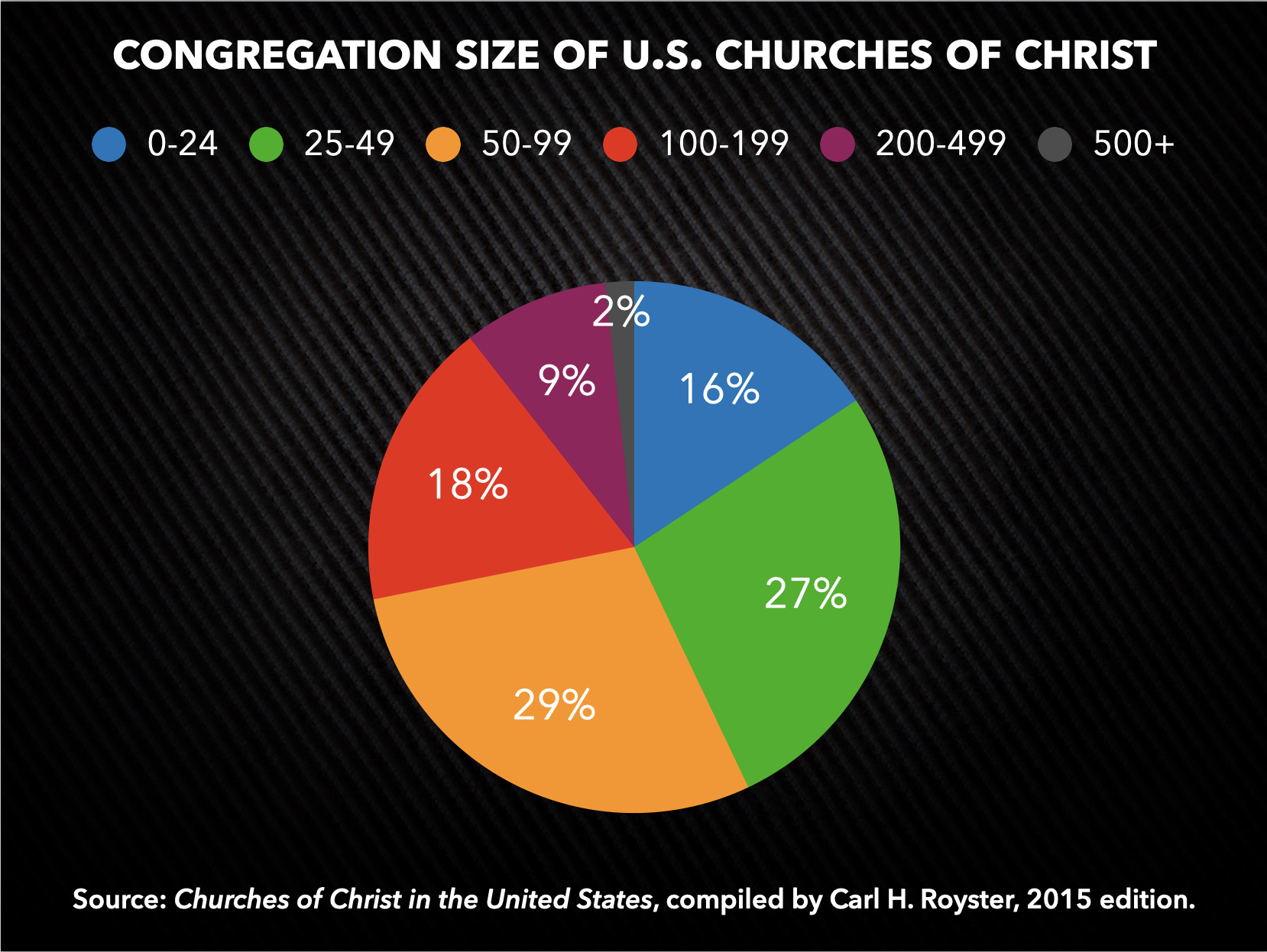
Over time, though, this trend is slowly changing. The United States is becoming increasingly urbanized, where small towns shrink and dry up as people move off for other opportunities, and as this happens, the small churches in those small towns dwindle as well. You probably hear statistics about “X number of churches close their doors every week/month/year….” Well, those churches are overwhelmingly small churches. It’s not that all of the Christians are disappearing and it’s certainly not that all of our churches are growing larger, but there is a shift that is occurring of members from smaller churches consolidating with larger ones as they move to cities, or as their previous congregations shrink beyond the point of sustainability.

Why does trend matter? Because small churches produce a disproportionate amount of preachers. This occurs because it is in small churches where young men receive opportunity to serve and lead. This comes out of necessity—there are jobs to be done and tasks to be performed, and no one else to do them. On the other hand, at larger churches, there are many more people willing to serve and lead, and you actually have to look for opportunities to get young people involved.[1]

In a context where more of our churches are larger, how can we create spaces for young people to have opportunities to lead in worship?

2. The Transformation (or Elimination) of Sunday Nights

I do not know the full history of the traditional Sunday night worship services in Churches of Christ. I know that for many years, it was essentially a carbon copy of what we did on Sunday mornings, but that they also tended to be less formal: men were less likely to wear suits, women were less likely to wear dresses, men who didn’t normally make it into the Sunday morning rotation got to lead singing, and in many churches, you would have occasional singing nights or youth worship nights where young men would have opportunity to serve. At the previous congregation where I worked, we had a monthly Youth-Led Worship where we would meet early to help young men practice and prepare, and then kids and teens would lead the entire service (prayers, songs, Lord’s Table, lesson, etc.).

Over the course of my lifetime, though, I have increasingly become aware of churches moving away from a traditional Sunday night service. Some churches have moved from a combined worship service to a small group model, and meet in members’ homes. Other churches have moved from a worship service to a Bible class format. Others have canceled evening services and replaced them with service projects. Others have canceled them and replaced them with nothing.

And, anecdotally, I would say that larger churches (i.e. the ones that already struggle to give young people a place to lead and be trained in leading worship) tend to be the most likely to abandon the traditional Sunday night service (removing yet another opportunity for training).

These Sunday night changes might be quite beneficial on the whole for the congregations in which they are occurring, but realistically, it still represents a lost venue for young people to have opportunity to lead.

In a context where the Sunday night service is disappearing, when and where can young people have opportunities to lead in worship?

3. Transition from Sect to Denomination: the Loss of Confidence and Importance

These next two trends have been developing for decades, but are helpful, I believe, in understanding so many things about Churches of Christ, especially in the 20th century and beyond.[2] First, a couple of definitions:

Sect: A religious organization that insists that it—and it alone—constitutes the entirety of the kingdom of God. Typically, a sect stands in judgment both on other religious organizations and on the larger culture in which it exists.

Denomination: In the American context, a church that recognizes it is only a part of the universal body of Christ. A denomination has typically made its peace with the dominant culture in which it exists.[3]

In other words, a sect is a group that emphasizes distinction: the call is to be radically different from the world, and to view other religious groups somewhat antagonistically. A denomination, on the other hand, tends to emphasize (or at least accept), being part of a larger whole: one “type” of Christianity amongst others, living in the context of the world.

This is a sociological description rather than a theological prescription: I’m not making the claim that this is a good development, but rather, that it is an accurate description of what has largely (not universally) happened within Churches of Christ over the last 100 years.[4] There was a time that Churches of Christ largely believed that “they were the only ones going to heaven” and that other believers, while they may be sincere, were sincerely mistaken, and not “true Christians.”[5] That still exists, but is much less prevalent than it once was. There are many in Churches of Christ today who have little to no appreciation of Restoration history or theology and would broadly claim that one church is as good as another. Others would hold strongly to certain doctrinal teachings, but still show a greater degree of both self-critique and approval of other groups than was true in the past. All of this reflects the shift from sect to denomination described above.

This is relevant to the issue at hand, I think, because this transition reflects a shakiness in our self-understanding: at one point, we were convinced that we taught the truth, while others were in error. This gives confidence in the importance of the preaching task: not only do we need to let the unchurched know about Jesus; but we also need to let the incorrectly churched know the truth about the importance of baptism, acceptable worship, and proper church governance. Virtually everyone is in error and, thus, in trouble, and we know the answer. This confidence and importance provide great motivation for dedicating a life to preaching.

On the other hand, if we are less confident in the rightness of our belief, and maybe many of our neighbors in other Christian groups don’t really need us to straighten them out, a life of preaching seems less important and less desirable.

In a context where we are less certain of our exclusive access to the truth, how can we still convey the value of preaching and other forms of ministry?

4. Transition from Sect to Denomination: at Home in the World

The other part of this transition is a feeling of comfort and belonging the world. In the early 20th century, this did not describe Churches of Christ. The early 1900s witnessed the growing split between the less educated, lower class, and theologically conservative Churches of Christ and the more educated, higher class, theologically liberal Disciples of Christ. As the split spread and then formalized, the Disciples often found themselves with the nice church buildings (now adorned with pianos) and standing in society, while the Churches of Christ were left with little in capital, real estate, and social standing.

Most members of Churches of Christ were not wealthy, and had no expectation of being so. This began to change in the economic boom following World War II, as wealth increased across virtually all demographics in the United States. Economic blessings led to nice, new church buildings, prestige in society, and changing expectations.

Those in ministry will tell you that a common barrier to young people entering ministry is discouragement from their parents because of financial concerns. The feeling is that ministry does not pay well (often true), and parents will often emphasize financial security over God’s call. My suspicion is that this parental discouragement stems from this broader transition to affluence: back when all of us were poor, being poor as a preacher was no worse than anything else. As our bank accounts have swelled, the desirability of preaching has diminished.

In a context where we value and respect financial security, how can we better compensate those in ministry so it is a more desirable option? How can we disciple all of our people to place less value upon financial security?

5. Secularization and the Loss of the Minister’s Prestige

Another major transition that has been going on in our society for a long time is increasing secularization. We have increasingly carved out spaces where God is not allowed (physically and metaphorically), a higher percentage of people no longer claim faith of any kind, and even people who are Christians increasingly view the world through secular lenses.[6]

In our increasingly post-Christian society, being a preacher (or some other type of minister) doesn’t bring the same sort of respect and prestige that it once did. In frontier America, where formal education was sparse, people tended to be self-taught, and many were illiterate, the preacher was often the most educated person in the community. It was naturally assumed that this was a person who had done some serious learning, and had something to say that was worth listening to.

This is no longer widely assumed. Many people are highly educated, and have access to tools that allow them to study Scripture in sophisticated ways. More than that, in a highly-secularized society, a minister may be well-educated, but the assumption may be that his or her education is fundamentally not valuable: if the Christian faith is ultimately a fairy tale, why should we be impressed that you are well-versed in it?[7]

In a context where ministers are not respected within society, how can we raise the level of respect they are shown in our churches? How can we disciple all of our people to place less value on the opinions of others?

6. Disquiet around Gender Roles

You are likely aware that the debate about gender roles is raging in Churches of Christ. This is certainly not unique to us, but what is relatively distinct is our practice of congregational autonomy: there is no denominational hierarchy dealing out an official position on female inclusion in church leadership, so individual churches have the task of interpreting the teachings of Scripture and applying them in their own contexts. In practice, this means that Churches of Christ are kind of like the wild west, where different churches have their own rules and understanding. Thus, you can find a variety of practices within Churches of Christ, ranging from full egalitarianism to full patriarchalism to all sorts of shades and variations in between.

Historically, this was not the case. Until fairly recently, for a long time, the broad consensus was that church leadership was for men, and the concept of “church leadership” was defined in such a way that it included any sort of up-in-front role during the worship assembly. Things are much different now: you really can’t assume where a given church is on this issue without doing some research, and honestly, a lot of churches themselves aren’t sure where they are on the issue.

My goal here is not to adjudicate this issue or tell you what you should think about it; rather, I am simply acknowleding that the landscape of Churches of Christ is much more confusing in this area than it once was, and I think it has ramifications for our actual topic at hand, helping to plant the seed of ministry within young people in our churches.

For churches that are clear about their positions on this (at one end of the spectrum or the other), it’s not really a problem, but for the large (and growing) number of churches that are somewhere in the middle and are trying to figure out what is permissable and what isn’t, it becomes a lot more complicated, and special worship services led by young people tend to bring a controversial issue front and center.[8]

In a context where gender roles are such a controversial topic, how can we seek to train young people in a way that doesn’t foster division and strife?


[1]This is easier said than done: we get nervous in front of people, and the larger the group of people, the more nervous we tend to get. So a young man who might be willing to present a lesson in front of 50 people will likely be less willing to do the same lesson in front of 500 people. Expectations of quality and professionalism tend to increase in larger congregations as well, placing a greater burden and barrier on young people who are inherently inexperienced and less skilled.

[2]What I present here will naturally be simplified and reductive. For fuller expositions on this topic, see David Edwin Harrell, “Emergence of the “Church of Christ” Denomination” (1972), and Richard T. Hughes, Reviving the Ancient Faith: The Story of Churches of Christ in America (Abilene, TX: ACU Press, 1996). Harrell and Hughes are two of the most respected historians within the Stone-Campbell Restoration Movement. Theologically, they were at different ends of the theological spectrum of Churches of Christ, but their sociological analyses of the transition of Churches of Christ from sect to denomination are closely in sync.

[3]These definitions come from Hughes, Reviving the Ancient Faith, xii-xiii.

[4]Indeed, I would argue that both of these categories fall short of how Jesus would have citizens of His kingdom envision themselves.

[5]There is good reason to argue that this sort of sectarianism betrayed the unifying vision of the early leaders of the Stone-Campbell Restoration Movement, but that is beyond the scope of this article. The point is simply that there was a time when this was a widespread and common belief amongst those in Churches of Christ.

[6]As famously argued in Charles Taylor’s A Secular Age.

[7]It should be added that some of the loss of respect felt toward those in ministry is self-inflicted: the constant drumbeat of those in various forms of ministry, across denominational affiliation and the theological spectrum, who abuse that position through sexual sin, financial dishonesty, or other types of abusive behavior have greatly diminished the public trust in those in ministry.

[8]This may seem counterintuitive to some readers: why would it be problematic to have a youth-led worship service that reflected the same gender roles that a regular worship service would have in that context? I understand the question, but it does seem to make a difference, for at least three reasons. First, young people, especially teens, tend to be more rebellious and push the envelope more than those of older generations. So, you might have lots of women who are very comfortable in traditional gender roles in the church, but that doesn’t mean that teenage girls are. Second, you may have parents who are generally okay with the ways things are for themselves, but feel the need to advocate for greater opportunities for their daughters. Third, there are some people who are fine listening to a sermon from a well-trained male preacher but start to ask questions when listening to a 12-year-old boy offer a fairly shallow (and sometimes theologically heterodox) lesson.


« Older posts Newer posts »

© 2026 The Doc File

Theme by Anders Noren — Up ↑