The online journal of Luke Dockery

Tag: Abortion (Page 2 of 4)

Friday Summary Report, September 7

I don’t have anything too exciting to report on this Friday morning, but here are some interesting/good/important links from around the worldwide web:

  1. First, a story from Louisiana, where, in the aftermath of Hurricane Isaac, a father and son teamed up to rescue 120 people over a 12-hour period with boats. Jesse Shaffer, the father, insisted that he and his son are not heroes, but their neighbors would disagree. A great story, and a glimpse of what Jesus meant by “Love thy neighbor.”
  2. Here’s a cool story (with picture) about Clemson wide receiver DeAndre Hopkins getting baptized after football practice.
  3. The last couple of weeks have been dominated by politics, with both the Republican and Democratic National Conventions taking place. I am not a fan of politics, in large part because it takes place in some weird twilight zone where the truth neither matters nor is really expected. I heard a ton of people raving about President Clinton’s speech, but was it accurate? Similar articles could probably be (and probably have been) written about every other speech that was given at either convention.
  4. Matt Dabbs wrote a really good blog post on the heinousness of abortion. The fact that abortion has been relegated to the political arena and has been turned into a mere talking point by both parties shows how warped and skewed our society has become. I mentioned this in the comments section of the blog I linked to above, but I’ll repeat it here: I am convinced that the legalized genocide against our own unborn is the greatest evil of our society. It is all too often discounted as ‘just another political issue’, but it far transcends politics. I sometimes wonder how long a nation that shows such little value for life will be allowed to continue.
  5. For those who are involved in youth ministry, here is a great post with some very practical suggestions for ways to get your students involved as leaders within your youth group. As Joseph points out, student leadership doesn’t have to be part of some big, elaborate, complicated program.

Friday Summary Report, August 10

I’ve read several blogs where, at the end of the week, the author will post an assortment of links and/or random thoughts that didn’t really merit their own individual post. After resisting the impulse to do something similar for quite a while, I finally decided to just go ahead and do it.

During a given week, I do a lot of reading (both on the Web and in books), and come upon several things that I would like to share, but I hate to write posts that are just 8 words long. So primarily, these end-of-week summaries will consist of links and quotations that I thought were interesting, but will also include random items that didn’t fit elsewhere. I’m not promising to do this every Friday, but I bet it will happen frequently.

  1. Although this article has been out for a while, I just came across it this week. Basically, a couple of ethicists (apparently it doesn’t take much to be an ethicist these days) have proposed that after-birth abortions (i.e. infanticide) should be permitted on newborns, because a newborn is not a person in the sense of being a “subject of a moral right to life.” This is obviously repulsive, but not surprising, and is really just an extension of the arguments that are already made to justify pre-birth infanticide. At least these people are honest enough to admit that no great change happens in the state of the infant at birth.
  2. Here is a somewhat scary article about a tech guru who had his online identity mercilessly hacked and had his iPhone and laptop wiped clean as a result (losing all the pictures of his infant daughter in the process!). I recommend reading the entire article, but a couple of takeaways: (1) Be very careful about linking online accounts together (using the same usernames and/or passwords); (2) Back up all of your computer data on an external hard drive; (3) hackers are jerks.
  3. This week, I successfully finished translating 1 John from Greek (the word successfully is used somewhat loosely here). I do feel some minor sense of accomplishment in doing this, but mostly, I feel a great debt to those who have gone on long ago and translated Scripture from original texts into the vernacular.
  4. As this post remains one of my most-read, most commented on, and most-disputed from this year, I updated it at the end, to make my intentions in writing it as clear as possible.
  5. Over the last two weeks, I’ve been watching as much of the Olympics as I possibly can. Perhaps I will have a post related to that next week.

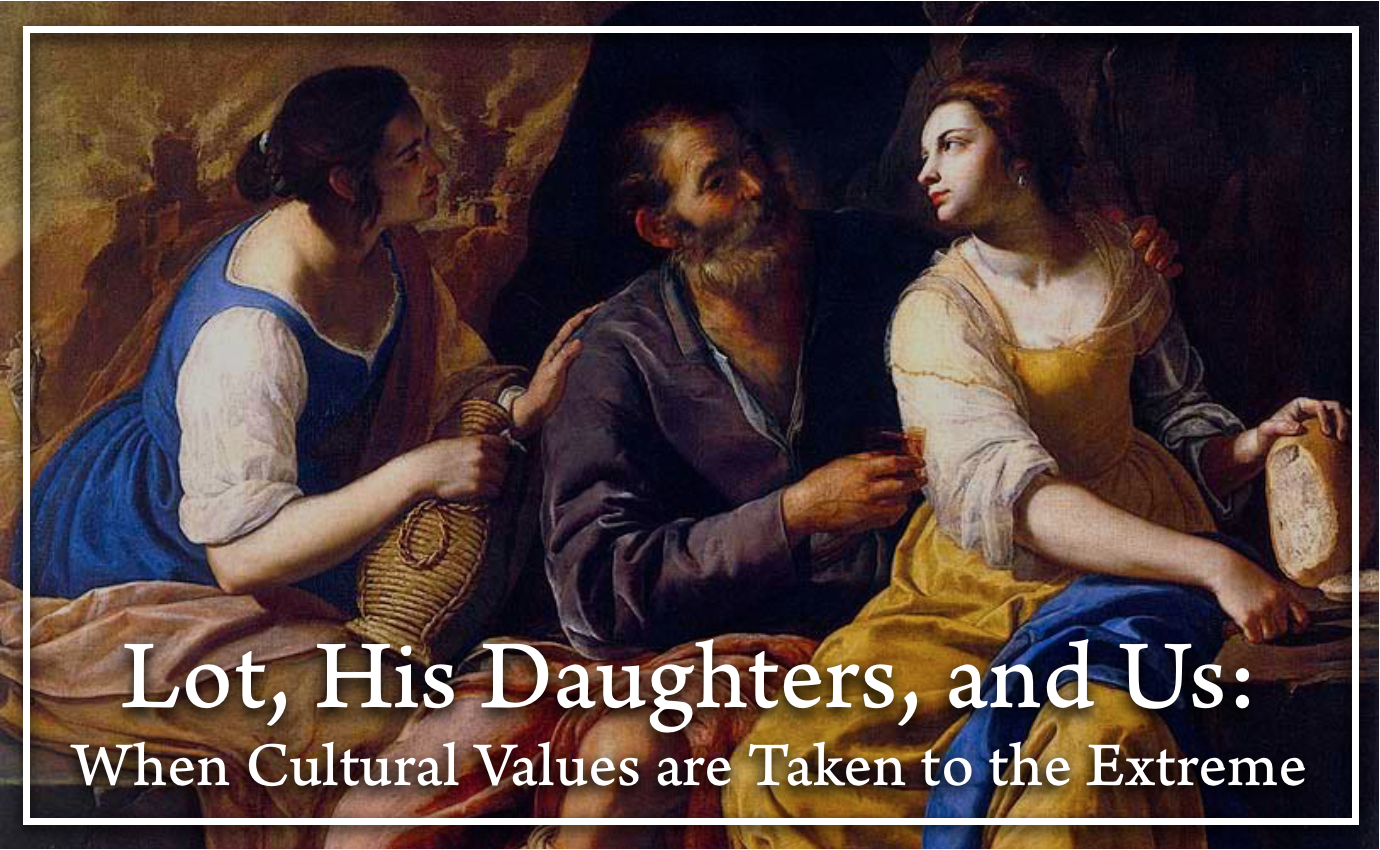
Lot, His Daughters, And Us: When Cultural Values are Taken to the Extreme

I’ve been encouraging my High School Bible Class to read through the narrative portions of Scripture this year and have been giving them a daily schedule to help. I think this is a good thing to do for many reasons, but one reason is that there are certain parts of the Bible which are often passed over in Bible classes and sermons, but it’s still important for people to know they are there (especially teens, who should be in the process of developing their own faith rather than relying on the faith of their parents).

When they made it to Genesis 19, I got a lot of questions, and as I discussed their questions with them, it struck me how often certain values that a culture emphasizes (which may be good in and of themselves) can be taken to dangerous and often sinful extremes.

The Importance of Hospitality

Genesis 19 covers the destruction of Sodom, which was something they were vaguely familiar with, but there were a couple of details that they had missed out on. Two angels, appearing as men, come to Sodom and stay with Lot, and the wicked men of the city bang on Lot’s doors and demand that Lot hand over the two men to them so they can engage in sexual relations with them. Lot’s response is shocking to our modern ears:

“Lot went out to the men at the entrance, shut the door after him, and said, ‘I beg you, my brothers, do not act so wickedly. Behold, I have to daughters who have not known any man. Let me bring them out to you, and do to them as you please. Only do nothing to these men, for they have come under the shelter of my roof.’”

Lot doesn’t seem to be in the running for any Father of the Year awards here, as he offers his daughters to the would-be rapists rather than his guests. That’s hard to understand unless you realize that the idea of hospitality and taking good care of one’s guests was of paramount importance in many ancient cultures (and some modern ones). It’s not that Lot was eager to give up his daughters—I’m sure he wasn’t—it’s just that hospitality was such an important cultural value that it led him to an extreme (and I would suggest, sinful) action. Fortunately for Lot’s daughters, the two angels intervene and strike the wicked men with blindness.

A Woman’s Value Through Child-Bearing

Another example of this phenomenon actually comes from the same chapter of Genesis. Ultimately, only Lot and his two daughters escape the destruction of Sodom, as his sons-in-law remained in the city and his wife was turned into a pillar of salt when she looked back on the destruction of the city.

Lot and his daughters flee to the hills and live in a cave, and here, another shocking development is recorded:

“And the firstborn said to the younger, ‘Our father is old, and there is not a man on earth to come in to us after the manner of all the earth. Come, let us make our father drink wine, and we will lie with him, that we may preserve offspring from our father.’ So they made their father drink wine that night. And the firstborn went in and lay with her father. He did not know when she lay down or when she arose.

The next day, the firstborn said to the younger, ‘Behold, I lay last night with my father. Let us make him drink wine tonight also. Then you go in and lie with him, that we may preserve offspring from our father.’ So they made their father drink wine that night also. And the younger arose and lay with him, and he did not know when she lay down or when she arose. Thus both the daughters of Lot became pregnant by their father.”

So a few days after Lot offers his daughters to rapists, they now get him drunk in order to sleep with him—Lot’s family seems to be the picture of dysfunction, right? Once again though, I think what we have here is a cultural value taken to an unhealthy extreme. In this case it seems that (as was often the case in many ancient cultures, and even some cultures today) for Lot’s daughters, their entire value as humans was derived from their ability to carry on the family line of their father through the bearing of children. With their husbands-to-be destroyed in the obliteration of Sodom and thus their means of child-bearing suddenly removed from them, Lot’s daughters turn to a sinful and (I imagine) undesirable last resort.

What About Us?

With a little careful reflection on the cultural forces that pulled on Lot and his daughters, I think their actions are a little more understandable. That being said, I don’t think these stories show us that the influences of culture validates sinful behavior—not at all. On the contrary, I believe one thing these stories do show us is how, if we’re not careful, the ideals we value as a culture can push us to do unthinkable things.

For example, in American society, one of our most sacred values is individual freedom. Many of the people who colonized the United States came here out of the desire to find freedom of one type or another. The American Revolution was fought because the descendants of those colonists felt that they should be free to govern themselves. The importance of liberty was hammered first into the Declaration of Independence and later into the U.S. Constitution, primarily through the Bill of Rights. As Americans, we pride ourselves on being free people.

But how could freedom be a bad thing? Well, it is the cultural value of freedom that, when taken to an extreme, is used to justify the yearly destruction of hundreds of thousands of unborn infants in the U.S. As a society, we are engaged in an ongoing genocide against our own unborn, but we pretend it is okay because supposedly, the mother should be free to do whatever she wants with her own body. It is cast as an issue of freedom and personal rights.

Clearly, our cultural values can cause moral blind spots for us today just as they did for Lot and his daughters some 4,000 years ago. Perhaps in the distant future, people will look back on our society and shake their heads in shame at the plague of abortion that we have embraced. And perhaps they will be able to somewhat understand our sin because of the cultural values that influence us and that we use to justify it.

But it will still be sin.

Waterboarding And Abortion

Ken Blackwell has written an interesting article pointing out the irony that the same Obama administration that claims to be morally horrified at the idea of waterboarding mass murderers also approves of Partial Birth Abortion.

A couple of interesting tidbits:

“The purpose of the Geneva Convention was to give warring nations a strong, positive incentive to behave according to international norms and not to engage in conduct that “shocks the conscience.” When we give Al Qaeda or Taliban terrorists prisoner of war status and Geneva Convention coverage—without demanding anything of them in return—we abandon one of the great achievements of the Geneva Convention.”

“Our new president abhors torture, unless it is the torture of the unborn. In that case, it is not torture at all, but simply inducing fetal demise. This great international uproar over what is and is not torture has been generated because of the treatment of three known mass murderers. The slaughter of innocents in their thousands elicits no international outrage. This is part of what Justice Breyer sees as evolving international standards of decency.”

I’m not dismissing the torture of captured terrorists as a non-issue (although I think the discussion of whether or not waterboarding constitutes torture is a valid one).

I’m just saying that the torture issue, in scale and severity, doesn’t compare to abortion.

« Older posts Newer posts »

© 2026 The Doc File

Theme by Anders Noren — Up ↑