The online journal of Luke Dockery

Tag: Abortion (Page 1 of 4)

Learning from the Apostolic Fathers: The Didache

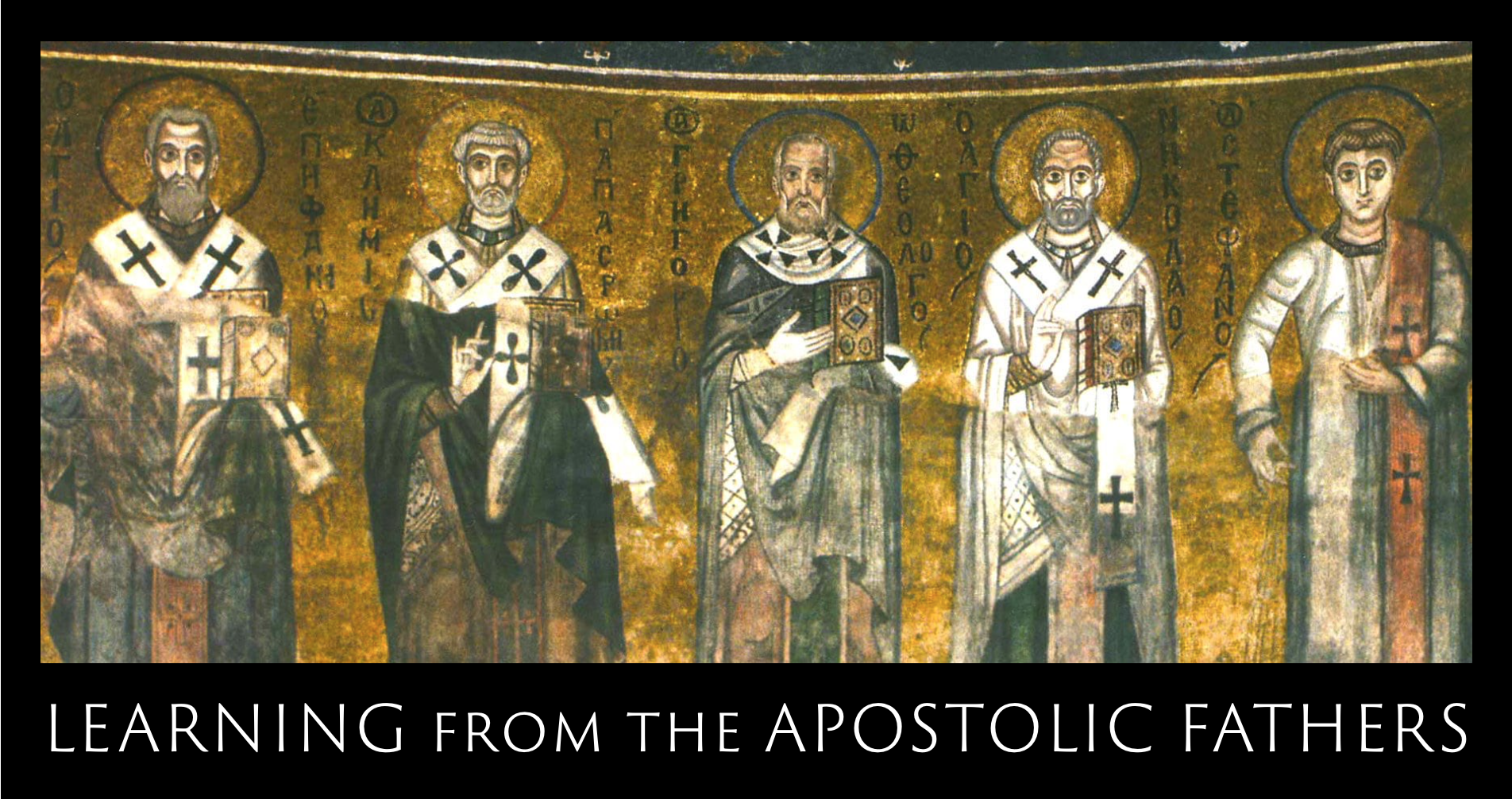
Last year, I read through Michael W. Holmes’s edition of The Apostolic Fathers in English as part of my daily devotional readings. Generally speaking, the term “Apostolic Fathers” refers to early Christian theologians from the 1st and 2nd centuries AD, some of whom would have known some of the apostles personally and sought to pass on their teachings. Related to those readings, I began a short series of blog posts where I wrote about Clement of Rome, Ignatius of Antioch, and Polycarp of Smyrna. I had intended to include one final post in that series on The Didache but, sadly, never got around to it. So, this represents the very tardy conclusion to that series.


The Background of The Didache

The Didache simply means “The Teaching”, and is the shorter, common title of The Teaching of the Lord to the Gentiles by the Twelve Apostles as it was known in ancient times. This work was known because it was referenced by various ancient writers, but the first known copy wasn’t discovered until 1873, with the full text being published in 1883.[1]

This short work—100 verses altogether—has received a great deal of scholarly treatment, but much about it remains quite mysterious. It is unknown who wrote it, when it was written, or where it was written. Regarding the date, The Didache in its current form may have come about as late as AD 150, but it is more likely that it came about near the end of the first century. As Michael Holmes points out:

“The materials from which it was composes reflect the state of the church at an even earlier time. The relative simplicity of th prayers, the continuing concern to differentiate Christian practice from Jewish rituals (8.1), and in particular the form of church structure—note the twofold structure of bishops and deacons (cf. Phil. 1:1) and the continued existence of traveling poses and prophets alongside a resident ministry—reflect a time closer to that of Paul and James (who died in the 60s) than Ignatius (who died sometime after 110).”[2]

The Didache contains three main sections: (1) Teaching on “the Two Ways” that resonates closely with portions of the Gospels of Matthew and Luke, (2) a sort of how-to manual related to church practices, and (3) a brief apocalyptic section.

Themes and Insights from The Didache

Specific Instructions for Church Practice: The New Testament gives much teaching about the gospel of Jesus Christ and the way that reality should transform disciples of Jesus as participants in new creation. Furthermore, at times—usually in response to a situational question or crisis—practical instruction will be given to believers to tell them how they should behave in a given situation. On the whole, though, this practical instruction is limited, and there are many questions left unanswered.

The Didache steps into this void with all sorts of practical recommendations and commands. Personally, I found these instructions to be all over the place, variously striking me as wise, quirky, surprising, and questionable:

  • Concerning baptism, it is best to baptize in the name of the Father, Son, and Holy Spirit in running water. If there is no running water, other water will work. If there is no cold water, then use warm water. If you have neither, pour water on the head three times in the name of the Father, Son, and Spirit (7.1-3).[3]
  • Fasting should be done on Wednesday and Friday, to avoid Monday and Thursday, which is when the “hypocrites” fast (8.1).
  • The Lord’s Prayer should be recited three times per day (8.2-3).
  • A specific prayer to be said prior to the taking of the Lord’s Supper (9.1-4).
  • A prohibition against sharing Communion with anyone who has not been baptized into the name of the Lord (9.5).
  • Instructions on how to treat itinerant apostles and prophets (11.3-13.7).

Condemnation of Abortion: In a list of prohibitions against various sins that hearken back closely to Exodus 20 and Matthew 5, there is an interesting bit that arrests the attention of our modern ears:

“The second commandment of the teaching is: You shall not murder; you shall not commit adultery; you shall not corrupt children; you shall not be sexually immoral; you shall not steal; you shall not practice magic; you shall not engage in sorcery; you shall not abort a child or commit infanticide. You shall not covet your neighbor’s possessions.”

(The Didache 2.1-2)

It has become a common argument, especially in more politically progressive circles, to claim that Christian opposition to the practice of abortion is only a recent historical occurrence, and came about through the shrewd maneuvering of the conservative political movement rather than historic Christian teaching.

It may very well be the case that conservative political strategists constructed a loyal voting block by tapping into sentiments about abortion (indeed, I am fairly cynical toward the motives behind much Pro-Life posturing), but clearly, Christian opposition to abortion is not a recent phenomenon. As we see in The Didache, the practice was explicitly condemned likely in the first century, and there are similar prohibitions in other ancient texts. If there was a time, prior to the rise of the Religious Right, where most Christians in America were supportive of the practice of abortion, those Christians were out of step with the ancient teaching of the Christian church.

Concluding Thoughts

The Didache is a fascinating text. It is short, and absolutely worth reading. There is much about it that we simply do not know—who wrote it? Is it possible that it actually stretches all the way back to some of the apostles? What level of authority would have been given to this collection of teachings in the early church? These questions remained unanswered.

What is clear, however, is that The Didache preserves the efforts of early Christians who were attempting to apply the teachings of Scripture to the circumstances of their time in order to address questions that needed to be answered. This is a faithful practice that is still desperately needed today.

The Didache preserves the efforts of early Christians who were attempting to apply the teachings of Scripture to address the circumstances of their time. This is a faithful practice that is still desperately needed today. Share on X

[1] Michael W. Holmes, ed., The Apostolic Fathers in English (Grand Rapids: Baker Academic, 2006): 157.

[2] Holmes, 159.

[3] This is, I believe, the first record of some sort of baptism other than immersion. It should be noted, however, that this is not held up as the ideal or permitted as a standard practice, but as an acceptable substitute in the absence of preferable conditions.

Inalienable Rights, Slavery, & Abortion

Relative Rights

Famously, the second paragraph of the Declaration of Independence states:

 We hold these truths to be self-evident, that all men are created equal, that they are endowed by their Creator with certain unalienable Rights, that among these are Life, Liberty and the Pursuit of Happiness. That to secure these rights, Governments are instituted among Men, deriving their just powers from the consent of the governed;

These are beautiful words, and the ideas they express run deep in our national ethos—even if we have struggled to live up to them at times.

One thing I have come to believe over time that I don’t hear people talk about very often is how our unalienable rights themselves are not, or should not be, considered equal: their importance is relative to one another.

Stated mathematically:

Life > Liberty > the Pursuit of Happiness

What I mean by that is that my right to pursue happiness should not infringe upon your liberty, and my right to liberty should not infringe upon your life. Stated positively, people need to have life before they can have liberty, and they need to have liberty before they are free to pursue happiness.

Great Evils

I think that slavery and abortion stand as two of the great evils in American history, and I think these two issues share striking similarities:

  • In both cases, the suffering of the victims was allowed on the basis that they were considered to be somewhat-less-than-human. This thinking was furthered by the use of dehumanizing terms like slave and fetus.
  • In both cases, the victims were treated as the property of others, without rights of their own.
  • In both cases, an evil practice was justified because of its economic benefit. Slavery was the backbone of Southern economy, considered by many to be a necessary evil. “What would happen to our economy without slave labor?” they cried. Similarly, proponents of abortion often describe it as a necessary evil, sometimes the only option for impoverished mothers. “What would happen to our economy if we had to support all of these unwanted babies?” they cry.
  • And in both cases, good but misguided people made the mistake of refusing to condemn the unacceptable behavior of others. Slavery continued for as long as it did because too many people who would never consider owning a slave themselves refused to take that “right” away from others. Think about the typical Pro-Choice bumper stickers and protest signs you see and translate them to the slavery issue: “Opposed to slavery? Don’t buy one!” It seems ludicrous to us today, but until we as a culture can realize that with abortion—as with slavery—humans are being denied basic human rights, such flawed thinking will continue.

These two issues are also similar in the way the relate to the issue of the relative importance of our inalienable rights which I set forth above:

  • In the case of slavery, one group’s right to pursue happiness through a certain type of agricultural lifestyle supported by slave labor was used to strip the liberty of another group. If inalienable rights are weighted correctly, the right to freedom would come first, and liberty would not be removed from someone to enable someone else’s pursuit of happiness.
  • In the case of abortion, one group’s right to freedom over control of their bodies is used to strip the life of another group. If inalienable rights are weighted correctly, the right to live would come first, and life would not be taken away from an infant because of someone else’s liberty.

When the words of the Declaration of Independence quoted above were penned, a profound and beautiful truth was set forth with implications that even the authors didn’t fully grasp or live out. May we strive for a society where all people are guaranteed their Creator-endowed inalienable rights: Life first, then Liberty, and then the Pursuit of Happiness.

The Validity of the Ideal

Some fireworks over Bentonville, Ark., on July 4, 2014.

Thomas Jefferson penned the famous second sentence of the Declaration of Independence, which was adopted by the Continental Congress on July 4, 1776:

“We hold these truths to be self-evident, that all men are created equal, that they are endowed by their Creator with certain unalienable Rights, that among these are Life, Liberty, and the Pursuit of Happiness.”

Those are beautiful words, and they describe an ideal that, in practice, our country has sometimes failed to live up to. We haven’t always treated all men as equals: African Americans were enslaved and then later discriminated against via Jim Crow laws. Native Americans were tricked and strong-armed off of their lands and herded to less desirable areas. Women were denied a political voice. The failure continues today, as we certainly don’t treat our unborn infants as being equal to those who want to dispose of them so easily.

Yes, we have failed and continue to fail to live up to the beautiful words quoted above. But our failure to live out that ideal in no way undermines the validity of it. May we continue to seek the ideal: all people are created equal, because they all bear the Image of the Creator Himself.

The Fall of Man and the Sociological Consequences of Sin

In our continuing discussion of the Fall of Man in Genesis 3 and the widespread devastation of sin, we have already covered the theological and personal consequences of Adam and Eve’s misdeed; in this post we turn to the sociological fallout of that sin, or the way that sin affects our relationships with one another.

Returning to our text, we can see this dimension clearly played out in verses 11-13:

“[God] said, ‘Who told you that you were naked? Have you eaten of the tree of which I commanded you not to eat?’ The man said, ‘The woman whom you gave to be with me, she gave me fruit of the tree, and I ate.’ Then the Lord God said to the woman, ‘What is this that you have done?’ The woman said, ‘The serpent deceived me, and I ate.’”

People were created to live in community with one another. Specifically, Eve was created to be the perfect partner for Adam (Genesis 2.18-25). But when God confronts Adam and Eve with their sin, something very significant (and unfortunate) happens: the unity that had previously existed between Adam and Eve is shattered as Adam immediately blames his wife for the sin which they had committed together.

This brings a conflict and disharmony between them that would be passed down over time (Genesis 3.16), and we can see it unfold in the pages of Genesis in the accounts of numerous broken relationships—Cain’s murder of his brother, the depraved society of Sodom and Gomorrah, the distorted relationships between Sarah and Hagar, Jacob and Esau, Jacob and Laban, Joseph and his brothers, and more. But the problems certainly don’t stop there—this same conflict and disharmony continue to darken and distort our world today.

Our world is deeply flawed by sin, and this manifests itself everyday sociologically, as we treat one another in a wide array of horrible, messed up ways:

  • On an international level, countries wage war and kill because of conflict over ideology or resources.
  • Systemic evils such as poverty, abortion, racism, sex trafficking, government corruption, lotteries, and more stem from our exploitation of our neighbors in order that we might obtain our own selfish desires.
  • Horrific acts of incomprehensible violence fill our news cycles. Mass shootings at elementary schools, the use of passenger airliners as terrorist missiles, bombings at marathon finish lines and incomprehensible barbarity at soccer matches shock and dismay us and cause us to weep.
  • Our interpersonal relationships are also a mess. Dishonesty, reckless ambition, and violence abound. The (supposedly) lifelong bonds of marriage are broken on a whim.

And the sum result: our society as a whole stagnates and decays, as people live lives marked by self-interest and fear of one another. The community for which we were created is broken.

Sin destroys our relationships with one another.

Abortion: A Lament and a Remembrance of the Faithfulness of God

It’s been 40 years since abortion became legal in this country. The legacy of that decision is beyond heart-breaking—there have been approximately 55 million abortions in the U.S. over the last four decades, and in our greatest city, 40% of all pregnancies end in abortion.

This is incredibly depressing stuff to me, as it represents the chilling disregard for life that we have developed in our culture. But last night, as I was thinking about it, something else dawned on me for the first time:

A sizable contingent of those who will dwell for eternity with God in the new heavens and new earth will be those who never experienced this earth in the first place.*

As Christians, that should not diminish our abhorrence for the premeditated destruction of unborn infants, but it should provide us with hope and comfort.

Blessed be our God, who provides for His children!

*Remember, the 55 million are just babies aborted in this country over the last 40 years. World-wide, that figure is much, much higher.

« Older posts

© 2026 The Doc File

Theme by Anders Noren — Up ↑