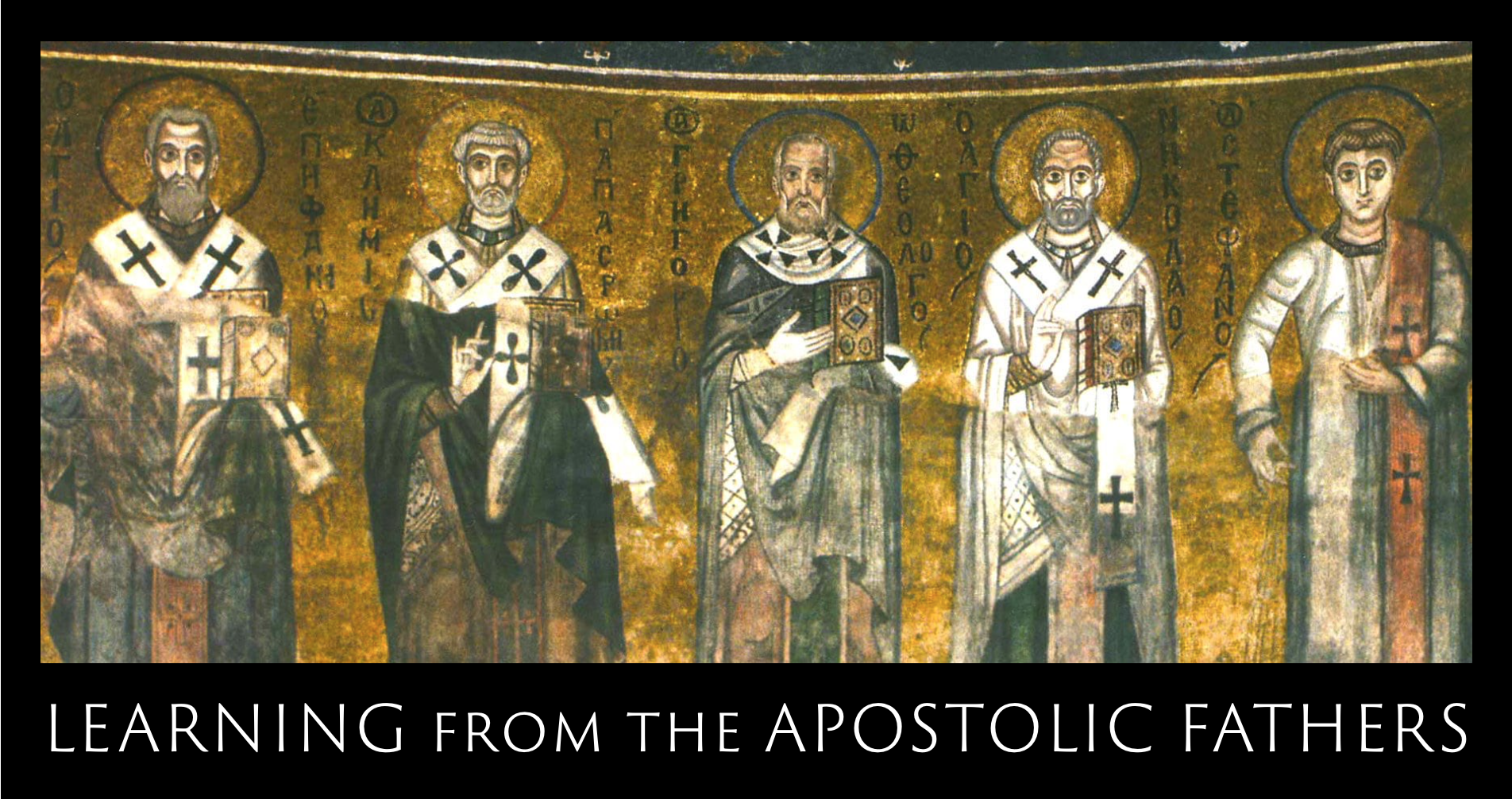
As I wrote in the first post in this series, I have been reading through Michael W. Holmes’s edition of The Apostolic Fathers in English as part of my daily devotional readings. Generally speaking, the term “Apostolic Fathers” refers to early Christian theologians from the 1st and 2nd centuries AD, some of whom would have known some of the apostles personally and sought to pass on their teachings. More specifically, “Apostolic Fathers” is frequently used in reference to Clement of Rome, Ignatius of Antioch, and Polycarp of Smyrna. Today, I want to focus on Polycarp.
The Life and Letter of Polycarp
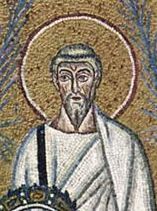
Polycarp of Smyrna
Polycarp served as the bishop of Smyrna in Asia Minor, and was the recipient of one of the letters of Ignatius of Antioch, his friend and mentor. Polycarp is one of the more notable figures of the early (post-apostolic) church,[1] and his fame stems from at least three streams:
- His writing The Letter of Polycarp to the Philippians
- His death as a martyr in AD 155-160, the details of which are shared in The Martyrdom of Polycarp
- His status as a significant link in the chain of apostolic tradition: as a child, Polycarp knew John the Apostle in his old age, and, in turn, later in his own life knew Irenaeus of Lyons when the latter was a child
In The Letter of Polycarp to the Philippians, Polycarp relies heavily on both the Old Testament scriptures and also early Christian writings and emphasizes the strong connection between orthodoxy and orthopraxy: wrong beliefs inevitably lead to wrong behaviors, and wrong behaviors are evidence of wrong beliefs.[2]
In The Martyrdom of Polycarp (written by anonymous eyewitnesses) records the account of the pursuit, arrest, trial, and execution of Polycarp, who is martyred for his faith at the age of 86. The Martyrdom of Polycarp reveals the growing challenge that the church of the mid-second century faced for its proclamation that Jesus was Lord. Situated firmly in an empire that proclaimed that Caesar was Lord, the Christian proclamation could not be left unchallenged, and persecution and martyrdom was increasingly the fate who held to their confession of faith in Jesus.
Themes and Insights from Polycarp
The Importance of Right Beliefs: Polycarp clearly shows a strong reaction against gnostic teaching, and echoes words from 1 John. Indeed, he holds the incarnation, crucifixion, and resurrection of Jesus and His role as judge to be essential aspects of Christian faith.
“For everyone who does not confess that Jesus Christ has come in the flesh is antichrist; and whoever does not acknowledge the testimony of the cross is of the devil; and whoever twists the sayings of the Lord to suit his own sinful desires and claims that there is neither resurrection nor judgment—well, that person is the firstborn of Satan. Therefore let us leave behind the worthless speculation of the crowd and their false teachings and let us return to the word delivered to us from the beginning; let us be self-controlled with respect to prayer and persevere in fasting, earnestly asking the all-seeing God to lead us not into temptation, because, as the Lord said, ‘the spirit is indeed willing, but the flesh is weak.’”
(Polycarp, To the Philippians 7.1-2)
The Importance of Right Behaviors: A key theme of Polycarp’s letter is his discussion of righteousness, which the Philippians had apparently asked him about. Relying heavily on New Testament teaching, Polycarp addresses wives, widows, deacons, younger men, and elders, instructing each group to lead righteous lives. Living a righteous life that pleases God is very important:
“If we please him in this present world, we will receive the world to come as well, inasmuch as he promised that he will raise us from the dead and that if we prove to be citizens worthy of him, we will also reign with him—if, that is, we continue to believe.”
(Polycarp, To the Philippians 5.2b)
Willingness for Martyrdom: With Ignatius, we saw an eagerness for martyrdom that is startling to modern ears. With Polycarp, one does not sense the same degree of eagerness (Polycarp actually leaves the city and then changes location again to avoid the authorities who are searching for him), but he is certainly willing to die for his faith.
After he is caught and implored to swear an oath by Caesar to deny Christ in order to secure his release, Polycarp famously responds:
“For eighty-six years I have been His servant, and He has done me no wrong. How can I blaspheme my King who saved me?”
(Martyrdom of Polycarp 9.3b)
When the proconsul persists and threatens him with death by fire, Polycarp remains firm:
“You threaten with a fire that burns only briefly and after just a little while is extinguished, for you are ignorant of the fire of the coming judgment and eternal punishment, which is reserved for the ungodly. But why do you delay? Come, do what you wish.”
(Martyrdom of Polycarp 11.2b)
Polycarp is killed for his faith, and his martyrdom is “in accord with the pattern of the gospel of Christ” (19.1), as he followed the example of Jesus, an innocent who was killed unjustly. His last words are a prayer to God:
“O Lord God Almighty, Father of your beloved and blessed Son Jesus Christ, through whom we have received knowledge of you, the God of angels and powers and of all creation, and of the whole race of the righteous who live in your presence, I bless you because you have considered me worthy of this day and hour, so that I might receive a place among the number of the martyrs in the cup of your Christ, to the resurrection to eternal life, both of soul and of body, in the incorruptibility of the Holy Spirit.”
(Martyrdom of Polycarp 14.1b-2b)
Powerful hope inspires powerful courage.
Concluding Thoughts
The Letter of Polycarp to the Philippians is so heavily influenced by Scripture that large chunks of it are very familiar, and read like a cut-and-pasted pastiche of biblical teaching. It is a simple and edifying read. The Martyrdom of Polycarp is a compelling narrative that fills the reader with admiration for this elderly churchman who has clung to Christ all his life, and is determined to cling to Him in death as well.
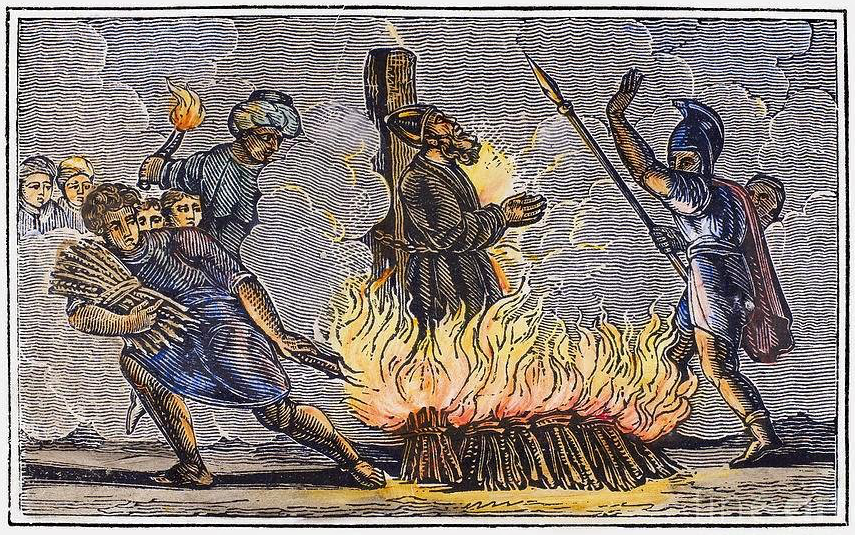
Polycarp is burned at the stake for refusing to forsake Jesus.
[1] Michael W. Holmes, ed., The Apostolic Fathers in English (Grand Rapids: Baker Academic, 2006): 130.
[2] Holmes, 132.








What is meant by “both of should and of body?”
Keith,
That should have been, “both of soul and body”—autocorrect strikes again!