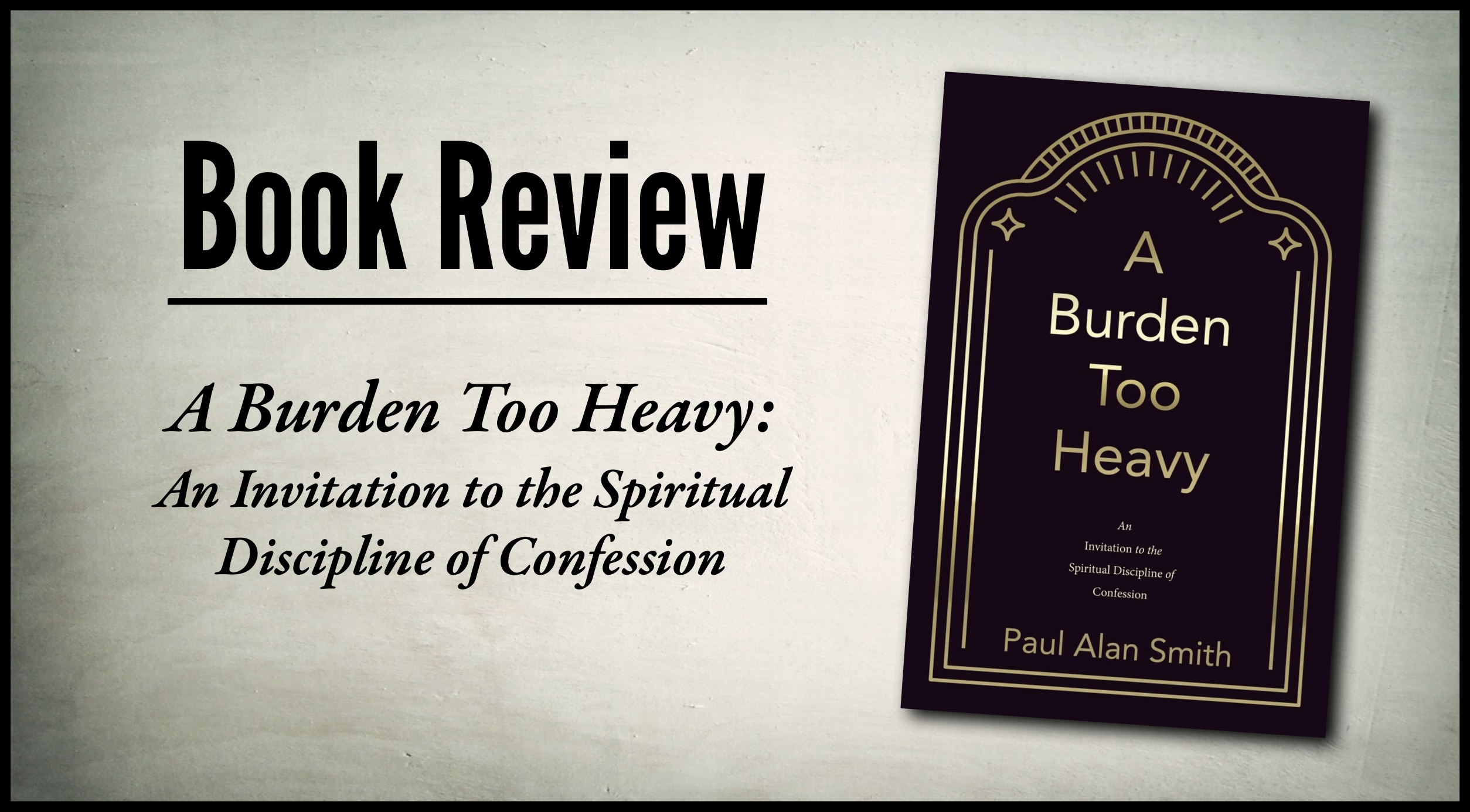
A while back, I was contacted by Paul Smith, who asked if I would be interested in reading and reviewing a book that he had recently written. I’ve never met Paul in person, but have interacted with him over the years on the web and have enjoyed his writing, so I was happy to agree. And I was not disappointed—his book, A Burden Too Heavy: An Invitation to the Spiritual Discipline of Confession, was an enjoyable read and offers needed corrective teaching to the church.
The word “confession” brings to mind different ideas, so Smith begins by helpfully defining what he means by the term:[1]
I believe the concept of “confession” has at least four applications found in Scripture.…First there are declarative confessions: adoration and praise to God, the declaration of faith in God, and the profession of the truth of a proposition. Second, there is the offering of thanksgiving and gratitude. Third, there is a recognition of physical and spiritual hardship, yet assertion of hopeful faith, through lamentation. Finally, there is a negative connotation of the acknowledgement of sin. In addition to these biblical usages of the word confession, there is another meaning of the word, that of a specific Confession of Faith, which serves to give identity to one assembly of Christians as distinct from others who observe a different confession of faith. (pp. xiv-xv)
Ultimately, what Smith hopes to impress upon the reader is the necessity of developing a confessional lifestyle, characterized by “a pervasive sense of the power of confession and an acceptance of the practices of confession” (xv). The book is structured in three parts.
Smith ministers and lives within the context of Churches of Christ, and those in Churches of Christ are the primary audience of the book, so in Part 1, he offers a brief (but excellent) history of the Stone-Campbell Restoration Movement (chapter 1) followed by an analysis of why the peculiarities that history made Churches of Christs resistant to the spiritual discipline of confession (chapter 2). To put it succinctly, a movement centered on the idea that we could perfectly restore God’s church through human effort led to a pride and arrogance that minimized the transcendence of God and made the admission of mistakes or errors very difficult—both elements of a confessional posture. This section of the book makes evident that the critiques offered by Smith throughout the book come from a place of deep affection for Churches of Christ and admiration for the spiritual ancestors of the Stone-Campbell Movement.[2]
Part 2 is comprised of three chapters. Chapter 3 provides a survey of the Bible, and examines how praise, thanksgiving, lament, and confession of sin are present in Scripture, particularly in the Psalms, but also in other places in the Old and New Testaments. Chapter 4 surveys confessional literature outside of Scripture, from the Early Church Fathers through the Medieval Period and Reformation and up through the Modern and Postmodern periods. Sadly, Churches of Christ have often been guilty of “neglecting the wisdom of the Christian centuries” (80), which means that strong historical emphasis on confessionalism has largely been missed. The historical record, however, is clear:
“The uniform message from many different theological perspectives promoting all forms of confession is an indication that confession has always been a critical component of any Christian theology.” (80)
Chapter 5 takes up the example of Dietrich Bonhoeffer as a case study. Although Bonhoeffer has no direct connection to the Stone-Campbell Movement, this chapter, in addition to being a fascinating survey study of Bonhoeffer in its own right,[3] serves to illustrate what a confessional lifestyle looks like “on the ground,” and how it would benefit Churches of Christ.
Part 3 is where things get practical: what is looks like for the principles emphasized in the book to be played out in life, and Paul addresses this by looking at confessionals in the life of the individual disciple (chapter 6) and the church (chapter 7). Chapter 6 reads much like a standard book on spiritual disciplines, with discussion of Lectio Divina, Meditation Prayer, Ignatius’s Spiritual Exercises, Fasting, and using a Spiritual Director.[4] Chapter 7 looks at how the “acts of worship” can shape a church confessionally, and helpfully examines the connection between confession and the Lord’s Supper, congregational prayer, singing, preaching, and giving.
A Burden Too Heavy ends with a conclusion summarizing the book’s key arguments, and especially why this matters for Churches of Christ:
“The twenty-first-century Churches of Christ share a unique opportunity and problem. The opportunity is to present the vision of men such as Elias Smith, Abner Jones, Barton W. Stone, and Thomas and Alexander Campbell to a culture where the reality of a divided Church is a stumbling block to accepting the gospel of Christ. The problem is that for over two centuries the vision of a restored and united Church has been distorted. It has been distorted by a number of issues, but primary among them has been the lack of a clear, focused and intentional theology of confession. A disposition toward arrogance, numbers acrimonious divisions, and a crippling identity crisis are all results of this lack of a confessional theology.” (146-47)
In addition to the quotations included above, there were several noteworthy quotations throughout the book that I thought were worth sharing (my own thoughts are added in bold):
“…This hermeneutic [command, example, necessary inference] elevated the human deductive reasoning that Thomas Campbell sought to minimize in the Declaration and Address. With the addition of “necessary implication” or “necessary inference” as a part of this restoration hermeneutic, Moses Lard negated the intent of Thomas Campbell to wean Christians off dependency on “the wisdom of men.” (12-13) This point might be a bit technical for some, but as a Restoration History hobbyist, I thought it was profound: basically, within 50 years, a key original tenet of the Restoration Movement was turned on its head.
“Praise is fundamentally an act of confession: a confession that someone or something is higher than the one offering the praise.” (44)
“…Confession is the antidote to the number one impediment of the life of faith—human pride.” (62)
“A church that has no sense of its history cannot own the positive features of its history nor can it confess the errors of its history.” (78) This is such a good point—when we don’t know our history, we truly do not know who we are. We can neither draw from our strengths or learn from our weaknesses.
“…If a preacher is unable to address his own joy and thanksgiving, as well as his doubts and fears, in the most intimate of worship settings, it will be impossible for his congregation to move toward a fully confessional lifestyle.” (131) This is an important reminder that leaders must actually lead. You cannot impart what you do not possess.
“A confessional theology is a theology that has the ability to admit its own failings. Confession praises God’s perfection and simultaneously acknowledges human weakness.” (142)
I really enjoyed A Burden Too Heavy. It was not a lengthy read (just under 150 pages), but Smith accomplished much in a short space: a penetrating analysis of the Stone-Campbell Movement, a survey of Biblical literature and the Christian tradition, a review of the life and theology of Dietrich Bonhoeffer, a summary of spiritual disciplines, and practical advice for congregational worship. And, most impressively of all, all of these seemingly disparate elements fit together as part of a coherent and forceful argument: the spiritual discipline of confession is a vital element that is largely missing in the ecclesiology of Churches of Christ and the individual lives of its members.
Smith’s work is a valiant attempt to reclaim that missing element. I fear—for the same reasons he mentions in his analysis of Churches of Christ—that many will be resistant to the sort of changes he proposes. But perhaps some will listen, and for that reason, I hope this book enjoys the widest possible readership.
[1] In this post, I will post page numbers in parentheses after quotations, and reserve footnotes for purposes of explanation. The italics in the following quotations are from the original.
[2] I point this out because it has been my experience that sometimes authors speak of the Restoration Movement with thinly veiled contempt, which I find to be off-putting. Smith is clearly writing this book out of a desire to help a fellowship that he loves and to which he is indebted.
[3] Bonhoeffer has long been a personal hero and area of study for Smith, so I was delighted (but not surprised!) to see this chapter in the book. Interestingly, I had just finished reading Bonhoeffer’s Life Together when I read this, and this summary helped emphasize some of the key ideas in Life Together.
[4] After talking about Spiritual Direction, Smith includes a section on “Redeeming the Role of Spiritual Director Within the Churches of Christ,” where he addresses the Boston Movement/International Churches of Christ, and issues of spiritual abuse in the past, and explains how different spiritual direction is from these abusive practices. This is a helpful section and I am glad it was included, but I fear it will be insufficient to soothe the concerns of those with direct experience with this movement.