The online journal of Luke Dockery

Tag: Stone-Campbell Movement (Page 1 of 4)

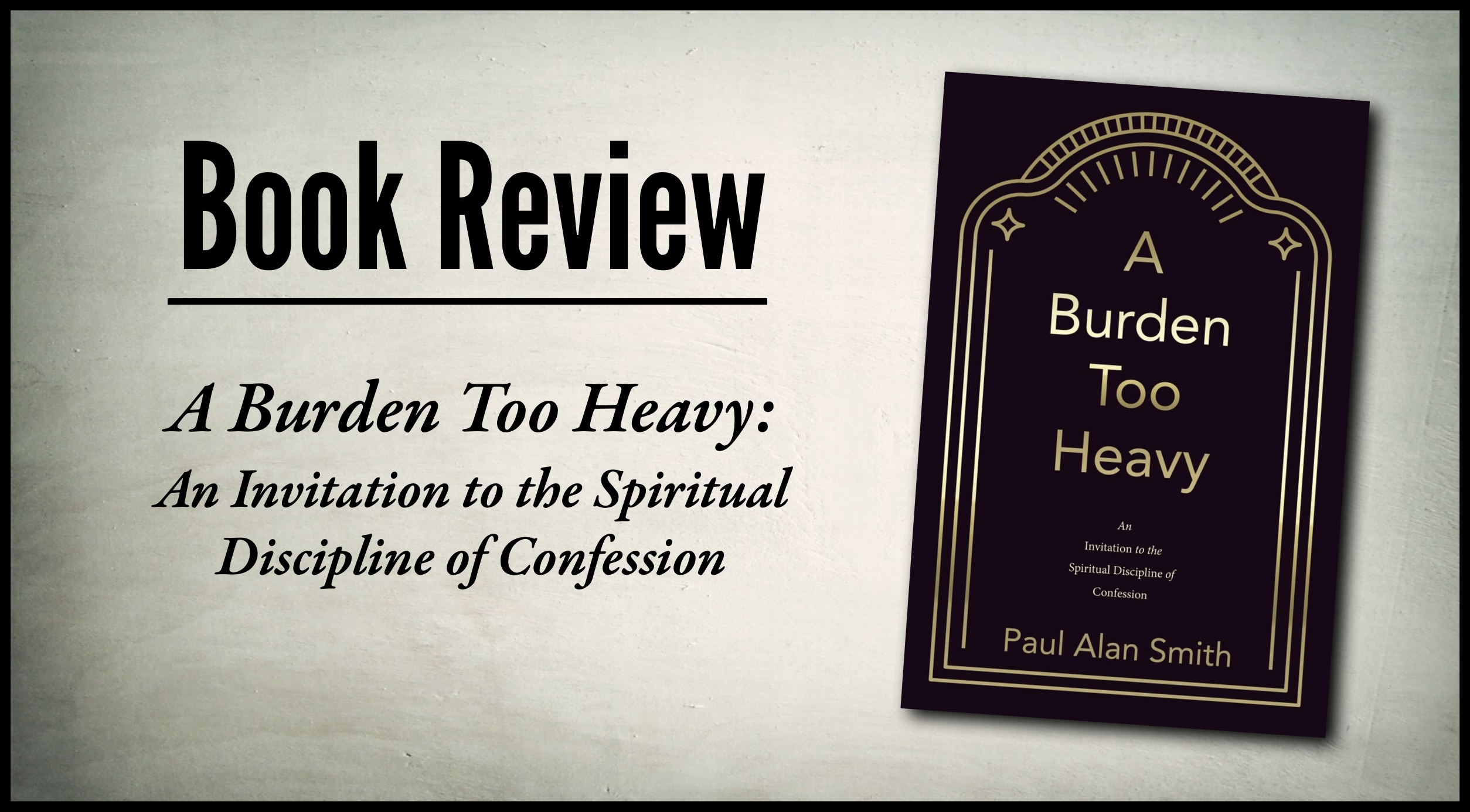
Book Review: A Burden Too Heavy

A while back, I was contacted by Paul Smith, who asked if I would be interested in reading and reviewing a book that he had recently written. I’ve never met Paul in person, but have interacted with him over the years on the web and have enjoyed his writing, so I was happy to agree. And I was not disappointed—his book, A Burden Too Heavy: An Invitation to the Spiritual Discipline of Confession, was an enjoyable read and offers needed corrective teaching to the church.

The word “confession” brings to mind different ideas, so Smith begins by helpfully defining what he means by the term:[1]

I believe the concept of “confession” has at least four applications found in Scripture.…First there are declarative confessions: adoration and praise to God, the declaration of faith in God, and the profession of the truth of a proposition. Second, there is the offering of thanksgiving and gratitude. Third, there is a recognition of physical and spiritual hardship, yet assertion of hopeful faith, through lamentation. Finally, there is a negative connotation of the acknowledgement of sin. In addition to these biblical usages of the word confession, there is another meaning of the word, that of a specific Confession of Faith, which serves to give identity to one assembly of Christians as distinct from others who observe a different confession of faith. (pp. xiv-xv)

Ultimately, what Smith hopes to impress upon the reader is the necessity of developing a confessional lifestyle, characterized by “a pervasive sense of the power of confession and an acceptance of the practices of confession” (xv). The book is structured in three parts.

Smith ministers and lives within the context of Churches of Christ, and those in Churches of Christ are the primary audience of the book, so in Part 1, he offers a brief (but excellent) history of the Stone-Campbell Restoration Movement (chapter 1) followed by an analysis of why the peculiarities that history made Churches of Christs resistant to the spiritual discipline of confession (chapter 2). To put it succinctly, a movement centered on the idea that we could perfectly restore God’s church through human effort led to a pride and arrogance that minimized the transcendence of God and made the admission of mistakes or errors very difficult—both elements of a confessional posture. This section of the book makes evident that the critiques offered by Smith throughout the book come from a place of deep affection for Churches of Christ and admiration for the spiritual ancestors of the Stone-Campbell Movement.[2]

Part 2 is comprised of three chapters. Chapter 3 provides a survey of the Bible, and examines how praise, thanksgiving, lament, and confession of sin are present in Scripture, particularly in the Psalms, but also in other places in the Old and New Testaments. Chapter 4 surveys confessional literature outside of Scripture, from the Early Church Fathers through the Medieval Period and Reformation and up through the Modern and Postmodern periods. Sadly, Churches of Christ have often been guilty of “neglecting the wisdom of the Christian centuries” (80), which means that strong historical emphasis on confessionalism has largely been missed. The historical record, however, is clear:

“The uniform message from many different theological perspectives promoting all forms of confession is an indication that confession has always been a critical component of any Christian theology.” (80)

Chapter 5 takes up the example of Dietrich Bonhoeffer as a case study. Although Bonhoeffer has no direct connection to the Stone-Campbell Movement, this chapter, in addition to being a fascinating survey study of Bonhoeffer in its own right,[3] serves to illustrate what a confessional lifestyle looks like “on the ground,” and how it would benefit Churches of Christ.

Part 3 is where things get practical: what is looks like for the principles emphasized in the book to be played out in life, and Paul addresses this by looking at confessionals in the life of the individual disciple (chapter 6) and the church (chapter 7). Chapter 6 reads much like a standard book on spiritual disciplines, with discussion of Lectio Divina, Meditation Prayer, Ignatius’s Spiritual Exercises, Fasting, and using a Spiritual Director.[4] Chapter 7 looks at how the “acts of worship” can shape a church confessionally, and helpfully examines the connection between confession and the Lord’s Supper, congregational prayer, singing, preaching, and giving.

A Burden Too Heavy ends with a conclusion summarizing the book’s key arguments, and especially why this matters for Churches of Christ:

“The twenty-first-century Churches of Christ share a unique opportunity and problem. The opportunity is to present the vision of men such as Elias Smith, Abner Jones, Barton W. Stone, and Thomas and Alexander Campbell to a culture where the reality of a divided Church is a stumbling block to accepting the gospel of Christ. The problem is that for over two centuries the vision of a restored and united Church has been distorted. It has been distorted by a number of issues, but primary among them has been the lack of a clear, focused and intentional theology of confession. A disposition toward arrogance, numbers acrimonious divisions, and a crippling identity crisis are all results of this lack of a confessional theology.” (146-47)

In addition to the quotations included above, there were several noteworthy quotations throughout the book that I thought were worth sharing (my own thoughts are added in bold):

“…This hermeneutic [command, example, necessary inference] elevated the human deductive reasoning that Thomas Campbell sought to minimize in the Declaration and Address. With the addition of “necessary implication” or “necessary inference” as a part of this restoration hermeneutic, Moses Lard negated the intent of Thomas Campbell to wean Christians off dependency on “the wisdom of men.” (12-13) This point might be a bit technical for some, but as a Restoration History hobbyist, I thought it was profound: basically, within 50 years, a key original tenet of the Restoration Movement was turned on its head.

“Praise is fundamentally an act of confession: a confession that someone or something is higher than the one offering the praise.” (44)

“…Confession is the antidote to the number one impediment of the life of faith—human pride.” (62)

“A church that has no sense of its history cannot own the positive features of its history nor can it confess the errors of its history.” (78) This is such a good point—when we don’t know our history, we truly do not know who we are. We can neither draw from our strengths or learn from our weaknesses.

“…If a preacher is unable to address his own joy and thanksgiving, as well as his doubts and fears, in the most intimate of worship settings, it will be impossible for his congregation to move toward a fully confessional lifestyle.” (131) This is an important reminder that leaders must actually lead. You cannot impart what you do not possess.

“A confessional theology is a theology that has the ability to admit its own failings. Confession praises God’s perfection and simultaneously acknowledges human weakness.” (142)

I really enjoyed A Burden Too Heavy. It was not a lengthy read (just under 150 pages), but Smith accomplished much in a short space: a penetrating analysis of the Stone-Campbell Movement, a survey of Biblical literature and the Christian tradition, a review of the life and theology of Dietrich Bonhoeffer, a summary of spiritual disciplines, and practical advice for congregational worship. And, most impressively of all, all of these seemingly disparate elements fit together as part of a coherent and forceful argument: the spiritual discipline of confession is a vital element that is largely missing in the ecclesiology of Churches of Christ and the individual lives of its members.

Smith’s work is a valiant attempt to reclaim that missing element. I fear—for the same reasons he mentions in his analysis of Churches of Christ—that many will be resistant to the sort of changes he proposes. But perhaps some will listen, and for that reason, I hope this book enjoys the widest possible readership.


[1] In this post, I will post page numbers in parentheses after quotations, and reserve footnotes for purposes of explanation. The italics in the following quotations are from the original.

[2] I point this out because it has been my experience that sometimes authors speak of the Restoration Movement with thinly veiled contempt, which I find to be off-putting. Smith is clearly writing this book out of a desire to help a fellowship that he loves and to which he is indebted.

[3] Bonhoeffer has long been a personal hero and area of study for Smith, so I was delighted (but not surprised!) to see this chapter in the book. Interestingly, I had just finished reading Bonhoeffer’s Life Together when I read this, and this summary helped emphasize some of the key ideas in Life Together.

[4] After talking about Spiritual Direction, Smith includes a section on “Redeeming the Role of Spiritual Director Within the Churches of Christ,” where he addresses the Boston Movement/International Churches of Christ, and issues of spiritual abuse in the past, and explains how different spiritual direction is from these abusive practices. This is a helpful section and I am glad it was included, but I fear it will be insufficient to soothe the concerns of those with direct experience with this movement.

Origin Story featured in The Christian Chronicle

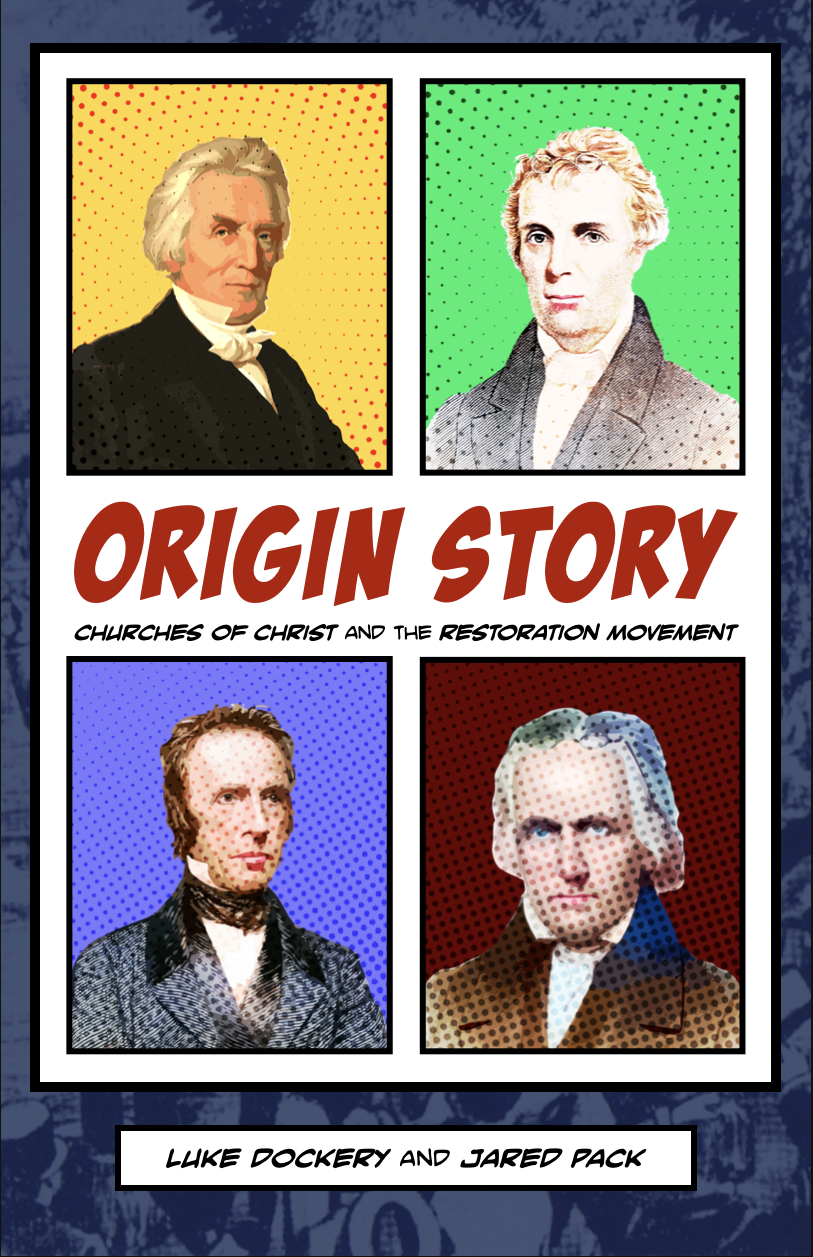
Back in March, I wrote about the release of Origin Story: Churches of Christ and the Restoration Movement. This book, which I co-authored with my good friend Jared Pack, is, as far as I know unique in that is seeks to present a history of Churches of Christ specifically geared towards teenagers. Published by Deeper Youth Ministry, the book has sold pretty well and received some good reviews, but I was pleasantly surprised when The Christian Chronicle reviewed it in a recent issue.

The reviewer, Zack Martin, is an instructor of historical theology and dean of students at Heritage Christian University in Florence, Alabama, and had several kind things to say:

[Dockery and Pack] are honest about how unity and restoration are in tension with one another in the life of a Christian; however, that should never stop one from seeking to live in balance with these two biblical ideas.

Due to the struggle between the two ideas, the Restoration Movement has consistently favored one over the other throughout its history. The results have not always been pretty, but the authors do not shy away from the unpleasant aspects of the movement, such as the presence of controversial figures or issues like segregation.

Also important is the book’s examination of the Restoration Movement within the broader context of church history. Churches of Christ will often start in the first century and then skip to 19th century America. But this book reminds the reader that historical events and movements do not happen in a vacuum.

This book is written and designed with young people in mind. But it can also be used for an adult Bible class or personal study for adults who want to learn more about their spiritual heritage and identity.

I am very thankful for Dockery and Pack and for this project. I hope that our fellowship supports this work not only because it is presented in an entertaining format, but also because it will help reshape Churches of Christ in the way of the true restoration plea.

I am thankful for the kind review, and the broader exposure given to the book. For the record, I don’t make a penny off any of these book sales; my motivation is simply to see more churches and students within Churches of Christ learn something about our history in the Restoration Movement, and appreciate the value of the restoration plea: the desire to bring about unity among God’s people by adhering to the clear teachings of Jesus and the apostles and the practices of the early church.

You can order the book from Amazon here, or read the full review at The Christian Chronicle here.

Origin Story: Churches of Christ and the Restoration Movement

I wrote a while back that I had taught a series of lessons to the students in my youth group regarding the Stone-Campbell Restoration Movement and how it affects our heritage and identity in Churches of Christ. I am pleased to announce that this study has now been compiled and formatted as a book that is now available in print and digitally. I won’t go into detail here why I think a study like this is need (I did that in the previous post), but I do want to say a couple of things and share some more detail about the book, before concluding with the summary information from the back cover.

First, this is a special project to me because it was done in conjunction with my good friend Jared Pack, and in many ways represents our friendship and the fruitful years of ministry we shared together. Jared is a historian by training and serves as Associate Professor of History and Chair of the History Department at York University in York, NE. I am a youth minister by trade and am decidedly not a trained historian, but I am an amateur enthusiast of Restoration History. Early in our friendship, Jared and I discovered a similar interest in the Restoration Movement and how it affects us today, and we co-taught a class together with our young adults group at the Farmington Church of Christ. Later, after I had moved to work with my current congregation, Jared taught the class again and added and expanded it. When I taught the material to my own students last year, I refined it further.

What all of that means is that this current product truly represents our combined work over a decade. Jared and I work so well together and think so similarly in many ways that with much of this book, at this point we are not sure who wrote which part! In many ways, this book is a perfect representation of and tribute to our friendship.

Second, this was a challenging project because I really was trying to push my creativity. Sadly, most teenagers do not find history to be an enthralling subject, and so I worked hard to make these lessons engaging. One way I sought to do this was by providing relevant discussion questions throughout the lessons to break up the lecture portions, but also, as the title suggests, I tried to tap into the notion of the origin story, a motif that has become very well understood in our society over the last twenty years with the proliferation of various movie franchises that center characters with remarkable abilities and comparing backstories (think MCU, the Harry Potter series, Star Wars, etc.). With this idea being central, Origin Story very much has the feeling of a comic book, completed with AI-generated images of the authors as superheroes!


Here is the Table of Contents, to give you an idea of the layout of the series:

Series Introduction

(1) Why Study the Restoration Movement?

(2) Background: Early Church to Reformation

(3) Background: European and American Influences

(4) The Big Four

(5) Unity and Division

(6) Churches of Christ after the Split

(7) Restoration Movement Slogans and Theology

(8) The Restoration Plea and Legacy

Appendix A: A Brief Overview of Calvinism

Appendix B: A Brief Overview of Millennialism


Purchase the Book

Paperback: Amazon $12.99

Digital: Deeper Youth Ministry $10


You can see the cover below, as well as some sample pages to give you a feel for the book (including the silly image of me as a superhero!).


From the back of the book:

Origin stories provide the background narrative that explains why characters are the way they are. When you know a character’s origin story, you also know important things about their feelings and motivations for why they do what they do. Churches of Christ have historical roots in the Stone-Campbell Restoration Movement, but teens in Churches of Christ tend to be largely ignorant about any of this history. This is a problem, because in a real sense, if we don’t know our history, we don’t know who we are.

The early Restoration leaders desired to bring about unity among God’s people by adhering to the clear teachings of Jesus and the apostles and the practices of the early church. In a world of bitter division and incredibly shaky notions of truth, that is a compelling idea, and one that is worth communicating to teenagers.

Origin Story is an eight-lesson series written specifically for teens.

“Teaching Restoration Movement history is tricky business, especially in church contexts. How best can we communicate the ups and downs, the successes and shortcomings, of our religious predecessors in a way that deepens rather than destroys faith? A lack of accessible educational resources for young Christians only compounds the problem. Fortunately, Luke Dockery and Jared Pack demonstrate both ministerial concern and scholarly acumen in this short volume which will help anchor the youth of the Churches of Christ more fully in their religious heritage and, even more importantly, point them back to the cross.”

—John Young, Associate Professor in the Turner School of Theology at Amridge University and historian of the Stone-Campbell Movement

Where Do Churches of Christ Come From? Teaching Restoration Movement History…to Teenagers

As regular readers of The Doc File likely know, I serve as a youth minister at the Cloverdale Church of Christ in Searcy, Arkansas. That reality is reflected quite often in this space, as I write frequently about youth ministry and also about the Stone-Campbell Restoration Movement, a Christian movement that emerged in the Second Great Awakening and in which Churches of Christ are historically rooted.

A major part of my job as a youth minister is teaching.[1] I get to teach teenagers dozens and dozens of times each year, and I put a lot of work and effort into developing a comprehensive curriculum map that plans out what students will study over their six years in our youth ministry, hoping to instill in them a clear understanding of Jesus Christ, a solid grasp of the biblical narrative and canon, an awareness of Christian theology and doctrine, and a Christian perspective on a variety of relevant topical issues. If that sounds like a challenging task, it’s because it is!

One topic that I have had on my curriculum map for the last couple of years but had not taught yet was an overview of Restoration history. It has been my experience that members of Churches of Christ are, generally, woefully ignorant of our history. And that’s the adults—teens are even less aware. This is really problematic, though, because in a real sense, if we don’t know our history, we don’t know who we are.


One of the best action movie franchises of my young adulthood was the Jason Bourne series. The first film in the series, The Bourne Identity, begins when the titular character is fished out of the Mediterranean Sea with gunshot wounds and a bad case of amnesia. Because Jason Bourne has lost his memory, in a real sense he has no identity, and the whole premise of the series is that Bourne is trying to piece together his past in order to figure out who he really is.

In Churches of Christ, the situation that we find ourselves in may not be as dramatic as Jason Bourne’s, but it is still an identity crisis of sorts. What are the identifying characteristics of Churches of Christ? Increasingly, that is a difficult question to answer as beliefs and practices vary widely across the theological spectrum of our churches in a way that was uncommon just a few decades ago. And I think it is directly tied to our general ignorance of our own history. That ignorance is likely caused by several factors, but a major one is competing ideologies that exist across the spectrum of Churches of Christ.


It is generally accepted that, from a sociological perspective, Churches of Christ largely shifted from a sect to a denomination during the latter half of the 20th century (something I write about more here).[2] However, this analysis describes a broad general phenomenon; the reality is that there are a great number of people in Churches of Christ who are distinctly sectarian in their thinking and many others who are thoroughly denominational (and, hopefully, many who are neither, but that is a subject for a different post).

For more sectarian circles within Churches of Christ, the assumption is that we represent the one true church, possessing some sort of unbroken line tracing all the way back to AD 30. Historical studies that show our very direct ties to a 19th-century movement obviously complicate this narrative, and so there is some degree of incentive for ignoring our history. On the other hand, for more ecumenical circles within Churches of Christ, the assumption is often that one church is just as valid as another, with differences coming down largely to personal preference (this is the denominational mindset). For many with this perspective, studies about our specific historical background fall somewhere between “unnecessary” and “embarrassing.”

In other words, if you view Churches of Christ from a sectarian or denominational lens, Restoration History isn’t likely to be a topic of central study.[3] And, sure enough, it hasn’t been for most of our people.

But what if there were another way to look at things? Is it possible to avoid being sectarian or denominational in our outlook? Well, that question is actually at the heart of the Restoration Plea—the driving force behind the Stone-Campbell Movement. That plea was a desire to bring about unity among God’s people by adhering to the clear teachings of Jesus and the apostles and the practices of the early church. And in a world of bitter division and incredibly shaky notions of truth, I think that’s still a compelling idea, and one that is worth communicating to teenagers.

A sectarian mindset would say that Churches of Christ have the market cornered on truth; we are the true Christians, all other churches are in error. A denominational mindset would say different churches are just different flavors of the same basic thing and it all comes down to personal preference; one church is just as good as another. But I reject those as the only two options. Looking at our history, it’s clear that we haven’t always gotten it right and that we have made some pretty big missteps. At the same time, we have gotten some really important things right and have made some significant contributions to the global understanding of what following Jesus looks like.

Reflective of the Restoration Plea, I would suggest that this is a better lens: neither sectarian nor denominational, we seek to be Christians only who deliberately follow the clear teachings of Scripture while maintaining an instinctive desire for unity with other believers whenever possible. These two impulses must remain at the center of our identity as we live as disciples of Jesus in the modern world. If anything, this is the lesson of the Restoration Movement. Our history shows us that men like Alexander Campbell and Barton W. Stone, men who devoted their lives to studying God’s word and living it out to the best of their abilities, could be united while not agreeing about everything because they believed they had gotten right the things that mattered most. In an age of unfriending, blocking, and muting people who don’t agree with us on every single issue, this approach to equally pursuing both truth and unity is perhaps more important than ever, and as members of Churches of Christ, it should be part of our DNA.

Neither sectarian nor denominational, we seek to be Christians only who deliberately follow the clear teachings of Scripture while maintaining an instinctive desire for unity with other believers whenever possible. Share on X

I believe this is a sustainable identity worth passing onto the next generation, and it is an identity that we really only get from historical study.

The series I ended up teaching to my teens was called “Origin Story,” and had a sort of superhero/comic book vibe.


[1] In fact, I consider teaching to be one of the six “Essential Elements of Effective Youth Ministry.”

[2] In religious studies, a sect is a religious organization that insists that it—and it alone—constitutes the entirety of the kingdom of God. Typically, a sect stands in judgment both on other religious organizations and on the larger culture in which it exists. On the other hand, a denomination in the American context is a church that recognizes it is only a part of the universal body of Christ. A denomination has typically made its peace with the dominant culture in which it exists. These definitions come from Richard T. Hughes, Reviving the Ancient Faith: The Story of Churches of Christ in America (Abilene, TX: ACU Press, 1996), xii-xiii.

[3] Because, again, from a sectarian perspective, Restoration History isn’t “our” history; “our” history is found in the book of Acts. From a denominational perspective, “our” history is largely unimportant.

Raising Up Ministers: Six Unhelpful Trends in Churches of Christ

If you pay any attention to these sorts of things, by now you are well aware that there is a ministry crisis in churches: there are far more churches seeking ministers than there are ministers seeking churches. This is a widespread phenomenon in churches (of various groups and denominations) within the United States, as indicated by a much-discussed Barna study. Looking more specifically at Churches of Christ, The Christian Chronicle has covered this multiple times. I even blogged about it myself in a roundabout way last year.

Despite all of the attention given to this very real problem, much of the focus has been on reasons why people leave ministry. An examination of those reasons is really important, but I think we also need to examine reasons why we are not training nearly as many ministers as we once did. There are groups out there that are working hard to encourage and train young people who have an interest in ministry (Harding’s Kerusso Experience is a great example of that; Lads to Leaders/Leaderettes and Leadership Training for Christ ostensibly do this as well), but I think a key aspect in this discussion—at least within the context of Churches of Christ—is for us to acknowledge some trends that have developed over several decades that are working against us when it comes to instilling interest in ministry in people at a young age.

So, why is it that we don’t train as many ministers as we once did? I’m sure there are lots of reasons, and what I am about to suggest is not intended to be an exhaustive list, but it is a start. For each trend I discuss, I’ll offer a question to prompt reflection on how we might respond, in light of these trends.

To be clear, I am not suggesting that these trends are inherently negative in and of themselves. They have had the effect, however, of making the practice of raising up ministers within the local congregation more difficult. 


1. Transitioning Away from a Small Church Fellowship

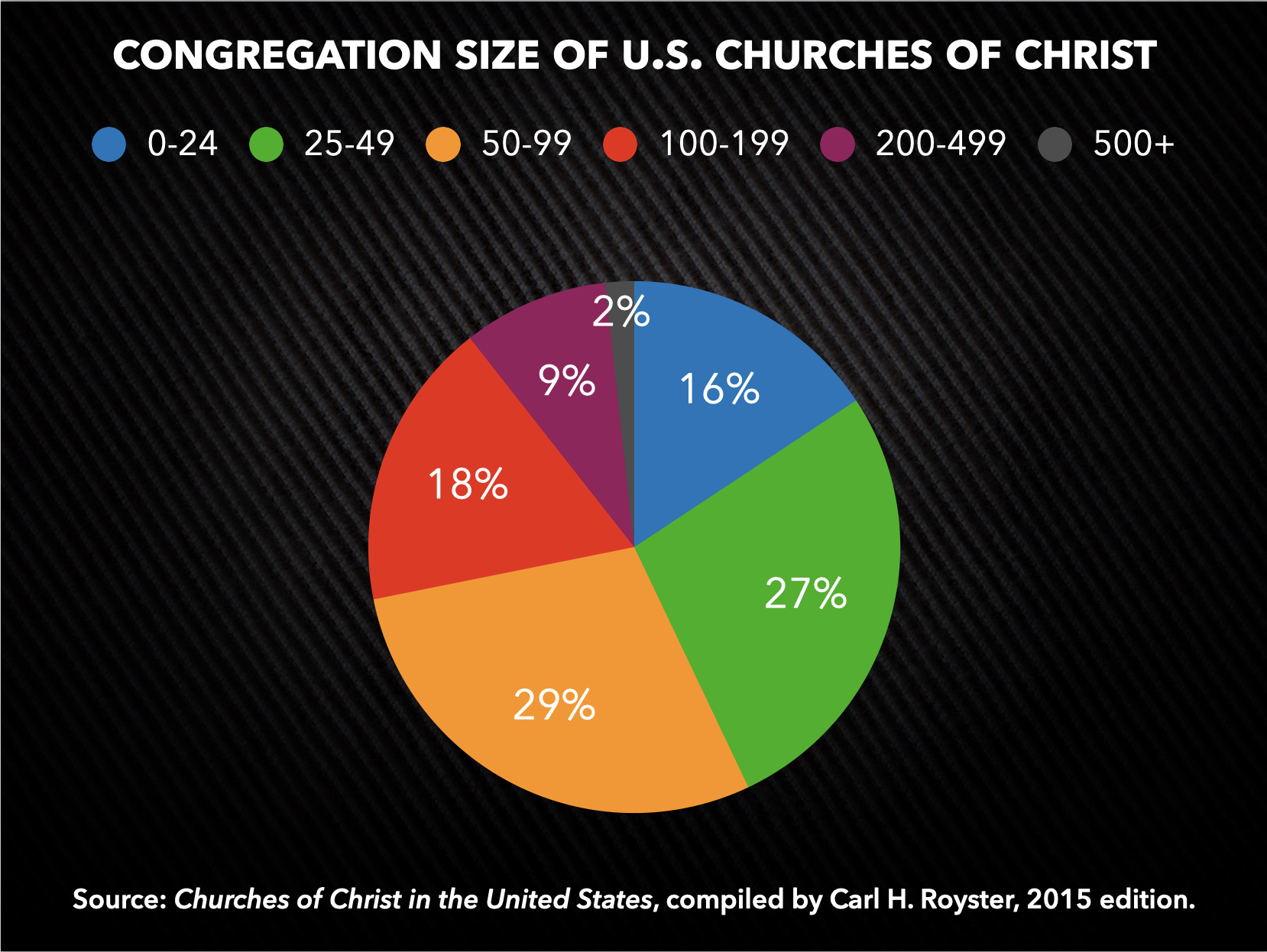
Historically, Churches of Christ have been a small church fellowship. As of 2015, nearly 90% of congregations within Churches of Christ had less than 200 members (see chart below).

Over time, though, this trend is slowly changing. The United States is becoming increasingly urbanized, where small towns shrink and dry up as people move off for other opportunities, and as this happens, the small churches in those small towns dwindle as well. You probably hear statistics about “X number of churches close their doors every week/month/year….” Well, those churches are overwhelmingly small churches. It’s not that all of the Christians are disappearing and it’s certainly not that all of our churches are growing larger, but there is a shift that is occurring of members from smaller churches consolidating with larger ones as they move to cities, or as their previous congregations shrink beyond the point of sustainability.

Why does trend matter? Because small churches produce a disproportionate amount of preachers. This occurs because it is in small churches where young men receive opportunity to serve and lead. This comes out of necessity—there are jobs to be done and tasks to be performed, and no one else to do them. On the other hand, at larger churches, there are many more people willing to serve and lead, and you actually have to look for opportunities to get young people involved.[1]

In a context where more of our churches are larger, how can we create spaces for young people to have opportunities to lead in worship?

2. The Transformation (or Elimination) of Sunday Nights

I do not know the full history of the traditional Sunday night worship services in Churches of Christ. I know that for many years, it was essentially a carbon copy of what we did on Sunday mornings, but that they also tended to be less formal: men were less likely to wear suits, women were less likely to wear dresses, men who didn’t normally make it into the Sunday morning rotation got to lead singing, and in many churches, you would have occasional singing nights or youth worship nights where young men would have opportunity to serve. At the previous congregation where I worked, we had a monthly Youth-Led Worship where we would meet early to help young men practice and prepare, and then kids and teens would lead the entire service (prayers, songs, Lord’s Table, lesson, etc.).

Over the course of my lifetime, though, I have increasingly become aware of churches moving away from a traditional Sunday night service. Some churches have moved from a combined worship service to a small group model, and meet in members’ homes. Other churches have moved from a worship service to a Bible class format. Others have canceled evening services and replaced them with service projects. Others have canceled them and replaced them with nothing.

And, anecdotally, I would say that larger churches (i.e. the ones that already struggle to give young people a place to lead and be trained in leading worship) tend to be the most likely to abandon the traditional Sunday night service (removing yet another opportunity for training).

These Sunday night changes might be quite beneficial on the whole for the congregations in which they are occurring, but realistically, it still represents a lost venue for young people to have opportunity to lead.

In a context where the Sunday night service is disappearing, when and where can young people have opportunities to lead in worship?

3. Transition from Sect to Denomination: the Loss of Confidence and Importance

These next two trends have been developing for decades, but are helpful, I believe, in understanding so many things about Churches of Christ, especially in the 20th century and beyond.[2] First, a couple of definitions:

Sect: A religious organization that insists that it—and it alone—constitutes the entirety of the kingdom of God. Typically, a sect stands in judgment both on other religious organizations and on the larger culture in which it exists.

Denomination: In the American context, a church that recognizes it is only a part of the universal body of Christ. A denomination has typically made its peace with the dominant culture in which it exists.[3]

In other words, a sect is a group that emphasizes distinction: the call is to be radically different from the world, and to view other religious groups somewhat antagonistically. A denomination, on the other hand, tends to emphasize (or at least accept), being part of a larger whole: one “type” of Christianity amongst others, living in the context of the world.

This is a sociological description rather than a theological prescription: I’m not making the claim that this is a good development, but rather, that it is an accurate description of what has largely (not universally) happened within Churches of Christ over the last 100 years.[4] There was a time that Churches of Christ largely believed that “they were the only ones going to heaven” and that other believers, while they may be sincere, were sincerely mistaken, and not “true Christians.”[5] That still exists, but is much less prevalent than it once was. There are many in Churches of Christ today who have little to no appreciation of Restoration history or theology and would broadly claim that one church is as good as another. Others would hold strongly to certain doctrinal teachings, but still show a greater degree of both self-critique and approval of other groups than was true in the past. All of this reflects the shift from sect to denomination described above.

This is relevant to the issue at hand, I think, because this transition reflects a shakiness in our self-understanding: at one point, we were convinced that we taught the truth, while others were in error. This gives confidence in the importance of the preaching task: not only do we need to let the unchurched know about Jesus; but we also need to let the incorrectly churched know the truth about the importance of baptism, acceptable worship, and proper church governance. Virtually everyone is in error and, thus, in trouble, and we know the answer. This confidence and importance provide great motivation for dedicating a life to preaching.

On the other hand, if we are less confident in the rightness of our belief, and maybe many of our neighbors in other Christian groups don’t really need us to straighten them out, a life of preaching seems less important and less desirable.

In a context where we are less certain of our exclusive access to the truth, how can we still convey the value of preaching and other forms of ministry?

4. Transition from Sect to Denomination: at Home in the World

The other part of this transition is a feeling of comfort and belonging the world. In the early 20th century, this did not describe Churches of Christ. The early 1900s witnessed the growing split between the less educated, lower class, and theologically conservative Churches of Christ and the more educated, higher class, theologically liberal Disciples of Christ. As the split spread and then formalized, the Disciples often found themselves with the nice church buildings (now adorned with pianos) and standing in society, while the Churches of Christ were left with little in capital, real estate, and social standing.

Most members of Churches of Christ were not wealthy, and had no expectation of being so. This began to change in the economic boom following World War II, as wealth increased across virtually all demographics in the United States. Economic blessings led to nice, new church buildings, prestige in society, and changing expectations.

Those in ministry will tell you that a common barrier to young people entering ministry is discouragement from their parents because of financial concerns. The feeling is that ministry does not pay well (often true), and parents will often emphasize financial security over God’s call. My suspicion is that this parental discouragement stems from this broader transition to affluence: back when all of us were poor, being poor as a preacher was no worse than anything else. As our bank accounts have swelled, the desirability of preaching has diminished.

In a context where we value and respect financial security, how can we better compensate those in ministry so it is a more desirable option? How can we disciple all of our people to place less value upon financial security?

5. Secularization and the Loss of the Minister’s Prestige

Another major transition that has been going on in our society for a long time is increasing secularization. We have increasingly carved out spaces where God is not allowed (physically and metaphorically), a higher percentage of people no longer claim faith of any kind, and even people who are Christians increasingly view the world through secular lenses.[6]

In our increasingly post-Christian society, being a preacher (or some other type of minister) doesn’t bring the same sort of respect and prestige that it once did. In frontier America, where formal education was sparse, people tended to be self-taught, and many were illiterate, the preacher was often the most educated person in the community. It was naturally assumed that this was a person who had done some serious learning, and had something to say that was worth listening to.

This is no longer widely assumed. Many people are highly educated, and have access to tools that allow them to study Scripture in sophisticated ways. More than that, in a highly-secularized society, a minister may be well-educated, but the assumption may be that his or her education is fundamentally not valuable: if the Christian faith is ultimately a fairy tale, why should we be impressed that you are well-versed in it?[7]

In a context where ministers are not respected within society, how can we raise the level of respect they are shown in our churches? How can we disciple all of our people to place less value on the opinions of others?

6. Disquiet around Gender Roles

You are likely aware that the debate about gender roles is raging in Churches of Christ. This is certainly not unique to us, but what is relatively distinct is our practice of congregational autonomy: there is no denominational hierarchy dealing out an official position on female inclusion in church leadership, so individual churches have the task of interpreting the teachings of Scripture and applying them in their own contexts. In practice, this means that Churches of Christ are kind of like the wild west, where different churches have their own rules and understanding. Thus, you can find a variety of practices within Churches of Christ, ranging from full egalitarianism to full patriarchalism to all sorts of shades and variations in between.

Historically, this was not the case. Until fairly recently, for a long time, the broad consensus was that church leadership was for men, and the concept of “church leadership” was defined in such a way that it included any sort of up-in-front role during the worship assembly. Things are much different now: you really can’t assume where a given church is on this issue without doing some research, and honestly, a lot of churches themselves aren’t sure where they are on the issue.

My goal here is not to adjudicate this issue or tell you what you should think about it; rather, I am simply acknowleding that the landscape of Churches of Christ is much more confusing in this area than it once was, and I think it has ramifications for our actual topic at hand, helping to plant the seed of ministry within young people in our churches.

For churches that are clear about their positions on this (at one end of the spectrum or the other), it’s not really a problem, but for the large (and growing) number of churches that are somewhere in the middle and are trying to figure out what is permissable and what isn’t, it becomes a lot more complicated, and special worship services led by young people tend to bring a controversial issue front and center.[8]

In a context where gender roles are such a controversial topic, how can we seek to train young people in a way that doesn’t foster division and strife?


[1]This is easier said than done: we get nervous in front of people, and the larger the group of people, the more nervous we tend to get. So a young man who might be willing to present a lesson in front of 50 people will likely be less willing to do the same lesson in front of 500 people. Expectations of quality and professionalism tend to increase in larger congregations as well, placing a greater burden and barrier on young people who are inherently inexperienced and less skilled.

[2]What I present here will naturally be simplified and reductive. For fuller expositions on this topic, see David Edwin Harrell, “Emergence of the “Church of Christ” Denomination” (1972), and Richard T. Hughes, Reviving the Ancient Faith: The Story of Churches of Christ in America (Abilene, TX: ACU Press, 1996). Harrell and Hughes are two of the most respected historians within the Stone-Campbell Restoration Movement. Theologically, they were at different ends of the theological spectrum of Churches of Christ, but their sociological analyses of the transition of Churches of Christ from sect to denomination are closely in sync.

[3]These definitions come from Hughes, Reviving the Ancient Faith, xii-xiii.

[4]Indeed, I would argue that both of these categories fall short of how Jesus would have citizens of His kingdom envision themselves.

[5]There is good reason to argue that this sort of sectarianism betrayed the unifying vision of the early leaders of the Stone-Campbell Restoration Movement, but that is beyond the scope of this article. The point is simply that there was a time when this was a widespread and common belief amongst those in Churches of Christ.

[6]As famously argued in Charles Taylor’s A Secular Age.

[7]It should be added that some of the loss of respect felt toward those in ministry is self-inflicted: the constant drumbeat of those in various forms of ministry, across denominational affiliation and the theological spectrum, who abuse that position through sexual sin, financial dishonesty, or other types of abusive behavior have greatly diminished the public trust in those in ministry.

[8]This may seem counterintuitive to some readers: why would it be problematic to have a youth-led worship service that reflected the same gender roles that a regular worship service would have in that context? I understand the question, but it does seem to make a difference, for at least three reasons. First, young people, especially teens, tend to be more rebellious and push the envelope more than those of older generations. So, you might have lots of women who are very comfortable in traditional gender roles in the church, but that doesn’t mean that teenage girls are. Second, you may have parents who are generally okay with the ways things are for themselves, but feel the need to advocate for greater opportunities for their daughters. Third, there are some people who are fine listening to a sermon from a well-trained male preacher but start to ask questions when listening to a 12-year-old boy offer a fairly shallow (and sometimes theologically heterodox) lesson.

« Older posts

© 2026 The Doc File

Theme by Anders Noren — Up ↑