The online journal of Luke Dockery

Tag: Church Fathers (Page 1 of 2)

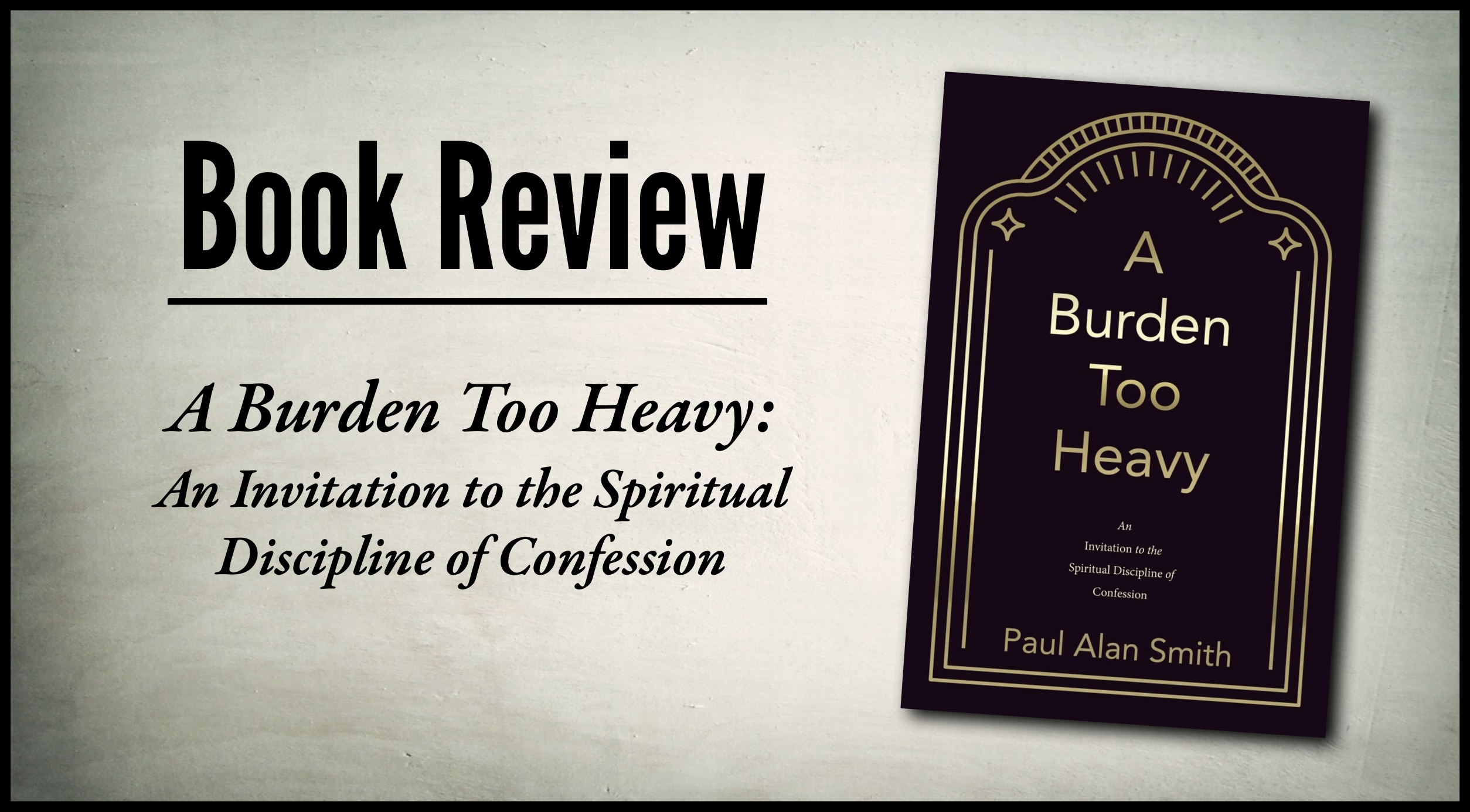
Book Review: A Burden Too Heavy

A while back, I was contacted by Paul Smith, who asked if I would be interested in reading and reviewing a book that he had recently written. I’ve never met Paul in person, but have interacted with him over the years on the web and have enjoyed his writing, so I was happy to agree. And I was not disappointed—his book, A Burden Too Heavy: An Invitation to the Spiritual Discipline of Confession, was an enjoyable read and offers needed corrective teaching to the church.

The word “confession” brings to mind different ideas, so Smith begins by helpfully defining what he means by the term:[1]

I believe the concept of “confession” has at least four applications found in Scripture.…First there are declarative confessions: adoration and praise to God, the declaration of faith in God, and the profession of the truth of a proposition. Second, there is the offering of thanksgiving and gratitude. Third, there is a recognition of physical and spiritual hardship, yet assertion of hopeful faith, through lamentation. Finally, there is a negative connotation of the acknowledgement of sin. In addition to these biblical usages of the word confession, there is another meaning of the word, that of a specific Confession of Faith, which serves to give identity to one assembly of Christians as distinct from others who observe a different confession of faith. (pp. xiv-xv)

Ultimately, what Smith hopes to impress upon the reader is the necessity of developing a confessional lifestyle, characterized by “a pervasive sense of the power of confession and an acceptance of the practices of confession” (xv). The book is structured in three parts.

Smith ministers and lives within the context of Churches of Christ, and those in Churches of Christ are the primary audience of the book, so in Part 1, he offers a brief (but excellent) history of the Stone-Campbell Restoration Movement (chapter 1) followed by an analysis of why the peculiarities that history made Churches of Christs resistant to the spiritual discipline of confession (chapter 2). To put it succinctly, a movement centered on the idea that we could perfectly restore God’s church through human effort led to a pride and arrogance that minimized the transcendence of God and made the admission of mistakes or errors very difficult—both elements of a confessional posture. This section of the book makes evident that the critiques offered by Smith throughout the book come from a place of deep affection for Churches of Christ and admiration for the spiritual ancestors of the Stone-Campbell Movement.[2]

Part 2 is comprised of three chapters. Chapter 3 provides a survey of the Bible, and examines how praise, thanksgiving, lament, and confession of sin are present in Scripture, particularly in the Psalms, but also in other places in the Old and New Testaments. Chapter 4 surveys confessional literature outside of Scripture, from the Early Church Fathers through the Medieval Period and Reformation and up through the Modern and Postmodern periods. Sadly, Churches of Christ have often been guilty of “neglecting the wisdom of the Christian centuries” (80), which means that strong historical emphasis on confessionalism has largely been missed. The historical record, however, is clear:

“The uniform message from many different theological perspectives promoting all forms of confession is an indication that confession has always been a critical component of any Christian theology.” (80)

Chapter 5 takes up the example of Dietrich Bonhoeffer as a case study. Although Bonhoeffer has no direct connection to the Stone-Campbell Movement, this chapter, in addition to being a fascinating survey study of Bonhoeffer in its own right,[3] serves to illustrate what a confessional lifestyle looks like “on the ground,” and how it would benefit Churches of Christ.

Part 3 is where things get practical: what is looks like for the principles emphasized in the book to be played out in life, and Paul addresses this by looking at confessionals in the life of the individual disciple (chapter 6) and the church (chapter 7). Chapter 6 reads much like a standard book on spiritual disciplines, with discussion of Lectio Divina, Meditation Prayer, Ignatius’s Spiritual Exercises, Fasting, and using a Spiritual Director.[4] Chapter 7 looks at how the “acts of worship” can shape a church confessionally, and helpfully examines the connection between confession and the Lord’s Supper, congregational prayer, singing, preaching, and giving.

A Burden Too Heavy ends with a conclusion summarizing the book’s key arguments, and especially why this matters for Churches of Christ:

“The twenty-first-century Churches of Christ share a unique opportunity and problem. The opportunity is to present the vision of men such as Elias Smith, Abner Jones, Barton W. Stone, and Thomas and Alexander Campbell to a culture where the reality of a divided Church is a stumbling block to accepting the gospel of Christ. The problem is that for over two centuries the vision of a restored and united Church has been distorted. It has been distorted by a number of issues, but primary among them has been the lack of a clear, focused and intentional theology of confession. A disposition toward arrogance, numbers acrimonious divisions, and a crippling identity crisis are all results of this lack of a confessional theology.” (146-47)

In addition to the quotations included above, there were several noteworthy quotations throughout the book that I thought were worth sharing (my own thoughts are added in bold):

“…This hermeneutic [command, example, necessary inference] elevated the human deductive reasoning that Thomas Campbell sought to minimize in the Declaration and Address. With the addition of “necessary implication” or “necessary inference” as a part of this restoration hermeneutic, Moses Lard negated the intent of Thomas Campbell to wean Christians off dependency on “the wisdom of men.” (12-13) This point might be a bit technical for some, but as a Restoration History hobbyist, I thought it was profound: basically, within 50 years, a key original tenet of the Restoration Movement was turned on its head.

“Praise is fundamentally an act of confession: a confession that someone or something is higher than the one offering the praise.” (44)

“…Confession is the antidote to the number one impediment of the life of faith—human pride.” (62)

“A church that has no sense of its history cannot own the positive features of its history nor can it confess the errors of its history.” (78) This is such a good point—when we don’t know our history, we truly do not know who we are. We can neither draw from our strengths or learn from our weaknesses.

“…If a preacher is unable to address his own joy and thanksgiving, as well as his doubts and fears, in the most intimate of worship settings, it will be impossible for his congregation to move toward a fully confessional lifestyle.” (131) This is an important reminder that leaders must actually lead. You cannot impart what you do not possess.

“A confessional theology is a theology that has the ability to admit its own failings. Confession praises God’s perfection and simultaneously acknowledges human weakness.” (142)

I really enjoyed A Burden Too Heavy. It was not a lengthy read (just under 150 pages), but Smith accomplished much in a short space: a penetrating analysis of the Stone-Campbell Movement, a survey of Biblical literature and the Christian tradition, a review of the life and theology of Dietrich Bonhoeffer, a summary of spiritual disciplines, and practical advice for congregational worship. And, most impressively of all, all of these seemingly disparate elements fit together as part of a coherent and forceful argument: the spiritual discipline of confession is a vital element that is largely missing in the ecclesiology of Churches of Christ and the individual lives of its members.

Smith’s work is a valiant attempt to reclaim that missing element. I fear—for the same reasons he mentions in his analysis of Churches of Christ—that many will be resistant to the sort of changes he proposes. But perhaps some will listen, and for that reason, I hope this book enjoys the widest possible readership.


[1] In this post, I will post page numbers in parentheses after quotations, and reserve footnotes for purposes of explanation. The italics in the following quotations are from the original.

[2] I point this out because it has been my experience that sometimes authors speak of the Restoration Movement with thinly veiled contempt, which I find to be off-putting. Smith is clearly writing this book out of a desire to help a fellowship that he loves and to which he is indebted.

[3] Bonhoeffer has long been a personal hero and area of study for Smith, so I was delighted (but not surprised!) to see this chapter in the book. Interestingly, I had just finished reading Bonhoeffer’s Life Together when I read this, and this summary helped emphasize some of the key ideas in Life Together.

[4] After talking about Spiritual Direction, Smith includes a section on “Redeeming the Role of Spiritual Director Within the Churches of Christ,” where he addresses the Boston Movement/International Churches of Christ, and issues of spiritual abuse in the past, and explains how different spiritual direction is from these abusive practices. This is a helpful section and I am glad it was included, but I fear it will be insufficient to soothe the concerns of those with direct experience with this movement.
Learning from the Apostolic Fathers: The Didache

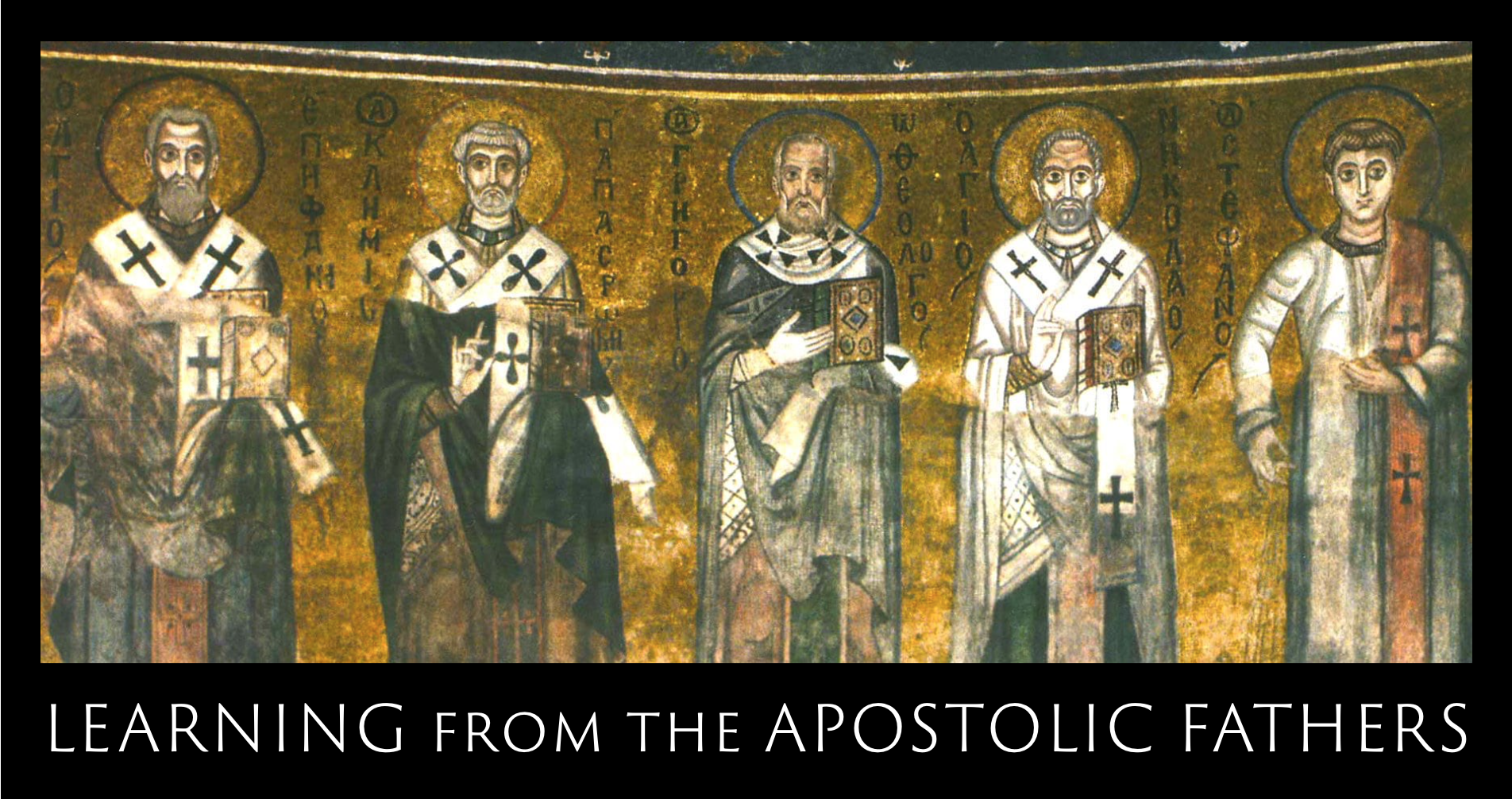
Last year, I read through Michael W. Holmes’s edition of The Apostolic Fathers in English as part of my daily devotional readings. Generally speaking, the term “Apostolic Fathers” refers to early Christian theologians from the 1st and 2nd centuries AD, some of whom would have known some of the apostles personally and sought to pass on their teachings. Related to those readings, I began a short series of blog posts where I wrote about Clement of Rome, Ignatius of Antioch, and Polycarp of Smyrna. I had intended to include one final post in that series on The Didache but, sadly, never got around to it. So, this represents the very tardy conclusion to that series.


The Background of The Didache

The Didache simply means “The Teaching”, and is the shorter, common title of The Teaching of the Lord to the Gentiles by the Twelve Apostles as it was known in ancient times. This work was known because it was referenced by various ancient writers, but the first known copy wasn’t discovered until 1873, with the full text being published in 1883.[1]

This short work—100 verses altogether—has received a great deal of scholarly treatment, but much about it remains quite mysterious. It is unknown who wrote it, when it was written, or where it was written. Regarding the date, The Didache in its current form may have come about as late as AD 150, but it is more likely that it came about near the end of the first century. As Michael Holmes points out:

“The materials from which it was composes reflect the state of the church at an even earlier time. The relative simplicity of th prayers, the continuing concern to differentiate Christian practice from Jewish rituals (8.1), and in particular the form of church structure—note the twofold structure of bishops and deacons (cf. Phil. 1:1) and the continued existence of traveling poses and prophets alongside a resident ministry—reflect a time closer to that of Paul and James (who died in the 60s) than Ignatius (who died sometime after 110).”[2]

The Didache contains three main sections: (1) Teaching on “the Two Ways” that resonates closely with portions of the Gospels of Matthew and Luke, (2) a sort of how-to manual related to church practices, and (3) a brief apocalyptic section.

Themes and Insights from The Didache

Specific Instructions for Church Practice: The New Testament gives much teaching about the gospel of Jesus Christ and the way that reality should transform disciples of Jesus as participants in new creation. Furthermore, at times—usually in response to a situational question or crisis—practical instruction will be given to believers to tell them how they should behave in a given situation. On the whole, though, this practical instruction is limited, and there are many questions left unanswered.

The Didache steps into this void with all sorts of practical recommendations and commands. Personally, I found these instructions to be all over the place, variously striking me as wise, quirky, surprising, and questionable:

  • Concerning baptism, it is best to baptize in the name of the Father, Son, and Holy Spirit in running water. If there is no running water, other water will work. If there is no cold water, then use warm water. If you have neither, pour water on the head three times in the name of the Father, Son, and Spirit (7.1-3).[3]
  • Fasting should be done on Wednesday and Friday, to avoid Monday and Thursday, which is when the “hypocrites” fast (8.1).
  • The Lord’s Prayer should be recited three times per day (8.2-3).
  • A specific prayer to be said prior to the taking of the Lord’s Supper (9.1-4).
  • A prohibition against sharing Communion with anyone who has not been baptized into the name of the Lord (9.5).
  • Instructions on how to treat itinerant apostles and prophets (11.3-13.7).

Condemnation of Abortion: In a list of prohibitions against various sins that hearken back closely to Exodus 20 and Matthew 5, there is an interesting bit that arrests the attention of our modern ears:

“The second commandment of the teaching is: You shall not murder; you shall not commit adultery; you shall not corrupt children; you shall not be sexually immoral; you shall not steal; you shall not practice magic; you shall not engage in sorcery; you shall not abort a child or commit infanticide. You shall not covet your neighbor’s possessions.”

(The Didache 2.1-2)

It has become a common argument, especially in more politically progressive circles, to claim that Christian opposition to the practice of abortion is only a recent historical occurrence, and came about through the shrewd maneuvering of the conservative political movement rather than historic Christian teaching.

It may very well be the case that conservative political strategists constructed a loyal voting block by tapping into sentiments about abortion (indeed, I am fairly cynical toward the motives behind much Pro-Life posturing), but clearly, Christian opposition to abortion is not a recent phenomenon. As we see in The Didache, the practice was explicitly condemned likely in the first century, and there are similar prohibitions in other ancient texts. If there was a time, prior to the rise of the Religious Right, where most Christians in America were supportive of the practice of abortion, those Christians were out of step with the ancient teaching of the Christian church.

Concluding Thoughts

The Didache is a fascinating text. It is short, and absolutely worth reading. There is much about it that we simply do not know—who wrote it? Is it possible that it actually stretches all the way back to some of the apostles? What level of authority would have been given to this collection of teachings in the early church? These questions remained unanswered.

What is clear, however, is that The Didache preserves the efforts of early Christians who were attempting to apply the teachings of Scripture to the circumstances of their time in order to address questions that needed to be answered. This is a faithful practice that is still desperately needed today.

The Didache preserves the efforts of early Christians who were attempting to apply the teachings of Scripture to address the circumstances of their time. This is a faithful practice that is still desperately needed today. Share on X

[1] Michael W. Holmes, ed., The Apostolic Fathers in English (Grand Rapids: Baker Academic, 2006): 157.

[2] Holmes, 159.

[3] This is, I believe, the first record of some sort of baptism other than immersion. It should be noted, however, that this is not held up as the ideal or permitted as a standard practice, but as an acceptable substitute in the absence of preferable conditions.

Learning from the Apostolic Fathers: Polycarp

As I wrote in the first post in this series, I have been reading through Michael W. Holmes’s edition of The Apostolic Fathers in English as part of my daily devotional readings. Generally speaking, the term “Apostolic Fathers” refers to early Christian theologians from the 1st and 2nd centuries AD, some of whom would have known some of the apostles personally and sought to pass on their teachings. More specifically, “Apostolic Fathers” is frequently used in reference to Clement of Rome, Ignatius of Antioch, and Polycarp of Smyrna. Today, I want to focus on Polycarp.


The Life and Letter of Polycarp

Polycarp of Smyrna

Polycarp served as the bishop of Smyrna in Asia Minor, and was the recipient of one of the letters of Ignatius of Antioch, his friend and mentor. Polycarp is one of the more notable figures of the early (post-apostolic) church,[1] and his fame stems from at least three streams:

  • His writing The Letter of Polycarp to the Philippians
  • His death as a martyr in AD 155-160, the details of which are shared in The Martyrdom of Polycarp
  • His status as a significant link in the chain of apostolic tradition: as a child, Polycarp knew John the Apostle in his old age, and, in turn, later in his own life knew Irenaeus of Lyons when the latter was a child

In The Letter of Polycarp to the Philippians, Polycarp relies heavily on both the Old Testament scriptures and also early Christian writings and emphasizes the strong connection between orthodoxy and orthopraxy: wrong beliefs inevitably lead to wrong behaviors, and wrong behaviors are evidence of wrong beliefs.[2]

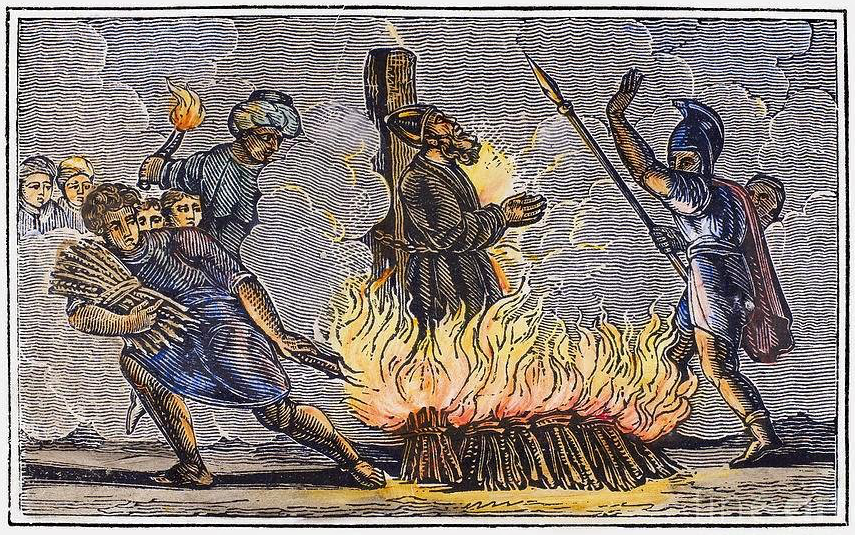
In The Martyrdom of Polycarp (written by anonymous eyewitnesses) records the account of the pursuit, arrest, trial, and execution of Polycarp, who is martyred for his faith at the age of 86. The Martyrdom of Polycarp reveals the growing challenge that the church of the mid-second century faced for its proclamation that Jesus was Lord. Situated firmly in an empire that proclaimed that Caesar was Lord, the Christian proclamation could not be left unchallenged, and persecution and martyrdom was increasingly the fate who held to their confession of faith in Jesus.

Themes and Insights from Polycarp

The Importance of Right Beliefs: Polycarp clearly shows a strong reaction against gnostic teaching, and echoes words from 1 John. Indeed, he holds the incarnation, crucifixion, and resurrection of Jesus and His role as judge to be essential aspects of Christian faith.

“For everyone who does not confess that Jesus Christ has come in the flesh is antichrist; and whoever does not acknowledge the testimony of the cross is of the devil; and whoever twists the sayings of the Lord to suit his own sinful desires and claims that there is neither resurrection nor judgment—well, that person is the firstborn of Satan. Therefore let us leave behind the worthless speculation of the crowd and their false teachings and let us return to the word delivered to us from the beginning; let us be self-controlled with respect to prayer and persevere in fasting, earnestly asking the all-seeing God to lead us not into temptation, because, as the Lord said, ‘the spirit is indeed willing, but the flesh is weak.’”

(Polycarp, To the Philippians 7.1-2)

The Importance of Right Behaviors: A key theme of Polycarp’s letter is his discussion of righteousness, which the Philippians had apparently asked him about. Relying heavily on New Testament teaching, Polycarp addresses wives, widows, deacons, younger men, and elders, instructing each group to lead righteous lives. Living a righteous life that pleases God is very important:

“If we please him in this present world, we will receive the world to come as well, inasmuch as he promised that he will raise us from the dead and that if we prove to be citizens worthy of him, we will also reign with him—if, that is, we continue to believe.”

(Polycarp, To the Philippians 5.2b)

Willingness for Martyrdom: With Ignatius, we saw an eagerness for martyrdom that is startling to modern ears. With Polycarp, one does not sense the same degree of eagerness (Polycarp actually leaves the city and then changes location again to avoid the authorities who are searching for him), but he is certainly willing to die for his faith.

After he is caught and implored to swear an oath by Caesar to deny Christ in order to secure his release, Polycarp famously responds:

“For eighty-six years I have been His servant, and He has done me no wrong. How can I blaspheme my King who saved me?”

(Martyrdom of Polycarp 9.3b)

When the proconsul persists and threatens him with death by fire, Polycarp remains firm:

“You threaten with a fire that burns only briefly and after just a little while is extinguished, for you are ignorant of the fire of the coming judgment and eternal punishment, which is reserved for the ungodly. But why do you delay? Come, do what you wish.”

(Martyrdom of Polycarp 11.2b)

Polycarp is killed for his faith, and his martyrdom is “in accord with the pattern of the gospel of Christ” (19.1), as he followed the example of Jesus, an innocent who was killed unjustly. His last words are a prayer to God:

“O Lord God Almighty, Father of your beloved and blessed Son Jesus Christ, through whom we have received knowledge of you, the God of angels and powers and of all creation, and of the whole race of the righteous who live in your presence, I bless you because you have considered me worthy of this day and hour, so that I might receive a place among the number of the martyrs in the cup of your Christ, to the resurrection to eternal life, both of soul and of body, in the incorruptibility of the Holy Spirit.”

(Martyrdom of Polycarp 14.1b-2b)

Powerful hope inspires powerful courage.

Concluding Thoughts

The Letter of Polycarp to the Philippians is so heavily influenced by Scripture that large chunks of it are very familiar, and read like a cut-and-pasted pastiche of biblical teaching. It is a simple and edifying read. The Martyrdom of Polycarp is a compelling narrative that fills the reader with admiration for this elderly churchman who has clung to Christ all his life, and is determined to cling to Him in death as well.

Polycarp is burned at the stake for refusing to forsake Jesus.


[1] Michael W. Holmes, ed., The Apostolic Fathers in English (Grand Rapids: Baker Academic, 2006): 130.

[2] Holmes, 132.

Learning from the Apostolic Fathers: Ignatius

As I wrote in the first post in this series, I have been reading through Michael W. Holmes’s edition of The Apostolic Fathers in English as part of my daily devotional readings. Generally speaking, the term “Apostolic Fathers” refers to early Christian theologians from the 1st and 2nd centuries AD, some of whom would have known some of the apostles personally and sought to pass on their teachings. More specifically, “Apostolic Fathers” is frequently used in reference to Clement of Rome, Ignatius of Antioch, and Polycarp of Smyrna. Today, I want to focus on the writings of Ignatius.


Ignatius and His Letters

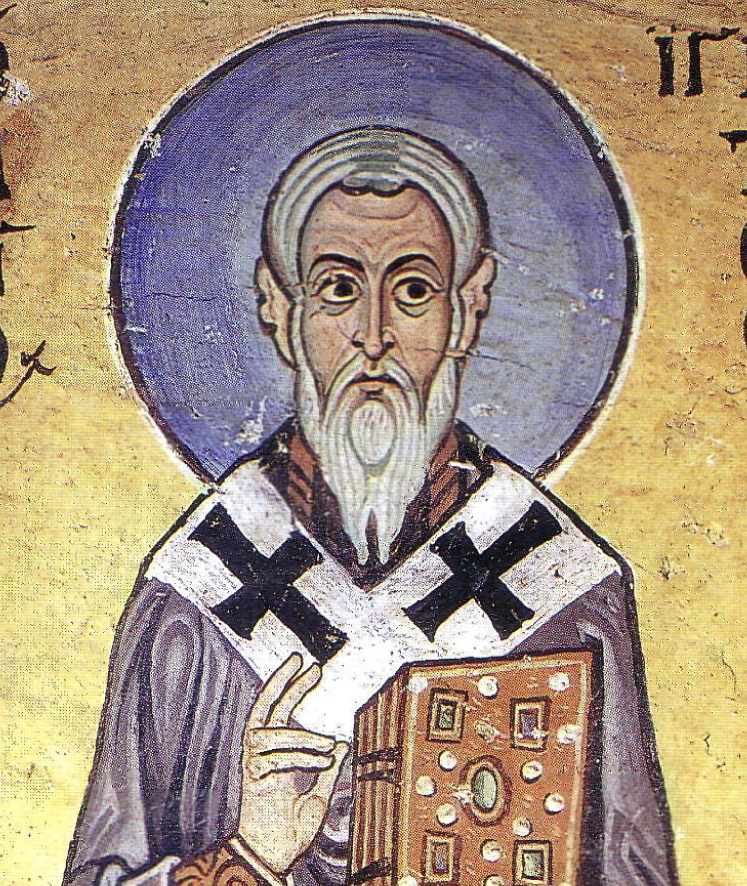
Ignatius of Antioch

Ignatius served as bishop of the church of Antioch in Syria, and we become aware of him as he is journeying to Rome to be martyred early in the second century.[1] Following his arrest in Syria for unknown reasons, Ignatius is sent to Rome in the custody of soldiers to be executed. While on the journey, Ignatius composes a series of letters: to churches that send delegations to meet him on his journey, to the church at Rome alerting them of his impending arrival, to churches he had previously visited, and to his friend Polycarp, bishop of Smyrna. Ignatius disappears from the historical record after being warmly received by the church in Philippi; presumably, he was thrown to the lions in the Roman Coliseum. Our best guess is that he was killed during the reign of the Roman emperor Trajan (AD 98-117).

There are seven Ignatian letters that are held to be authentic: Ignatius to the Ephesians, To the Magnesians, To the Trallians, To the Romans, To the Philadelphians, To the Smyrnaeans, and To Polycarp. As Michael Holmes says, these letters collectively represent Ignatius’s last will and testament, and are of great value:

“[These are] seven letters of extraordinary interest because of the unparalleled light they shed on the history of the church at that time, and because of what they reveal about the remarkable personality of the author. Because of the early date of these writings and the distinctiveness of some of his ideas, particularly with regard to the nature and structure of the church, Ignatius’s letters have influenced later theological reflection and continue to be a focus in scholarly discussion of Christian origins.”[2]

Themes and Insights from the Ignatian Letters

The Image-bearer: Each of Ignatius’s letters begin the same way: “Ignatius the Image-bearer to…” The Greek word for Image-bearer, Theophoros, “is commonly used in Greek inscriptions as a title, describing those who carry divine images or shrines in religious processions.”[3] It is possible that here, Ignatius uses the word as a name rather than a title (e.g. “Ignatius, who is also called Theophorus”), but if so, this would be the first instance of such a usage. It is fascinating, then, that a church bishop of such renown would choose to describe himself in a way that places him on common ground with those to whom he is writing: humans created in God’s image.

Eagerness for Martyrdom: As mentioned above, Ignatius composes his letters while en route to be martyred, so it is not surprising that the topic of his impending death features prominently in his writings. What is more surprising, indeed startling, to the modern reader, is the degree to which he is eager about the violent death that looms ahead of him.

“For when you heard that I was on my way from Syria in chains for the sake of our shared name and hope, and was hoping through your prayers to succeed in fighting with wild beasts in Rome—in order that by so succeeding I might be able to be a disciple—you hurried to visit me.”

(Ignatius, To the Ephesians 1.2)

“For while I strongly desire to suffer, I do not know whether I am worthy, for the envy, though not apparent to many, wages war against me all the more.”

(Ignatius, To the Trallians 4.2)

“Since by praying to God I have succeeded in seeing your godly faces, so that I have received more than I asked—for I hope to greet you in chains for Christ Jesus, if it is his will for me to be reckoned worthy to reach that goal. For the beginning is auspicious, provided that I attain the grace to receive my fate without interference. For I am afraid of your love, in that it may do me wrong; for it is easy for you to do what you want, but it is difficult for me to reach God, unless you spare me.

For I do not want you to please people, but to please God, as you in fact are doing. For I will never again have an opportunity such as this to reach God, nor can you, if you remain silent, be credited with a greater accomplishment. For if you remain silent and leave me alone, I will be a word of God, but if you love my flesh, then I will again be a mere voice. Grant me nothing more than to be poured out as an offering to God while there is still an altar ready, so that in love you may form a chorus and sing to the Father in Jesus Christ, because God has judged the bishop from Syria worthy to be found in the west, having summoned him in the east. It is good to be setting from the world to God in order that I may rise to him.

Just pray that I will have strength both outwardly and inwardly so that I may not just talk about it but want to do it, so that I may not merely be called a Christian but actually prove to be one.”

(Ignatius, To the Romans 1, 2, 3.2)

“From Syria all the way to Rome I am fighting with wild beasts, on land and sea, by night and day, chained amidst ten leopards (that is, a company of soldiers) who only get worse when they are well treated. Yet because of their mistreatment I am becoming more of a disciple; nevertheless I am not thereby justified. May I have the pleasure of the wild beasts that have been prepared for me; and I pray that they prove to be prompt with me. I will even coax them to devour me quickly, not as they have done with some, whom they were too timid to touch. And if when I am willing and ready they are not, I will force them. Bear with me—I know what is best for me. Now at last I am beginning to be a disciple. May nothing visible or invisible envy me, so that I may reach Jesus Christ. Fire and cross and battles with wild beasts, mutilation, mangling, wrenching of bones, the hacking of limbs, the crushing of my whole body, cruel tortures of the devil—let these come upon me, only let me reach Jesus Christ!

Neither the ends of the earth nor the kingdoms of this age are of any use to me. It is better for me to die for Jesus Christ than to rule over the ends of the earth. Him I seek, who died on our behalf; him I long for, who rose again for our sake. The pains of birth are upon me.”

(Ignatius, To the Romans 5.1-6.1.)

“For if these things were done by our Lord in appearance only, then I am in chains in appearance only. Why, moreover, have I surrendered myself to death, to fire, to sword, to beasts? But in any case, “near the sword” means “near to God”; “with the beasts” means “with God.” Only let it be in the name of Jesus Christ, so that I may suffer together with him! I endure everything because he himself, who is the perfect human being, empowers me.”

(Ignatius, To the Smyrnaeans 4.2)

Ignatius is clearly eager to die. To the Romans, he specifically requests that they not interfere in any way in an attempt to prevent his martyrdom, but to allow it to happen. If the beasts of the Coliseum prove too timed, he vows to “force” them to kill him. While this may come across as off-putting to modern Christians, there are a few factors to keep in mind:

  • Ignatius clearly believed that he could only fully be a disciple of Jesus if he followed Jesus to execution, and this explains his desire to die. Furthermore, this was the clearest and most direct way for him to reach Jesus, which was his life’s desire.
  • Additonally, Ignatius’s attitude could have been affected by the fact that, “…generally, the only basis for releasing a Christian condemned to death was apostasy; even if the Roman church had won his release for good reasons (something he feared they might attempt to do [Rom. 1.1-2.1, 4.1], rumors that he had apostatized likely would have arisen, and he no doubt wished to avoid such speculation.”[4]
  • There is no evidence that Ignatius sought out persecution or prompted confrontation with Roman authorities. But, once arrested, he sought to rejoice in persecution and glorify God in his suffering, as Scripture commands.

We might still quibble with aspects of Ignatius’s perspective, but on the whole, I think he represents a helpful corrective to many modern, Western Christians who seem to live in constant fear of the spectre of persecution. In the United States, Christians go to great lengths to accumulate political and cultural power as a means of remaining free to worship as we choose and to avoid persecution. I think that would be hard for Ignatius…or Paul…or Jesus to understand.

Obedience to the Bishop: I belong to a religious fellowship where we believe that Christ is the head of the universal church, but that local congregations are to be led by a plurality of elders (also referred to as shepherds or overseers) based on the teaching of the New Testament.[5] Although I would argue that the biblical witness is a little more complex and nuanced than we sometimes make it out to be, I affirm the basic validity of this model of church governance.

Having said that, it must be admitted that, in Ignatius, we have a very early witness to monoepiscopal church polity: the elevation of a single bishop as the leader of a church (likely, Ignatius refers to a church with deacons, presbyters/elders, and the bishop functioning as the “chief presbyter”).

Ignatius emphasizes the importance of obedience to the bishop in nearly all of his letters; some of his statements were jarring to me:

“Let us, therefore, be careful not to oppose the bishop, in order that we may be obedient to God.

Furthermore, the more anyone observes that the bishop is silent, the more one should fear him. For everyone whom the Master of the house sends to manage his own house we must welcome as we would the one who sent him. It is obvious, therefore, that we must regard the bishop as the Lord himself.”

(Ignatius, To the Ephesians 5.3b-6.1)

“Flee from divisions as the beginning of evils. You must all follow the bishop as Jesus Christ followed the Father, and follow the council of presbyters as you would the apostles; respect the deacons as the commandment of God. Let no one do anything that has to do with the church without the bishop. Only that Eucharist which is under the authority of the bishop (or whomever he himself designates) is to be considered valid.

Wherever the bishop appears, there let the congregation be; just as wherever Jesus Christ is, there is the catholic church. It is not permissible either to baptize or to hold a love feast without the bishop. But whatever he approves is also pleasing to God, in order that everything you do may be trustworthy and valid.”

(Ignatius, To the Smyrnaeans 8)

Honestly, I’m not quite sure what to make of this. It seems there are a few different options:

  • We can, based on Ignatius’s words and testimony, suggest that monoepiscopacy was the form of governance in the early church, and that this developed soon after the writing of 1 Timothy and Titus, or that instructions in those letters should be read in light of Ignatius.
  • We can view what Ignatius says as non-authoritative, classify the church governance model that he describes as an early departure from the biblical model, and reject it accordingly.
  • We can conclude that governance in the early church is perhaps not quite as clear as we sometimes make it out to be, and approach discussions of the topic with a dose of humility. This is my current position.[6]

Core Christian Doctrine: Not unlike with Clement, we see in the writings of Ignatius an emphasis on key elements of Christian faith.

In multiple places, he emphasizes the centrality of certain facts about Jesus: that He really came in the flesh, suffered and died for our sins, was physically resurrected, and will come again:

“There is only one physician, who is both flesh and spirit, born and unborn, God in man, true life in death, both from Mary and from God, first subject to suffering and then beyond it, Jesus Christ our Lord.”

(Ignatius, To the Ephesians 7.2)

“But the gospel possess something distinctive, namely, the coming of the Savior, our Lord Jesus Christ, his suffering, and the resurrection. For the beloved prophets preached in anticipation of him, but the gospel is the imperishable finished work.”

(Ignatius, To the Philadelphians 9.2)

“For he suffered all these things for our sakes, in order that we might be saved; and he truly suffered just as he truly raised himself—not, as certain unbelievers sa, that he suffered in appearance only… For I know and believe that he was in the flesh even after the resurrection…And after his resurrection he ate and drank with them like one who is composed of flesh, although spiritually he was united with the Father.”

(Ignatius, To the Smyrnaeans 2.1, 3.1, 3)

“Wait expectantly for the one who is above time: the Eternal, the Invisible, who for our sake became visible; the Intangible, the Unsuffering, who for our sake suffered, who for our sake endured in every way.”

(Ignatius, To Polycarp 3.2b)

Ignatius also emphasizes radical daily living that echoes the Sermon on the Mount:

“Pray continually for the rest of humankind as well, that they may find God, for there is in them hope for repentance. Therefore allow them to be instructed by you, at least by your deeds. In response to their anger, be gentle; in response to their boasts, be humble; in response to their slander, offer prayers; in response to their errors, be steadfast in the faith; in response to their cruelty, be civilized; do not be eager to imitate them. Let us show by our forbearance that we are their brothers and sisters, and let us be eager to be imitators of the Lord, to see who can be the more wronged, who the more cheated, who the more rejected, in order that no weed of the devil may be found among you, but that with complete purity and self-control you may abide in Christ Jesus physically and spiritually.”

(Ignatius, To the Ephesians 10)

On the importance of the church meeting together regularly:

“Therefore make every effort to come together more frequently to give thanks and glory to God. For when you meet together frequently, the powers of Satan are overthrown and his destructiveness is nullified by the unanimity of your faith.”

(Ignatius, To the Ephesians 13)

Concluding Thoughts

I enjoyed the letters of Ignatius more than 1 Clement; although the content from letter to letter is similar, the individual letters are much shorter so it is easier to follow the argumentation throughout each.

Ignatius’s views on martyrdom and church bishops were jarring enough to me that they forced me to reflect upon my own views of these topics. Although I am ambivalent about his exhortations regarding church governance, I do believe that his perspective on suffering and martyrdom is a needed corrective for Christians who are so used to comfort and power that we seek to avoid persecution at all costs. This reason alone is sufficient for Christians to read Ignatius today; his powerful testimony of important Christian doctrines is an added bonus.


[1] Michael W. Holmes, ed., The Apostolic Fathers in English (Grand Rapids: Baker Academic, 2006): 87-95, is the source of the background information that follows.

[2] Holmes, 87.

[3] Ibid., 96.

[4] Ibid., 89.

[5] Typically speaking, Churches of Christ are opposed to the “Senior Pastor” model, and are rigidly opposed to hierarchical models where multiple churches fall under the authority of a regional bishop (or archbishop, or Pope, etc.).

[6] I think it is worth pointing out here that there is a wide gulf between what Ignatius seems to describe here—a singular bishop of a congregation or perhaps a city who functions as the head of a group of elders/presbyters, possibly a “first among equals”—and the full-blown hierarchy that was later developed and still exists within the Roman Catholic Church. But, it is easy to see how the principle of the former could have led to the development of the latter.

Learning from the Apostolic Fathers: Clement

I have long been interested in church history, and especially the history of the early church, but despite this, I have not done a good job of immersing myself in early Christian writings outside of the New Testament. To work towards remedying this deficiency, I began reading The Apostolic Fathers in English late last year as part of my daily devotional reading. Generally speaking, the term “Apostolic Fathers” refers to early Christian theologians from the 1st and 2nd centuries AD, some of whom would have known some of the apostles personally and sought to pass on their teachings. More specifically, “Apostolic Fathers” is frequently used in reference to Clement of Rome, Ignatius of Antioch, and Polycarp of Smyrna.

While these writings are not part of the Christian canon, I have still found them to be interesting and insightful, and I wanted to share some reflections from a few of them in a short series of posts. Today, I want to focus on 1 Clement.


Clement of Rome and 1 Clement

The letter known as 1 Clement is written on behalf of the church at Rome to their fellow believers in Corinth.[1] It is believed to have been written at roughly the same time that John wrote the Book of Revelation, but while the latter has a very negative portrayal of the Roman government, the perspective of 1 Clement is more positive. As Michael Holmes states:

“…The elements of peace, harmony, and order that are so important to the author (or authors) of this letter reflect some of the fundamental values of Roman society. Thus it provides important evidence of the diverse and creative ways in which Christians sought to come to terms with the Greco-Roman culture and society within which the church was so rapidly expanding.”[2]

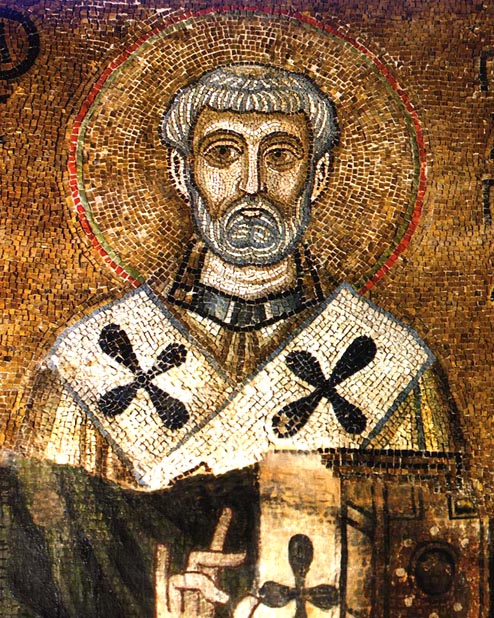
Clement of Rome

First Clement is unified in style rather than disjointed, which suggests one author rather than a composite work, and well-attested ancient tradition identifies this author as Clement (despite Clement not being named in the text itself). The exact identify of “Clement” is harder to discern, however. Catholic Church tradition identifies him as the third bishop of Rome after Peter, but the “office of monarchical bishop, in the sense intended by this later tradition, does not appear to have existed in Rome at this time.”[3] More likely, church leadership consisted of a group of presbyters or bishops, of whom Clement was likely a leading figure. It was probably written during the last two decades of the first century.

The intended recipient of the letter is the church at Corinth. This group of Christians had received repeated correspondence from Paul in previous decades, and the spiritual problems of that church (and divisiveness in particular) clearly persisted after his death. In the days of Clement, some of the younger men in the church at Corinth had apparently deposed the leadership of the congregation, and the church at Rome was so distressed by this turn of events that they produced this letter and dispatched mediators in an effort to restore unity and order to this fractured church.[4]

Themes and Insights from 1 Clement

Close Dependence on Scripture: As I read 1 Clement, I was struck by the degree to which the author relied on Scripture, and the Hebrew Bible in particular, to make his argument. Clement gives ancient examples of both jealousy and good behavior from the Book of Genesis, and warns the Corinthians about the former while admonishing them to follow the latter. Although he references New Testament texts less, Clement is still closely connected to the apostolic era, and invokes Jesus, Peter, and Paul as examples to follow.

Orthodox Theology: I was also interested to see 1 Clement’s affirmation of key Christian doctrines that, although taught in the New Testament, are sometimes dismissed by critical scholars as later theological developments that early Christians wouldn’t have recognized. Clement is an early, extrabiblical witness to the doctrine of resurrection:

“Let us consider, dear friends, how the Master continually points out to us the coming resurrection of which he made the Lord Jesus Christ the first fruit when he raised him from the dead.”

(1 Clement 24.1)

He also reflects Trinitarian language and thinking:

“Do we not have one God and one Christ and one Spirit of grace that was poured out upon us?”

(1 Clement 46.6)

Finally, although this is a less controversial idea in the history of Christian theology and interpretation, Clement heavily emphasizes the doctrine of unity. Indeed, the whole letter represents an urging for the Corinthian Christians to give up their schisms, submit to their rightly established leadership, and be united in Christ.

A Marvelous Prayer: I was struck by a beautiful prayer near the end of 1 Clement, and wanted to share a section of it:

“You alone are the benefactor of spirits and the God of all flesh, looking into the depths, scanning the works of humans; the helper of those who are in peril, the savior of those who are in despair; the creator and guardian of every spirit. You multiply the nations upon the earth, and from among all of them you have chosen those who love you through Jesus Christ your beloved servant, through whom you instructed us, sanctified us, honored us.

We ask you, Master, to be our helper and protector. Save those among us who are in distress; have mercy on the humble; raise up the fallen; show yourself to those in need; heal the sick turn back those of your people who wander; feed the hungry; ransom our prisoners; raise up the weak; comfort the discouraged. Let all the nations know that you are the only God, that Jesus Christ is your servant, and that we are your people and the sheep of your pasture.

For you through your works have revealed the everlasting structure of the world. You, Lord, created the earth. You are faithful throughout all generations, righteous in your judgments, marvelous in strength and majesty, wise in creating and prudent in establishing what exists, good in all that is observed and faithful to those who trust in you, merciful and copassionate: forgive us our sins and our injustices, our transgressions and our shortcomings.”

(1 Clement 59.3-60.1)

Concluding Thoughts

To compare it to New Testament writings, 1 Clement is a very long letter (about 50% longer than Paul’s longest letter, 1 Corinthians), and Clement is painstakingly deliberate about the way in which he constructs his argument and structures his plea to the Corinthian Christians. Perhaps this is because, unlike Paul, he cannot rely upon apostolic authority and instead has to build the weight of authority from lengthy biblical examples.

This means that 1 Clement not a fast-paced read, but it is absolutely worthwhile. The extended use of Scripture as the foundation for Christian behavior and practice is exemplary, and the drumbeat emphasis on the importance of love and unity within the Christian community is need in every time and place. First Clement is an edifying early-Christian writing that all Christians would do well to read, reflect upon, and appreciate.


[1] Michael W. Holmes, ed., The Apostolic Fathers in English (Grand Rapids: Baker Academic, 2006): 36-38, is the source of the background information that follows.

[2] Holmes, 36.

[3] Ibid., 37.

[4] Ibid.

« Older posts

© 2026 The Doc File

Theme by Anders Noren — Up ↑