The online journal of Luke Dockery

Tag: American Restoration Movement (Page 2 of 4)

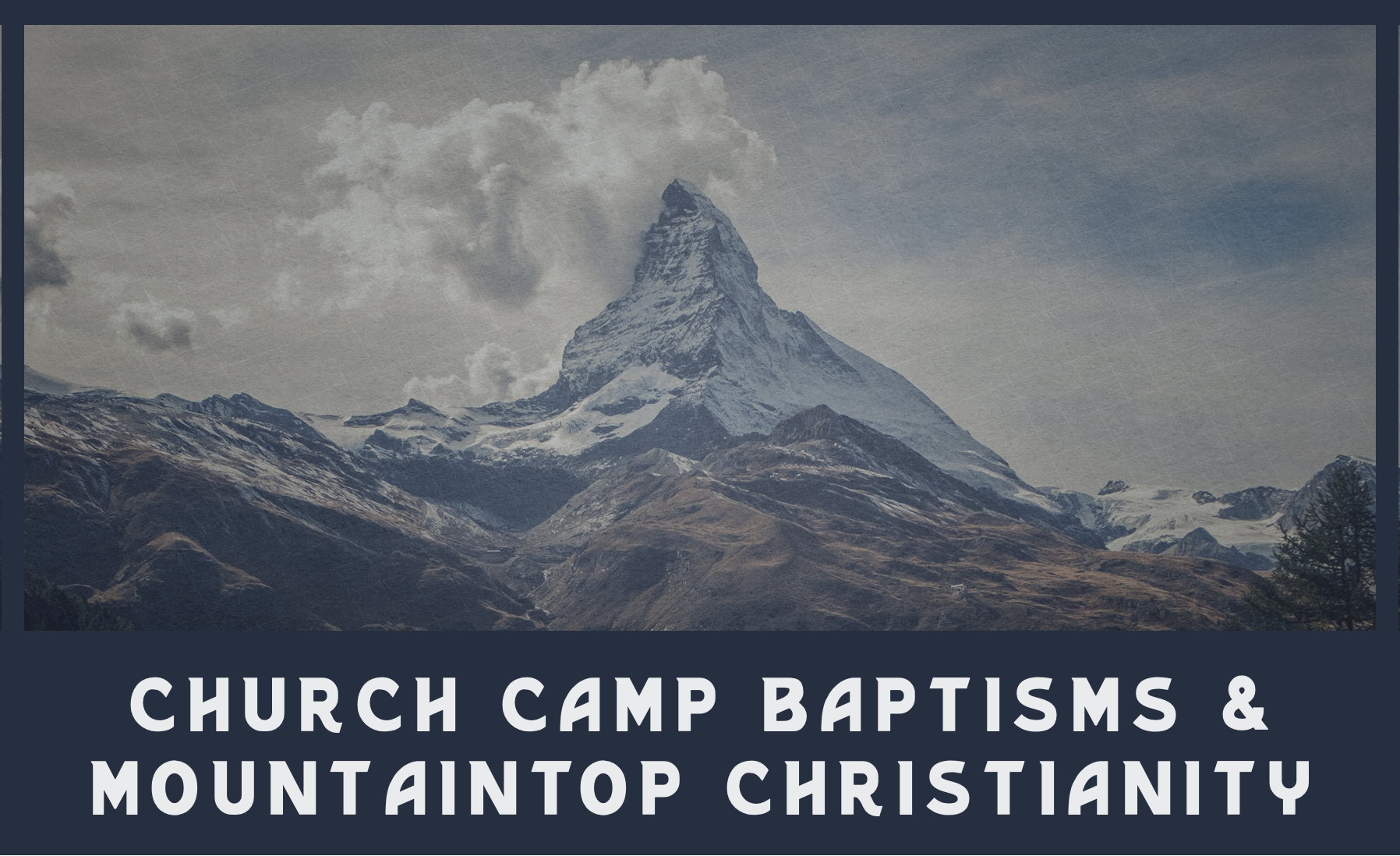
Church Camp Baptisms and Mountaintop Christianity

Note: this post is a little more disjointed than much of what I write, but it accurately reflects the way in which I have been wrestling with this topic back-and-forth for some time.

Church camp is a significant part of the yearly youth ministry calendar, and a pretty standard feature of church camp (at least in my experience) are camp baptisms. The next statement I make may be jarring to some of you, and I want to clearly state that if you were baptized at church camp and had your sins washed away and hold to that moment as the time when you committed your life to Jesus, that is great, and I applaud you. Having said that, here comes the (perhaps) jarring statement: I am not a huge fan of camp baptisms.

There are several reasons for this:

  1. Camp baptisms usually happen away from the presence of the camper’s parents, and since parents are the primary spiritual influencers of their children, not having them present for such a major step is not ideal.
  2. Camp is an emotionally-charged environment, and it can be easy to get caught up in the camp experience and make a decision that no longer seems so pressing or important a few weeks later when camp is over and the emotional experience has faded.
  3. Many times camp baptisms happen in clusters: several kids from one cabin or one friend group will all decide to get baptized together or within a couple of days of one another and the question arises: do these students really want to give their lives to Christ, or are they just doing what all of their friends are doing?
  4. The purely pragmatic reason: personal experience shows that a lot of time these baptisms don’t really “stick” in the sense that they are often false starts that don’t lead to a life of faithfulness (probably because of some combination of reasons 1-3).

At this point, youth ministry veterans are likely reflecting on these reasons and nodding in agreement—they have seen it all before, too many times to count!

Having acknowledged all this, I now want to push back against what I have just said.


A few years ago, I was talking to a young man (out of college, in his 20s) who was questioning his baptism largely for the reasons mentioned above. He did it at church camp when he was young and he didn’t know a lot at the time—what if he was just caught up in the emotions of the moment and decided to get baptized because other people were?

And, of course, these are some of my own concerns.


Churches of Christ are spiritual descendants of the Stone-Campbell Restoration Movement, a primitivist, back-to-the-Bible movement whose aim was to bring about unity among followers of Jesus by simply trying to be the church that we read about in the Bible. At the same time, that Movement developed in a specific time and place, and was certainly influenced by that historical context. For the sake of this post, that influence can be seen in at least two ways.

First, it was a movement that prized logic and reason. Intellectually and philosophically, the early leaders of the Stone-Campbell Movement were greatly influenced by the Enlightenment. This doesn’t mean that they universally condemned emotion, but rationality and clear thinking were highly valued.

Second, as a product of the American frontier, the Stone-Campbell Movement also valued the rugged individualism that was so characteristic of American society. People were free to read the Bible and interpret it for themselves, and should base their beliefs on Scripture rather than the teachings of some priest or state church.

Against such a backdrop, is it any wonder that I am immediately suspicious of decisions to follow Jesus that seem to be largely influenced by emotion and the influence of what other people are doing?


My favorite thing about my spiritual heritage is that the Stone-Campbell Movement is, fundamentally, a back-to-the-Bible movement, so as I was talking to my friend who was questioning his own baptism, I immediately thought of Scripture, and specifically, the Book of Acts, where we have so many accounts of people giving their lives to following Jesus.

One of the prime examples is in Acts 2, where Peter preaches to a large crowd on Pentecost, basically telling them that the Jesus they had crucified was the Messiah and Son of God, and that He had been raised from the dead and was sitting at the right hand of God:

37 Now when they heard this they were cut to the heart, and said to Peter and the rest of the apostles, “Brothers, what shall we do?” 38 And Peter said to them, “Repent and be baptized every one of you in the name of Jesus Christ for the forgiveness of your sins, and you will receive the gift of the Holy Spirit. 39 For the promise is for you and for your children and for all who are far off, everyone whom the Lord our God calls to himself.” 40 And with many other words he bore witness and continued to exhort them, saying, “Save yourselves from this crooked generation.” 41 So those who received his word were baptized, and there were added that day about three thousand souls.

(Acts 2.37-41)

Two details pertaining to our present conversation that jump out of this text: (1) Peter’s audience was cut to the heart, and (2) 3,000 responded and were baptized. In other words, in this biblical example of conversion, those who made the decision to be baptized were clearly influenced by emotion and almost certainly by the example of others as well.


The issue of church camp baptisms is clearly tied to what might generally be referred to as “Mountaintop Christianity”, the idea that we have mountaintop experiences—intense, emotional events where we encounter God in a powerful way.

Traditionally, youth ministry has largely been structured around mountaintop experiences and scheduling these sorts of events—mission trips, youth rallies, spiritual retreats, and, yes, church camp—throughout the year. The idea is to provide meaningful spiritual experiences and hope that they will contribute to lifelong discipleship. For example, just last week, I spent a week camping, hiking, and climbing a literal mountain with some of my students. It was a wonderful week characterized by deepened relationships with one another and with God.

The problem, of course, is that you cannot live on the mountain. At some point, you have to come back down to real life, and just like the fading glory of Moses’s face after he spent time with God on Sinai, over time, the spiritual clarity and closeness experienced at church camp or on the mission trip begins to fade. Students are left to limp along until their next spiritual fix at the next mountaintop experience—unless, of course, they have graduated and had their last such experience. It seems likely to me that this is another reason that teens struggle with faithfulness after high school.


So what should we do? The experience you get on the mountaintop clearly isn’t sustainable; should we eliminate such emotional experiences altogether? When kids want to get baptized at church camp, should we prevent them from doing so?

I don’t think so.

Let’s remember, God is the Originator of the mountaintop experience! His encounters with Moses left him fundamentally changed. In the New Testament, Peter, James, and John were blown away by their own mountaintop experience when Jesus was transfigured before them.

And perhaps most fundamentally of all, God mandated mountaintop experiences in the communal life and yearly rhythms of the people of Israel with the pilgrimage feasts of Passover, Pentecost, and Tabernacles. Three times per year, they were to travel to Jerusalem; you think traveling with thousands of your fellow Israelites to visit the Temple in Jerusalem and commemorate great events in your national history would constitute a mountaintop experience? Would it stir up your spiritual devotion and strengthen your identity as part of God’s people? Surely it would.

But, when you returned home, would the feeling fade away after a while? Would it be difficult to go back to normal life?


So, what are we to make of all this? Sometimes, church camp baptisms seem to be decisions made on the spur of the moment, driven by emotion and the influence of others. All too often, the conviction behind the decision fades away once camp is over. And yet, we undoubtedly have biblical conversion accounts driven by emotion and the influence of others.

Similarly, a spiritual diet of mountaintop binges offset by long periods of famine seems to be unsustainable and, likely, spiritually damaging. And yet, we see the principle of spiritual highs in Scripture, even established by God Himself.

I am not sure what to make of it all, but here are a few ideas:

  1. We should emphasize discipleship over conversion. I truly believe that a large part of our struggle is that we have focused too much on converting people and not enough on discipling them. Conversion may occur in hyper-emotional mountaintop experiences, but discipleship occurs every day, on the mountains, in the valleys, and in the monotony of the plateaus as well. In the example of 3,000 being baptized on the Day of Pentecost (Acts 2.41), that mountaintop experience was followed by the habitual practices of teaching, fellowship, the breaking of bread, praising God, and prayers (Acts 2.42, 46-47). These are practices of discipleship. When I talk to young people who are considering baptism, increasingly, I focus on the cost of discipleship and the demands of following Jesus long term, after the water has dried and the emotions have faded.
  2. We don’t want to manipulate people, but we should seek to minister to the whole person, including the emotions. In other words, I don’t believe that we should always be carefully crafting events and experiences in order to trigger an emotional response, but neither should we ignore the emotional aspect of people or dismiss it as irrelevant. God created us as whole persons, emotions included.
  3. We should rejoice when people are influenced for good by the community of faith. When you stop to think about it, this is kind of a no-brainer. As parents, we want our kids to be surrounded by good influences who will point them to Jesus. As a dad, minister, and Christian in general, I am very mindful of the influence I have on others and want to point them to Jesus. Of course I don’t want to coerce people into becoming followers of Jesus, but I absolutely want to influence others in that direction. When that occurs, it should be cause for rejoicing, not for questioning the motives of the convert.
  4. We shouldn’t eliminate the mountains in life, but should use those experiences to enlighten the valleys. Spiritual mountaintop experiences are not the problem; indeed, as we saw, they are biblical. The problem is the expectation that all of life will be a mountaintop. Rather than eliminate these experiences, we should embrace them, but we should also prepare students for the times when things are not as easy or inspiring. The spiritual truths and spiritual vibrancy that we learn and experience on the mountain can give us clarity for the more difficult times in life.
  5. We should provide mountaintop experiences for adults too. If going from a regular diet of mountaintop experiences in youth group to never having them as adults is jarring (it is), but mountaintop experiences themselves are biblical and beneficial (they are), then the solution isn’t to get rid of them; it is to include them in adult life as well. One of the great personal blessings of youth ministry is that, as an adult, I still regularly get to participate in things like this. Whether it is participating in church-wide retreats, mission trips, attending lectureships, or volunteering to serve at a summer camp, these experiences provide needed spiritual encouragement for adults just as they do with teenagers.
Restorationism and the Very Flawed Church at Corinth

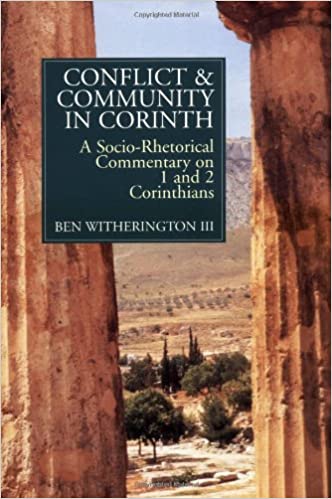
A few years ago, I had the opportunity to take a graduate school class on 1-2 Corinthians, and as part of that class, read several commentaries and lots of articles. One of my favorite reads was Conflict & Community in Corinth: A Socio-Rhetorical Commentary on 1 and 2 Corinthians by Ben Witherington III.

Here is one particularly insightful quotation from Witherington:

Careful attention to the historical and social matrix of the Pauline communities makes it clear that the early ekklesia [church] was far from perfect. As often as not, Paul was busy exhorting Christians to change their ways. If we believe that the Christian community of today should in some sense be biblically shaped and if we hold up the example of the Pauline communities, then we must say “go and do otherwise” at least as often as we say “go and do likewise.”

One reason we tend to commit the fallacy of idealism when we reflect on the early ekklesia is that we have assumed that the “determining factors of the historical process are ideas and nothing else, and that all developments, conflicts and influences are at bottom developments of, and conflicts and influences between, ideas.” Such a premise too often leads to the false conclusion that if we get our ideas about the faith right or if we emulate “the pattern” of the early ekklesia, then our Christian community will be what it ought to be.

But if we read Paul’s letters carefully, they reveal that right living and proper social interaction both within the Christian community and with the larger world were at least as much of a concern as right thinking, and evidently the early Christians had difficulties with all these matters.

Ben Witherington III, Conflict & Community in Corinth, p. xv

As many readers know already, and as I have written about before, I am a spiritual descendant of the American Restoration Movement, which is based on the premise that Christians should seek unity in God’s church by emulating the teachings of the New Testament and following the example of the early church. I believe that such an approach is fundamentally valid, but I think Witherington provides some important words of caution.

When we read about different congregations of the early church in the pages of Scripture, we come across some like the church at Corinth or some of the seven churches of Asia in the Book of Revelation that serve better as negative examples of what not to do rather than examples that we should try to follow today. So, when we say that we want to be like the church of the New Testament, we need to understand that we don’t exactly mean that, because the various New Testament congregations of which we are aware varied greatly in practice, and not all of them are worth emulating. Because of that, sometimes we might clarify our restorationist goals by saying that we want to be the church of the New Testament as conceptualized and instructed by apostolic teaching. But Witherington provides a caution here too, since having the right ideas and beliefs does not necessarily lead to right practices. And after all, what does it matter what we think if we don’t live right?

To me, none of this discredits the validity of the Restoration principle, but it does mean that we should be careful when we talk about it and as we seek to apply it. For example, rather than seeking to emulate the practices of the early church in wholesale fashion, we should examine biblical texts carefully to see where and how first century congregations were affirmed or reproved for their beliefs and practices, and choose to emulate them accordingly. Furthermore, we need to realize that faithful Christianity is about more than simply believing the right things; it also entails living in a certain way. As Witherington points out, the latter does not necessarily follow the former. At the same time, while it is true that right ideas do not guarantee right practices, it’s also true that wrong ideas make right practices nearly impossible.

While it’s true that right ideas don’t guarantee right practices, wrong ideas make right practices nearly impossible. Share on X

God is concerned with both: He wants us to believe certain things, which in turn empower us to live a certain way. And from this perspective, the positive and negative examples of the early church, along with apostolic teachings preserved in the New Testament, are incredibly helpful.

A New Heaven & A New Earth Part 11: Voices From the Past

This post is part of an ongoing series. You can find links to all the posts here.

We have spent a lot of time now looking at the idea of renewed eschatology from a variety of different perspectives, and for some readers, a lot of different pieces are starting to click into place and make a lot of sense.

But something that may be bothering you (it certainly bothered me as I was studying through this): “If this is the correct view, why am I just now hearing about this? I mean, Christianity has been around for 2000 years, and we’re just now understanding what the Bible actually teaches about eternity?!”

The question, “why am I just now hearing about this?”, is a difficult one, but the short answer is that the view of eternity where this world will be destroyed and then we will go off to heaven and have some sort of eternal spiritual existence with God has been the dominant view within conservative, evangelical Christianity for all of our lives.

But here is the important idea I want to emphasize: just because this idea is relatively new to you, or because it was new to me when I first heard it does not at all mean that it is a new idea.

I am very suspicious of brand new ideas in Christianity. When someone suggests an interpretation of a particular verse that I can’t find anywhere else, that makes me very suspicious. I am supposed to believe that in the whole history of Christianity, this guy is the first person to come along and actually figure out what this means? But that’s not the case here, and what I want to emphasize in this post is that the renewed earth perspective is not new at all. It is actually a very old understanding of what the Bible teaches about eternity.

Now, I am not going to trace this perspective in detail for 2,000 years, because for the majority of people, that would be mind-numbingly boring. However, I do want to give you some examples from different time periods to emphasize that this is not a new idea.


Early Church

Irenaus is one of what we call the “Church Fathers”, Christians who lived and wrote in the first few centuries. Irenaus wrote a famous work called Against Heresies in the late 100s, in which he opposed false teachings that had arisen. One very popular heresy was called gnosticism and it held, among other things, that material creation is evil. Irenaus rejected this notion, and argued that the Bible teaches that creation is good. He also says:

  • The righteous will “rise again to behold God in this creation which is renovated…”[1]
  • Speaking of Jesus’ words in Matthew 26.27-30 (I will not drink again of this fruit of the vine until that day when I drink it new with you in my Father’s kingdom), he says “[Jesus] cannot by any means be understood as drinking of the fruit of the vine when settled down with his disciples above in a super-celestial place; nor, again, are they who drink it devoid of flesh, for to drink of that which flows from the vine pertains to flesh, and not spirit.”[2]
  • “For neither is the substance nor the essence of the creation annihilated.”[3]

Irenaus viewed resurrection as a bodily experience that was directly tied to the restoration of all creation. Clearly, the renewed earth perspective is an ancient view.[4]

Reformation

You are likely familiar with the Protestant Reformation that began in the 1500s. Two of the major figures of the Reformation were Martin Luther and John Calvin. These two men differed in significant ways, but they  make similar, interesting statements in their commentary on 2 Peter 3 (a text we looked at earlier):

“…some may disquiet themselves as to whether the saints shall exist in heaven or on the earth. The text seems to imply that man shall dwell upon the earth, yet so that all heaven and earth shall be a paradise where God dwells…”[5]

“Of the elements of the world I shall only say this one thing, that they are to be consumed, only that they may be renovated, their substance still remaining the same, as it may be easily gathered from…other passages.”[6]

If you have been following along with this series, these ideas will seem very familiar.

Now, Luther and Calvin agreeing with the NHNE perspective doesn’t automatically make it correct. Indeed, these men hold a variety of views that I disagree with on various topics. My point here is not that we should believe in renewed eschatology because Luther and Calvin did; rather, I am simply illustrating that this is by no means a new perspective.

Restoration Movement

In Churches of Christ, we are spiritual descendants of the Stone-Campbell Restoration Movement. If you know me well or have read The Doc File for long, you know that I am extremely interested in the history of our movement. Imagine my surprise and fascination when I discovered that the renewed earth perspective that we have been talking about was held by influential early leaders in our movement!

Alexander Campbell was likely the single most influential thinker in the history of the Stone-Campbell Movement. Campbell was famous in the 19th century, and disseminated his perspectives as an orator, editor, debater, educator, and author. Among the many topics he touched on in his vast array of writings was eschatology and the renewal of creation:

“The Bible begins with the generations of the heavens and the earth; but the Christian revelation ends with the regenerations or new creation of the heavens and the earth. This [is] the ancient promise of God confirmed to us by the Christian Apostles. The present elements are to be changed by fire. The old or antediluvian earth was purified by water; but the present earth is reserved for fire, with all the works of man that are upon it. It shall be converted into a lake of liquid fire. But the dead in Christ will have been regenerated in body before the old earth is regenerated by fire. The bodies of the saints will be as homogeneous with the new earth and heavens as their present bodies are with the present heavens and earth. God re-creates, regenerates, but annihilates nothing; and, therefore, the present earth is not to be annihilated. The best description we can give of this regeneration is in the words of one who had a vision of it on the island of Patmos. He describes it as far as it is connected with the New Jerusalem, which is to stand upon the new earth, under the canopy of the new heaven.”[7]

“The impression prevails in many minds, that the earth is to be annihilated. Such is not our belief. There is a vast difference between annihilation, and change, or general alteration. This earth will, unquestionably be burned, yet, through the process of variation and reconstruction of its elements, God will fashion the earth and heavens anew, and fill them with tenants to glorify His name forever.”[8]

Walter Scott was another key early Restoration leader.[9] Unlike Campbell, Scott’s focus was particularly on evangelism, and his use of simple, memorable methods led to thousands upon thousands of baptisms in the Western Reserve. Scott was also a theologian who mused on the nature of eternity. From Embracing Creation:

“Just as the present world was “formed out of the ruins of the first and original one, so the third and future world shall, by the power of God, be constructed from the ashes of the present one.” The “present habitable globe,” like the primitive one, will be destroyed, but “from the ashes will rise another heaven and another earth…the abode of [the] righteous.” This is “the new heavens and new earth…created as the second coming of our Lord Jesus Christ.” This “new earth” is the inheritance promised Abraham (Rom. 4.13) and it is the “hope of all Christians.”[10]

In case the above language is confusing, Scott is reflecting on ideas from 2 Peter 3. He is referencing the “destruction” of the world through the flood, and then the future “destruction” by fire. This accounts for his three worlds.

David Lipscomb was an influential leader in Southern Churches of Christ following the Civil War (so, a different generation of leadership than Campbell and Scott). Lipscomb was primarily an educator, and also served as the longtime editor of the Gospel Advocate. In his words:

“God is holy. As a pure and holy being, he cannot tolerate guilt and sin. The two cannot permanently dwell together in the universe. When sin came into the world, God left this world as a dwelling place. He cannot dwell in a defiled and sin-polluted temple. He has since dwelt on this earth only in sanctified altars and temples separated from the world and consecrated to his service. He will again make this earth his dwelling place, but it will be only when sin has been purged out and it has been consecrated anew as the new heaven and new earth in which dwelleth righteousness.”[11]

James A. Harding was a contemporary and close associate of Lipscomb, but while Lipscomb functioned primarily as a teacher and editor, Harding was a traveling preacher. His thoughts on renewed creation closely resembled Lipscomb’s:

“But—thanks be to God—through Jesus Christ grace came with a mighty hand to meet this great, dark, cursing, onrushing tide of woe and death, to roll it back, to free men from death and the earth from every curse of sin, and to give to it a glory and beauty never dreamed of by Adam and Eve in the midst of their Edenic home. This earth, with its surrounding heaven, is to be made over, and on the fair face of the new earth God himself will dwell with all the sons and daughters of men who have been redeemed through grace…through Adam we lost the garden of Eden; through Christ we gain the paradise of God.”[12]

“…the earth is God’s nursery, his training grounds, made primarily for the occupancy of his children, for their education, development and training until they shall have reached their majority, until the end of the Messianic age has come; then it is to be purified a second time by a great washing, a mighty flood, but this time in a sea of fire. Then God will take up his abode himself with his great family upon this new, this renovated and purified earth.”[13]

Jimmy Allen was one of my favorite teachers at Harding University; he was legendary there for his class on the Book of Romans. He was a longtime teacher at Harding, but was most famous for being a revival-style evangelist in the tradition of Billy Graham. Back in the 1960s, he would preach to overflowing arenas and baptized thousands.

Here are some thoughts from Allen in his commentary on Romans (and also, from 2 Peter):

“The point about groaning creation is that when man fell, the earth was cursed, when man is glorified, the earth will also be glorified…This means, if I am correct, that at the end of time our present system will not be annihilated…

What are the “new heavens” and “new earth” (II Pet. 3:13)? There are at least two Greek words that are translated as new. One is “neos” and the other is “kainos.” A few times they are used interchangeably…However, there is a difference in the two words. “‘Kainos’ denotes new, of that which is unaccustomed or unused, not new in time, recent, but new as to form or quality, of different nature from what is contrasted as old… ‘Neos’ signifies new in respect of time, that which is recent” (Vine, III, pp. 109-110).

The word translated as “new” in connection with the earth at II Pet. 3:13 is not “neos,” signifying an object that is “brand-new” like the Ford pickup truck that has been in my carport the last couple of weeks. Rather, it is “kainos,” meaning new as to its form, quality, or nature. We will have new bodies in the next life in that they will be changed from what they are now. Similarly, we will have a new earth in eternity in that it will be this one changed by fire into what is glorious and incorruptible.”[14]

These influential leaders from Restoration Movement history are certainly not infallible, but for me, as someone who has great respect for Campbell, Lipscomb, Harding, and others, it was a relief to see that they held these views. In a sense, it was almost like it “gave me permission” to believe this myself: “we” had historically believed this!

Again, all of these quotations—from the Early Church, the Reformation, and from Stone-Campbell Movement history—do not prove anything about the accuracy of the New Heavens/New Earth perspective. That stands or falls based on what Scripture teaches, and we have spent several posts examining that case. But these quotations do demonstrate that this is not a new perspective, and for those in churches of Christ, this is a perspective that has historical roots in our own heritage.


[1] Irenaeus, Against Heresies Book V, Chapter 32, http://www.newadvent.org/fathers/0103532.htm

[2] Irenaeus, Against Heresies Book V, Chapter 33, http://www.newadvent.org/fathers/0103533.htm

[3] Irenaeus, Against Heresies Book V, Chapter 36, http://www.newadvent.org/fathers/0103533.htm

[4]Other Church Fathers refer to elements of renewed eschatology as well. Papias (Eusebius, Fragments of Papias VI) was a historical premillennialist, and understood that there would be a personal reign of Christ on earth after the resurrection. The author of the Epistle of Barnabas (late first century, early second century document) believed that Christians in eternity would reign over birds, fish, and beasts, clearly suggesting a material existence.

[5] Martin Luther, Commentary on Peter and Jude (Grand Rapids, MI: Kregel Publications, 1990): 285.

[6] John Calvin, Commentaries on the Catholic Epistles (New York: Cosimo, 2007): 421.

[7] Alexander Campbell, Christian System (Pittsburg, PA: Forrester & Campbell, 1839): 257.

[8] Alexander Campbell, Familiar Lectures on the Pentateuch (H.S. Bosworth, 1887): 310.

[9] Scott, along with Alexander Campbell, Thomas Campbell (Alexander’s father), and Barton W. Stone (the “Stone” in “Stone-Campbell Movement”) are often referred to as “the big four”. Scott is less remembered than the other three, but was of tremendous importance in the solidification and spread of the Movement and its ideals.

[10] This quotation comes from John Mark Hicks, Bobby Valentine, and Mark Wilson, Embracing Creation: God’s Forgotten Mission, (Abilene, TX: Leafwood: 2016): 203. The quotations referenced herein are from Walter Scott,“Of a Succession of Worlds, and of the Great Physical Destinies of Our Globe, as Spoken of in the Scriptures,” The Evangelist 6 (January 1838): 3-5, (February 1838): 34-35, and (April 1838): 77.

[11] David Lipscomb, Salvation from Sin (Nshville: McQuiddy, 1913): 35-36.

[12] James A Harding, “Three Lessons from the Book of Romans,” in Biographies and Sermons, ed. F.D. Srygley (Nashville: McQuiddy, 1898), 249.

[13] James A. Harding, “What Are We Here For?” The Way 5 [3 December 1903], 1041).

[14] Jimmy Allen, Romans: The Clearest Gospel of All (Searcy, AR, 2005): 178-80.

Abolition & the Stone-Campbell Movement: James O’Kelly’s Essay on Negro-Slavery

I have written before about the unfortunate fact that there were some Christians in the antebellum South who used the Bible to justify the practice of slavery. I argued that they were wrong to do so on at least two grounds:

  1. They failed to see a distinction between the ancient slavery described and regulated in the bible and the race-based chattel slavery of the U.S. colonies and Southern states that was basically “man-stealing,” something the Bible expressly forbade (Exodus 21.16).
  2. They failed to see the profound argument set forth by Paul in the Letter to Philemon. Here, he does not seek to abolish all slavery in the Roman Empire, but instead seeks to get one man to understand the radical implications of the Christian message: slave owners should view their slaves as Christian brothers and sisters (or at least, as potential brothers and sisters) in the family of God, and to treat them accordingly. In such a family where all are equally servants of God, there is no place for slavery.

Thankfully, many Christians were not wrong on these points, and were actually at the forefront of the fight for the abolition of slavery. One prominent abolitionist (in fact, he was one of the first clergymen to write an anti-slavery publication) was James O’Kelly (1735-1826), who is of particular interest to me (and many of my readers) because of his connection to the Stone-Campbell Restoration Movement.

O’Kelly was a circuit-riding Methodist preacher in North Carolina in the 1770s and 1780s. O’Kelly withdrew from the Methodist Church in 1792 over matters of church polity, and founded the Republican Methodist Church, which later became a part of the Christian Connexion. Some of the members of this group later became a part of the Stone-Campbell Movement (though O’Kelly himself died before the Stone and Campbell groups united). You can read more about him here.

In 1789, O’Kelly wrote Essay on Negro-Slavery, in which he published his strong anti-slavery views. Abilene Christian University has a digital scan of this work available for free download, and I enjoyed reading this short publication last summer. O’Kelly writes forcefully and well. I have included some quotations from the work below, along with some of my own thoughts.

First, O’Kelly didn’t actually desire to write about such a topic, but felt compelled to do so:

“Not that I looked upon it as difficult to prove the injustice of slavery, for a man of half sense can see that; but I was reluctant to become an author. Yet the word of the Lord, whenever I thought of declining, would burn like fire in my bones, and rob me of my sleep.” [“To the Reader”]

He seeks to help his audience feel empathy, as he describes the horrible practice of the breaking up of families in slave markets, and the inhumane treatment that slaves at times received from their masters:

“O husbands, who have tender wives and precious children, can you acquiesce with a law that tolerates a practices so inhuman, which enslaves human creatures who have as much right to their natural liberty as to their common air?” [9]

“A master who drank to excess, one morning, lately, took his man-slave, and hoisted and weighed him by a tobacco-beam fixed between his legs, another standing on the beam to increase the pain; beat, cut, and lashed him, till the blood poured down in streams: the slave begged for mercy, but in vain; then spake in a soft manner to the tyrant, saying, master, you have killed me. He then lifted up his eyes to Heaven and expired.” [9]

Beyond an emotional level, O’Kelly addresses the issue of slavery from a theological perspective:

“When GOD called Abraham (Gen. xii) he preached the gospel to him, saying, “In thy seed all the nations of the earth shall be blessed,”—Africa not excepted.” [15]

“The Son of GOD did not come to destroy lives, but to save. Neither did he come to enslave men’s persons, but to preach the great jubilee. Involuntary slavery directly opposes the benevolent purposes of the Christian religion. The Christian religion is the pure undefiled religion, gathering proselytes from every nation into one fold. The Christian, who through the Spirit hath received a divine nature, even the mind of Christ, hath learned of his great master to be meek to his countrymen, neighbors and brethren, and the inhabitants of the remotest regions as well as of the nearest. He calls no man common or unclean. He is like his Father and his Master, whose sun shines upon the evil and the good, and who sends rain on the just and the unjust.” [17]

O’Kelly also does not shy away from the difficult issue of the practical consequences of emancipation. With blacks subjugated for so long and deprived of education and a means of building up personal wealth, what would happen to them if they were suddenly freed? O’Kelly acknowledges this problem and suggests that a gradual emancipation would be best, but with the clear understanding that the very people who have created this problem through enslaving others need to be involved in helping former slaves to live as independent, self-sufficient free people:

“You say, “they are poor and having to begin upon, how can they live, if free?” This objection is stronger than all. They are the poorest people that mine eyes ever saw. you shall take every rag of clothing that is on a thousand, and put them in the road as free plunder, and hardly a free-man would alight from his horse to pick them up! But why such poverty? Where is all their labour that you have got? Your objections make your injustice only more glaring. You are the cause of their poverty. Will you rob a man of his all, and then out of pity make a slave of him, because he has nothing to begin upon? Perhaps the grand objection lies here. “What shall we do?” Only let a gradual emancipation commence, from the pure love of GOD and man in our christian brethren, and that glorious example will influence the civil powers. Reward them for their labour; encourage good behaviour; subject them to your laws; let them have interest to study, and our country will not want hands to till the earth with comfort; their minds will be no longer so contracted: the activity of the magistrates will suppress the flagitiousness of white and black. The natural genius of the people will soon appear.” [26]

“If your present situation is such that you cannot liberate your captives without defrauding your creditors, or reducing your family into deep distress; acknowledge the wrong detention, converse with your dear preachers who feel for you, and emancipate them in a more gradual manner; and we shall rejoice in your sincerity, and acknowledge you as dear brethren in Christ.” [31]

In many ways this was not an enjoyable read, as it described and decried a terrible practice in a dark period of our national history. However, it was inspiring to read the thoughts of someone like O’Kelly who, thoroughly infused with the principles of the Gospel, was willing to buck the trends of his time and take a stand for justice and righteousness. Furthermore, the knowledge that he was in some sense a spiritual ancestor of mine was a simultaneous source of pride and hope.

The Mutual Admiration of Alexander Campbell and Barton W. Stone

The American Restoration Movement, of which I count myself a descendant, has a somewhat complex combination of origins, but it is with good reason that priority is often given to the contributions of Barton W. Stone and Alexander Campbell. Stone was chronologically prior to Campbell, but the latter eventually came to be the primary face, thinker, and influencer of the movement. Together, their accomplishments are so recognized that the movement itself is often called, “The Stone-Campbell Movement.”

At the risk of oversimplification, both Stone and Campbell led religious movements in the early 19th century that were concerned with following the practices of the church as laid out in the pages of the New Testament, and doing so as a means of producing unity among the fragmented segments of Christendom. As a testament to that unity, their two movements united in 1832.

This union occurred despite significant theological disagreements between Stone and Campbell, but the nature of those disagreements is not my focus here. Rather, my emphasis is on the fact that, in the face of such disagreement, Stone and Campbell did not regard one another suspiciously or denigrate one another; instead, they possessed great admiration for one another, and did not fail to say so publicly. Consider the following quotations:

I will not say there are no faults in brother Campbell; but that there are fewer, perhaps, in him than any man I know on earth; and over these my love would throw a veil and hide them from view forever. I am constrained, and willingly constrained, to acknowledge him the greatest preacher of this reformation of any man living.

Barton W. Stone, 1843[1]

In the heat of controversy he may, indeed, like most other men, have been carried too far on some points; still he was the honored instrument of bringing many out of the ranks of human tradition, and putting into their hands the Book of Books, as their only confession of faith and rule of life, and will no doubt, on this account, as well as others, long continue to be a blessing to those who, by his instrumentality, have already been, or may hereafter be, translated into the fullness of the blessings of the gospel of Christ.

Alexander Campbell, 1844[2]

Again, I should emphasize that these are two men who had significant disagreements on a variety of issues, and historians of the movement are often quick to point this out. However, regardless of these disagreements, I find it incredibly significant and impressive that both regarded the legacies of the other so charitably.

What a sterling example both men set for us to follow!


[1]B. W. Stone and John Rogers, The Biography of Eld. Barton Warren Stone, Written By Himself: with Additions and Reflections by Elder John Rogers (Cincinnati: J.A. & U.P. James, 1847), 76.

[2]Stone and Rogers, Biography, 107.

« Older posts Newer posts »

© 2026 The Doc File

Theme by Anders Noren — Up ↑







