Every year, I write a post recapping Harding’s annual Bible Lectureship, which occurs in late September–early October. Since I am writing this post in November, I am a little behind, but it is still a helpful practice for me, and perhaps others will find something of interest here as well.
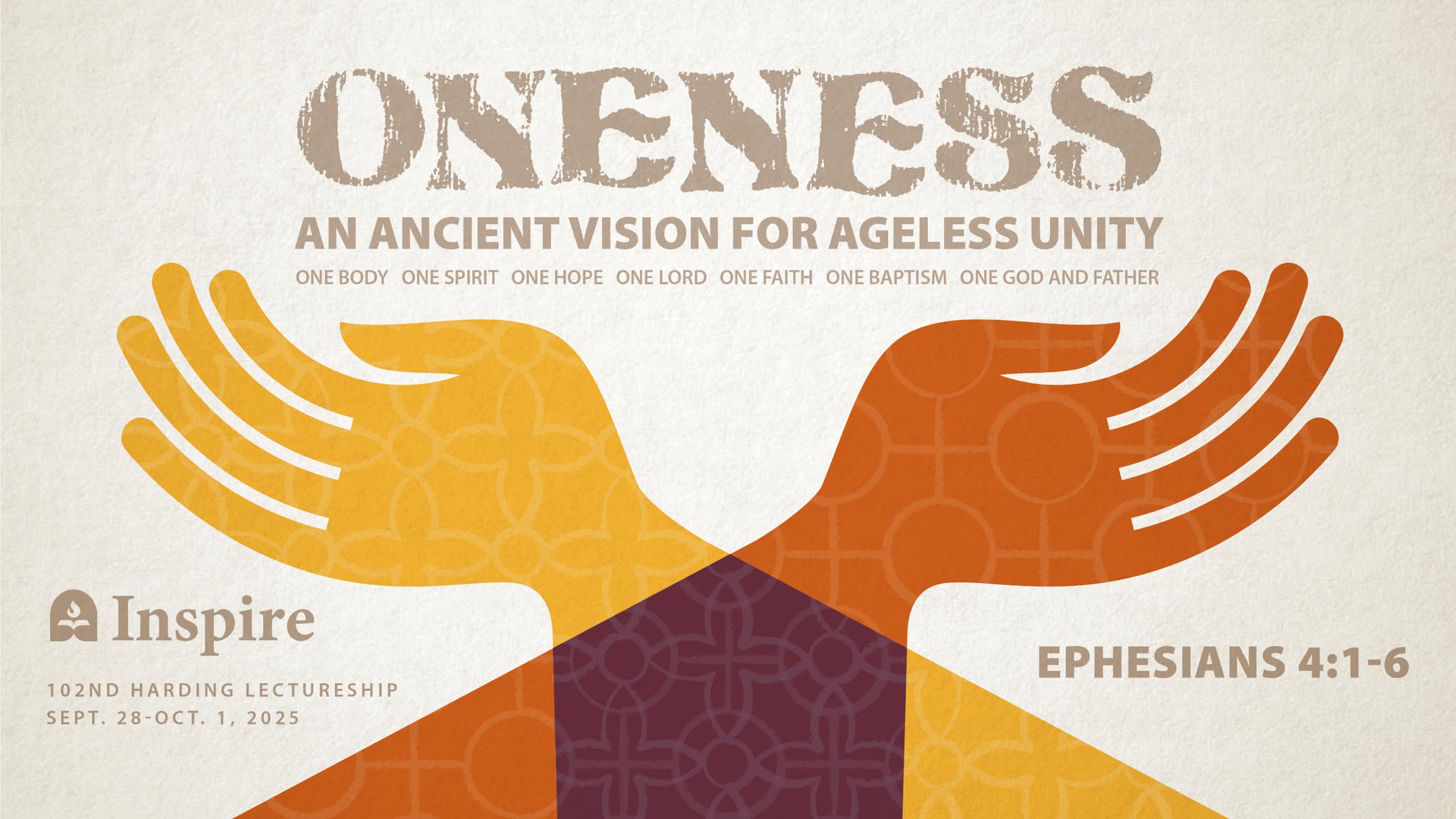
The theme of the Inspire Lectureship this year was Oneness: An Ancient Vision for Ageless Unity, and focused on the 7 Ones of Ephesians 4 as a source of unity among God’s people. As part of that emphasis on unity, the Lectureship Committee seemed to make a concerted effort to cross some traditional divides, inviting a large number of ethnically diverse presenters (African American, Latino, and Native American, among others), as well as some speakers from outside the fellowship of Churches of Christ (albeit, ones with broad theological kinship, like the Independent Christian Churches or a local nondenominational church). This latter move generated great controversy on social media, which I thought was unfortunate. Focusing on that controversy is not the main point of this post, but I feel I would be remiss if I ignored it and pretended it didn’t happen, so here are some brief thoughts:[1]
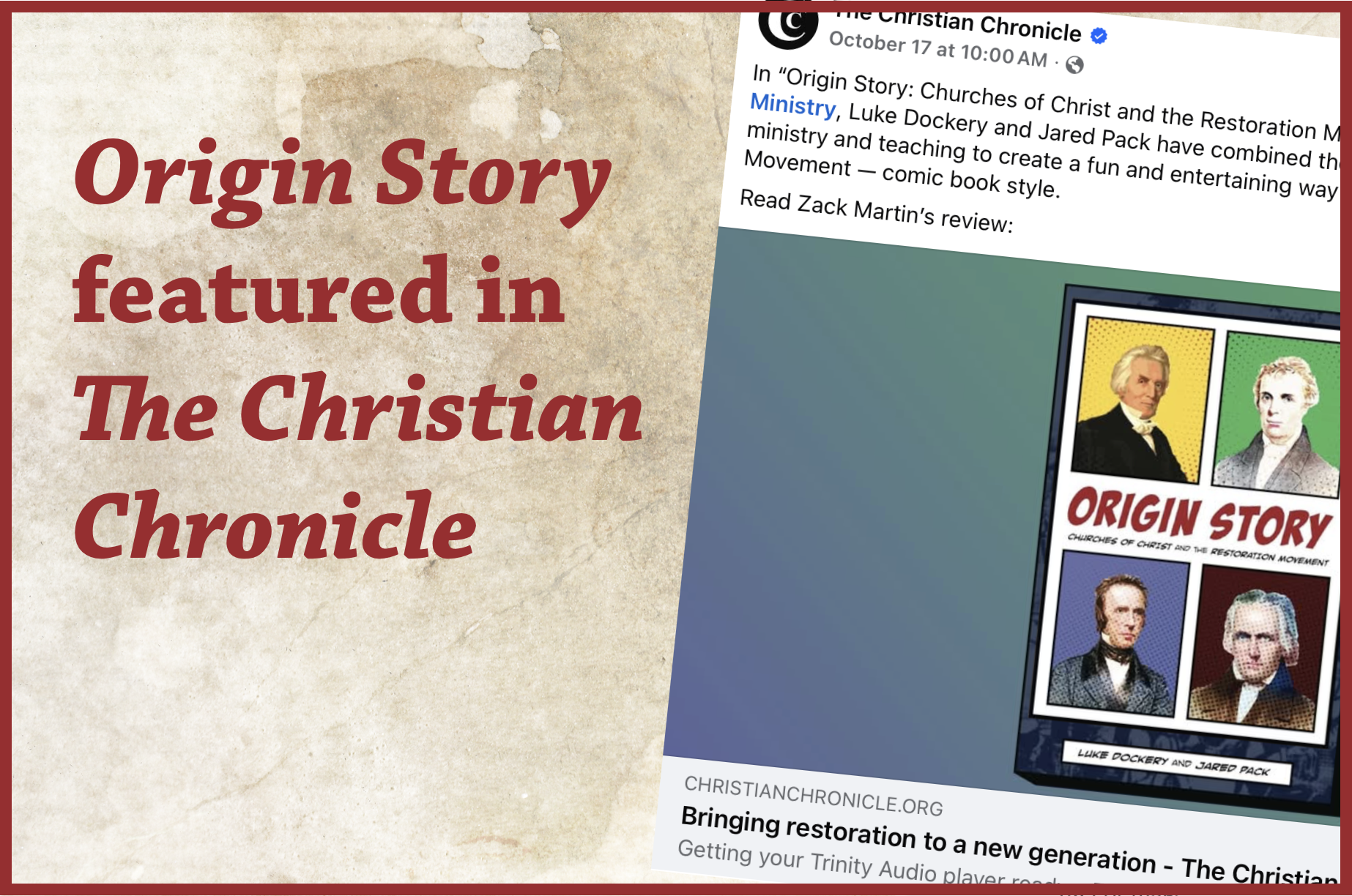
- I coauthored a book earlier this year on the history of Churches of Christ and the American Restoration Movement, and how unity was an early and driving goal of that movement. I have written before how unity itself is a doctrine, a teaching of Jesus, and how we must take it seriously if we desire to follow Him. With that in mind, it is more than a little ironic that those purporting to be faithful caused an online uproar in response to a concerted effort to seriously reflect on the doctrine of unity.
- Many of the critics hold the opinion that only members of Churches of Christ should be allowed to speak at Harding’s Lectureship (and, to be more accurate, only members of the right kind of Churches of Christ). They are certainly entitled to that perspective, but objectively, it is a sectarian one.
- Some of the critics suggested that this Lectureship reflected a dangerous slide down the slippery slope to liberalism for Harding, and that they were not sure if they could continue to support the school. These warnings could be taken more seriously if the same critics had not been saying the same things for years; as it is, it comes across as disingenuous.
- For all of the controversy, I found this year’s Lectureship to be remarkably similar to previous ones. It did not seem to be edgy, and when I spoke to others in attendance, they agreed. Furthermore, for a school purportedly sliding into liberalism, it was surprising on the first night to hear the school president share Harding’s new Statement of Faith that requires alignment from faculty and staff on a historically Christian sexual ethic (Harding has never done this in the past, so this represents a markedly theological conservative move), the president affirm a continued commitment to a cappella worship and male spiritual leadership, and the keynote speaker reject theological progressivism as an exit to non-faith (see below).
Now, on to the main thing!
With the new format that was adopted last year, there is a greater emphasis on multi-session tracks than standalone lectures. For a variety of reasons (sometimes I wanted to be sure to stop in for a session to greet a presenter I knew; other times I had meetings that interrupted my schedule), I ended up often hopping around and catching bits and pieces of different tracks. I still heard good content, but overall I lament my haphazard approach because I know I would have gotten more out of the week if I would have stayed with a few of the tracks for their entirety.
I got to attend a variety of lectures and classes, and here is a brief recap of what I went to, along with some takeaway quotes:
One Body, Rubel Shelly: Shelly has been a longtime preacher and academic within Churches of Christ, and as you will see, I heard from him multiple times at this year’s lectureship. He offered the opening keynote and I thought did a great job at challenging us to appreciate the very notion of unity:
“Few topics in the Churches of Christ are as divisive as unity.”
“We are one body whether we like it or not.”
“The greater concern than accepting someone Jesus rejected is rejecting someone Jesus accepted.”
“It’s not about us being right and everyone else being wrong, but Christ being right and all of us being wrong.”
I thought one of the best parts of Rubel’s presentation was his warning against theological progressivism, which he referred to as the opening of the door for people to exit to non-faith. This warning might come as a surprise to many within Churches of Christ who consider Shelly himself to be a progressive, but this is kind of the point: there is a desperate need in our churches to be able to distinguish between orthodoxy and progressivism. For a variety of reasons, most within our churches are not well equipped see the difference between practices that go against our traditions and convictions (that we often label as “progressivism”) and true progressivism, which is faith-destroying. Maybe I’ll write more on this sometime, but I thought this was a valuable admonition.
S.R. Cassius and the Fight against Racism in America, Edward Robinson: Dr. Robinson is the preeminent historian of African American Churches of Christ, and did a three-part series on noted African American leaders in Churches of Christ. He was also a former professor of mine in grad school, and I loved his class on the American Restoration Movement.
I was only able to attend one of Robinson’s sessions, which was on S.R. Cassius, a bi-racial preacher in Churches of Christ in the late 1800s and early 1900s. Unlike the more famous Marshal Keeble who came after him, Cassius openly and consistently criticized racism, and worked more diligently than anyone else in Churches of Christ to lift up his race.
One Baptism, Scott Adair: Scott teaches in the College of Bible and Ministry at Harding, and offered the Monday morning keynote. Scott talked about how in the ancient world, the way you walked revealed something about who you were. Paul uses “walk” thirty times in the New Testament, and in Ephesians, addresses the idea of walking a lot. Unfortunately, after receiving our commission at baptism, we often walk like the world.
In Ephesians, Paul is not trying to baptize people; he’s talking to baptized people. And as baptized people, we should know that baptism is supposed to remind us of who we are:
- At baptism, we make a confession of Jesus as one Lord. We are loyal servants of the crucified and risen Savior, so we should act accordingly.
- We are baptized in the name of the Father, Son, and Holy Spirit—the one God. This reminds us that we are beloved children, and the one Spirit seals us with the one hope.
- Baptism is a reenactment of the death, burial, and resurrection of Jesus, the core historical event the one faith rests upon.
- We are baptized by someone else; someone else re-presents the church, the one body to us. The church is the presence of God in the world.
“Our calling: we are washed, resurrected sons and daughters of God who are empowered by the Spirit to re-present Christ to the world.”
The Future of Churches of Christ: Proposals for Unity, Keith Stanglin, Scott Adair, Rubel Shelly: This was a three-part series over the course of three days where each day one speaker would present his ideas and the other two would respond. Unfortunately, it was a popular series in a too-small room, and I wasn’t able to attend one of the presentations (Adair’s).
Keith Stanglin went first, and presented the common argument that the Restoration goal of achieving unity through restoration has not worked. Churches of Christ today represent significant diversity, but the tension between unity and restoration is still present. Furthermore, Stanglin argued that it wasn’t the Bible that united first-century Christians, because the New Testament wasn’t completed yet. Instead, it was the common belief in the core content of Christian proclamation, the common confession of the apostolic faith. Ultimately, Stanglin’s argument is that unity should be based on something like the Apostle’s Creed, which sums up the earliest proclamations of the gospel.
“The faith confessed at baptism should be a sufficient test of unity.”
“Everyone including God recognizes the difference between ignorance and willful disobedience.”
“Is there room for a category that is not essential but still worth defending?”
In Shelly’s session, what stood out to me was his suggestions that we need to start with Ephesians 4.1-3 before skipping ahead to the “seven ones” of Ephesians 4.4. Unity begins not with doctrine, but with a spirit of humility, gentleness, patience, and bearing with one another in love. The reality is that we can agree about the seven ones, but still violate Ephesians 4.1-3.
“We would do well to pray the prayer that Jesus prayed in John 17. It must be possible or Jesus wouldn’t pray for it.”
One Lord, Rodney Dulin: Rodney serves as the Senior Minister for the Central Pointé Church of Christ in Dallas and delivered the Monday evening keynote. Dulin emphasized that our salvation is centered on the person and work of the one Lord, Jesus Christ.
The early Christian confession that Jesus is Lord was significant and controversial no matter who you were—for Gentiles, it meant that Caesar was not Lord, and for Jews, it identified Jesus with the God of the Hebrew Scriptures. We reference Jesus as Lord and Savior; Him being Savior is what He did for us; Him being Lord is what we do for Him—we must respond to the rule and reign of our Lord.
“It doesn’t matter if you went to Penn State or the state pen, if you’ve been baptized…you belong to the one church.”
Where on Earth is Heaven? Rubel Shelly: This was a three-part series of which I was only able to catch the first session. Much of this was introduction where Shelly was laying the groundwork for what he was going to say next (which I missed), but he did a good job of showing how Plato’s views significantly affected Christian thought in a way that departed from biblical teaching:
- The material world is deficient and negative to spirituality (in extreme forms, matter is evil)
- The human soul is immortal (a necessary conclusion for Plato because of the transmigration of souls)
- Our new bodies will be “ethereal” and escape the flesh (envisioned the world of “forms” beyond matter)
- The goal of life is to escape Earth/flesh/matter (the biblical goal is quite the opposite!)
I wish I would have been able to take in more of this track, but ultimately, Rubel affirms what I argue for in this series (see especially this post on our resurrection bodies).
One Faith, Olu Shabazz: Shabazz serves as the Senior Minister and Evangelist for the Harlem Church of Christ in New York City, and delivered the Tuesday morning keynote. He emphasized how the “7 Ones” speak to the exclusivity of apostolic Christianity, which distinctly contrasts with the subjectivity of our own time. It is simply not possible to look at the “one faith” of Ephesians 4 and come away thinking that just any path will lead to God; when man rejects the one faith, he establishes his own religion instead.
“If your truth is not God’s truth, then it is no truth at all.”
The Anxious Generation: The Challenge of Collective Action, Monte Cox and Rachel Wisdom: Monte serves as the Dean of the College of Bible and Ministry at Harding, and Rachel, his daughter, is a school counselor in a nearby town. Their track focused on big ideas from Jonathan Haidt’s The Anxious Generation, a book I love and reviewed here.
Because I had already read the book and am very familiar with Haidt’s ideas, I decided not to attend this entire track, but just went to one session (so I could be with my wife, who attended this track). The session I went to, “The Challenge of Collective Action,” was great, and it made me regret missing the other sessions. Cox and Wisdom were a brilliant combination, and clearly enjoyed presenting together. They were witty and knew the material well. The material itself was not new for those who had read the book, but Wisdom’s insights from her school context were helpful, and it is always good to be reminded of important things that you already know.
One helpful reminder from Haidt is the metaphor of parenting as carpentry or gardening. Carpenters follow detailed plans with precise measurements, and if they follow the plans precisely, they get the result they desire. Gardeners realize that they are not ultimately in control of producing growth, but that instead their job is to create an environment where healthy growth can occur. Many people try to parent as carpenters, following the right plan and controlling all the variables to produce the perfect, ideal children, but parenting is more like gardening than carpentry: as parents, our job is to provide a healthy environment where children can thrive, and not try to micromanage the outcome. Though Haidt is not a person of faith, I think there is deep biblical wisdom in this admonition, as we know that we are ultimately in control of very little, and that our task to is to be faithful in our opportunities and trust God to yield the results that honor Him, including with our children! As a parent who is often inclined toward carpentry, this is a very helpful metaphor and reminder.
The Restoration of Israel, the Kingdom of God, and the Church in Luke–Acts, Mark Black: Mark Black is a long-time professor at Lipscomb University (His older brother Allen was one of my professors at HST). Black shared a ton of information, but ultimately was reflecting the work of Jacob Jervell, a Norwegian theologian who argued that the church in Acts is the beginning of the fulfillment of promises made to Israel. His views have largely won the day in the academy, but are not necessarily as widely understood in the church.
I couldn’t even begin to write down all that Dr. Black shared, but here were some concluding remarks (some of which are fairly provocative for a variety of reasons). If the church is essentially restored Israel…
- We shouldn’t call ourselves the New Israel.
- The Old Testament has not been abolished.
- God didn’t change His ways with the Messiah; His interactions with humanity have always been based on grace.
- The church does not replace Israel.
- The are no Christians outside of the church anymore than there are Jews outside of the people of Israel.
- The mission of the church remains the same mission of Israel—bless all the nations and bring them into God’s people.
- We should take kingdom language literally—the land itself will be restored.
- There is no “right” proscribed method of church leadership.
Some of these conclusions seem evident to me, and others less so; I wish there would have been more time for all of these to be unpacked! But this was a rich session with lots of important ideas that would help the average church member to better understand the story of Scripture and the implications of it.
Who Are You Really? Accepted and Secure in Christ (Eph. 1.3-14), Evan Todachine: Evan preaches at the Kayenta church of Christ on the Navajo Reservation in Northeast Arizona. I first met Evan when my former church began to support his work in Arizona, and I wanted to reconnect with him and support him as he spoke as part of the Youth Ministry track.
Evan talked about the idea of identity and what that looks like in a Navajo context (you introduce yourselves through your clan identity), and how we live in a world that is obsessed with identity, but according to the Bible, identity is God-declared rather than self-defined.
“Until we know who Christ is, we will always struggle with identity.”
Does a Man’s Color Matter? Olu Shabazz: I went to a couple sessions from this track, and it was fascinating—Bro. Shabazz shared his experience growing up in a family in the Nation of Islam and also discussed Black Hebrew Israelites. This was part of a larger discussion about ethnic identity and whether or how a person’s skin color matters. God created humans as “trichotomy beings,” or, in the words of Shabazz, “You are a spirit that has a soul that lives in a body.”
This is another session where I would have enjoyed being able to sit down and have a follow-up discussion with the speaker. I believe Bro. Shabazz would argue that our embodied experiences matter and that we should seek to understand one another based on those experiences, but that one’s skin color doesn’t give particular insight into spiritual truth or special access to God.
Does God Predestine Individuals to Salvation or Condemnation? Kevin Burr: Kevin is one of my best friends, and is now a Bible professor at Harding. He tackled a historically controversial question regarding predestination, and did a great job. His basic thesis is not particularly controversial to me: the Bible teaches predestination and free will. Here are some key points:
- Scripture repeatedly affirms God’s election of Israel, and Paul knows this—He believes God’s election of those in Christ is based on this.
- Choice and love are essential, necessary actions in establishing and continuing a relationship.
- Paul understands a “corporate election” model for Israel, and preserves corporate election for the church. I have held to a model of corporate election for a long time, but it was new to me that Paul bases his understanding of this in God’s relationship with Israel. It seems obvious to me now!
- God’s predestination has room for human agency; if your view of predestination rejects human agency, then Paul’s words are nonsense.
One Hope, Matt Love: Matt preaches for the Beebe Church of Christ and also teaches at Harding School of Theology, and wrapped up the Lectureship with the Wednesday evening keynote. Matt offered some poignant thoughts on hope as an essential element of the Christian faith that we are perhaps in danger of losing. Noting the increasing move toward happy funerals that avoid the heaviness of death:
“We have a big problem and it is death…but Jesus rose and we will too. Your entire life was supposed to point people to Jesus, and your final gift is to point people to Jesus one last time.”
Perhaps, one of our problems is that we have hoped in the wrong things…hoping that “our team” (Churches of Christ) would win, hoping that this Christian life would be easy, hoping that death wasn’t waiting for us at the end of this:
“When the time comes, will we let go of our other hopes for the sake of one hope?”
“When it comes to our faith, there is only one basket to put our eggs in…. Our hope is not in the idea of God, but God. Not church, doctrines, or religious systems; our hope is in a single person—the Lord Jesus Christ.”
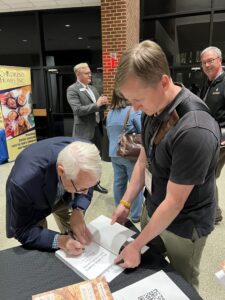
Dr. Black signing my copy of the new book in his honor.
In addition to attending all of the lectures described above, a highlight of Lectureship was a presentation of a festschrift (a book of essays in honor of someone) to Dr. Allen Black. Dr. Black, as mentioned above, was one of my professors at Harding School of Theology. He had a profound impact on my life, faith, and ministry, and several of his former students banded together to write and produce Teaching God’s Sons and Daughters: Essays in Honor of Allen Black.
This was presented during one of the evening keynotes, and when prompted, dozens of Dr. Black’s former students stood up. Dr. Black was overjoyed and overwhelmed, and it was a touching moment.
As mentioned previously, I wish I would have done a better job planning out my week, but I still got to hear a lot of good sessions at Inspire this year, and it was a blessing to see so many old friends and professors. For me, autumn is a season of blessing, and the Harding Lectureship is one of the many great blessings I enjoy in my life.
[1] I am employed (albeit, in a very part-time fashion) by Harding University, so I should note that I am in no way speaking on behalf of the school in an official capacity. Furthermore, I had nothing to do with the planning of the Lectureship, so I was not responsible for anything that happened, and nor am I automatically defensive of it. My thoughts here are my own.

 This past year I re-read Tim Keller’s modern classic, The Prodigal God. Though it wasn’t my intention to do so before reading the book, I was so struck by aspects of it that I ended up writing a brief, three-part series to emphasize some key ideas: