The online journal of Luke Dockery

Tag: Bible Class Curriculum (Page 1 of 2)

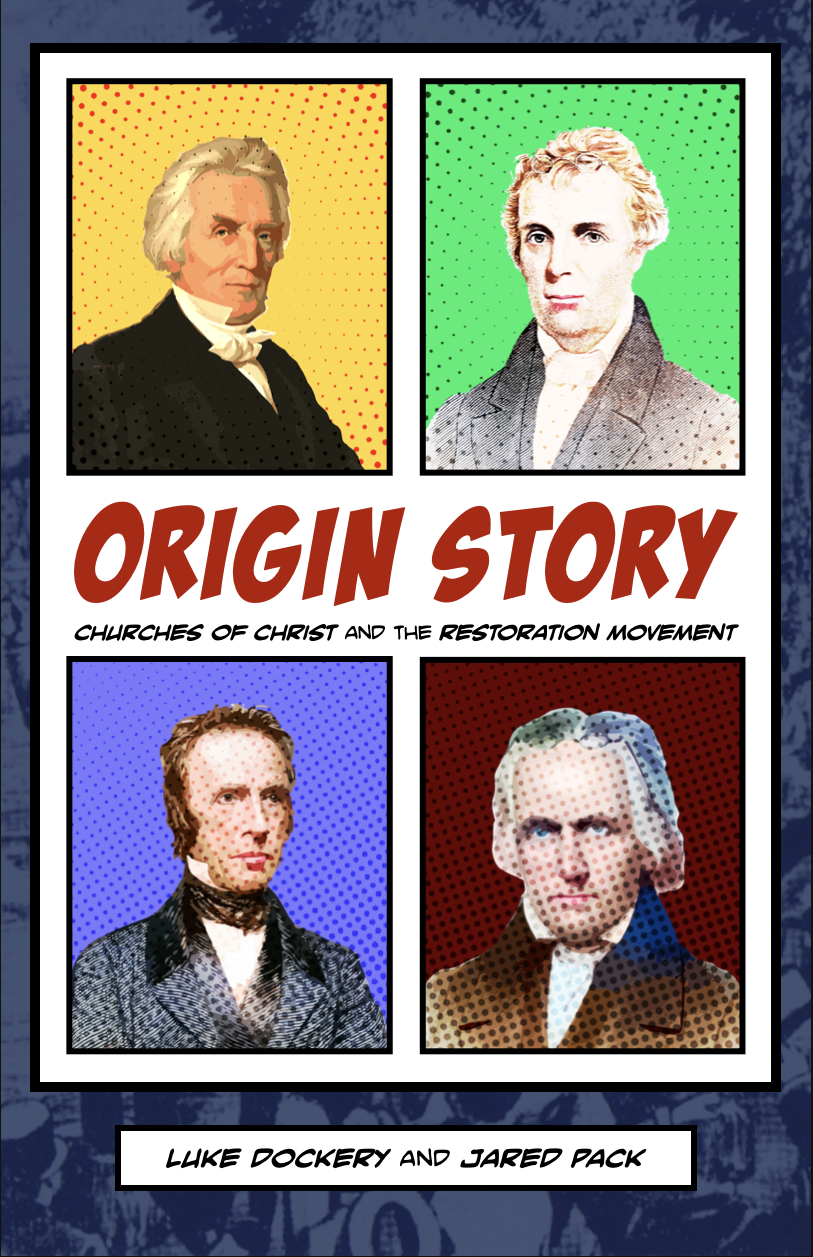
Origin Story: Churches of Christ and the Restoration Movement

I wrote a while back that I had taught a series of lessons to the students in my youth group regarding the Stone-Campbell Restoration Movement and how it affects our heritage and identity in Churches of Christ. I am pleased to announce that this study has now been compiled and formatted as a book that is now available in print and digitally. I won’t go into detail here why I think a study like this is need (I did that in the previous post), but I do want to say a couple of things and share some more detail about the book, before concluding with the summary information from the back cover.

First, this is a special project to me because it was done in conjunction with my good friend Jared Pack, and in many ways represents our friendship and the fruitful years of ministry we shared together. Jared is a historian by training and serves as Associate Professor of History and Chair of the History Department at York University in York, NE. I am a youth minister by trade and am decidedly not a trained historian, but I am an amateur enthusiast of Restoration History. Early in our friendship, Jared and I discovered a similar interest in the Restoration Movement and how it affects us today, and we co-taught a class together with our young adults group at the Farmington Church of Christ. Later, after I had moved to work with my current congregation, Jared taught the class again and added and expanded it. When I taught the material to my own students last year, I refined it further.

What all of that means is that this current product truly represents our combined work over a decade. Jared and I work so well together and think so similarly in many ways that with much of this book, at this point we are not sure who wrote which part! In many ways, this book is a perfect representation of and tribute to our friendship.

Second, this was a challenging project because I really was trying to push my creativity. Sadly, most teenagers do not find history to be an enthralling subject, and so I worked hard to make these lessons engaging. One way I sought to do this was by providing relevant discussion questions throughout the lessons to break up the lecture portions, but also, as the title suggests, I tried to tap into the notion of the origin story, a motif that has become very well understood in our society over the last twenty years with the proliferation of various movie franchises that center characters with remarkable abilities and comparing backstories (think MCU, the Harry Potter series, Star Wars, etc.). With this idea being central, Origin Story very much has the feeling of a comic book, completed with AI-generated images of the authors as superheroes!


Here is the Table of Contents, to give you an idea of the layout of the series:

Series Introduction

(1) Why Study the Restoration Movement?

(2) Background: Early Church to Reformation

(3) Background: European and American Influences

(4) The Big Four

(5) Unity and Division

(6) Churches of Christ after the Split

(7) Restoration Movement Slogans and Theology

(8) The Restoration Plea and Legacy

Appendix A: A Brief Overview of Calvinism

Appendix B: A Brief Overview of Millennialism


Purchase the Book

Paperback: Amazon $12.99

Digital: Deeper Youth Ministry $10


You can see the cover below, as well as some sample pages to give you a feel for the book (including the silly image of me as a superhero!).

From the back of the book:

Origin stories provide the background narrative that explains why characters are the way they are. When you know a character’s origin story, you also know important things about their feelings and motivations for why they do what they do. Churches of Christ have historical roots in the Stone-Campbell Restoration Movement, but teens in Churches of Christ tend to be largely ignorant about any of this history. This is a problem, because in a real sense, if we don’t know our history, we don’t know who we are.

The early Restoration leaders desired to bring about unity among God’s people by adhering to the clear teachings of Jesus and the apostles and the practices of the early church. In a world of bitter division and incredibly shaky notions of truth, that is a compelling idea, and one that is worth communicating to teenagers.

Origin Story is an eight-lesson series written specifically for teens.

“Teaching Restoration Movement history is tricky business, especially in church contexts. How best can we communicate the ups and downs, the successes and shortcomings, of our religious predecessors in a way that deepens rather than destroys faith? A lack of accessible educational resources for young Christians only compounds the problem. Fortunately, Luke Dockery and Jared Pack demonstrate both ministerial concern and scholarly acumen in this short volume which will help anchor the youth of the Churches of Christ more fully in their religious heritage and, even more importantly, point them back to the cross.”

—John Young, Associate Professor in the Turner School of Theology at Amridge University and historian of the Stone-Campbell Movement


New Projects

I have not written as much recently here on The Doc File as I would like, largely because I have been busy with other things:

To this list, most recently I have added a new project: my good friend Kevin Burr and I launched Regnum Media, a publishing house that will produce scholarly-yet-accessible Bible studies that are primarily intended for use in adult Bible classes as well as personal study. Regnum Media will be operating in partnership with the Center for Christian Studies, and will serve as the publishing imprint for CCS. CCS seeks to provide “scholarship for the church,” and has been doing this in excellent fashion already through video teaching modules and a scholarly journal that is released three times per year. We are excited to partner with CCS in this good work.

From the CCS press release about our partnership, here is a quotation from yours truly:

In our years of congregational ministry, both Kevin and I have become keenly aware of the need for quality Bible class resources that are trustworthy, scholarly, and engaging, and it was with this need in mind that Regnum Media was formed.

Regnum is the Latin word for ‘reign’ or ‘rule,’ and from the beginning it has been our goal to work for the good of the Kingdom, using our humble efforts to help the reign of God come more fully on earth as it is in heaven. We believe that quality biblical teaching that leads to discipleship in the local church is a key ingredient of that, and we are thrilled with the opportunity to partner with the good work that CCS is already doing in this regard.

We are planning to release four titles in 2023, including a version of my Ecclesiastes material specifically geared toward adults. You can follow our Facebook page to keep up to date on news and releases.

I still remain fully committed to all of the various roles and projects listed above, and intend to keep writing in this space as well. There are busy days ahead, but my hope is that God can use my humble efforts in the advancement of His kingdom.

New Resources Page for Free Downloads

I have been involved with youth ministry for over ten years now, and during that time I have put together a lot of devotionals, Bible class material, and other resources.

A while back, one of my good friends encouraged me to make some of these materials available on my blog for others to use. I thought this was a good idea, and have intended to do it for a while, but general busyness combined with the time it takes to edit and convert certain files into more downloadable formats has prevented me from doing so…until now.

If you look up in the navbar, you’ll see a link that says “Free Resources”. Under that page, you’ll find downloadable links to a youth ministry plan I developed, as well as a couple of Bible class lessons and one class series for teens.

I realize that there’s not a ton of stuff available right now, but I hope to add more in the future as time permits (see above comments on general busyness and the time-intensiveness of converting and uploading files).

Hashtag Media: A Creative Solution to a Common Problem (Curriculum Confusion Part 2)

Yesterday I talked about the difficulty that youth ministers and others face who have the task of choosing Bible class curriculum for teenagers. I discussed three different common approaches to finding curriculum, but also mentioned that each of these has significant drawbacks.

Today I want to write a little about Hashtag Media, which is a new effort that I see as a creative solution to the problems I talked about yesterday.

If you’re a regular reader of this blog, you may remember me talking about the Hashtag Youth Series, which was a free video-based youth summer series that was released last year. Hashtag Media was launched in early October as a companion project to the Youth Series, and proceeds from Hashtag Media’s resources are reinvested in future Youth Series and other projects.

All of this is pretty exciting because the products that Hashtag Media have released so far have virtually all of the advantages I talked about yesterday from the different curriculum types without any of the drawbacks:

  • The material is created by youth ministers from churches of Christ, which means that distinctive doctrines aren’t ignored—I don’t have to worry that the significance of baptism will be diminished or that the lessons will implore teens to come to salvation through a Sinner’s Prayer method that isn’t talked about in Scripture.
  • Written by professional ministers also means that the content of the lessons is high quality.
  • The material is created to be Christ-centered, which means it still has a “big picture” focus that is very important for teens.
  • The lessons are fundamentally biblical; the current series we are studying is from the Book of Ephesians and uses an expository verse-by-verse approach which encourages the students to really dig into the text (it is excellent).
  • More than just the content of the lesson, the overall product is very good: the graphic design is excellent, and the lessons come with starter activities and illustrations which help bring the biblical message to life.
  • It is affordable. The longer quarter-length series are only about $50, and they have recently rolled out the option of buying a year’s subscription which means that you can get all the new material which comes out in 2013 for only $200. These prices are very competitive (read: cheap), and knowing that all of the proceeds go toward creating more material makes it even easier to justify.
  • The creators of Hashtag want to increase the size of their curriculum library, and solicit the help of others who would be interested in submitting Bible class series to them. I appreciate the collaborative spirit of this project and will likely send them some of my own material at some point.

The only drawback I really see at this point is that currently, Hashtag’s offerings are a bunch of stand-alone class series which aren’t connected as part of a larger curriculum plan. To me that isn’t a huge problem (right now I am just using Hashtag products to fill in the gaps of other curriculum plans that I have), but perhaps as this project continues, they will put more thought in this direction.*

On the whole, I am really excited about the potential of Hashtag Media, and am grateful to the team of youth ministers behind its creation. If you are a youth minister or the person at your church in charge of selecting Bible class material for teens, I would encourage you to take a look at what they have to offer.

*Also, all of Hashtag Media’s resources are exclusively in an electronic, PDF format. Some people might see this as a drawback, but I don’t: you can get the resources immediately through email once you order them, and everything is going digital anyway. Before we know it, “class books” will be a thing of the past.

Curriculum Confusion Part 1: Different Approaches to Bible Class Material for Teens

If you are in youth ministry or are involved with organizing Bible class curriculum at church, you are likely aware of how difficult it is to select quality Bible class material for teenagers (in fact, I’ve actually written a bit about this before). If you find yourself in this situation, you basically have three different options:

The “Do It Yourself” Model

This option is actually pretty self-explanatory: you want Bible class curriculum for your teens? Write it yourself.

There are several advantages to this approach:

  • Theoretically, you should know your teens pretty well, so you ought to have a good idea of what they need to study, and on what level they need to study it (generally speaking, 12th graders are completely different than 7th graders and need to be taught differently).
  • If you are producing the material, you can be confident in the content—you don’t have to worry about something being taught that you disagree with or think is unbiblical.
  • This is a cheap way to go about acquiring Bible class material—aside from the small cost of making copies of handouts, basically the only cost is your time.

But there are significant problems to this as well:

  • It is very time-consuming to write every lesson for your teenagers from scratch. I have written lots of Bible class material for my youth group and invariably, it takes a lot of time. If you happen to have a lot of excess time, that’s great, but I don’t: realistically, with other ministry responsibilities, grad school, and family concerns on my plate, there are only a few quarters a year when I have time to produce original Bible class material.
  • Your Bible class material will only be as good as you are. What I mean is that if you are great at doing research, writing lessons, and putting together attractive powerpoint presentations, then your students will be in for a treat…but if this just isn’t one of your strengths, then subjecting your students to quarter after quarter of mediocre material is less than ideal. 

The “Least Common Denominator” Model

This option involves purchasing curriculum from a large company which specializes in producing it. I use the term “Least Common Denominator” because usually, in an effort to appeal to as many potential customers as possible, this material presents a very generalized, inter-denominational Christianity that offends no one.

Purchasing material from a large company like this does have its advantages:

  • Curriculum like this is written by professionals, and is usually well planned and very professional. It will usually come with supplemental materials like activities related to the Bible lesson or videos for your students to watch.
  • Sometimes it will be planned so well that it integrates with children’s and adults’ curriculum as well; it is a neat thing to have everyone in the church studying the same lessons at the same time.
  • By its inter-denominational nature, this approach it tends to focus on “big picture” biblical themes that everyone basically agrees with (Jesus, grace, sin, etc.) and which really do need to be emphasized to and understood by teens.

Although this is a very popular model, it comes with multiple problems as well:

  • It is usually very expensive: a quarter’s worth of material could cost hundreds of dollars, and if you follow an entire curriculum plan, it could be thousands of dollars each year. A lot of churches (mine included) simply don’t have the education budget to afford this year-round.
  • There are a lot of disagreements within Christianity (about things like salvation, the relationship between faith and works, the way the Bible should be read, the way we should worship, etc.), but the Least Common Denominator approach tries to ignore all of them by presenting a simplified Christianity that few find objectionable. Maybe that sounds idyllic, but ultimately, a diet of only this type of material produces students who haven’t thought deeply about (and potentially aren’t even aware of) any of these issues. To me, that’s a significant problem.
  • Also (and related to the last point), going along with the Least Common Denominator approach, oftentimes these studies are topical rather than textual, and focus on moral issues that virtually all Christians agree about: the dangers of drinking, drugs, premarital sex, etc. While these topics are important and need to be discussed, too much focus on them leads to the already-too-prevalent idea (among teenagers and the church as a whole) that being a Christian is nothing more than following a particular moral Do’s and Don’ts List rather than living a redeemed life as part of the Kingdom of God. In other words, curriculum should focus on the Gospel, which includes, but is much bigger than, the fact that Christians should behave in a certain way.

The “Brotherhood Material” Model

The third option is to purchase material from within your particular religious fellowship. In churches of Christ, we don’t like being referred to as a “denomination”, so we tend to refer to publications put out by members or companies affiliated with churches of Christ as “brotherhood material”.

Advantages to this approach include:

  • Theoretically, getting material from within your own fellowship should mean that it is doctrinally agreeable.
  • Usually, the cost for this type of curriculum is considerably less than the Least Common Denominator model.

But once again, there are multiple problems:

  • A lot of times, these materials are produced by smaller companies, and frankly, the quality is sometimes lacking.  In my experience, I have found this to be especially true on the presentation side (i.e., it doesn’t look that good), but it can also be weak on content as well.
  • Even “brotherhood” publishing companies want to make money and sell lots of their products, so they too can fall victim to the temptations to publish very general material that appeals to as many people as possible. When this happens, it is subject to the same problems as the Least Common Denominator model mentioned above.

So each of these models, although possessing strengths, is also characterized by significant disadvantages. I guess the major takeaway from all of this analysis is this: it is a challenge to find quality Bible class material for teens. So what is the solution? More on that in the second half of this discussion…

« Older posts

© 2026 The Doc File

Theme by Anders Noren — Up ↑