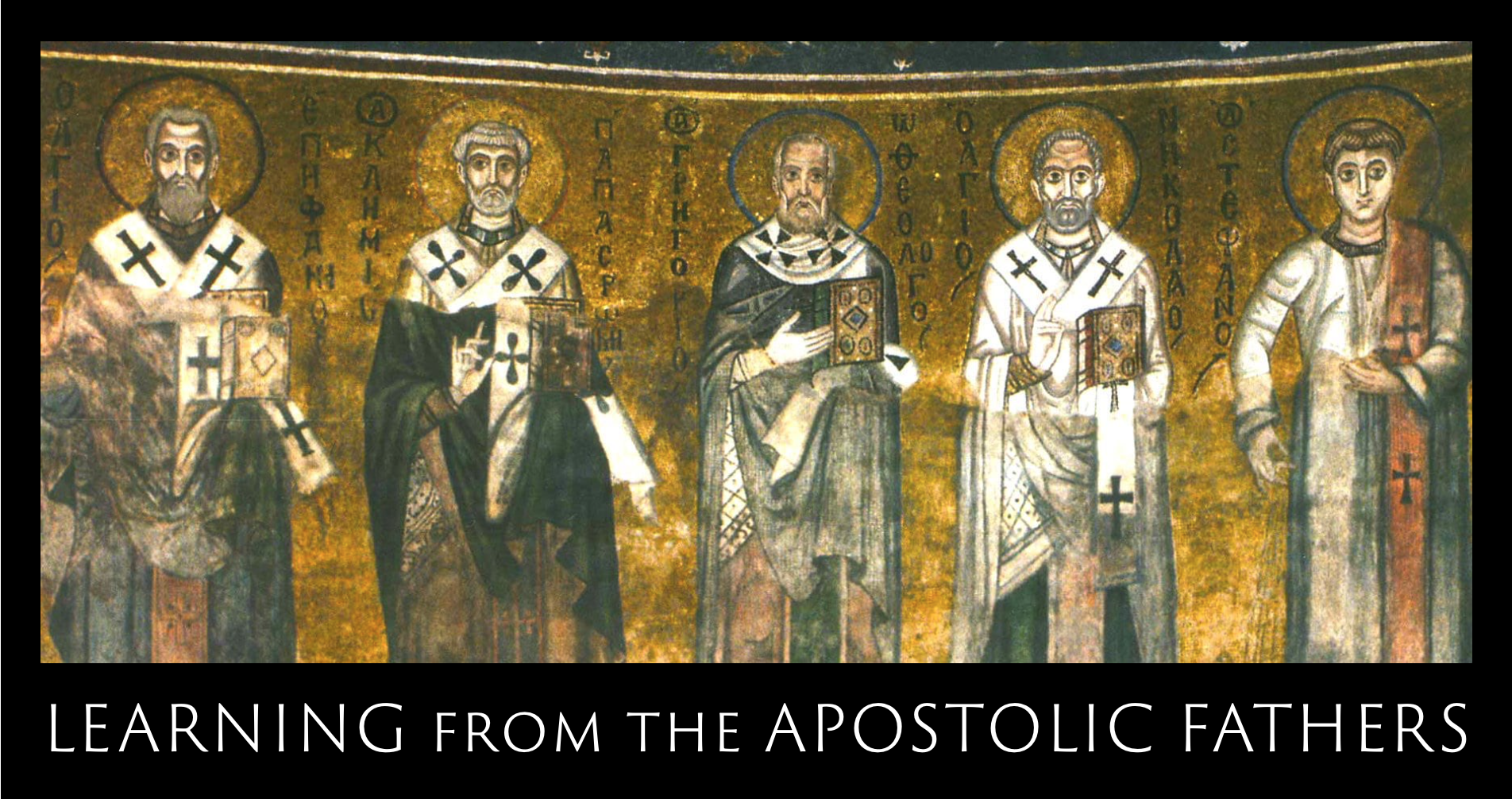
Last year, I read through Michael W. Holmes’s edition of The Apostolic Fathers in English as part of my daily devotional readings. Generally speaking, the term “Apostolic Fathers” refers to early Christian theologians from the 1st and 2nd centuries AD, some of whom would have known some of the apostles personally and sought to pass on their teachings. Related to those readings, I began a short series of blog posts where I wrote about Clement of Rome, Ignatius of Antioch, and Polycarp of Smyrna. I had intended to include one final post in that series on The Didache but, sadly, never got around to it. So, this represents the very tardy conclusion to that series.
The Background of The Didache
The Didache simply means “The Teaching”, and is the shorter, common title of The Teaching of the Lord to the Gentiles by the Twelve Apostles as it was known in ancient times. This work was known because it was referenced by various ancient writers, but the first known copy wasn’t discovered until 1873, with the full text being published in 1883.[1]
This short work—100 verses altogether—has received a great deal of scholarly treatment, but much about it remains quite mysterious. It is unknown who wrote it, when it was written, or where it was written. Regarding the date, The Didache in its current form may have come about as late as AD 150, but it is more likely that it came about near the end of the first century. As Michael Holmes points out:
“The materials from which it was composes reflect the state of the church at an even earlier time. The relative simplicity of th prayers, the continuing concern to differentiate Christian practice from Jewish rituals (8.1), and in particular the form of church structure—note the twofold structure of bishops and deacons (cf. Phil. 1:1) and the continued existence of traveling poses and prophets alongside a resident ministry—reflect a time closer to that of Paul and James (who died in the 60s) than Ignatius (who died sometime after 110).”[2]
The Didache contains three main sections: (1) Teaching on “the Two Ways” that resonates closely with portions of the Gospels of Matthew and Luke, (2) a sort of how-to manual related to church practices, and (3) a brief apocalyptic section.
Themes and Insights from The Didache
Specific Instructions for Church Practice: The New Testament gives much teaching about the gospel of Jesus Christ and the way that reality should transform disciples of Jesus as participants in new creation. Furthermore, at times—usually in response to a situational question or crisis—practical instruction will be given to believers to tell them how they should behave in a given situation. On the whole, though, this practical instruction is limited, and there are many questions left unanswered.
The Didache steps into this void with all sorts of practical recommendations and commands. Personally, I found these instructions to be all over the place, variously striking me as wise, quirky, surprising, and questionable:
- Concerning baptism, it is best to baptize in the name of the Father, Son, and Holy Spirit in running water. If there is no running water, other water will work. If there is no cold water, then use warm water. If you have neither, pour water on the head three times in the name of the Father, Son, and Spirit (7.1-3).[3]
- Fasting should be done on Wednesday and Friday, to avoid Monday and Thursday, which is when the “hypocrites” fast (8.1).
- The Lord’s Prayer should be recited three times per day (8.2-3).
- A specific prayer to be said prior to the taking of the Lord’s Supper (9.1-4).
- A prohibition against sharing Communion with anyone who has not been baptized into the name of the Lord (9.5).
- Instructions on how to treat itinerant apostles and prophets (11.3-13.7).
Condemnation of Abortion: In a list of prohibitions against various sins that hearken back closely to Exodus 20 and Matthew 5, there is an interesting bit that arrests the attention of our modern ears:
“The second commandment of the teaching is: You shall not murder; you shall not commit adultery; you shall not corrupt children; you shall not be sexually immoral; you shall not steal; you shall not practice magic; you shall not engage in sorcery; you shall not abort a child or commit infanticide. You shall not covet your neighbor’s possessions.”
(The Didache 2.1-2)
It has become a common argument, especially in more politically progressive circles, to claim that Christian opposition to the practice of abortion is only a recent historical occurrence, and came about through the shrewd maneuvering of the conservative political movement rather than historic Christian teaching.
It may very well be the case that conservative political strategists constructed a loyal voting block by tapping into sentiments about abortion (indeed, I am fairly cynical toward the motives behind much Pro-Life posturing), but clearly, Christian opposition to abortion is not a recent phenomenon. As we see in The Didache, the practice was explicitly condemned likely in the first century, and there are similar prohibitions in other ancient texts. If there was a time, prior to the rise of the Religious Right, where most Christians in America were supportive of the practice of abortion, those Christians were out of step with the ancient teaching of the Christian church.
Concluding Thoughts
The Didache is a fascinating text. It is short, and absolutely worth reading. There is much about it that we simply do not know—who wrote it? Is it possible that it actually stretches all the way back to some of the apostles? What level of authority would have been given to this collection of teachings in the early church? These questions remained unanswered.
What is clear, however, is that The Didache preserves the efforts of early Christians who were attempting to apply the teachings of Scripture to the circumstances of their time in order to address questions that needed to be answered. This is a faithful practice that is still desperately needed today.
The Didache preserves the efforts of early Christians who were attempting to apply the teachings of Scripture to address the circumstances of their time. This is a faithful practice that is still desperately needed today. Share on X[1] Michael W. Holmes, ed., The Apostolic Fathers in English (Grand Rapids: Baker Academic, 2006): 157.
[2] Holmes, 159.
[3] This is, I believe, the first record of some sort of baptism other than immersion. It should be noted, however, that this is not held up as the ideal or permitted as a standard practice, but as an acceptable substitute in the absence of preferable conditions.







