The online journal of Luke Dockery

Tag: Eschatology (Page 1 of 5)

The Coming One

Revelation is a challenging book. It is written as apocalypse—a specific literary genre that leans heavily into historical context. The problem is that most readers are not familiar with the genre or the historical context, so Revelation remains largely impenetrable, susceptible to the wild speculation of religious charlatans and geopolitical prognosticators.

Regardless of the difficulties, most Christians are at least vaguely aware of the broad point of the book—there is a cosmic spiritual struggle going on between Jesus and the forces of darkness (the great dragon and his allies). The forces of darkness are powerful and seductive. They are actively recruiting followers of the Slain Lamb to commit treason and switch sides, and at times, it can seem like this is the smart move because it appears that the dragon is winning.

“Don’t be deceived!” says John in his apocalypse, and indeed, he reveals the reality of the situation: it is important that we choose wisely about whose side we are on in this cosmic struggle, because it is God’s side that will be overwhelmingly victorious.

At times, Christians can lose sight of this essential aspect of the Christian story. Often when we think of Jesus, we look back to the things Jesus did—His incarnation, ministry, miracles, crucifixion, and resurrection. Sometimes, we look around at our current lives and the ways Jesus gives meaning, comfort, and support to our existence right now. All of this is good, but while Christianity is a historically rooted faith that empowers meaningful life in the present, it is ultimately a future-facing endeavor: Jesus is coming again, and when He returns, He will fix the brokenness of the world and set it right.

This truth is underscored by one of Jesus’s titles that occurs multiple times in the book of Revelation, and is in the Gospels as well: ho erchomenos (Ὁ ἐρχόμενος), which translates as “The One who is to come” or more directly, “The Coming One.”[1] 

8 “I am the Alpha and the Omega,” says the Lord God, “who is and who was and who is to come, the Almighty.”

(Revelation 1.8)

2 Now when John heard in prison about the deeds of the Christ, he sent word by his disciples 3 and said to him, “Are you the one who is to come, or shall we look for another?”

(Matthew 11.2-3)

Jesus is The Coming One; His awaited arrival is a key aspect of His characterization, and while the title remains the same, the two verses quoted above (and others like them) describe two different comings. The first coming, of course, began at His incarnation. It was the arrival of the Jewish Messiah from the line of David, the one who would fulfill the faithfulness that Israel had always lacked. Jesus of Nazareth perfectly imaged the Father, sacrificed His life on behalf of the world, and conquered evil, sin, and death in His resurrection.

He then ascended to heaven, which leads to the Second Coming, because Jesus promised a return. He remains the Coming One, because He is coming again. This is an aspect of the Son that is somewhat out of vogue into today’s world (even among Christians!). Perhaps this is because He has been so long in coming that we are a bit embarrassed about it. Doesn’t it seem that He is perhaps, well, late? Don’t worry about that, Peter says:

8 But do not overlook this one fact, beloved, that with the Lord one day is as a thousand years, and a thousand years as one day. 9 The Lord is not slow to fulfill his promise as some count slowness, but is patient toward you, not wishing that any should perish, but that all should reach repentance.

(2 Peter 3.8–9)

Or perhaps we deemphasize this because the Second Coming is tied to judgment—King Jesus will eradicate evil when He returns, and that necessarily involves a quarantine of all those who reject His authority and want nothing to do with Him. Such notions are unpopular in a tolerant, pluralistic world where everyone is encouraged to live out their own truths.

Regardless of our emphasis, however, Scripture is clear: Jesus is the Coming One. He came before, and He is coming again. It’s who He is.

Scripture is clear: Jesus is the Coming One. He came before, and He is coming again. It’s who He is. Share on X

Despite the many centuries of waiting, many were not ready when He came the first time. We cannot make the same mistake:

10 But the day of the Lord will come like a thief, and then the heavens will pass away with a roar, and the heavenly bodies will be burned up and dissolved, and the earth and the works that are done on it will be exposed.

11 Since all these things are thus to be dissolved, what sort of people ought you to be in lives of holiness and godliness, 12 waiting for and hastening the coming of the day of God, because of which the heavens will be set on fire and dissolved, and the heavenly bodies will melt as they burn! 13 But according to his promise we are waiting for new heavens and a new earth in which righteousness dwells.

(2 Peter 3.10–13)

We must be ready. He is, and was, and is to come. The Coming One.


In this loose series of Scripture Reflections, I am sharing brief thoughts spurred on by my Bible reading. By way of reminder, my goal for these brief posts is two-fold:

(1) To remark on aspects of the biblical text that I find to be of interest that the reader may or may not have thought about previously.

(2) When possible, to point to the work and person of Jesus Christ. I believe the Bible is a unified story that points to Jesus, which means that He is frequently alluded to or foreshadowed in some way throughout the biblical canon.


[1] Fleming Rutledge, Advent: The Once and Future Coming of Jesus Christ (Grand Rapids: Eerdmans, 2018), 279n6, called my attention to this title.

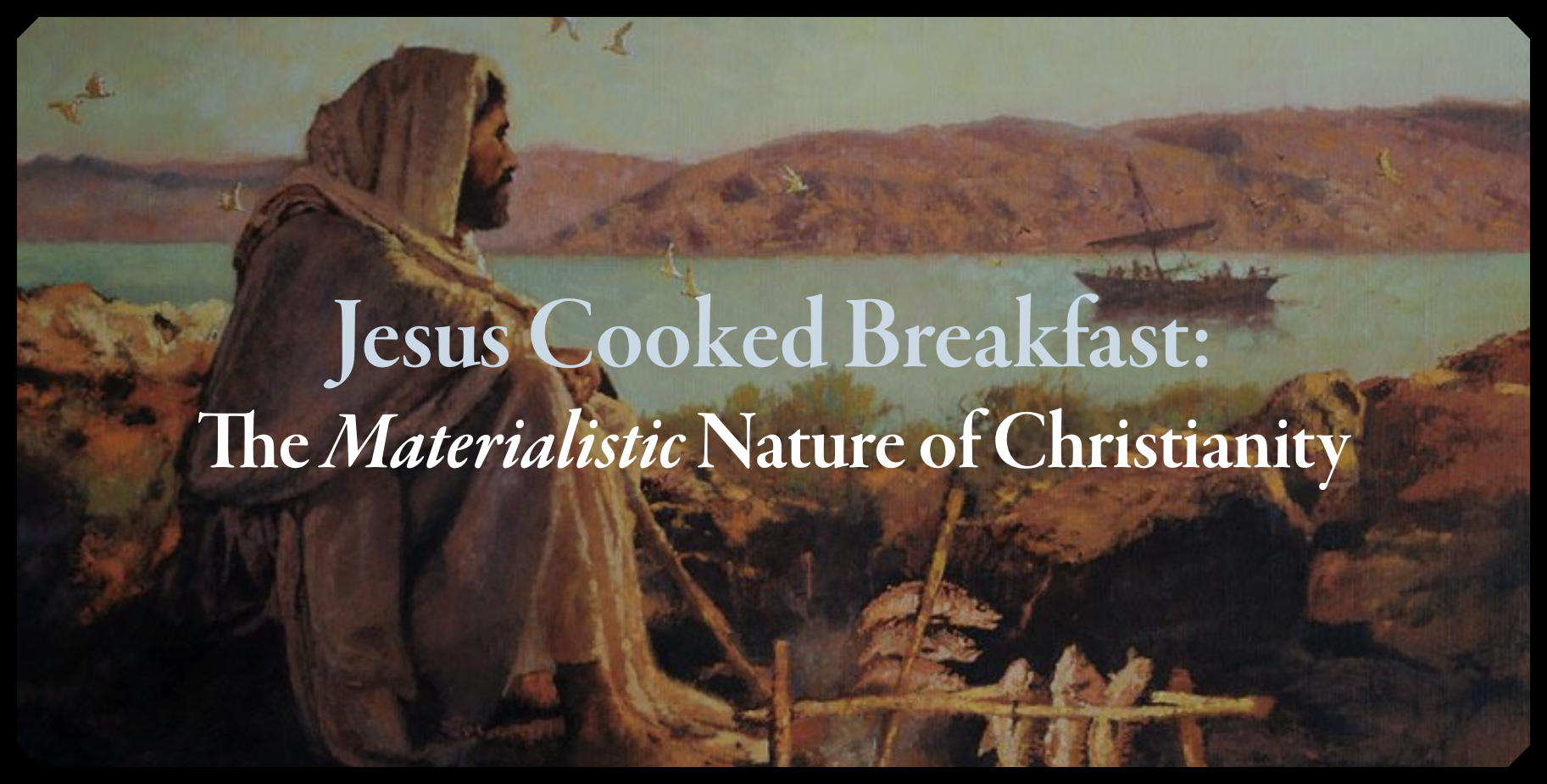
Jesus Cooked Breakfast: The Materialistic Nature of Christianity

This is the third and final post in a short series based on a rereading of Tim Keller’s The Prodigal God. Although I liked the book well enough the first time, I found it to be particularly insightful the second time I read it; you can read the previous posts, “The Elder Brother We Need” and “Exiled from Home.”


Something that I have observed frequently in my life as a Christian is the elevation of “spiritual” things in a way that trivializes things that are material. This seemed normal and right to me for a long time, until I became a better student of theology and Christian history and realized that attempts to downplay “physical” and “material” things as unimportant are actually echoes of ancient Christian heresies like gnosticism or reflect influence from Greek platonism rather than being a genuine representation of the historic Christian faith, which emphasizes the goodness of creation and God’s intention to redeem it.

One of the things I loved about The Prodigal God was Keller’s section, “Salvation Is Material.”[1] In this section, he makes a brief but strong case for the material nature of Christianity. In fact, Keller claims that Christianity is perhaps the most materialistic of the world’s faiths. Here he does not mean materialism in the sense of being focused on wealth and possessions, but rather that the Christian faith values what is created and tangible.

Keller begins with the significance of meals in the Christian faith, and then traces God’s love for the material world through the biblical narrative (words in bold reflect my own emphasis):

A meal is a very physical experience. Jesus left a meal, the Lord’s Supper, to be remembered by, and the final goal of history is a meal, the wedding supper of the Lamb (Revelation 19). The resurrected Christ ate with his disciples when he met with them (Luke 24:42–43; John 21:9). What does it all mean? It is a sign that, for Jesus, this material world matters.

The book of Genesis tells us that when God made this world he looked upon the physical creation and called it “good.” He loves and cares for the material world. The fact of Jesus’s resurrection and the promise of a new heavens and new earth show clearly that he still cares for it. This world is not simply a theater for individual conversion narratives, to be discarded at the end when we all go to heaven. No, the ultimate purpose of Jesus is not only individual salvation and pardon for sins but also the renewal of this world, the end of disease, poverty, injustice, violence, suffering, and death. The climax of history is not a higher form of disembodied consciousness but a feast. God made the world with all its colors, tastes, lights, sounds, with all its life-forms living in interdependent systems. It is now marred, stained, and broken, and he will not rest until he has put it right.

Distinct from other world religions and philosophies, ministry of Jesus emphasized his care and concern for what happened to people in this material existence:

If the material world were only an allusion, as Eastern philosophy says, or only a temporary copy of the real, ideal world, as Plato says, then what happens in this world or in this life would be unimportant. All that would matter would be issues of soul or spirit. However, Jesus was not simply saved “in spirit” but was resurrected in body. God has made both soul and body and is going to redeem both soul and body. Everything about the ministry of Jesus demonstrated this fact. Jesus not only preached the world, but also healed the sick, fed the hungry, and cared for the needs of the poor.

In Matthew 25, Jesus describes Judgment Day. Many will stand there and call him “Lord,” but Jesus says, stunningly, that if they had not been serving the hungry, the refugee, the sick, and the prisoner, then they hadn’t been serving him (Matthew 25:34–40). This is no contradiction to what we have heard from Jesus in the Parable of the Prodigal Son. He is not saying that only the social workers get into heaven. Rather, he is saying that the inevitable sign that yo know you are a sinner saved by sheer, costly grace is a sensitive social conscience and a life poured out in deeds of service to the poor. Younger brothers are too selfish and elder brothers too self-righteous to care for the poor. 

I love what Keller says about the miracles of Jesus: rather than somehow overwhelming natural law and the way things are supposed to work, they were actually revelations of the way things are supposed to work—a restoration of the way God designed things from the beginning. And indeed, Jesus reveals a determination to deal with the broken aspects of life on earth, and his followers should have a similar determination:

Christianity, therefore, is perhaps the most materialistic of the world’s faiths. Jesus’s miracles were not so much violations of the natural order, but a restoration of the natural order. God did not create a world with blindness, leprosy, hunger, and death in it. Jesus’s miracles were signs that someday all these corruptions of his creation would be abolished. Christians therefore can talk of saving the soul and of building social systems that deliver safe streets and warm homes in the same sentence. With integrity.

Jesus hates suffering, injustice, evil, and death so much, he came and experienced it to defeat it and, someday, to wipe the world clean of it. Knowing all this, Christians cannot be passive about hunger, sickness, and injustice. Karl Marx and others have charged that religion is “the opiate of the masses.” That is, it is a sedative that makes people passive toward injustice, because there will be “pie in the sky bye and bye.” That may be true of some religions that teach people that this material world is unimportant or illusory. Christianity, however, teaches that God hates the suffering and oppression  of this material world so much, he was willing to get involved in it and to fight against it. Properly understood, Christianity is by no means the opiate of the people. It’s more like the smelling salts. 

The Christian faith, as revealed and embodied in Jesus of Nazareth, doesn’t pretend that suffering doesn’t matter or that it doesn’t exist. Rather, it helps wake us up to the reality of the brokenness of the world in which we live, and stirs us to action as representatives of a different sort of world where evil will be defeated and suffering will be no more.[2]

Tim Keller: Properly understood, Christianity is by no means the opiate of the people. It’s more like the smelling salts. Share on X

[1] The quoted portions are from Timothy Keller, The Prodigal God: Recovering the Heart of the Christian Faith (New York: Dutton, 2008), 110-13.

[2] In The Silver Chair in the Chronicles of Narnia, Puddleglum sticks his foot into the fire, and the suffering he experiences breaks the enchantment of evil that has overshadowed he and his companions. I believe C.S. Lewis was making a similar point to Keller, that suffering through a Christian lens “wakes us up” to the reality of the brokenness of our world.

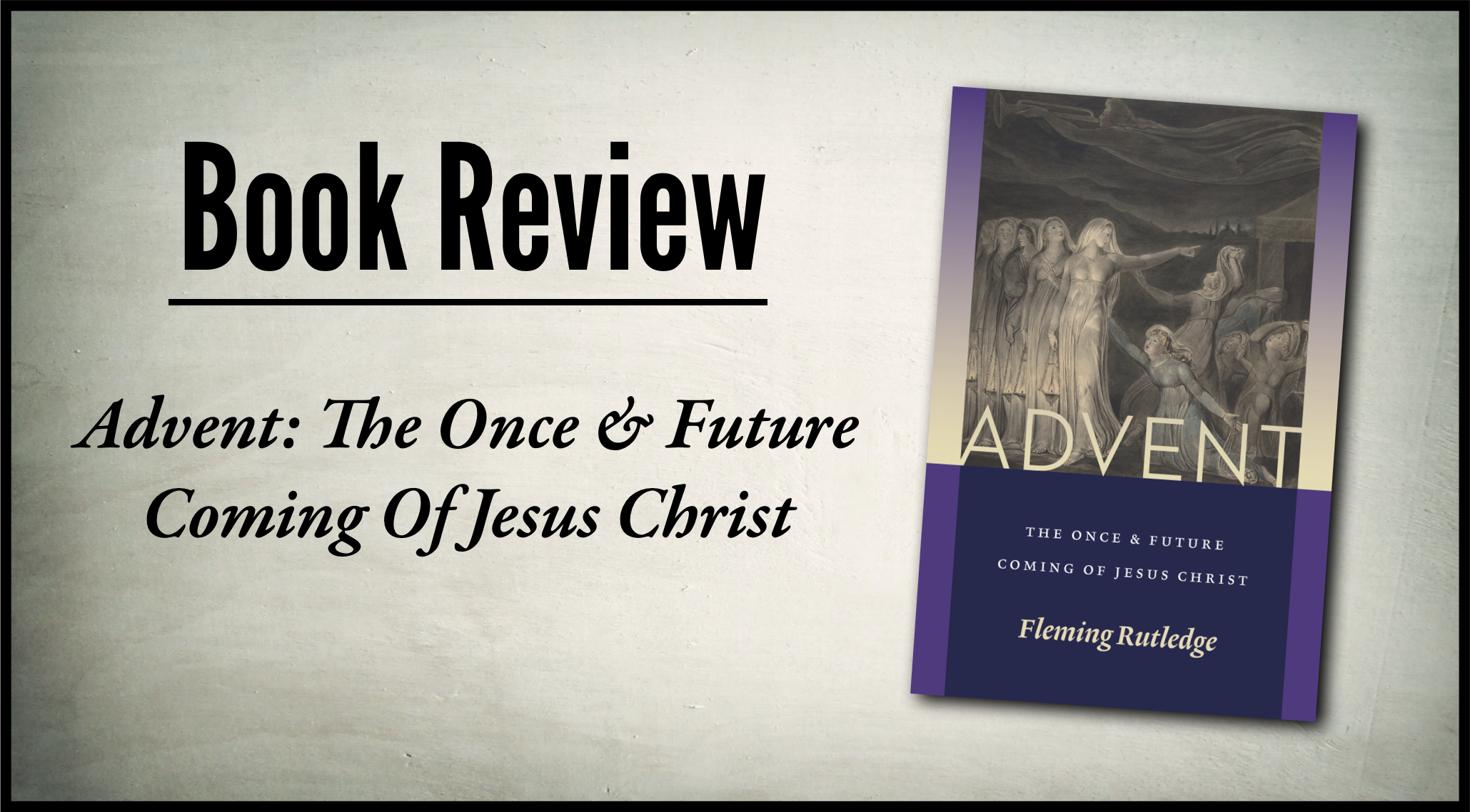
Book Review: Advent: The Once & Future Coming Of Jesus Christ

We are a couple of weeks away from my annual post in which I discuss my favorite books of the year, but I wanted to go ahead and highlight one of those books with a brief review.

Fleming Rutledge’s Advent: The Once & Future Coming of Jesus Christ is a collection of writings and sermons from her decades as an Episcopal priest. I had heard good things about the book and was hopeful that it would give me a better understanding Advent. It did not disappoint; growing up in a church context where we did not observe the liturgical calendar, my knowledge of Advent was gleaned mainly from culture, which is rarely a good way to learn about something accurately!

Advent is not about extending a commercialized and sentimental Christmas holiday. Indeed, in many ways, celebration of Advent postpones the celebration of Christmas by instead emphasizing the waiting that is central to the lives of God’s people, both in the sense of waiting for the arrival of the Messiah, but also, now, waiting for Him to return. In that sense, Advent is essentially eschatological. Also, far from being sappy and sentimental, Advent looks unblinkingly at the brokenness of our world and acknowledges our need for the coming of a Judge who will stamp out sin, evil, and death.

Of all the seasons of the church year, Advent most closely mirrors the daily lives of Christians and of the church, asks the most important ethical questions, presents the most accurate picture of the human condition, and above all, orients us to the future of the God who will come again. (1)

A key emphasis of Rutledge’s book, however, is that much of the eschatological focus of Advent has been lost and needs to be reclaimed. Advent cannot be pressed into the service of Christmas, but must instead be about what it is supposed to be about:

During much of the twentieth century, the second coming of Christ was considered in the mainline churches to be an obsolete if not downright embarrassing topic for preaching, and the subject of the divine judgment that was so familiar to medieval and Reformation-era congregations fell into disfavor with the ascendancy of liberal theology. (6).[1]

Rutledge is a keen theological thinker and an excellent communicator. She was one of the first women to be ordained to the priesthood of the Episcopal Church,[2] and is now in her 80s. This means that she draws from a remarkable well of experience, and also that she at times exhibits a delightful sort of crankiness that comes with age and many years of ministry. She is also a Southerner (born in Virginia), which comes out in endearing ways as well.

The book is comprised of a sort of theological introduction to the practice of Advent, followed by a section of Writings, articles written by Rutledge on Advent over the years, and Sermons, divided according to where they fall in the church calendar. In the section of sermons, in particular, there is, at times, a good deal of overlap, as you can imagine that 40 years of sermons on the same topic will re-tread some of the same ground. I can imagine that this would be one of the main critiques of the book, but in my case, I read it slowly over a period of several weeks (usually reading one or two sermons per day), so it did not seem as repetitive as it may have otherwise.

Now, on to some of my favorite quotations (bolded text reflects my own emphasis):

We live not according to the reign of Satan, but as those who know that “the ruler of this kosmos” is already doomed—in spite of all appearances to the contrary. …The church lives, therefore, without fear, in faith that the cosmic change of regime has already been accomplished. (12-13)

Nothing short of divine intervention can arrest the ever-recurring cycle of human misery. (13)

…Far from escaping the world, the Christian disciple finds his or her vocation precisely here: at the collision of the ages where the struggle of the Enemy against God continues, making a space for the conquering love of God for the world. (16)

The concept of justice is indeed central to the biblical portrait of the God who has revealed himself in his written Word and in the incarnate Word who is his Son. However, the current use of “justice” as a rallying cry for the church is reductive, because it is limited to particular political and economic issues without reference to the righteousness of God. A key biblical meaning of justice is found in the fact that the world translated “justice” and “righteousness” is the same word in Hebrew and in Greek. …All the references to judgment in the Bible should be understood in the context of God’s righteousness—not just his being righteous (noun) but his “making right” (verb) all that has been wrong. Clearly, human justice is a very limited enterprise compared to the ultimate making-right of God in the promised day of judgment. (21-22)

The way of Christian community is not, however, to retreat from horror into the solace of personal religion, but to proclaim Christ’s hope to the world. (53)

In Advent, we don’t pretend, as I once thought, that we are in the darkness before the birth of Christ. Rather, we take a good hard look at the darkness we are in now, facing and defining it honestly, so that we will understand with utmost clarity that our great and only hope is in Jesus’s final victorious coming. (58)

Even our smallest lights will be signs in the world, lights to show the way, beachheads to hold against the Enemy until the day when the great Conqueror lands with Michael the archangel at the head of his troops. (81)

We need to understand the difference between optimism and hope. Optimism often arises out of denial of the real facts; hope, however, persists in spite of the clearly recognized facts because it is anchored in something beyond.…Mere optimism cannot survive the brutal facts; but Christian hope is something else. Christian hope does not build a foundation on a new millennium. Christian hope builds its foundation on the promise of the living God that the random chaos of the world will be revealed one day to have been led and shaped by the same hand that reached out to heal the sick and make the blind to see, to raise the dead and “to call into existence the things that do not exist” (Rom. 4:17). (92,94)

Power is most dangerous in the hands of the strong and well-meaning, those who are sure that they can use it for good purposes. Evil is loose in the world and can take over anyone, anywhere, at any time—but the proud and the self-righteous are especially vulnerable. (124)

In the New Testament, the basic imagery of this world is that of a country occupied by the enemy forces—like most of Europe occupied by the Nazis. It is not that the world itself is bad, for as we know, the world is God’s good creation; but since the fall of Adam and Eve, the world is occupied by Satan. …If you live in occupied territory, you can be a collaborator or you can be in the underground resistance, but you can’t just be neutral. (143-44)

The human being is in the grip of impulses that are more powerful than our wish to do good. (151)

One of the idols of our own time is the idol we have made of a God who never judges anyone or anything. We have created a God who accepts everyone “just as they are” and never says anything against us, because that would be “judgmental.” (179)

The season was not intended to be the run-up to Christmas in the sense that we think of today. I t was designed to be the season to look forward, not to the birth of the baby Jesus in Bethlehem, but to the second coming of Christ. Advent locates the church properly, in between the times, the time of waiting through the night for the Bridegroom to come. (180)

We bear witness to our allegiance to the kingdom of God by giving away a lot of our money. (197)

For the Christian, the time is always getting late; the situation is always grave; ultimate matters press in upon us. (238)

More often than not, the Bible isn’t taught today as if it were about God. It’s taught as a repository of human religious thinking. It’s presented as an interesting and important document about human spiritual development. It’s treated as a collection of human imaginings about God. But this is precisely what the Bible is not. The Bible demands to be understood as the revelation of the one true God who is really God. This doesn’t have to be believed, of course, but it requires that we hear it in the way it means to be heard, whether we believe it or not. (318)

The idea of a resurrection is preposterous enough, but not as preposterous as the idea of a crucified Messiah. To believe that it is all illusory, you have to believe that resurrection was a tidy idea invented by the disciples of a crucified man so that they could go out and meet their deaths proclaiming him to the entire world. People who believe that will believe anything; they will even believe that mankind is inherently good and progressing nearer and nearer to perfection every day. (335)

We humans try to create artificial worlds of light at Christmas, hoping to stave off the darkness. Advent summons us to do exactly the opposite; to renounce the easy consolations of artificial light in order to recognize the Coming One, who said, “I am the Light of the world” (John 8:12). (340)

I thought this was a wonderful book—it was one of my favorite reads 0f 2022. For those who observe Advent but would like to root that observance on more theological foundations, this is an excellent resource. But I would also recommend it for those who don’t observe Advent at all, but who are wanting to think more clearly about what it means to live in the in-between time of the inauguration of the reign of Jesus, and the consummation of that reign when He returns—in other words, all Christians.


[1]This quotation reveals one of my favorite characteristics of this book. Considering that Rutledge is a priest in the Episcopal Church, I had assumed that she would be operating from the perspective of liberal theology, but I was far from the mark. To be sure, Rutledge and I come from very different places religiously, but her theology was delightfully orthodox, and in many places, she offered critiques of liberal theology and her own context.

[2]Anticipating some potential pushback here, I will mention that I am not advocating for women priests or, indeed, the ordination of any sort of priesthood at all. I am merely providing a biographical sketch.

2020 Blog Review


The end of the year is a good time for reflection, and one of the things I like to look back on is my yearly blogging here at The Doc File.

Overview

Since I started writing here back in 2006 (wow, it is hard for me to believe it has been that long!), I have been very up-and-down in how much I write each year. Last year, I lamented that I had written less in 2019 than any other year since The Doc File began; in 2020, I blogged 50 times, which is the most since 2014. This increase in production was largely due to two factors, I believe:

  • First, the lockdown situation that arose from COVID-19 back in late winter/early spring. It is not so much that this left me with an abundance of free time, but rather that I was sensing the great anxiety that so many were feeling (and feeling some of it myself), and wanted to produce some content that might, perhaps, be encouraging.
  • I engaged in a few different ongoing series this year, which helped give me direction in what to write (more on that below).

The increased frequency of posts combined with the popularity of several posts (see below) meant that The Doc File had over 31,000+ hits in 2020—the second-highest total since I started writing.

Top Posts

By traffic totals, here are my most-read posts during 2020 (posts in bold represents those actually written in 2020):

  1. A Christian Response to COVID-19, March 12, 2020
  2. A New Heaven & A New Earth: What the Bible Teaches about Eternity, April 9, 2020
  3. The Role and Character of Elihu in the Book of Job, December 3, 2010
  4. Lessons from David: Sin Has Consequences, March 17, 2014
  5. Creation and New Creation: Connections Between Genesis and Revelation, April 25, 2017
  6. Links Between Daniel and Esther, October 10, 2011
  7. Scattered Reflections on Race-Related Issues, June 9, 2020
  8. A New Heaven & A New Earth: What the Bible Teaches about Eternity Part 2: Distractions, April 16, 2020
  9. Moral Evil and Natural Evil, February 24, 2015
  10. A New Heaven & A New Earth: What the Bible Teaches about Eternity Part 3: “Problem” Texts: 1 Thessalonians 4.13-18, April 23, 2020

Five of the top ten posts were not written this year, and four of those (Elihu, David, Creation/New Creation, Evil) were in my top posts from last year as well. Those posts must be particularly accessible to search engines based on their enduring popularity.

“A Christian Response to COVID-19” was my most popular post of the year, and went somewhat viral (pun intended). I wrote it in the early days of the pandemic, and it clearly struck a chord with a lot of people. Similarly, “Scattered Reflections on Race-Related Issues” was read a lot, and also reflected on current events that were dominating all forms of media. The three posts on “A New Heaven & A New Earth” were all part of a much longer series that a lot of people read and seemed to benefit from.

The Year of Blog Series

That last sentence helps me transition to one of the biggest changes in my blogging in 2020, which was the extent to which I wrote multi-post blog series. Over the years, I have written several series on The Doc File, but it is something I have struggled to do (often taking a really long time to complete series or even abandoning a series midstream). With that in mind, I was proud of my perseverance in completing a few series in 2020:

A New Heaven & A New Earth: What the Bible Teaches about Eternity: I had taught on this subject back in 2019, but blogging through all of this material enabled me to polish my notes and provide citations as well as refine my thoughts. This series summarized what has been a significant theological shift for me over the past decade, one which has provided a great sense of purpose, hope, and excitement. Additionally, I felt that it was a fitting topic for the extended season of fear and uncertainty that Spring/Summer 2020 turned out to be.

It was a significant project—12 posts and some 37,000 words—and had I realized how much work it would take, I’m not sure that I would have begun it. I am really glad I did, though—in addition to the satisfaction of bringing a project of this size to a state of semi-polished completion, it also led to a lot of good conversations and feedback, and three of my most-read posts from 2020 were from this series (with several more just outside the Top 10).

Ranking Narnia: Early in quarantine, I began reading through The Chronicles of Narnia, which I found to be very good reading for the craziness of 2020: it provided imaginative distraction from current reality, and also helped re-orient me from fear to trust.

I have enjoyed these books since college, and the idea of blogging about them had been in my mind since at least 2007 or so. What began as a plan to write a post or two ranking the various books in the Narnia series continued to grow and expand, ultimately resulting in an 8-part, 23,ooo word series. In a sense, these were book reviews. I have never particularly enjoyed reviewing books, and so I didn’t get a lot of pleasure from writing this series, but I was really proud of the result for a few reasons. First, these posts represented growth for me as a writer as these reviews reflect greater depth and thoughtfulness than what I have done in the past. Also, spending so much time thinking and writing about Narnia helped me to appreciate the series even more and yielded new theological insights. Finally, I pushed through and finished[1] this series of posts despite the fact that almost no one read them.[2] In other words, while this series was not as long as the “A New Heaven & A New Earth” series, I am more impressed with it in the sense that I didn’t get a dopamine hit from lots of likes and comments every time I would share a post, but I still finished the series regardless.

Lament For A Son: One of my favorite books in 2020 was Nicholas Wolterstorff’s Lament For A Son. It was a short book, but I thought Wolterstorff shared so many compelling thoughts on the topic of suffering that I decided to write a series of short reflections and basically grouped them as a sub-series of posts under a larger, loosely-united series entitled A Theological View of Suffering (which dates back several years). Like Narnia, this was not a particularly popular series, but I thought Lament For A Son was an important book and worth writing about.

Politics From a Christian Perspective: One of the reasons I write The Doc File is because it helps me work out my thinking on certain topics, and that was certainly the case for this three-part series that I wrote in late October/early November in the midst of a rancorous election season. As a person of faith, I’m convinced that Scripture has a lot to tell us about the way we view politics, but I was dissatisfied with the political engagement I was witnessing from many professed Christians, and I wanted to wrestle with my own views against the background of biblical teaching.

I was under no illusion that my thoughts would change anyone’s mind (and in an election where an unprecedented number of people voted early, this series of posts came a little too late anyway), but this was a popular series that I got some good feedback on, and it was helpful for me to write about and work through my own beliefs.


So, that was The Doc File in 2020! I’m not sure what 2021 will look like, but it is my hope to continue to write about once a week (the rough pace of my blogging in 2020), and to continue with some multi-post series as well. Thanks to everyone who continues to read and follow, and especially to those who comment and join in the conversation. May God bless each of you in the coming year!


[1] As the length of these posts grew, they became more and more difficult to write and I was sorely tempted to revert to old habits and abandon the series. This can be seen in the release dates of the various posts: May 18, May 26, June 16, June 30, July 20, August 24, October 13, October 23. I went from eight days between the first two posts, to about two weeks between posts, two three wees, to a month, and then seven weeks. The concluding post was shorter and easier to write than the others, and came ten days after the last review.

[2] There were, of course, exceptions, as several people told me how much they enjoyed this series and a few actually reached out to me to see when (or if!) the next post would come out. But on the whole, these posts were amongst the least-read of what I wrote in 2020.

Ranking The Chronicles of Narnia, Part 7: The Last Battle

For a few months now, I have been ranking the different volumes of C.S. Lewis’s masterpiece, The Chronicles of Narnia. So far, I have covered The Magician’s Nephew, The Lion, the Witch and the Wardrobe, The Horse and His Boy, Prince Caspian, The Voyage of the Dawn Treader, and The Silver Chair.

To evaluate each book, I am using a rubric with four different categories: story, characters, worldcraft, and theology. For each category, I will provide a subscore of 1-10, yielding a cumulative maximum score of 40 points.

I have been following the chronological order of the books (even though I don’t consider that to be the best order in which to read the books), which means that this week, I will be ranking the final Narnia book, The Last Battle (LB). I plan to write one additional post to conclude the series.

The Last Battle
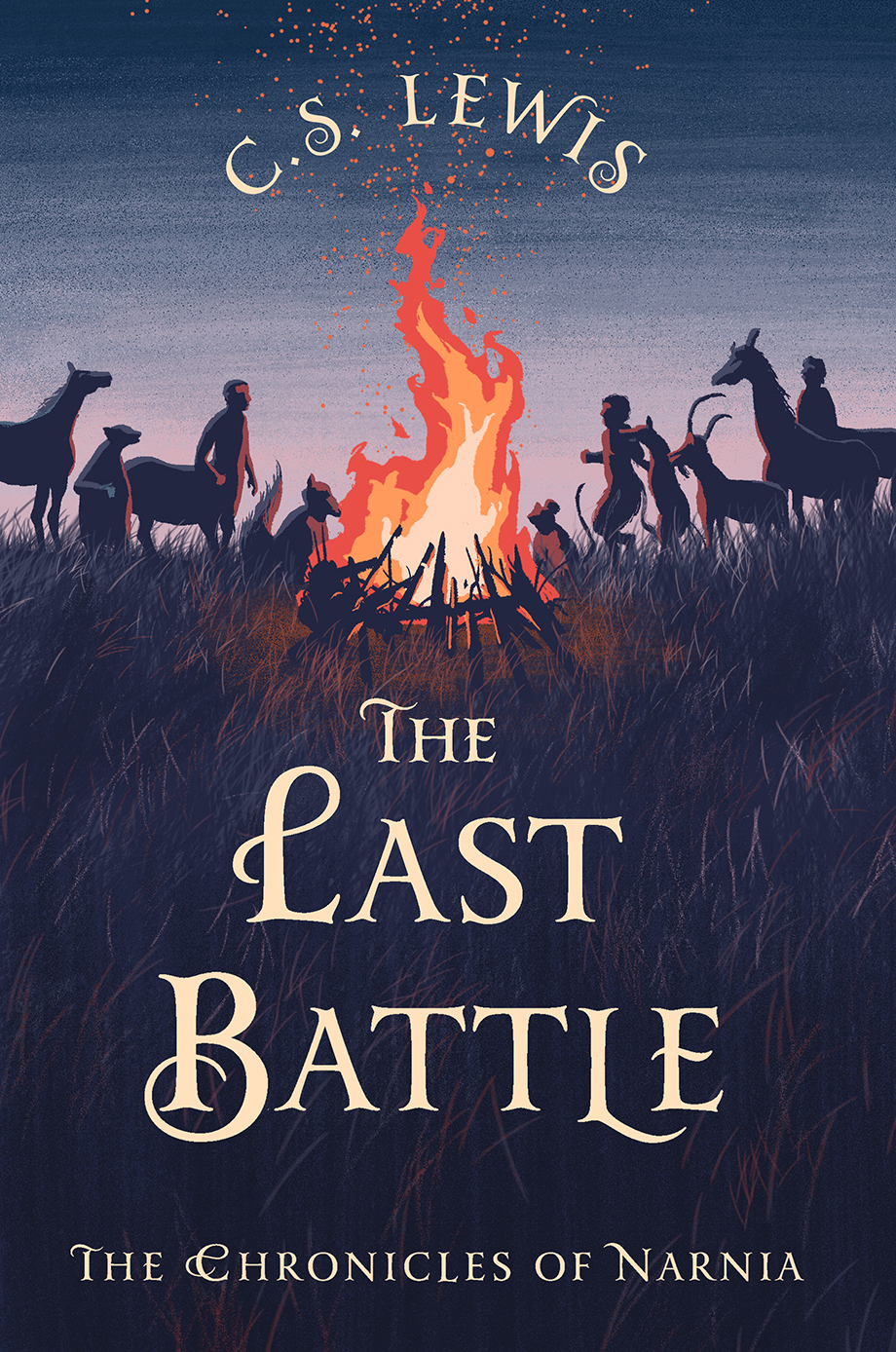
This is from a series of brilliant Narnia cover designs by Jeffrey Nguyen

Story

LB is the story of a coup d’état against Tirian, the last king of Narnia. Shift, a clever but wicked ape, comes across a lion skin floating in the water, and has his well-intentioned-but-dim-witted donkey companion Puzzle wear it and pretend to be Aslan, the Great Lion. “Aslan” is kept hidden away in a stable, Shift serves as his mouthpiece, and, in league with the Calormene warlord Rishda Tarkaan and the Talking Cat Ginger, deceives many of the Narnians into serving the Calormenes and cutting down Talking Trees for lumber.

Tirian and his friend Jewel, a unicorn, learn of the death of the Talking Trees and rush to intervene, ending up captured in the process. Shift and his compadres are now proclaiming the false message that Aslan and the Calormene god Tash are really one and the same (they begin referring to this syncretistic deity as “Tashlan”), and Tirian, seeing through the plot, calls out to Aslan for help. In response, Eustace and Jill (from VDT and SC) arrive in Narnia and, in quick succession, free the king and Jewel, and also find the hapless Aslan-impersonator Puzzle in the stable and allow him to join their company.

Things get worse for Tirian and his allies, as he learns that the Narnian army has been destroyed by invading Calormene troops and Cair Paravel has been taken. Worse still, they see the Calormene god Tash traveling north toward the stable, summoned unintentionally by Shift and Rishda. Driven by desperation, Tirian takes his small band of loyal followers to the stable to confront Shift and his associates and expose their deception. This sets up the climactic battle that gives LB its title: Narnians vs. Calormenes, the rightful king vs. the usurpers, Aslan vs. Tash.

To me, the primary weakness of LB’s storyline is that it just seems unthinkable that Shift’s simplistic plot could deceive so many Narnians and achieve such great success without Tirian having any clue what was going on until it was too late to do something about it. Lewis clearly needed a plot device to bring Narnia to its end, and although this particular one was somewhat unsatisfying, if you look beyond that, what remains is that LB is a poignant story of tragedy, beauty, and finally seeing the true nature of reality.

Story: 8/10

Characters

It seemed to me that there was a greater number of characters with significant roles in LB, and rather than try  to describe them all in detail, I will provide brief sketches of the different characters especially in the context of the groups in which they appear.

Tirian is the last king of Narnia, descendent of Caspian and Rilian. He is loyal to Aslan and loves his country, and although he is somewhat rash and hotheaded in his actions, he is also an excellent leader who shows courage, tactical skill, and concern for his allies. Of course, it should probably be mentioned that virtually the entirety of his subjects were fooled into supporting a coup d’état without his even being aware that it was happening, but there doesn’t seem to be any suggestion that this is due to a character fault on Tirian’s part (which, as pointed out above, is a weakness in the plot). Tirian’s best friend is Jewel the unicorn, a brave and loyal ally and fearsome warrior, who, like Tirian, is faithful to Aslan and willing to fight to the death for Narnia. Farsight the eagle is another member of Tirian’s small band of followers, and provides vital intelligence in the book as a scout as well as useful air support during the climactic battle.

Shift the Ape, Rishda Tarkaan, and Ginger the Talking Cat form a sort of unholy trinity that collaborates to oppress the Narnian population, make possible the Calormene conquest of Narnia, and, as a result, usher in the end of the world. Shift appears first, a clever and ancient ape who, motivated by his greed and lust for power, maneuvers his simple-minded “friend” Puzzle the donkey into impersonating Aslan and then, with the authority gained as “Aslan’s” spokesman, manipulates the talking animals of Narnia into serving himself and the battalion of disguided Calormene troops who have snuck into Narnia. As the farce continues, Shift begins to drink and increasingly becomes less in charge, as he himself is manipulated by Rishda Tarkaan, the captain of the Calormene contingent, and Ginger, the cunning cat. Really, though, it is hard to distinguish between the three characters: all seem to be motivated by greed and self-interest, and have no devotion to speak of, either toward Aslan or Tash. In fact, it is their religious pragmatism that leads to the construction of “Tashlan”, a blasphemous abomination that ultimately brings negative consequences for all three.

It seems worthwhile to also mention the Dwarfs, who play an important role in the story and also illustrate a theme that has been woven throughout the Narnia books: they represent extreme self-interest. When the climactic battle between Tirian and his forces and the Calormene invaders ensues, the Dwarfs don’t take sides (with the notable exception of Poggin, who joins Tirian), and instead attack both parties, saying that “the Dwarfs are for the Dwarfs”. Tirian is disappointed by their lack of support, but again, this is a thread that has been woven throughout the chronicles: in LWW, Dwarfs aided the White Witch in exchange for power, and in PC, Nikabrik was willing to ally himself with anyone who would bring about the end the Dwarfs desired. The Dwarfs are not devoted to Aslan, but to their own self-interests.

“Friends of Narnia” is the description given to the humans who entered Narnia as children and rendered great aid to it in times past: Professor Digory Kirke, Polly Plummer, Peter Pevensie, Edmund Pevensie, Eustace Scrubb, and Jill Pole (sadly, Susan Pevensie is no longer a “friend of Narnia” and thus, is not present[1]). These friends appear to Tirian in a vision when he calls out to Aslan for assistance, and then later, Jill and Eustace appear to free Tirian and Jewel and join them in the last battle for Narnia. Ultimately, Tirian gets to meet all of the Friends after he enters the Stable.

As in the other Narnia books, Aslan’s role in LB is limited in page count but of immense significance for the story.  When Aslan does appear late in the narrative, it is to bring about the death of the old Narnia, the birth of the new, and the judgment of all creatures.

The characterization in LB is solid. Because of the sheer number of characters, we do not get to know them in as much depth as some of the characters from the other stories, but viewing them as groups with various responses to Aslan as I have tried to do above is, I think, a helpful way to reflect on their roles in the narrative.

Characters: 8.5/10

Worldcraft

In one respect, LB does not significantly expand the map of Narnia at all. The majority of the story takes place in the Northwest of Narnia, and while this is a new area, we are told so little about it that it is somewhat disappointing.

But the strength of LB is its depiction of the end of Narnia as it currently exists, and the transition to the fuller and realer Narnia. Repeatedly the characters are urged to go “further up and further in!” and as they do so, they find an exponentially increasing level of depth and beauty:

“Lucy looked hard at the garden and saw that it was not really a garden at all, but a whole world, with its own rivers and woods and sea and mountains. But they were not strange: she knew them all.

“I see,” she said. “This is still Narnia, and more real and more beautiful than the Narnia down below, just as it was more real and more beautiful than the Narnia outside the Stable door! I see…world within world, Narnia within Narnia…”

“Yes,” said Mr. Tumnus, “like an onion: except that as you go in and in, each cirlce is larger than the last.” (765)[2]

Really, the last five chapters of LB are an account of this great process of uncreation and recreation, and in terms of worldcraft, this is the high point of the book.

Worldcraft: 9/10

Theology

Fundamentally, LB is a book about eschatology; Lewis once summarized it as being about “the coming of the Antichrist (the Ape), the end of the world and the Last Judgement,”[3] and we will use those categories to reflect on the theology of LB.

Antichrist(s)

A great amount of ink has been spilt over the centuries seeking to interpret the Book of Revelation, and one particular interpretive method has been to suggest that a literal battle between the forces of good and evil  will precede the return of Jesus and the judgment of the world, and heading up the forces of evil will be the Antichrist. Interestingly, the Bible doesn’t actually teach this in Revelation at all, and the use of the word antichrist (always in 1-2 John) is probably better understood in a lowercase sense: those who deny the Father and the Son or who refuse to confess that Jesus came in the flesh are antichrists. 

I am not certain what Lewis believed about the Antichrist and futuristic cosmic battles, but I still think that LB captures an element of biblical truth when he portrays Shift’s plot to have Puzzle impersonate Aslan and deceive his followers. In the apocalyptic Matthew 24, Jesus warns of “false Christs” who will perform great signs and wonders and claim to be the Christ, and in Revelation 13, John warns of a beast that looked like Jesus (“he had two horns like a lamb”), but spoke like a dragon (Satan). Here is the message, clear to both LB and biblical witness: there is great danger when forces of evil speak for Jesus and His followers cannot tell the difference.

Late in LB, Jill reflects to herself:

“And then she understood the devilish cunning of the enemies’ plan. By mixing a little truth with it they had made their lie far stronger.” (723)

This is devilish because, indeed, it is how the Devil operates: a mixture of truth with falsehood to make the lie more believable and more dangerous. Earlier in the story, when Tirian and Jewel learn of the horrible things that Shift is commanding in the name of Aslan, they are torn: surely this is not what they would expect from Aslan, but haven’t they always heard that He is “not a tame lion” (677, 679, 682)? Does that not mean that he is unpredictable and may do things they don’t understand? Shift seizes upon this same language to force compliance from the Narnians who feel that “Aslan’s” demands are harsh and who wish that they could see him for themselves rather than always having to take Shift’s word for it:

“But why can’t we see Aslan properly and talk to him?” it said. “When he used to appear in Narnia in the old days everyone could talk to him face to face.”

“Don’t you believe it,” said the Ape. “And even if it was true, times have changed. Aslan says he’s been far too soft with you before, do you see? Well, he isn’t going to be soft any more. He’s going to lick you into shape this time. He’ll teach you to think he’s a tame lion!” (684)

To say that Aslan is “not tame” is to say that he is powerful, he is sovereign, and, ultimately, that he is free—free to act in keeping with his own will and character. It does not mean, as Shift suggests and as Tirian and Jewel fear, that he is wildly unpredictable and free to act in ways that are inconsistent with his character. But when truth is mixed in, the lie is made far stronger.

The End of the World(?)

As LB reaches its climax, Tirian and his followers lament what they see as the ending of Narnia and also dread what awaits them through the door of the Stable. What they discover, however, is that the ending of the old Narnia was necessary, and that it has ushered in Aslan’s judgment and, ultimately, their own entrance into the new Narnia, which is in some ways like the Narnia they previously knew, but is richer and fuller in every way:

“And yet they’re not like,” said Lucy. “They’re different. They have more colours on them and they look further away than I remembered and they’re more…more…oh, I don’t know…”

“More like the real thing,” said the Lord Digory softly. (759)

“But that was not the real Narnia. That had a beginning and an end. It was only a shadow or a copy of the real Narnia which has always been here and always will be here: just as in our own world, England and all, is only a shadow or copy of something in Aslan’s real world. You need not mourn over Narnia, Lucy. All of the old Narnia that mattered, all the dear creatures, have been drawn into the real Narnia through the Door. And of course it is different; as different as the real thing is from a shadow or as waking life is from a dream.” (759)

“I have come home at last! This is my real country! I belong here. This is the land I have been looking for all my life, though I never knew it till now. The reason why we loved the old Narnia is that it sometimes looked a little like this. Come further up, come further in!” (760)

To be clear, this is not some sort of eastern philosophy that suggests that the present world in which we live and operate is all an illusion; rather, it is that this present world is temporary, but is made to point us to that which is eternal. In describing that world, John describes it as “a new heaven and a new earth,” a world where God is “making all things new” (Revelation 21.1-5a). When all things are made new, it may signify the end of this world as it presently is, but it is truly just the beginning of the life that God intends for the faithful:

“There was a real railway accident,” said Aslan softly. “Your father and mother and all of you are—as you used to call it in the Shadowlands—dead. The term is over: the holidays have begun. The dream is ended: this is the morning.”

And as He spoke, He no longer looked to them like a lion; but the things that began to happen after that were so great and beautiful that I cannot write them. And for us this is the end of all the stories, and we can most truly say that they all lived happily ever after. But for them it was only the beginning of the real story. All their life in this world and all their adventures in Narnia had only been the cover and the title page: now at last they were beginning Chapter One of the Great Story which no one on earth has read: which goes on forever: in which every chapter is better than the one before.  (767)

The Last Judgement: Was C.S. Lewis a Universalist?

Based on his characterization of the end of the world and the last judgement in LB, C.S. Lewis is sometimes accused of being a universalist, someone who holds that all people will ultimately be saved.

Specifically, this point is argued because of the character of Emeth, the loyal Calormene servant of Tash who finds himself in the real Narnia. Emeth recounts his meeting with Aslan, whose very name had always been hateful to him:

“Then I fell at his feet and thought, Surely this is the hour of death, for the Lion (who is worthy of all honour) will know that I have served Tash all my days and not him. Nevertheless, it is better to see the Lion and die than to be Tisroc of the world and live and not to have seen him. But the Glorious One bent down his golden head and touched my forehead with his tongue and said, “Son, thou art welcome.” But I said, “Alas, Lord, I am no son of thine but the servant of Tash.” He answered, “Child, all the service thou hast done to Tash, I account as service done to me.” Then by reason of my great desire for wisdom and understanding, I overcame my fear and questioned the Glorious One and said, “Lord, is it then true, as the Ape said, that thou and Tash are one?”

The Lion growled so that the earth shook (but his wrath was not against me) and said, “It is false. Not because he and I are one, but because we are opposites—I take to me the services which thou hast done to him. For I and he are of such different kinds that no service which is vile can be done to me, and no which is not vile can be done to him. Therefore, if any man swear by Tash and keep his oath for the oath’s sake, it is by me that he has truly sworn, though he know it not, and it is I who reward him. And if any man do a cruelty in my name, then, though he says the name Aslan, it is Tash whom he serves and by Tash his deed is accepted. Does thou understand, Child?” I said, “Lord, thou knowest how much I understand.” But I also (for the truth constrained me), “Yet I have been seeking Tash all my days.” “Beloved,” said the Glorious One, “unless thy desire had been for me thou wouldst not have sought so long and so truly. For all find what they truly seek.” (756-57)

In other words, the service that the good and virtuous Emeth had rendered for (he thought) Tash, was actually service to Aslan and, as a result, he was rewarded as if it had been Aslan that he had been seeking all his life.

This perspective is not actually universalist, however; it is inclusivist. Inclusivists believe that salvation is found only in Jesus (or in Aslan!), but:

“Those who die before they learn of Jesus or who are faithful to “God” as they understand him will be saved by Jesus in the end…[t]he Muslim who dies a Muslim will not be surprised to find Jesus at the gates of Heaven; the Qur’an teaches that Jesus will be there. They will be surprised to learn that he is, in fact, the Son of God and not merely a prophet. But Jesus will welcome them in based on their faithfulness to what they thought they knew.”[4]

Indeed, there is ample evidence in LB that Lewis believes that not all will be saved. Shift is devoured by Tash, and Rishda is carried away by him. Ginger is terrified in his presence, and loses the ability to speak, which is very similar to the Talking Beasts who approach Aslan in the judgment, and look at him with fear and hatred for just a moment. Then, something happens to them:

“You could see that they suddenly ceased to be Talking Beasts. They were just ordinary animals. And all the creatures who looked at Aslan in that way swerved to their right, his left, and disappeared into his huge black shadow, which (as you have heard) streamed away to the left of the doorway. The children never saw them again. I don’t know what became of them.” (751)

This is hardly a picture of salvation.

There are also the Dwarfs, who find themselves inside the Stable in the same glorious location as Tirian and the Friends of Narnia but who are totally blind to their surroundings and just see a dark and smelly stable. They certainly don’t appear to be saved and, indeed, Aslan says that he can do nothing for them:

“You see,” said Aslan. “They will not let us help them. They have chosen cunning instead of belief. Their prison is only in their own minds, yet they are in that prison; and so afraid of being taken in that they cannot be taken out.” (748)

Lewis shares a similar idea in his classic, The Great Divorce:

“There are only two kinds of people in the end: those who say to God, “Thy will be done,” and those to whom God says, in the end, “Thy will be done.” All that are in Hell, choose it. Without that self-choice there could be no Hell.”[5]

The Dwarfs are emblematic of those to whom Aslan sadly says, “Thy will be done.”

Lewis’s inclusivism may be unacceptable to some Christians, but he clearly is not a universalist. At least from the perspective of LB, there are some who will be saved who may not actually know Christ, but there are many who, tragically, will not be saved at all.

Theology: 9/10
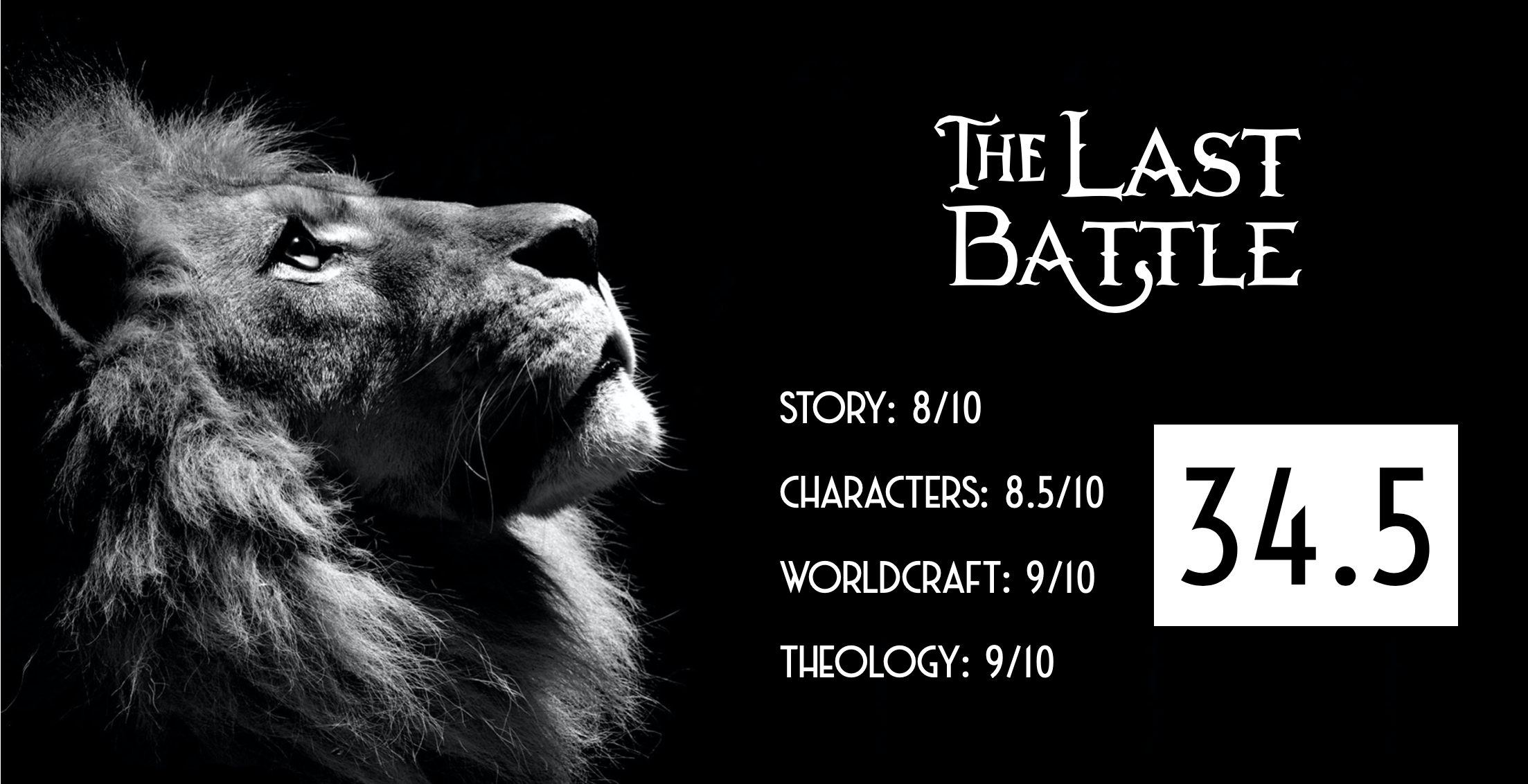
With a score of 34.5/40, LB holds the median position for me of the seven Narnia books. It is a notch below the top-tier books (LWW, HHB, and VDT) but solidly above PC and SC, and way above MN. On Amazon, it would garner a 4 or 5-star rating.


Check out the full series of posts:


[1]  We probably have to mention here that Lewis receives a lot of criticism for his portrayal of Susan in LB, which is, supposedly, sexist. Jill says of Susan: “She’s interested in nothing nowadays except nylons and lipstick and invitations. She always was a jolly sight too keen on being grown-up.” That Susan is described as embracing womanhood in this way and that Lewis writes her out of the “friends of Narnia” as a result is considered to be damning evidence.

It is beyond the purview of what I am doing in this series to address that criticism in detail, but I would suggest that, similar to the allegations of racism in HHB, this is off-base. In addition to the fact that Lewis repeatedly portrays female characters positively (Lucy is arguably the most admirable of all the human characters, Aravis is awesome, Polly and Jill are both likable, etc.), the clear emphasis of the criticism against Susan in the surrounding context is not on her sex but on her grown-upness. This has always been a problem for Susan, and in the world of Narnia, being “old” or “grown-up” is presented as a barrier to having faith in Aslan, as we discussed in the post on PC. In other words, Susan’s problem is not that she is now a woman; it is that she has decided that being a woman means chasing after shallow and frivolous things and distancing herself from the childlike faith that Aslan requires.

[2]  I did not have my regular edition of The Last Battle as I wrote this post, and so the page numbers come from the Barnes & Noble edition. I apologize for the inconsistency with the other posts in the series.

[3]  Paul Ford, Companion to Narnia: Revised Edition (San Franciso: HarperCollins, 2005): 6.

[4] Monte Cox, Significant Others: Understanding Our Non-Christian Neighbors (Abilene, TX: Leafwood, 2017): 24. Cox, himself an exclusivist, provides a helpful discussion on “Exclusivists, Inclusivists, and Pluralists” on pages 22-28.

[5] C.S. Lewis, The Great Divorce (New York: HarperCollins, 2001): 75.
« Older posts

© 2026 The Doc File

Theme by Anders Noren — Up ↑