The online journal of Luke Dockery

Tag: Eschatology (Page 4 of 5)

A New Heaven & A New Earth Series

Below, you can find links to each of the posts in the A New Heaven & A New Earth series:

A New Heaven & A New Earth Part 3: “Problem” Texts–1 Thessalonians 4.13-18

Introduction

Last week, we talked about some “distractions”—different things that are not really related to renewed eschatology, but that people often think of and want to talk about when NHNE is discussed. First, we talked about some alternative visions of what the end times look like: historic premillennialism, dispensational premillennialism, and Jehovah’s Witness eschatology, and ultimately, I shared with you the problems I have with each of those perspectives, and insisted that renewed eschatology is not any of these views.

Then, we talked about the intermediate state, the time period between an individual’s death and the second coming of Christ. Ultimately, I did not come down strongly on what happens to us when we die, but I argued that this is not the basis of Christian hope. The Bible says that believers will be taken care of when they die and in some sense “be with the Lord”, but that this is not the focus. The Christian hope is not about “going to heaven when you die” (those words are never found in the Bible); rather, it is about what happens when Jesus returns—Satan, sin, and death are defeated, we are resurrected and given new bodies, and we live with God eternally. That’s where this series comes in: what does that look like? Do we fly off to heaven and live as spirits with God, or does God in some sense come down, heaven and earth unite, and we live eternally with Him in some sort of embodied existence?


“Problem” Texts

Today and for the next few weeks, we are going to be looking at texts that are often produced in an attempt to refute the renewed earth position. These three texts—1 Thessalonians 4, 2 Peter 3, and John 14.1-3—are ones that I thought of myself when I was first exposed to the NHNE perspective, and I have repeatedly witnessed them being produced in an attempt to refute it.[1] However, I consider these to be “problem” texts, with the quotation marks meaning that I don’t believe these texts, properly understood, oppose the renewed earth perspective at all.

The first text that we want to consider is 1 Thessalonians 4.13-18:

13 But we do not want you to be uninformed, brothers, about those who are asleep, that you may not grieve as others do who have no hope. 14 For since we believe that Jesus died and rose again, even so, through Jesus, God will bring with him those who have fallen asleep. 15 For this we declare to you by a word from the Lord, that we who are alive, who are left until the coming of the Lord, will not precede those who have fallen asleep. 16 For the Lord himself will descend from heaven with a cry of command, with the voice of an archangel, and with the sound of the trumpet of God. And the dead in Christ will rise first. 17 Then we who are alive, who are left, will be caught up together with them in the clouds to meet the Lord in the air, and so we will always be with the Lord. 18 Therefore encourage one another with these words.

Generally, this is read to mean that we will “meet” Jesus in the air (v.17) and then float away with Him back to heaven. But is this the best way to read this passage?

First, what is the purpose of this passage? Contextually, Paul is providing comfort to the Thessalonian Christians about their fellow believers who have died. The point here is really not to describe exactly what their current condition is, but rather to argue that they are taken care of by Jesus. They will rise first when Jesus returns. Paul’s words are meant to provide comfort and reassurance to the Christians in Thessalonica about their loved ones who have died.

Second, to interpret this passage properly, we have to see that this is a text with political overtones, and for us to pick up on this, we have to be familiar with the politics of the first century. Paul is writing to people living in a Roman colony, and the Imperial Cult was a major feature of their lives.[2]

There are several terms used in our Bibles that were actually very commonly used in reference to Rome. For example, we tend to think of the word “gospel” (ευαγγελιον) as a specifically Christian word that refers to the “Good News” of Jesus Christ. But before that, this same word was used in reference to Caesar Augustus, who was seen as bringing about an age of peace and prosperity. Similarly, we tend to think of the title “Lord” as a specific title for Jesus, but first, it was a title for Caesar. When early Christians referred to Jesus as Lord, they were actually making a very subversive claim, because they were stating that Jesus is Lord; Caesar is not. In a similar way, some of the language used in 1 Thessalonians 4 is technical language that Paul borrows from Roman political life.

In 1 Thessalonians 4.15, Paul uses the Greek word parousia (παρουσια; this is the word translated as the “coming” of the Lord). This word often referred to an official divine or imperial visit, the coming of a god or a king into a city. In ancient times, this was a matter of great ceremony and celebration (and, indeed, Paul mentions the voice of an archangel and the sound of a trumpet).

Then, in 4.17, Paul uses the Greek word apantesin, (απαντησιν) which is translated in our Bibles as “meet” the Lord in the air. In English, the word meet can mean different things. Consider three hypothetical scenarios between me and a friend:

  • Scenario 1: My friend calls me at my office at the church building. “Let’s go eat! I’ll drive. Meet me in the parking lot.” So in this instance, my friend comes, I go out to meet him, and then leave with him.
  • Scenario 2: My friend calls me at my office at the church building. “Hey, I have that document you needed, but I am in a hurry. Can you meet me in the parking lot?” So in this instance, my friend comes, I go out to meet him, and then we both go our separate ways.
  • Scenario 3: My friend calls me at my office at the church building. “Hey, I brought those books for you. There are several boxes of them, and I could use some help bringing them in. Can you meet me in the parking lot?” So, in this instance, my friend comes, I go out to meet him, and we both come back to where I am.

In English, any of these scenarios work, because the word “meet” has a range of meaning. The context is necessary to determine which meaning is the correct one. When we read 1 Thessalonians 4.17 and see the English word “meet”, we just assume that the word has the same range of meaning as our word “meet”, and then we have tended to interpret it as meaning that we “meet” Jesus in the air and then return with Him to heaven.

But the Greek word that is used here for “meet” (apantesin/απαντησιν) has an almost technical meaning: sending a delegation outside the city to receive a dignitary who was on the way to the town. So, if Caesar came to your city, you would apantesin him—the leading citizens of the city would go out to welcome him and escort him back. This is how the word is used in many ancient documents and inscriptions outside of the Bible, but is also used this way elsewhere in the New Testament:

  • Acts 28.11-15: In this passage, Paul is on his journey to Rome, and in verse 15, the “brothers” come out to “meet” Paul. When they “meet” him, did they go back with Paul to where he came from? Or did they welcome Paul and then accompany him back to Rome? Obviously, the latter.
  • Matthew 25.1-6: This is the Parable of the Wise and Foolish Virgins. In verse 6, when the wise virgins went out to “meet” the bridegroom, did they leave and go back with him? Or did they welcome the bridegroom into where they had been? Obviously, the latter.
  • John 12.12-15: A version of this same word (hypantesin/υπαντησιν) is also used in verse 13 of John’s account of Jesus’s triumphal entry. When the crowd went out to “meet” Jesus with palm branches, did they leave and go back to where Jesus came from? Or did they welcome him into Jerusalem where they had been? Obviously, the latter.

In each of these contexts, you can see that the word means precisely as we defined it earlier: apantesin refers to a group of people going out to meet someone special (Caesar, an apostle, a bridegroom, the Messiah, the Returning King Jesus), and then welcoming that person back to where you are.

1 Thessalonians 4 is a passage written by a Roman citizen (Paul), to Roman citizens (Thessalonian Christians) living in a Roman colony (Thessalonica) where he borrows politically-charged Roman words and applies them to the return of Jesus. Against this backdrop of what these Greek words actually mean, this text takes on a clear (but different than what we are used to) meaning: Jesus will return with great ceremony, and we will meet Him in the air to escort Him back here. And we will be with Him forever.[3]

I am going to share 1 Thessalonians 4.13-18 again, but now, instead of the words “Lord”, “coming”, and “meet”, I am going to replace them with what the words mean in their historical context:

13 But we do not want you to be uninformed, brothers, about those who are asleep, that you may not grieve as others do who have no hope. 14 For since we believe that Jesus died and rose again, even so, through Jesus, God will bring with him those who have fallen asleep. 15 For this we declare to you by a word from [Our King, Jesus, the true Caesar], that we who are alive, who are left until the [royal visit from our God, King Jesus], will not precede those who have fallen asleep. 16 For [King Jesus] himself will descend from heaven with a cry of command, with the voice of an archangel, and with the sound of the trumpet of God. And the dead in Christ will rise first. 17 Then we who are alive, who are left, will be caught up together with them in the clouds to meet [King Jesus] in the air, [to welcome Him and escort Him back here], and so we will always be with [our God and King]. 18 Therefore encourage one another with these words.

1 Thessalonians doesn’t argue against the renewed earth perspective. It doesn’t teach that we will meet Jesus in the air and then float off to heaven with Him. That is simply not what the word means. 

If you only know the English word “meet”, then the traditional interpretation makes sense. But once you know what the Greek word apantesin means, it changes everything. This is not a case of having different possible interpretations: in English, the word “meet” can mean a lot of different things, but the Greek word apantesin does not have that same flexibility. We have looked at it and it has a very specific meaning: the traditional interpretation does not work with the actual meaning of the Greek word.[4]

This passage tells us that we are going to meet Jesus in the air, and then come back here. It doesn’t tell us what “here” means exactly, or what it is going to look like (in other words, it doesn’t prove the NHNE case), but it does not refute it in any way.

When I was ignorant about the historical background of this passage and the specific meaning of the word, it was one of my top passages for “disproving” renewed eschatology. But when I studied it, I had to face the facts that it didn’t say what I assumed it said. So it forced me to reconsider my thinking: if I am going to be honest, I have to do something with this information; I can’t just pretend that it’s not there.

Excursus: How in the World are we Supposed to Know This?

When I first presented this material, one question I received was, “How in the world are we supposed to know this? Do we have to read Greek or be experts on ancient history to understand the Bible?”

That is a good and important question, and I understand the concern and confusion that underlies it. As Christians, we believe it is really important for us to understand the Bible, because it directs how we should live our lives. If mastery of ancient languages and obscure historical details is necessary to understand it, that is too high of a bar for the vast majority of us.

We need to remember, though, that Scripture was written for us, but it was not written to us. It is written for us in the sense that it has something to teach us, it applies to our lives, it gives us instruction and direction, etc. But it was not written to us in the sense that we were not the immediate, primary audience. In this case, that audience was the Christians at Thessalonica. Paul was writing to them about problems they were having, telling them things they needed to hear, and in ways that they could understand. When he talked to them and referred to concepts like parousia and apantesin, they would have absolutely understood what he was talking about without any trouble. But we are 2,000 years removed from that context and are products of a different culture who speak a different language.

Although it is a common assumption that we should be able to just read the Bible for what it says at face value and that it should be easy for us to understand, when you think about it, that’s really not a very reasonable assumption. I do think that Scripture is basically understandable and that we can learn what we need to know about the Gospel story and how to be saved by just reading the text without understanding much behind it. But the idea that we can basically read someone else’s mail—Paul’s letter to the Thessalonian Christians—from 2,000 years ago and easily understand everything that is going on without doing some extra work at times doesn’t make a lot of sense. Let me give an example to explain my point.

I live in Arkansas, in the Southern United States. Since we don’t write a lot of letters anymore, let’s say that I send an email or a text to a friend who lives in Alabama. While updating my friend on how things are going in my life, I say, “Oh, I burned my hand on the 4th of July; I was holding a Roman candle.” My friend in Alabama would know exactly what I was talking about: July 4th is Independence Day in the United States, and a common way of celebrating in the United States is by shooting off fireworks, of which Roman candles are one variety. Particularly daring (or foolish!) celebrants sometimes hold Roman candles in their hands to shoot them off, which can easily lead to burns. All of this background knowledge related to the celebration of American Independence Day would be easily understood by my friend.

If, however, I were to send an email or Facebook message to a preacher in, say, India or Uganda, and were to say, “Oh, I burned my hand on the 4th of July; I was holding a Roman candle,” that statement would likely require some explanation. What is special about July 4? Why am I holding a candle from the capital city of Italy, or, alternatively, some ancient Roman artifact? How did it come to burn my hand?

With this example in mind, I think it is easy to see how it would be necessary for us to do some additional work (through understanding historical background, cultural practices, and linguistic nuances) to come to a place where we can understand certain parts of the biblical text at a deeper level.[5]

All of that to say, it shouldn’t alarm us that studying the Bible on a deeper level yields new insights and understandings. Rather, it should fill us with wonder and praise that God’s Scripture can be so meaningful at different levels—providing comfort, guidance, and purpose for life at even surface-level readings, while also containing untold depths that keep scholars searching and learning for their entire lives.


[1]When I taught this material as a Bible class, I solicited additional texts from the class for us to consider, but these were the only ones that were really brought up. I am sure there are other texts that could be discussed as well; J. Richard Middleton, A New Heaven and a New Earth: Reclaiming Biblical Eschatology, (Grand Rapids: Baker Academic, 2014): 179-237, discusses at length various texts that could be construed as presenting a perspective contrary to renewed eschatology, and I recommend his work.

[2]For more on the political background of 1 Thessalonians 4, see Bobby Valentine’s excellent post, “Paul, the Roman Imperial Cult, the Return of King Jesus and “Flying Away” in 1 Thessalonians 4.17”, http://stonedcampbelldisciple.com/2011/03/10/paul-the-roman-imperial-cult-the-return-of-king-jesus-and-flying-away-in-1-thessalonians-4-17/; Also, Middleton, 222-25. These two sources lie significantly behind what I have written here.

[3]Michael R. Cosby, “Hellenistic Formal Receptions and Paul’s Use of ΑΠΑΝΤΗΣΙΣ in 1 Thessalonians 4:17,” Bulletin for Biblical Research 4 (1994): 15-34, argues against this technical meaning, saying that Paul’s description in this passage lacks many of the elements of Hellenistic receptions as seen in records from ancient papyri: “Instead of being a cipher for understanding what Paul meant through the supposed use of a technical term, they function more as a foil—a loose pattern to play against when describing the coming of the heavenly king” (31). Cosby’s analysis is flawed for multiple reasons, as Robert H. Gundry, “A Brief Note on “Hellenistic Formal Receptions and Paul’s Use of ΑΠΑΝΤΗΣΙΣ in 1 Thessalonians 4:17,”” Bulletin for Biblical Research 6 (1996): 39-41 points out: “Paul’s description of the Parousia in 1 These 4:15-17 comes closer to what we know of Hellentistc formal receptions than Cosby allows” (41). Gundry further states that all the imperial elements that Paul includes in this passage combine to render the connotation of απαντησις that I have set forth in this article. 

Additionally, Cosby’s analysis is problematic because, in his survey of relevant ancient texts, he acknowledges a diversity of practices in relation to Hellenistic Formal Receptions, but then conjures up some sort of standard set of practices against which Paul’s description supposedly comes up deficient. Finally, the notion that Paul is using the entire imperial imagery as a foil to lampoon imperial power and highlight the superiority of Jesus is surely correct; but such a comparison only makes sense if it is referring to the arrival of a conquering dignitary who is welcomed back to his rightful domain.

More recent commentators like Middleton and Valentine (mentioned above) and Gene L. Green, The Letters to the Thessalonians (Pillar New Testament Commentary; Leicester: Apollos; Grand Rapids: Eerdmans, 2002), 223-26, reject Cosby’s view as well. The scholarly case for the technical meaning of απαντησις as has been suggested here is solid. 

[4]A question I was asked when teaching this material is that if this is what the word apantesin means, why do all of our translations use the word “meet”? Why don’t they use something like “welcome” or “escort”? Well, in short, those words don’t really convey the meaning of apantesin, either. Again, this is a specialized technical word that simply doesn’t have a parallel in English. It conveys the meaning of “go out and meet a visiting dignitary, welcome him, and escort him back to your city.” We simply don’t have a word for that. “Meet” doesn’t convey all of that meaning, but it does as good of a job as any other English word we have.

[5]Valentine, “Paul, the Roman Imperial Cult, the Return of King Jesus and “Flying Away” in 1 Thessalonians 4.17”,  begins his essay by establishing this same idea, that we must within “Understanding Distance” of 1 Thessalonians.

A New Heaven & A New Earth Part 2: Distractions

Introduction

Last week, we introduced renewed eschatology, the idea that at the return of Jesus, the entire cosmos will be made over into a “New Heaven and New Earth”, and that God will dwell there with His people forever.

This differs from the more traditional spiritual heaven view that emphasizes that we will in some sense “fly away” to be with Jesus in heaven, and the earth will be burned up at His second coming.

In this series of posts, I will be explaining and supporting the renewed earth position, and as I mentioned last time, it has taken me a long time to come around to this perspective. If you think I am crazy for believing this, that’s okay at this point, because I haven’t tried to biblically support it yet. We’re going to spend the next several weeks doing that; don’t worry!

Today, we’re actually going to spend our time talking about some ideas that don’t really have anything to do with renewed eschatology at all, which is why I titled this post “Distractions”—these ideas distract us from our purpose of examining the renewed earth argument, but it is still important that we talk about them, because in my experience, anytime NHNE is discussed,[1] people immediately think of these other things. So, my hope is that we can address these ideas in this post and get them out of the way so we can then proceed with our study and not worry about them anymore.


What Renewed Eschatology is Not

Renewed Eschatology is not premillennialism. In my context (churches of Christ), premillennialism is generally looked down upon, and anything that remotely sounds like premillennialism is regarded with suspicion. The NHNE perspective is not premillennialism, but to better establish that point, we first need to discuss premillennialism a bit. So, what is it?

Premillennialism falls into two basic categories:

  • Historic premillennialism is a very old view (dating back to early Church Fathers) that interprets Revelation 20.1-6 as a period of time when Christ will literally reign on this earth before final judgment. I disagree with this view and this interpretation of Revelation 20, but I don’t find it to be particularly harmful.
  • Dispensational premillennialism is a relatively young view (1800s) and is the version of premillennialism that you are likely more familiar with. Like historic premillennialists, dispensational premillennialists also interpret Revelation 20 to refer to a literal reign by Jesus on earth, but this is no minor point of doctrine; rather, it becomes a controlling lens through which they look at all of Scripture. When Jesus came to earth, He intended to set up His kingdom but was rejected by His people and had to set up the church instead.[2]

There are many different teachings associated with dispensational premillennialism (the rapture, the Left Behind books, a literal battle of Armageddon, etc.) and also many different variations (pre-tribulation, mid-tribulation, post-tribulation, etc.), but ultimately, this isn’t a study of premillennialism, so we don’t need to get into all of that. What is important to emphasize here is that all of this (the 1000-year reign of Jesus on earth) happens before the final judgment and an eternity in heaven.

Really, the only element in common between renewed eschatology and premillennialism is that both have something to do with the earth. But in premillennialism, the millennium is a temporary time of Jesus reigning before the end. NHNE is about a renewed earth and heaven united, and God dwelling with His people there forever.

Renewed Eschatology is not what Jehovah’s Witnesses believe. Jehovah’s Witnessed believe that God will extend His heavenly kingdom to include earth, and earth will be transformed to a paradise similar to Eden. But they also believe a lot of things that, from my perspective, are way out there:

A central teaching of Jehovah’s Witnesses is that the current world era, or “system of things”, entered the “last days” in 1914 and faces imminent destruction through intervention by God and Jesus Christ, leading to deliverance for those who worship God acceptably. They consider all other present-day religions to be false, identifying them with “Babylon the Great,” or the “harlot” of  Revelation 17, and believe that they will soon be destroyed by the United Nations, which they believe is represented in scripture by the scarlet-colored wild beast of Revelation chapter 17. This development will mark the beginning of the “great tribulation”. Satan will subsequently use world governments to attack Jehovah’s Witnesses, an action that will prompt God to begin the war of Armageddon, during which all forms of government and all people not counted as Christ’s “sheep” will be destroyed.

After Armageddon, God will extend his heavenly kingdom to include earth, which will be transformed into a paradise similar to the Garden of Eden. Most of those who had died before God’s intervention will gradually be resurrected during the thousand year “judgment day”. This judgment will be based on their actions after resurrection rather than past deeds. At the end of the thousand years, Christ will hand all authority back to God. Then a final test will take place when Satan is released to mislead perfect mankind. Those who fail will be destroyed, along with Satan and his demons. The end result will be a fully tested, glorified human race on earth.[3]

Commonalities

Renewed eschatology does hold that Jesus will return to “earth”, but it is not this earth, but rather, a renewed earth. Also, this will not be part of a millennium, but is the eternal state of things.

Renewed eschatology has some similarities to the Jehovah’s Witness view of some sort of Edenic, recreated earth, but these similarities were not borrowed from Jehovah’s Witnesses. NHNE is a much older view, and if anything, it lies in the background and had elements borrowed from it by Jehovah’s Witnesses. Furthermore, the biblical vision of the “new earth” is not simply a return to Eden, but rather, the potential of Eden fully realized, with God, humanity, and creation living in harmony with one another.

Neither of these views—dispensational premillennialism nor Jehovah’s Witness eschatology—is what I am advocating in this series, but it is important that we discuss them, because as we move forward, there may be a temptation, at least with some, to think “this sounds like __________” (especially premillennialism). It’s not. I don’t believe in any of the views that we just described. Speaking candidly, from my perspective:

  • Historic premillennialism misinterprets Revelation 20.1-6, but isn’t really a big deal.
  • Dispensational premillennialism is a hot mess that leads to a lot of theological problems.
  • Jehovah’s Witness eschatology is crazy.

The Intermediate State

The intermediate state is the time period between an individual’s death and the second coming of Christ. In this series, we are most interested in what happens at the return of Jesus rather than our individual deaths, but we will address the intermediate state here because many people conflate these two issues.

There are different perspectives of what the intermediate state will look like. Here are some of the most common ones:[4]

  • Hadean Realm: This is the view that when we die, we go to “Hades”, the realm of the dead, and experience a conscious existence either in a place of bliss or a place of torment. This is based significantly on the story of the Rich Man and Lazarus that Jesus tells in Luke 16.19-31. After death, Lazarus finds himself in a place of comfort at “Abraham’s Bosom”, while the Rich Man is in Torment. Some find further support for this perspective in Luke 23.39-43, where Jesus tells the thief on the cross, “Today you will be with Me in paradise.”

But what if the story of the Rich Man and Lazarus is actually a parable (as the vast majority of New Testament scholars believe) rather than Jesus trying to give a sheet-sermon description of what happens after death? The point of the parable seems to be that our actions in this life influence our destination in the next life, and that once we have died, it is too late to change that destination.

Furthermore, should we equate “Paradise” from Jesus’ statement to the thief on the cross with “Abraham’s Bosom” without explicit biblical teaching telling us that they are the same?

Finally, in some sense, doesn’t this view suggest that judgment has already happened as opposed to judgment being what happens when Jesus returns? It seems disingenuous to say that Lazarus and the Rich Man are awaiting judgment when they are already experiencing reward and punishment, respectively, as they await the formality of additional judgment.

  • Entrance Into Eternity–Heaven: This is the view that, at death, the faithful immediately enter into the presence of God and live with Him in heaven. Supporters of this perspective point to passages from Paul in Philippians 1.21-24 and 2 Corinthians 5.1-9, where he seems to say that it is better to be with the Lord than to continue living. But does Paul mean that this (being with the Lord) will happen immediately at death, or is he just looking forward to being with God in eternity, and he knows that death is, in a sense, the first step toward that?

Some proponents of this view believe it to be supported by the “thief on the cross” passage mentioned above (Luke 23.39-43), only in this view, “paradise” is “heaven.” But was Jesus really in heaven “today”—the same day He was crucified? Jesus was raised on the third day, and on that day, He told Mary Magdalene, “Do not cling to me, for I have not yet ascended to the Father” (John 20.17). It doesn’t seem to me like Jesus went to heaven at death.

Furthermore, there is the passage in Revelation 6.9-10 where martyrs surround God’s throne crying out, “How long?” They are wondering how long evil will continue on earth; do they actually seem to be at peace? This seems to cut against the traditional idea.[5]

Plus, if the Hadean Realm perspective seems to cut against the notion that judgment occurs at the return of Jesus, this view, which places the faithful dead in heaven already, certainly does so.

  • Entrance Into Eternity–Soul Sleep: What if we’re only aware of the passing of time because we are living on earth? What if we die and for us it seems like we immediately enter judgment because we have no concept of time? Thousands of years pass on earth, but we have no knowledge go it? This view is largely based on the notion that in the Bible, death is frequently described as “sleep.” A good example of this comes from the story of Saul and the Witch of Endor in 1 Samuel 28.15, where the spirit of Samuel is summoned and he complains about being “awakened” from his rest.

But should “sleep” be taken literally here, or is this (and other places in Scripture employing the same terminology) simply a metaphor for death, and a suggestion that death brings about a rest from the toils of life here on earth?

Furthermore, what about Hebrews 12.1 and the great cloud of witnesses mentioned there? How can they witness what we are doing and cheer us on if they are asleep?

Ultimately, we can debate these back and forth.[6] As you have probably discerned, I am not entirely sure what I believe about this because I think there are problems with each perspective.

But here is the real point: regardless of what you believe about this, it is a “distraction” from the topic of this study on renewed eschatology in the sense that it’s not what we’re talking about. We’re talking about what happens when Jesus returns, not what happens in the time in between when you die and when Jesus returns. So we can debate these different views and have interesting discussions about them, but it really doesn’t have to do much with renewed eschatology.

Except…it is a good example of how distracted we have become from the actual Christian hope.

We have long talked about going to heaven when we die, but there is not even one passage in the Bible that talks about “going to heaven” after we die. The phrase “go to heaven” doesn’t appear anywhere in the Old or New Testaments in relation to death.[7] Not once. If that was what Christian hope was all about, don’t you think we’d find that in there somewhere?

There are passages that talk about getting to be “with Jesus” after death, and we have mentioned them above (Luke 23.42-32; Philippians 1.21-24; 2 Corinthians 5.6-9), but this really isn’t the focus of our hope.

The hope for Christians isn’t about life after death—a temporary condition until the Second Coming of Christ where, regardless of which view you take, we are, in some sense, with God and taken care of. Instead, the hope for Christians is about life after life after death—what happens when Jesus returns, we are resurrected and given new bodies, and live with God for eternity.[8]

So, why the change? If the Bible teaches that our hope is based on what happens when Jesus returns, why do we focus so much on what happens when we die?

I don’t know the answer to that question; there are probably several reasons. I do wonder, though: it has been nearly 2,000 years since the New Testament was written and these promises were made, and I wonder if we get tired of waiting. The return of Jesus can seem so uncertain and far off in the future, while death seems much closer and much more certain. Perhaps it is easier for us, impatient as we are, to focus on what happens to us at death than what happens when Jesus returns, and death is defeated.

And I do want to reassure you: whatever happens after death, whichever of the views above is the correct one, for those who die in Christ, we will be taken care of, and we will in some sense “be with the Lord.” We can rest assured of that. But that is just temporary. It is the intermediate state. It’s not what we hope for.

With these “distractions” out of the way, next time we can dive into Scripture, and begin looking at several passages that are generally used to “refute” the renewed earth perspective. When considered closely, I don’t think they do.


[1]As a reminder, NHNE is short for “New Heavens and New Earth.” Throughout this series, I will use “NHNE”, “New Heavens and New Earth”, “renewed eschatology”, and “renewed earth” interchangeably.

[2]This makes the church, and really, the crucifixion and atonement, a back-up plan. Those who subscribe to this position would disagree with the characterization I just used, but theologically, I think it is unavoidable.

[3]Wikipedia contributors, “Eschatology of Jehovah’s Witnesses,” Wikipedia, The Free Encyclopedia, https://en.wikipedia.org/w/index.php?title=Eschatology_of_Jehovah%27s_Witnesses&oldid=898880289 (accessed October 28, 2018).

[4]This discussion of the intermediate state is influenced by Stanley J. Grenz, Theology for the Community of God, (Grand Rapids: Eerdmans, 1994): 589-98, and J. Richard Middleton, A New Heaven and a New Earth: Reclaiming Biblical Eschatology, (Grand Rapids: Baker Academic, 2014): 227-37.

[5]In “Waiting With Us,” John Mark Hicks suggests that these saints, though in the presence of God, share with those of us on earth the lamenting over sin and injustice, and yearn for God’s redemption of all things. So, just because these martyrs are not entirely blissful does not mean the notion that the faithful enter into heaven upon death is incorrect.

[6]For an excellent overview of these different views, see Scott Elliott, “Where Do We Go When We Die.” Scott leans toward the “heaven” view, though rightly asserts that there isn’t enough biblical data for us to be dogmatic about it.

[7]Timothy Mackie and Jonathan Collins, When Heaven Meets Earth: A 12-Part Biblical Study on Heaven (Portland: The Bible Project, 2017). This resource is available for download on The Bible Project website here.

[8]For “Life after life after death” see N.T. Wright, Surprised By Hope: Rethinking Heaven, the Resurrection, and the Mission of the Church, (New York: HarperOne, 2008): 148-52.

A New Heaven & A New Earth: What the Bible Teaches about Eternity

Introduction

A major part of the hope that we have as Christians—a hope that gives us motivation to live faithfully—is that we trust that God will raise us from the dead and that we will live with Him for eternity. 

This should give us peace, confidence, purpose, and boldness.

But there are different ways of viewing what this eternity with God, this paradise, will look like. In fact, an entire branch of Christian theology called eschatology is devoted to the study of eternity and the end times.[1] I’d like to spend several blog posts talking about eschatology, and looking at what the Bible says about it. 

I want to warn you up front: this will be a very challenging study for some. The view that I am going to propose in this series of posts I will refer to as renewed eschatology or NHNE.[2] I believe this to be the biblical view, but it is not what I would call the typical view of eternity that most American Christians hold.

Before we get any further, I want to quickly give you two different perspectives to help frame what we are going to be talking about in this series. These are two different views of what the Bible is about and what our future looks like.

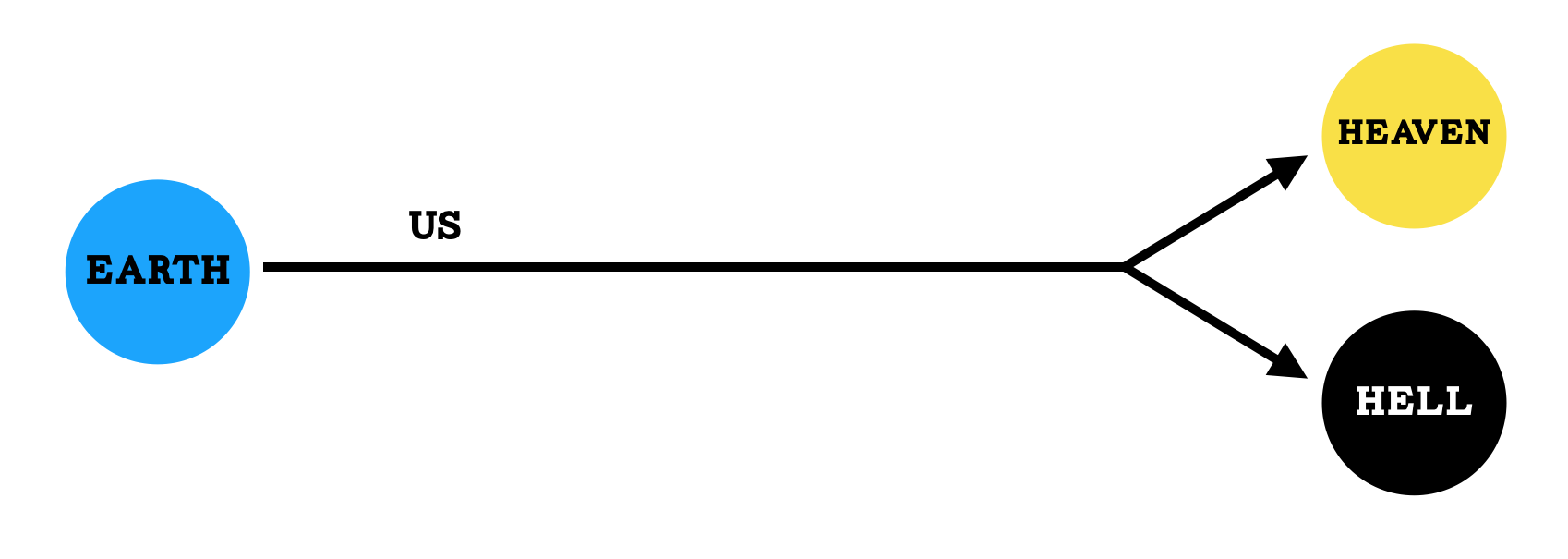
The first view, which I will call the spiritual heaven perspective, says that we live in a world that was created good but became tainted after Adam and Eve’s sin in the Garden. Things are bad and broken and we are lost in our sin.

The Good News is that Jesus came to die for our sin and save us, so that when we die, we can forever leave this broken world (which is bound for fiery destruction) and enjoy a spiritual existence with God forever in heaven. The people that reject God will spend eternity in hell.

In the meantime, we are basically running out the clock, doing our best to survive in a broken world, waiting for Jesus to come rescue us, and hopefully, trying to help other people to be rescued as well. You might think of the Titanic going down: as Christians, we are in the lifeboats, going around trying to save people from drowning…but the ship is going down.


I think this is what much of the non-Christian world believes that Christians believe,[3] and furthermore, I think it actually is what many Christians believe. I believed it myself for a long time. In many ways, it is the traditional Christian perspective.[4]

The problem is, I don’t think the Bible actually teaches this. It certainly teaches parts of it: heaven and hell are real, judgment is real, Jesus came to save us, etc.—but the overall presentation of this view is not, in my opinion, what the Bible teaches.

(Some of you are thinking that I am nuts, and at this point, that is okay.)

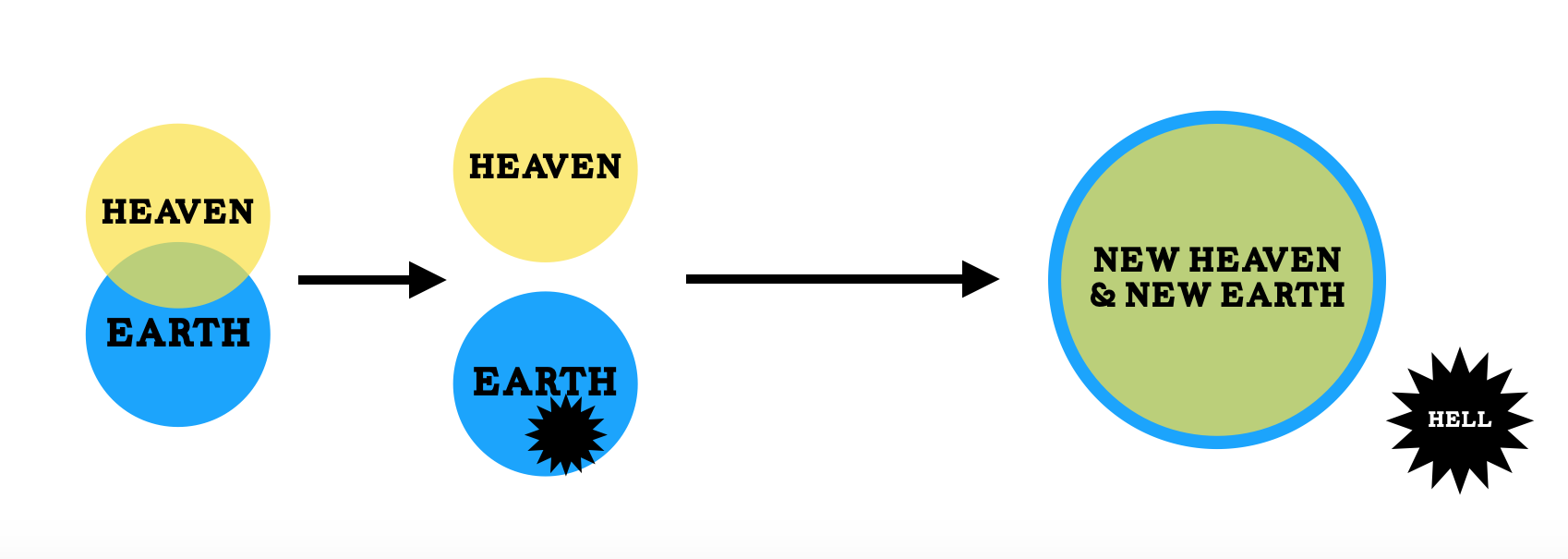
The second view, the renewed earth perspective, also says that this world was created good as the dwelling place of people. Earth parallels heaven, the dwelling place of God (Genesis 1.1), and at the beginning, these two realms overlapped: God was able to dwell with people and walked in the Garden with them. But we sinned. The earth became tainted. Our close relationship with God was destroyed. Our sin separates us from God, forcing the close union of heaven and earth to be driven apart. Things are bad and broken, and we are lost in our sin. And more than that: our accumulated sin multiplies and continues to defile the earth—there is a sense in which we have created hell on earth with our cumulative rebellion against God.

The Good News is that God is not content to leave things this way. Jesus came to reconcile all of creation to Himself, including humanity, and to specifically confront the problem of sin. Through His death and resurrection, Jesus has brought about a new order of things, or as Paul says, “new creation.” One day Jesus will return and sin, Satan, and death will be fully defeated, the entire cosmos will be made over into a “New Heaven and New Earth”—a unified whole—and God will dwell with His people forever, while those who reject Him will be separated from Him forever.[5]

In the meantime, rather than running out the clock, waiting to be rescued, or even frantically rowing around in our lifeboat picking up survivors while the world sinks around us, we are actively involved as citizens of God’s kingdom and agents of new creation in taking back the world that rightly belongs to God and inviting others to join us in that project. We do this by living according to the principles that Jesus lays out for His followers, and seeking to counteract the effects of sin in our world.

Now, these two views share a lot of terms and concepts, but when you look at them as a whole, they are two very different perspectives on the story the Bible is telling, and what eternity will look like.

Background of this Study

Over the last couple of years, I have seen more and more discussions about eschatology in the Christian blogosphere and in various Facebook groups, and, honestly, I have been concerned at times by the tone I have witnessed in some of those discussions (where those who hold to renewed eschatology are written off as false teachers or heretics) as well as the general level of ignorance (where some who have sought to refute the NHNE perspective reveal that they don’t actually understand it at all). Perhaps this series of posts will add something constructive to those conversations, but really, I did not write all of this material in response to the recent interest that I have observed about this topic.

Actually, this topic is one that I have been personally wrestling with for about ten years. When I first heard the renewed earth perspective, I was in graduate school and, well, I thought it was crazy. I had several immediate objections based on some specific passages of Scripture, and I wondered if my professor had ever read them! But, as it turned out, my teacher had read the Bible (more thoughtfully than I had), and had answers to my objections.

Time passed and I continued to read and study, and this idea of God redeeming and renewing all of creation at the return of Jesus continued to pop up over and over. I realized that a lot of respected biblical scholars held to this view, and I also came to realize that this wasn’t a “new” interpretation, but actually a very old one, and one that had also been held by my ancestors in the Restoration Movement. I gradually came to think, “This isn’t so crazy…I can see it either way.”[6]

Later, I began to study some of the specific passages that I used to think refuted the renewed earth view, but I realized that when I studied them in context and did the linguistic and historical legwork, they actually seemed to argue against the spiritual heaven (“traditional”) view rather than for it. I grudgingly thought, “Well, this renewed eschatology view seems more biblically accurate to me, but I’m not sure it really matters that much.”

Eventually, at the church where I worked, we started this project called The Story of the Bible. This was a long Bible survey study for our adult Bible classes using videos from The Bible Project as a companion resource. As I had never done before, I sat down and studied the Bible, writing dozens of lessons (and editing dozens more) about different biblical books and drawing main ideas from them. When we started that project, I had zero intention of teaching a different view on eternity (or really, emphasizing anything related to eternity) but as we studied, this idea of God redeeming all of creation just hit us over and over again…because this is what the Story of the Bible is about.

As we went through this study in our adult classes, it became clear to me that our church leadership needed to discuss eschatology (and specifically, the renewed earth perspective) more, so I went to our Elders and they agreed. We had a great study together for several weeks and wrestled with a lot of Scripture and talked back and forth and challenged one another. By the end of the study, they no longer thought I was crazy (I think a couple of them did when we started!), and they wanted me to teach an adult Bible class specifically on renewed eschatology. And that class is the source of the material you are reading now.

Goals for this Series

I believe that Scripture teaches that when Jesus returns, the cosmos will be renewed and redeemed and that the faithful will live with God eternally in a New Heaven and a New Earth. If, at the end of this series, you agree with me—great! But that is not my primary goal for this series.

Instead, here are my goals:

First, I want to look at what the Bible teaches about eternity with an open mind. This will be very difficult for some, and I get that—this material was very challenging for me when I was first exposed to it. I am stubborn and I give up the positions I hold with great reluctance; as I mentioned previously, I have been wrestling with this for ten years. 

Ultimately, I don’t ask that you agree with me, but I do ask that you have an open mind and honestly consider what we discuss. Read the biblical passages that are mentioned. Look at the extra material I link to that lays out certain arguments in greater detail. If you want to respond to something that I say (and I welcome that!), make arguments based on Scripture, not on tradition. Ultimately, what I am going to present in this series of posts is correct or incorrect based on whether or not it lines up with what the Bible teaches. With that in mind, counter-arguments to what I am presenting that start with, “I always thought…” or “I’ve always heard that…” aren’t the best.

Second, I want to provide an opportunity for us to challenge ourselves. Some of the ideas that we’re going to discuss will be challenging. It will require looking at certain passages very carefully and learning some things about Greek, about history, and about textual criticism.

From my perspective, we have decades and decades of confusion and misinterpretations that we have to peel back to see what the Bible teaches on this subject, and that is going to require hard work. I will do my best to make everything as understandable as possible, but I am sure that I will not be as clear sometimes as I would like to be. Having said that, if you feel like some of this material is difficult, that’s okay, because it is supposed to be.

I’m not sure where we got the idea that we can become mature Christians by never challenging ourselves to dig deeper into God’s word, but it’s not true. 

Finally, at the end of this study, I want us to respect one another regardless of which conclusion we come to. I think this is an important topic, and at the end of all this, I will explain why I think it matters, but ultimately, understanding how eternity works is not necessary for you to enjoy it. Getting this right or wrong is not a “salvation issue” (I dislike that terminology), although I would argue that you will appreciate and anticipate your salvation more if you hold to the view that I am going to teach in this series.

I mentioned earlier that I have witnessed some unfortunate conversations over the last couple of years where people who hold to renewed eschatology are branded as false teachers. I would find that to be laughable if writing someone off as a false teacher was not such a serious act—one that Scripture doesn’t take lightly. Suffice it to say, if at the end of all this you arrive at a different conclusion than I do, I will still respect you for it; I hope you can reciprocate that feeling.

What does the Bible teach about eternity? I hope you’ll join us as we seek to answer that question.


[1]The Greek word εσχατος means “last”, so literally, “eschatology” refers to the study of the last things.

[2]Short for “New Heavens and New Earth.” Throughout this series, I will use “NHNE”, “New Heavens and New Earth”, “renewed eschatology”, and “renewed earth” interchangeably. 

[3]I think many non-Christians also fundamentally misunderstand the notion of God’s grace, and think Christians believe that we get to heaven by being “good enough”. To be fair, many Christians misunderstand this as well!

[4]I really hesitate to concede the term “traditional” to refer to this view, because as we will see later, the alternative view—renewed eschatology—has a long and storied place in the historical Christian tradition. But nevertheless, the spiritual heaven perspective has been the dominant view among evangelical and fundamentalist churches (and certainly churches of Christ as well) for as long as any of us have been alive.

[5]Much of the language in this description is drawn from Timothy Mackie and Jonathan Collins, When Heaven Meets Earth: A 12-Part Biblical Study on Heaven (Portland: The Bible Project, 2017). This resource is available for download on The Bible Project website here.

[6]I will have a post later focusing specifically on this, but as many readers of this blog know, I am deeply interested in the history of the Stone-Campbell Restoration Movement, and seeing that many of my spiritual forebears believed in renewed eschatology was very significant to me.

The Role of the Individual Person in God’s Universal Plan

For an upcoming grad school class, I have been reading Everett Ferguson’s Backgrounds of Early Christianity. It is a bit of a dense work, but I am enjoying it: Ferguson is brilliant, and is unparalleled in his knowledge and understanding of early Christianity. I read as much of his stuff as I can.

In Backgrounds of Early Christianity, he has a discussion of apocalyptic literature that I really enjoyed. Apocalypse was a certain literary form that was very popular for a few centuries on either side of the life of Christ. We are familiar with it in the Bible largely through the Book of Revelation and portions of Daniel (and small sections of a couple gospels), but there are a lot of extrabiblical works which feature apocalyptic writing as well.

We tend to equate apocalyptic literature with eschatology (which refers to teaching about the last days or end of the world), but it’s not always or even primarily focused on that. Here are Ferguson’s words:

Although much study of apocalyptic literature has centered on its eschatology, its authors’ main concern was with revelation (as the word apocalypse indicates) rather than eschatology. Events are marching toward a predetermined goal; but while history is under divine control, individual decisions are not. There is both a universalism and an individualism in apocalypticism. God’s plans are universal, but the individual (not the nation as a whole) decides whose side he is on and so where he will stand in the final cataclysm.

(p. 476-77)

Put in other words, works like the Book of Revelation aren’t about providing us with a detailed map of future events. Rather, they are meant to underscore that God is ultimately in control, and things will unfold according to His plan and will. For us as individuals, it is imperative that we choose to follow that will, and be on His side.

« Older posts Newer posts »

© 2026 The Doc File

Theme by Anders Noren — Up ↑