The online journal of Luke Dockery

Tag: Eschatology (Page 5 of 5)

Christmas 1914 and the Hope for Peace

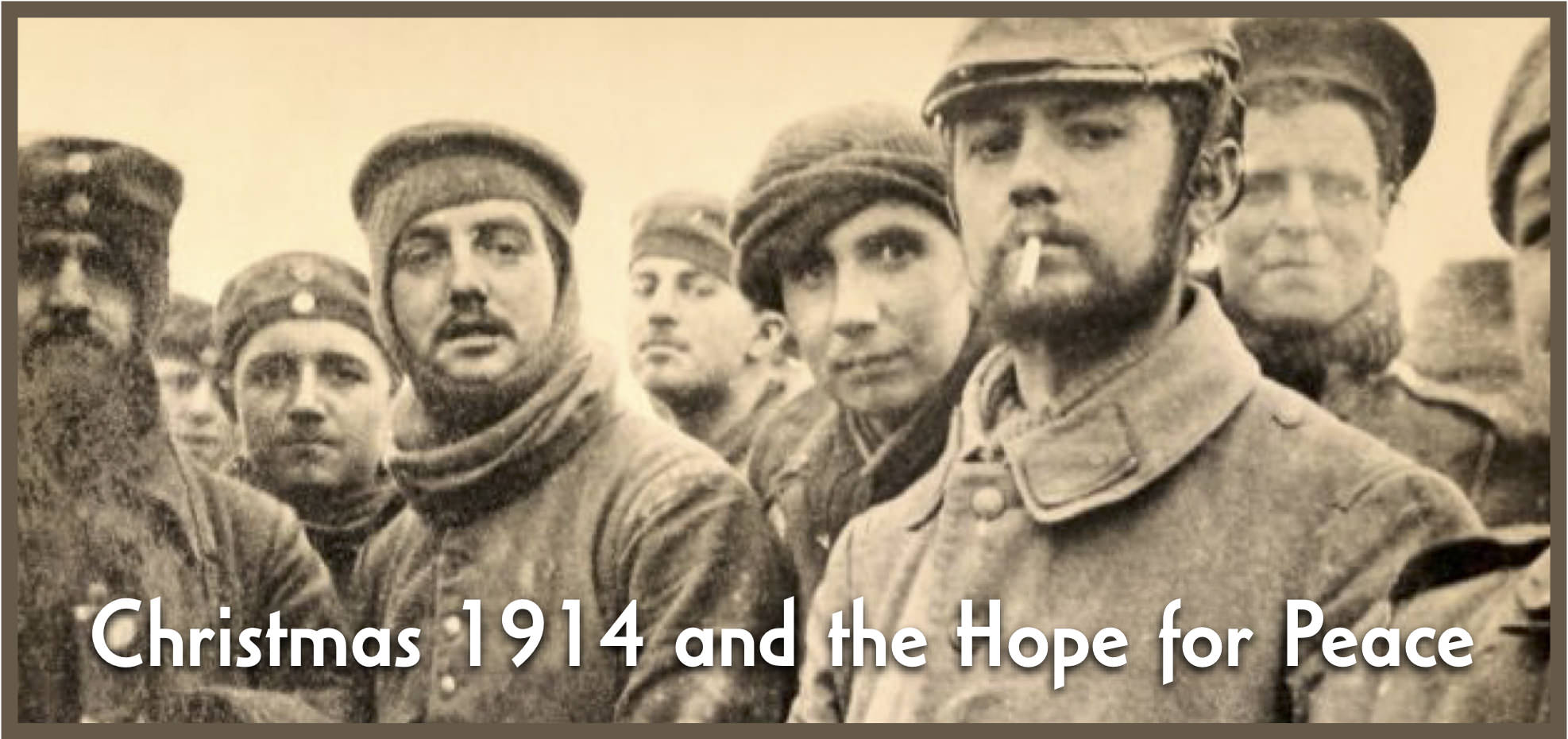
The Christmas Truce of 1914 is fairly well-known; my brother once wrote about it here:

“The First World War broke out in August of 1914. Many rushed to war almost gleefully, confident in victory for their particular side. Many thought the war would be over by Christmas. But when Christmas came the war was still young. It would last another four years and claim the lives of some 8 million soldiers before it was through.

In the midst of this bloodshed, though, a remarkable thing happened. In many places along the Western Front, particularly where the British and the Germans faced each other, unofficial Christmas truces were made in 1914. And here, for a brief few hours, the killing ceased.

Instead of firing bullets at each other, the mortal enemies sang Christmas carols to one another on Christmas Eve. German soldiers even decorated their trenches with candles and with Christmas Trees—tannebaum, they called them. On Christmas morning, soldiers from both sides met in no man’s land and exchanged what gifts they had: buttons and medals, candy and tobacco and liquor. Soldiers who had once been barbers gave free haircuts. One German soldier who had been a juggler in happier times gave a performance in no man’s land.

The goodwill between enemies was only temporary. In a matter of days they were back to the grim business of trying to blow one another apart. But for a few brief hours, the influence of the Prince of Peace had been felt.”

Moments like these where the Kingdom of God breaks into the twisted and fallen world in which we live don’t seem to come often enough. But they are made possible by the fact that 2000 years ago, the Word became Flesh and the Son of God came to earth. The baby Jesus grew to be a man, lived a perfect life, and then died on our behalf, and for Christians, that is a source of great hope.

A lot of times we don’t understand the concept of biblical hope very well, because in everyday usage, the word hope means something very different than what it means in the Bible. We use hope as a synonym for wish, as in “I hope I win the lottery”, or “I hope our economy gets better soon”—both of these are things that people wish would happen, but they don’t actually expect either of them to happen.

Biblical hope is something different though—it is a confident expectation of something that will happen because it has been promised by God. And the entrance of Jesus into the world and His subsequent death and resurrection are a source of great hope for Christians because they make possible a Day of Peace—a day when there will be no more suffering, no more disease, no more school shootings, and no more war. For those who have made peace with God, it is a day to look forward to—an everlasting day which will find the faithful in the presence of the Heavenly Father. That’s the hope—the confident expectation— that Christians have.

And in the meantime, as we wait for that day to come, Christians have a lot to do to keep busy:

  • We gather together to remind one another of that hope and to pledge our devotion to the cause of Christ…
  • We work to instill the values of the heavenly Kingdom into our earthly surroundings, so that our friends and neighbors can taste the peace of God for themselves…
  • And we celebrate the small down payments on the promise of peace that God has given us…such as the few blessed hours when the armies of the world ceased their strife and remembered the Baby of Bethlehem.

Merry Christmas to you and your family this holiday season! Glory to God in the highest, and on earth peace and good will toward men!


The Last Days

I’ve recently developed the habit of listening to a local Razorback talk show on radio while I drive home from work.

This means that in the morning, my radio is still tuned into the talk radio station from the previous afternoon, and since I’m usually too asleep or indifferent to change it, I generally just listen to whatever is on.

This morning, Glenn Beck had Joel C. Rosenberg on, and the two were talking about how closely the “last days” prophecies of the Bible were lining up with current political happenings.

I think Beck makes some good points from time to time (although I think he’s a jerk), but it makes me really nervous when people mix eschatology and politics.

This may come as somewhat of a surprise since I personally mix my theological and political views all the time, but frankly, people believe some pretty crazy things about the end of the world.

Without refuting the specific prophetic interpretations that Rosenberg and Beck were espousing, I just want to point out a couple of basic (and common) fallacies that were mentioned.

First, Rosenberg talked a lot about the Antichrist, and made a big deal about how in the Bible, there is a distinction made between “big a Antichrist” and “little a antichrist.”

The problem with this point is that in most of the “major” translations (NIV, NAS, KJV, ESV) there is no distinction at all. All five occurrences of the word antichrist in the Bible are in either 1 or 2 John, and all are of the lower-case variety.

Well, who is this antichrist that we hear so much about? According to John, an antichrist is one who denies the Father and the Son, and in the historical context of John’s letters, this is a clear denunciation of the heresy of gnosticism rather than a prediction about the personality traits of some world leader from thousands of years in the future.

Secondly, Rosenberg backs up his claims by saying that Jesus himself clearly explains the signs of the end of the world when asked in Matthew 24.3. Unfortunately, Rosenberg fails to realize that in Matthew 24 Jesus is asked two separate questions and gives different answers to them.

“Jesus came out from the temple and was going away when His disciples came up to point out the temple buildings to Him.
And He said to them, ‘Do you not see all these things? Truly I say to you, not one stone here will be left upon another, which will not be torn down.’
As He was sitting on the Mount of Olives, the disciples came to Him privately, saying, ‘Tell us, when will these things happen, and what will be the sign of Your coming, and of the end of the age?’
And Jesus answered and said to them, ‘See to it that no one misleads you…’”


Matthew 24.1-4

Upon seeing some of the temple buildings, Jesus informs his disciples that a day is coming when the temple will be destroyed. His disciples ask Jesus when this will happen and when He will return and the world will end. Although they probably assume that all of these events will happen at the same time, Jesus’ answer reveals that they will not.

From Matthew 24.4-34, Jesus answers the first part of His disciples question, and gives them many signs that will happen before the temple is destroyed. He then concludes his answer in verse 34 by saying,

“Truly I say to you, this generation will not pass away until all these things take place.”

And sure enough, the temple is destroyed in AD 70, approximately 40 years after Jesus speaks these words and when many of the people who heard them would still be alive. Based on this verse, it’s remarkable to me that so many people think that the preceding verses describe something that hasn’t already happened, because as far as I know, no one from the generation that Jesus was speaking to is still alive today.

At this point in the text in verse 35-36, Jesus transitions and answers the second part of the question, which was about His coming and the end of the world:

“Heaven and earth will pass away, but My words will not pass away. But of that day and hour no one knows, not even the angels of heaven, nor the Son, but the Father alone.” [emphasis added]

Jesus then goes on to describe about how when He returns, many people will be caught off guard and unprepared, because there will be no sign or warning in advance.

And if the angels in heaven nor Jesus Himself knew when it would happen, there’s no way that Joel Rosenberg or Glenn Beck or Luke Dockery knows either.

Like I said earlier, I’m really not interested in going into specific signs and prophecies that Mr. Rosenberg thinks he’s interpreting. Instead, my point is this: if a guy can’t understand what’s written in the Bible in black and white, why would you trust him to interpret difficult metaphor, whether it’s in the book of Daniel, Matthew or Revelation?

A lot of people have political opinions, and there’s nothing wrong with that, but when you start basing your views on faulty Biblical interpretation, you have a real problem.

Steve Irwin: 1962-2006

I was saddened to hear that Steve Irwin, famous worldwide as the “Crocodile Hunter”, died Monday morning when he was fatally stabbed in the chest by a stingray barb while snorkeling near the Great Barrier Reef off the coast of Australia.


Irwin was famous for his commitment to conservationism and his passion for wildlife, and ever since he came onto the scene in the U.S. in the late 1990s, I liked him for the childlike enthusiasm he always displayed for animals, the unbelievable courage he had to get as close as possible to animals that most of us choose to stay away from, and his funny Australian accent.

Spending so much time around dangerous animals like crocodiles and poisonous snakes, Irwin avoided death on such a regular basis that he almost seemed to be impervious to it. Sure, hanging out with an angry crocodile would be a hazardous endeavor for you or me, but for the Croc Hunter, it never really seemed to posed a threat; he was always in control of the situation.

Or at least, that was the case until Monday, when I was reminded that, despite appearances, none of us is really in control of the situation we find ourselves in, and none of us can escape death forever. One of the realities of life is that it is ended by a physical death that comes for all of us, and can come at any time.

But fortunately, that doesn’t have to be the end of the story. The Bible teaches that for those who live for Christ, death is overcome by resurrection, and then eternal life.

I am not impervious to death; it will claim me someday. But it will not be the end of my story.

Newer posts »

© 2026 The Doc File

Theme by Anders Noren — Up ↑





