The online journal of Luke Dockery

Tag: Harding University (Page 3 of 4)

2021 Harding University Lectureship Recap

Harding University’s 98th annual Bible Lectureship was a couple of weeks ago, at the end of September. I always enjoy going to Lectureship and was bummed when it had to be canceled in 2020 due to COVID-19*. I have also developed the practice of providing a quick recap of Lectureship and the different presentations I got to attend. The theme for this year was Invincible! Courageous Faith in Troubled Times, with Daniel being the theme book.

I was privileged to attend several good lectures and classes, and here is a brief recap of what I went to, along with some takeaway quotes:

Invincible: God’s Eternal Kingdom, David Shannon: David is the President of Freed-Hardeman University, and kicked off Lectureship with this keynote on Sunday night. His emphasis was on Daniel 7, the depravity of earthly kingdoms, and the superiority of the kingdom of the Son of Man.

“The only way to overcome Satan is to belong to a kingdom with power greater than his.”

In Your Dreams, Nebuchadnezzar: There Is A God in Heaven!, Sammie Berry: Sammie is a long-time preacher at Dallas West Church of Christ, and focused on Daniel 2 and the interpretation of Nebuchadnezzar’s dream. Daniel and his friends had received the very best Babylonian training, but that had proven insufficient to decipher Nebuchadnezzar’s dream. Instead, Daniel went to his friends and asked them to pray that the God of Heaven would reveal the interpretation.

“God is in control and His children can thrive in a toxic culture.”

T.B. Larimore and Christian Identity: Respecting Conscience, United By Love, Nathan Guy: Nathan is an alumnus and the current headmaster of Mars Hill Bible School, which has historical ties to Larimore, the popular and influential second-generation Restoration Movement teacher and preacher. Larimore was known for his devotion to peace and unity, and Guy described him as a man of the Book, a man of peace, and a man who left minor matters alone.

“No word of bitterness shall ever fall from my lips, even in self-defense. I shall certainly never retaliate.”

(Larimore)

A Supernatural Cast of Characters, Dan Oden: Dr. Oden teaches Old Testament at Harding, and was one of my professors at Harding School of Theology. His lecture focused on some of the supernatural figures in the book of Daniel and tracked points of comparison with Divine Council motifs from the Ancient Near East. I thought he did an excellent job in making a challenging and scholarly topic accessible and compelling for his audience.

“When we put our faith in God, the Cloud-Rider, we become Sons of God.”

In the University of Babylon: Daring to Be Different, David Hunzicker: David serves as one of the ministers at the North Boulevard Church of Christ in Murfreesboro, TN. I had never heard him before, but his was perhaps my favorite of all the lectures I heard. He focused on the clash between the kingdom of Babylon and the kingdom of God, and for those of us who belong to the latter, offered the following encouragements: (1) If you have been stunned silent by Babylon, speak up; (2) If you have developed bitterness toward Babylon, look up; (3) If you have compromised to Babylon, stand up.

 “Seize every opportunity to show where your true loyalty lies.”

History in His Story: Biography and Archaeology of the Life of Jesus, Kevin Burr: This lecture was technically off-schedule, but was another of my favorite presentations. Kevin is the Minister of Discipleship at the Kings Crossing Church of Christ in Corpus Christi and also received his Ph.D. from Asbury Seminary where he wrote a dissertation combining the fields of historiography and Jesus studies. This presentation reflected on the gospels as Greco-Roman biographies and applied some of the historian’s tools of the trade to the New Testament.

“If an author is generally reliable in areas we can check them, it is reasonable to infer they are generally reliable where we can’t.”

In the Fiery Furnace: Demonstrating Courage Under Fire, Phil Brookman: Phil preaches for the Memorial Road Church of Christ in OKC, and I always enjoy hearing him. He focused on the story of Shadrach, Meshach, and Abednego, and the idea of resistance: this is not a story of how to avoid death, but how to live life: when we practice resistance, we are fully alive.

“For Christians, resistance is vital; without it, we become weak and ineffective.”

Courageous Faith in the Face of Persecution (Parts 1-2), Mani Pagidipalli: Mani was a classmate of mine at HST, and is a remarkable individual, who serves as both a medical surgeon and preacher. He gave a moving presentation of the persecution of Christians in India.

“If you feel like you are living under Nebuchadnezzar, be like Daniel. No whining, no complaining, no “woe is me”, no “it’s not fair”. Just a willingness to be God’s servant wherever and whenever to whomever.”

Pledging Allegiance: Unpacking Images of Authority in the Books of Daniel and Revelation, Part 1, Alan Howell and Garrett Best: Alan is the Missionary in Residence at Harding, and Garrett preaches for the Oliver Creek Church of Christ in the Memphis area and just recently wrote his dissertation on the book of Revelation. This was a really neat presentation that combined biblical studies with missiology. The basic thesis was that proper interpretation of symbols of authority is important for navigating both our cultural settings and the contours of Scripture. Garrett examined symbols of power in the book of Revelation, and Alan talked about symbols of power in Mozambique and interpreting Revelation for that context.

“Revelation takes imperial propaganda, subverts it, and reorients it to Jesus.”

Arkansas College: “A Sacrifice to the Fierce Spirit of War and Destruction”, Allen Diles: Allen teaches church history at Harding, and did a really fine job with this presentation. I have done research on Robert Graham and the creation of Arkansas College, so this was of special interest to me. Diles provided a helpful review of things I had studied a few years ago, but also taught me a good bit of new information about the college (my focus was more on Graham than the school itself). Ultimately, the story of Arkansas College is a tale of tragedy, as a really promising and prestigious school was destroyed in the flames of the Civil War.

“Winds of secession began to swirl, and Arkansas College was not exempt from the storm.”

The Handwriting on the Wall: God is Not Mocked!, Jason Darden: Jason teaches Bible at Harding, preaches at the West Pleasure Church of Christ, and is someone I always enjoy hearing. He focused on the story of Belshazzar, who mocks God by using sacred vessels taken from the Jerusalem temple by Nebuchadnezzar (likely his grandfather) for a wild party. But God is not mocked, and will not have His vessels misused.

“Belshazzar had to have known [the story of Nebuchadnezzar’s humbling]. But he learned nothing!”

Written in the Book: God Gives a Hope Beyond the Grave, Jeff Jenkins: I have known of Jeff for several years in his work as the preacher of the Lewisville Church of Christ in the Dallas area as well as The Jenkins Institute, but this was my first opportunity to hear him preach. This keynote didn’t interact with the text from Daniel as much as I would have hoped, but it was an excellent message on the importance of biblical hope in difficult times. Jeff emphasized that biblical hope is tied to the appearing of Christ: His first appearing brought grace, and His second appearing will bring glory (Titus 2.11-14).

“Biblical hope is not wishful thinking.”

The Coddling of the Christian Mind, Bob Turner: Bob preaches for the Church of Christ at White Station in Memphis, and formerly worked in the library at Harding School of Theology. I always love to listen to Bob; he is a great thinker, and an outstanding cultural exegete. In this lecture, Bob talked about the well-known The Coddling of the American Mind, and applied the lessons therein to Christian faith by refuting three popular myths: (1) What doesn’t kill you makes you weaker, (2) Always trust your feelings, (3) Life is a battle between good people and evil people.

“If you demonize people who are just like you, what are you going to do with people who are different?”

The Biggies: Teaching the Essentials of the Christian Faith, Scott Adair: Scott teaches in the Bible department at Harding, and this class was a representation of the major project that he has been working on for the last few years. Scott shows how the practice of baptism encapsulates the core doctrines of the Christian faith: (1) Jesus Christ is Lord, Son of God; (2) A Belief in One God, who is Father, Son, and Spirit; (3) The Death and Resurrection of Jesus; (4) The Church as the Assembly of the Saints; (5) Forgiveness of Sins; (6) The Gift of the Holy Spirit; (7) Resurrection of the Dead. I love Scott’s work in this area, teach it regularly to my teenagers, and believe it can be an invaluable tool to help us discern whether or not a church conflict is related to a foundational matter.

“The New Testament is a compilation of apostolic documents written primarily to remind churches or individuals of the gospel they received, to establish them further in the gospel, and to hold them accountable to the ethical demands of the gospel.”

As He Had Done Before: Persisting in Prayer, Bruce McLarty: Lectureship ended with a bang, as Dr. McLarty returned to Harding for the first time since he was retired as Harding’s President last fall. He received a standing ovation and predictably did a wonderful job emphasizing Daniel’s long life of persistent faithfulness while living in exile. Daniel’s story gives us a wider perspective that reveals God’s faithfulness to the Hebrew exiles, and Bruce finished with a stirring declaration of God’s faithfulness to us today, despite whatever difficulties and challenges we may face.

“Daniel’s strategy was not to change Babylon or Persia; it was to not let Babylon or Persia change him.”

As always, Lectureship was a blessing for me, and it was especially nice to be able to attend again after the necessary cancellation last year. I would highly recommend taking part in this next year if you are able!


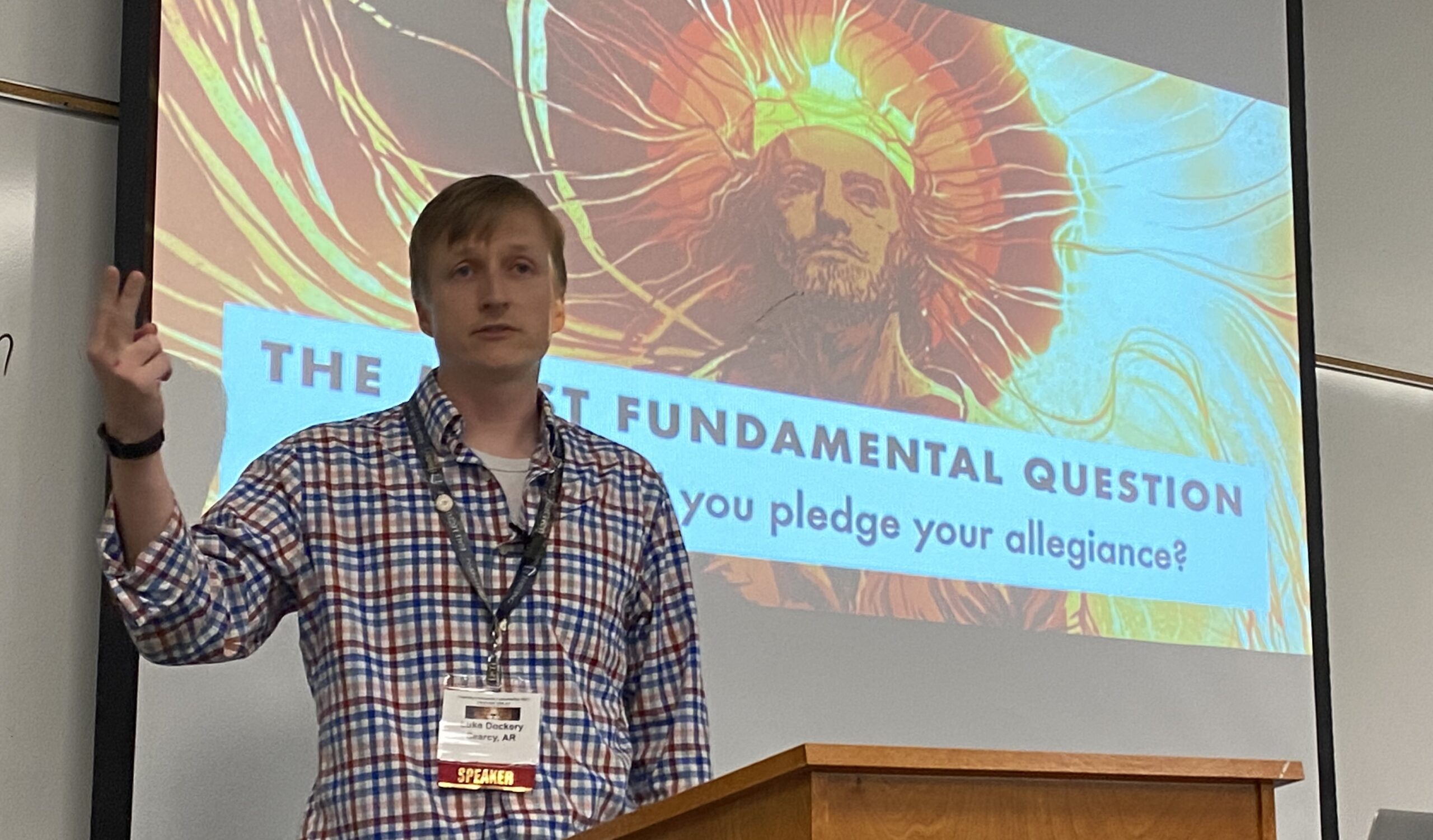
I was honored to have the opportunity to present this year as well, as part of the youth ministry track. My lecture was entitled, Allegiance to the King: Single-minded Devotion in a World of Divided Loyalties, and focused on the faith of American teenagers (and adults), Hananiah, Mishael, and Azariah, and some important ideas from Matthew Bates’s Salvation By Allegiance Alone. I will likely share more of that content at some later time, but it was studying for this year’s presentation was a great blessing to me, and I am glad to have done it.

*Technically, it wasn’t canceled and was still offered online in a scaled-back, modified fashion. But really, it was canceled.

2019 Harding University Lectureship Recap

I am a little late posting this, but I wanted to provide a quick recap of Harding University’s 96th annual Bible Lectureship, which was September 29-October 2. The theme for this year was “Fan the Flame—Acts: Renewed by the Power of the Holy Spirit.” This was my third time to take part as a presenter at Lectureship (I was part of a panel for young ministers), but this was my first time to take part as a resident of Searcy, so it was nice to be able to enjoy the many sessions and also sleep in my own bed. 🙂

I was privileged to attend several good lectures and classes, and here is a brief recap of what I went to:

  • Restoring an Acts 2 Church, David Young: David is the preacher at the North Boulevard Church of Christ in Murfreesboro, TN, and kicked off Lectureship with this keynote on Sunday night. This was a highpoint for me. I was reading Young’s book, New Day: Restoring the Revolutionary Mission of Christ’s Church before and during Lectureship, and was really tracking with much of what he had to say. Short version: Churches of Christ (and churches across the spectrum) are declining in the US, and the solution is to get serious about making disciples and planting churches. Another helpful takeaway: as a church (or an individual, I guess), you can seek to be comfortable, or you can seek to be awesome; there is no overlap between the two. In addition to this keynote, I also attended Young’s two class sessions on Monday, which further covered similar material.
  • Devoted to the Apostles’ Doctrine, Scott Adair: Dr. Adair is on the Bible faculty at Harding, and recently has been developing a proposal for unity by identifying the central tenants of the Christian faith by mining the practice of baptism. In this lesson, he used the sermon material from the Book of Acts to highlight these same central beliefs: (1) Jesus Christ is Lord, Son of God; (2) A Belief in One God, who is Father, Son, and Spirit; (3) The Death and Resurrection of Jesus; (4) The Church as the Assembly of the Saints; (5) Forgiveness of Sins; (6) The Gift of the Holy Spirit; (7) Resurrection of the Dead. There is still more to work out beyond these beliefs (each has ethical demands that goes along with it), but I do think this is a helpful framework for trying to distinguish between preferences, important convictions, and foundational gospel matters.
  • Resurrection Preaching, Fate Hagood: Fate is a preacher from California, and presented a really stirring message during Monday evening’s keynote session on the nature of resurrection preaching from the Book of Acts. While he said a lot of good things, his closing was incredibly powerful for me, as he used Paul’s reasoning from his block of teaching in 1 Corinthians 15 to encourage us that our labor for the Lord is not in vain.
  • Devoted to the Breaking of Bread, B. Chris Simpson:  B. Chris has been a great speaker for as long as I have known him, and the depth and quality of his content just gets better and better. He presented a thoughtful and powerful lesson emphasizing that if we wish to resemble the Acts 2 church, we must be similarly devoted to food and fellowship, and the radical hospitality they practiced.
  • Intentional Connections with Parents and Teens, Brent Wilhite: Brent is one of the youth ministers at the College Church of Christ here in Searcy, and talked about current trends for teenagers both in the church and in the culture at large, and also tips for building resilient faith within teens. Brent had a lot of good content, and I felt like he could have gone for another thirty minutes.
  • Devoted to Fellowship, Harold Shank: I had heard of Harold Shank before, who is well known in Oklahoma Christian circles, but I had never heard him speak. I enjoyed his Tuesday night keynote, where he discussed why the early church was devoted to fellowship, and dreamed aloud what Acts 2 churches might look like in modern contexts.
  • Devoted to Prayer, Juan Meza: Juan was a former classmate of mine, and serves as the Latino Minister at the Church of Christ at White Station in Memphis. I thought he did a good job discussing how prayer builds our relationship with God, its power, and its purpose. It was all the more impressive to me because he was presenting in a second language!
  • A Dialogue on Two Views of Heaven, Dan Chambers and Ralph Gilmore: This was a discussion on the nature of eternal life: will eternity be spent with God in a spiritual heaven (“up there” somewhere), or will it God come to dwell with His people on a renewed earth (“down here” somewhere)? On the whole, I was disappointed in this. The two men had not shared their notes ahead of time, and I thought this was a mistake as it lead to a disjointed conversation, where Chambers was presenting his perspective on a renewed earth, while Gilmore tried to anticipate Chambers’ arguments and refute them rather than actually present his own perspective on heaven. On the positive side, the two men repeatedly affirmed their love and respect for one another and were adamant that this was not a fellowship issue, or something to be divisive about. I appreciated that.
  • Artifacts and Acts, Part 3: The Flame in Jerusalem, Dale Manor: Dr. Manor is a treasure—a classically-trained archaeologist with a wealth of information about the ancient world, and I try to catch one of his lectures each year. This one focused on some archaeological finds and background information from Corinth, Ephesus, Jerusalem, and Caesarea.
  • This Is Us, Part 3: Spiritual Ancestry of Churches of Christ, Monte Cox: Dr. Cox is another favorite of mine, and I thought he had some good things to say about the history of Churches of Christ and our future. He talked about the early days of the Restoration Movement (focusing on Thomas and Alexander Campbell and Barton W. Stone) and their strong emphasis on unity. In the 20th century, the (unofficial) list of essential doctrines grew longer and longer, and a unity movement became increasingly fractured. He concluded by posing the question: are Churches of Christ in crisis, or are we experiencing a reorientation toward Christ at the center?
  • Boldness In Adversity, Jesse Robertson: Jesse is a New Testament professor at Harding, and also a deacon at Cloverdale (where I work), and is someone I have come to deeply respect and appreciate. He closed out Lectureship on Wednesday by focusing on the boldness that we witness in the Book of Acts: it is something the apostles repeatedly prayed for and then evidenced in their lives. Jesse passionately implored us to pray for courage as we seek to tell the world about Jesus. As he pointed out insightfully: it takes one kind of courage to speak truth to your enemies; it takes another kind of courage to speak truth to your friends.

As always, Lectureship was a blessing for me and I greatly enjoyed it.  I would highly recommend taking part in this next year if you are able!

Preparing for Ministry in Small Churches


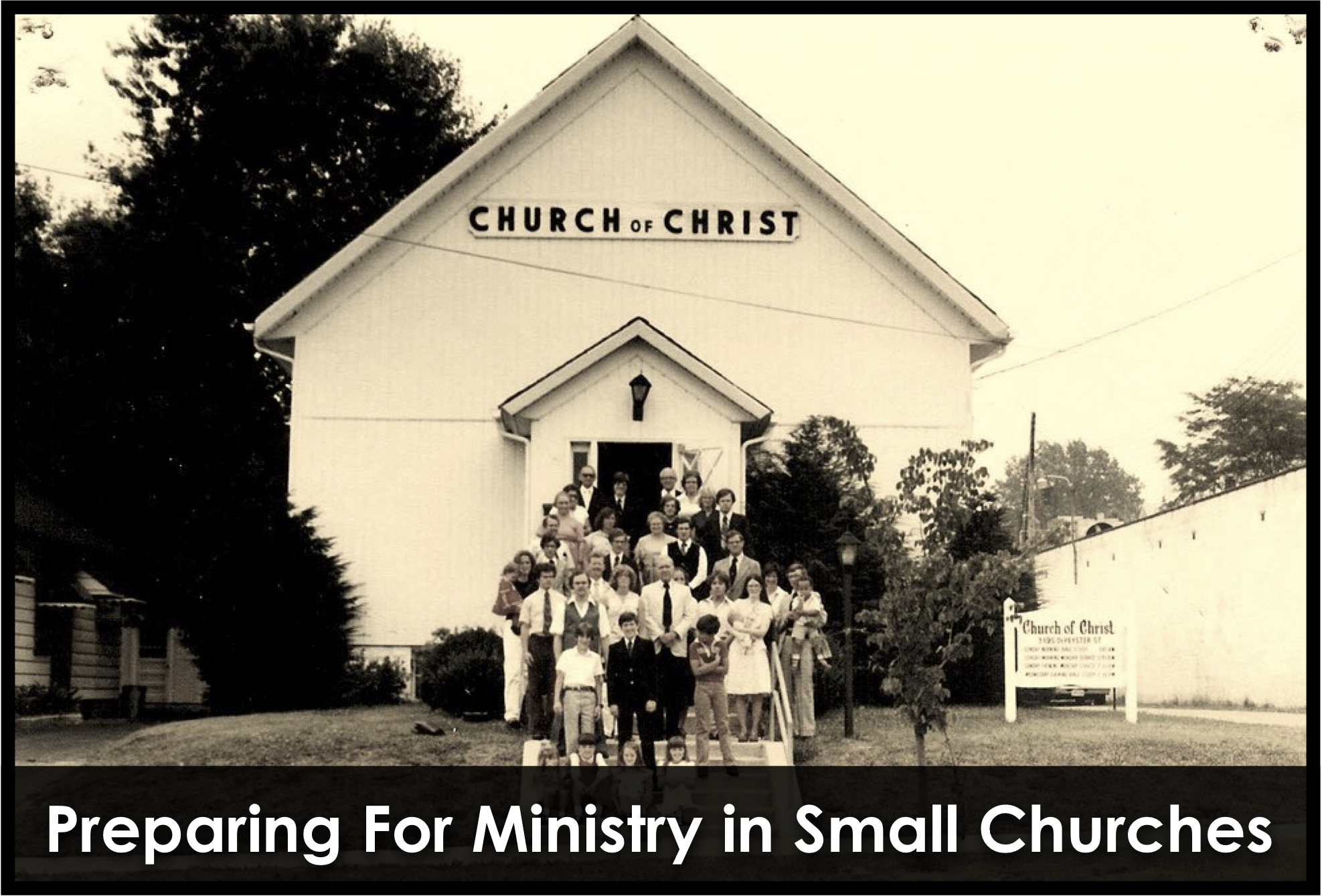
Several days ago, I had the opportunity to speak to a class of ministry students at Harding University who are near the completion of their degrees. While my primary task was to speak to them about youth ministry, I was also supposed to give them some practical tips for doing ministry in a congregational setting.

I offered several tips, some of which were likely more helpful than others, but some of my advice was focused on the reality that Churches of Christ represent a fellowship of small churches.

Consider some of the following information from the 2015 edition of Churches of Christ in the United States, compiled by Carl H. Royster. Of 12,303 congregations of Churches of Christ in the United States:

  • 1,932, or 15.7%, are congregations of 0-24 people
  • 3,351, or 27.2%, are congregations of 25-49 people
  • 3,556, or 28.9%, are congregations of 50-99 people
  • 2,159, or 17.5%, are congregations of 100-199 people
  • Combined, this means that roughly 89% of congregations are less than 200 people in size

The congregation where I currently serve doesn’t seem overly large to me, but at 230, it is in the top ten percent of congregations in our fellowship by size.

Again, Churches of Christ represent a fellowship of small churches. With this reality in mind, I offered a couple of suggestions to the Harding students I talked to who were about to graduate and head into ministry roles in Churches of Christ.

First, it is important to develop a diversified skill set. If you want to work in a church of Christ, and what you really, really want to do is be an adult education minister and do only that, there just aren’t that many jobs like that out there. The reality is that in smaller churches (i.e., the vast majority of churches of Christ), you have to wear a lot of hats, and you need to have a diversified skill set to be able to do that.

In my current position (and remember, we are over 200 in size, so we are larger than 9/10 churches in our fellowship), in a given week I might find myself planning a youth retreat, writing adult Bible class lessons, designing our church website, preaching, and negotiating a new contract with our copier company—and that’s not an unusual week!

Out of necessity, you have to wear a lot of different hats. You might have a specialized skill or skills that you are really good at, and that’s great, but you need to develop general skills as well.

Second, it is important to develop humility about your role. I was speaking that day to Christian college-trained ministry students, which means that in many ways, they are the upper echelon, the elite. They have spent lots of money and countless hours receiving training in biblical languages, intensive Bible study, ministerial skills, etc. Simply put, there are things that they have been trained to do that a lot of people in the congregations where they serve won’t be able to do, and it’s important that they prioritize and do those things.

But at the same time, that doesn’t mean they are too good to do less glamorous, more menial things. I cannot begin to count the number of hours I have spent straightening up chairs, taking out the trash, or putting things away in storage closets while at work. I didn’t need an M.Div to do that work, but it was still a vital part of my job. A couple of years ago, we had a major problem with the sewage line at our church building. Toilets backed up, and foul water flooded the hallway. And our preaching minister got out the mop and went to work. Ultimately, ministers are servants, and they step up to serve where it is needed; they are not too good to do the “small” things.

I am sure there are many more ideas that could be added, and again, this is coming from a guy who isn’t really at a small church. But if these lessons are true for me, how much more they must apply to even smaller congregational contexts. There are some real blessings that come with working with small churches, but it requires a certain type of minister as well.

Judging by demographic realities, many of the ministry students I spoke to will find themselves (at least at some point) working in smaller congregations. I hope what I shared with them will prove to be helpful.

2018 Harding University Lectureship Recap


This week I had the opportunity to take part in Harding University’s 95th annual Bible Lectureship, and had a great time. I got to spend time with family and close friends, renew friendships and acquaintances of people I haven’t seen for a while, and I was honored to present two sessions on Youth In Family Ministry on Wednesday, and had good attendance in both sessions and got to field a lot of excellent questions after each session.

Also, though, I was privileged to get to hear several excellent sessions. Really, everything I went to was quite good, but below, I’ll just share brief recaps of the sessions for which I took notes:

  • Honoring Our Parents, Claiming the Promise, Andrew Phillips: this was a morning keynote session, and I thought Andrew did very well. He emphasized that honor is a heavy matter, but that not every heavy, weighty aspect of life is a burden. The weight of honoring one’s parents provides a serious responsibility in life, but it also provides a solid foundation for life.
  • The Good, the Bad, and the Gestalt: Thoughts About a High View of Scripture, Richard Oster: Dr. Oster was one of my favorite HST professors, and always does a great job. He said some fairly predictable, but laudable and appropriate things about the nature of Scripture, including this gem: “Scripture is the litmus test against which we are to measure all spiritual experiences.” He also discussed two problem areas related to Scripture that sometimes plague believers: (1) Failing to discern that Scripture is the “map” that points us to Jesus. As important as the Bible is, we are more interested in the “territory” to which it points than we are in the map itself. (2) The tendency of some to want to distance themselves from the Old Testament or shelve it altogether. This is untenable: the OT was the Bible of the early church, and the very identity of Jesus cannot be explained without it.
  • The Work of the Holy Spirit, Part 2, Monte Cox:  Dr. Cox was one of my favorite undergrad teachers at Harding, and is always a treat to listen to. He had three sessions on the Holy Spirit, but there were so many good options on Monday that I could only get in to listen to this one. It was outstanding. This was a very practical class, which sought to answer the question, “How can we cooperate with the Spirit?” in terms of defeating the influence of sin in our lives and being transformed into the image of Christ.
  • Right Click: Parenting Your Teenager in a Digital Media World, T.J. Davidson: T.J. is a friend and a really good youth minister, and he did a great job here, discussing how digital media is changing us, and some of the things we can do about it. I wish T.J. could have had more time, because I felt like there was more that he could have shared with us.
  • Serving With Honor Without Losing Your Mind, Jim Martin: Dr. Martin spoke at the Celebration of Ministry Dinner. He is Vice President at HST, and is also one of the best Twitter follows out there (@JimMartin). This dinner is always fun and basically serves as a pep talk for those in ministry. Dr. Martin laid out four ideas to address the topic at hand: (1) Believe that God is larger than my problems; (2) Beware of anxious, negative people who speak with great certainty; (3) Learn to function as a less-anxious person; (4) Remember that our God rules.
  • From Mozambique to Millennials, Part 2, Logan Thompson: Logan is a youth minister in Beebe, Arkansas, and delivered what I thought was an absolutely brilliant lecture (I was bummed that I missed Part 1). Logan discussed the three basic types of cultures (Guilt-Innocence, Shame-Honor, Fear-Power) and then discussed atonement theories that naturally fit with these different cultures. From there, he argued that pervasive social media use is basically prompting youth culture to transition from a Guilt-Innocence to Shame-Honor paradigm (I hadn’t made this connection before, but I totally agree), and suggested theosis as an atonement model that is helpful for approaching young people in this context. If this sounds completely nerdy to you, that’s fine; if you are interested in learning more, you can check out an article that Logan co-wrote with Alan Howell here.
  • The Christian’s Essential Reading List, Bob Turner: Bob is the head librarian at HST in Memphis, and was completely in his element here. In a two-part session, Bob suggested six pairs of books (in each pair, one was the type of book that you would find on the NYT bestseller list, and the other was a similar book that you would find in a theological library). In addition to being a lot of fun, these sessions gave me a bunch of books that I want to read (which, actually, is the last thing I need!).
  • Scrapper’s Delight: Ancient Trash and the World of the New Testament, Kevin Burr: This was a bonus, as it was not actually part of the Lectureship proper, but was rather a presentation of the HU Archaeology club by one of my best friends. Kevin talked about ancient trash: scraps of papyrus that have been discovered in various places of Egypt, the stories they tell, and the information they give us about the world of the New Testament. The major takeaway: “The better we know the world around the Bible, the better we can understand the Bible.”

As you can probably tell, I greatly enjoyed my time at Lectureship this year, heard a lot of good content, and left spiritually refreshed (if physically exhausted). I would highly recommend taking part in this next year if you are able!

A packed room for my youth ministry sessions: I think the sensationalist title is what brought them in. 🙂

Harding Lectures Audio Files

Last month, I had the honor of taking part in the Harding Lectureship. Several people who were unable to attend the Lectureship have asked me if there is a way to hear my presentations, and there is! You can click on the links below to listen to the lectures:

You can listen to a variety of other presentations from this year’s lectureship by going here.

« Older posts Newer posts »

© 2026 The Doc File

Theme by Anders Noren — Up ↑