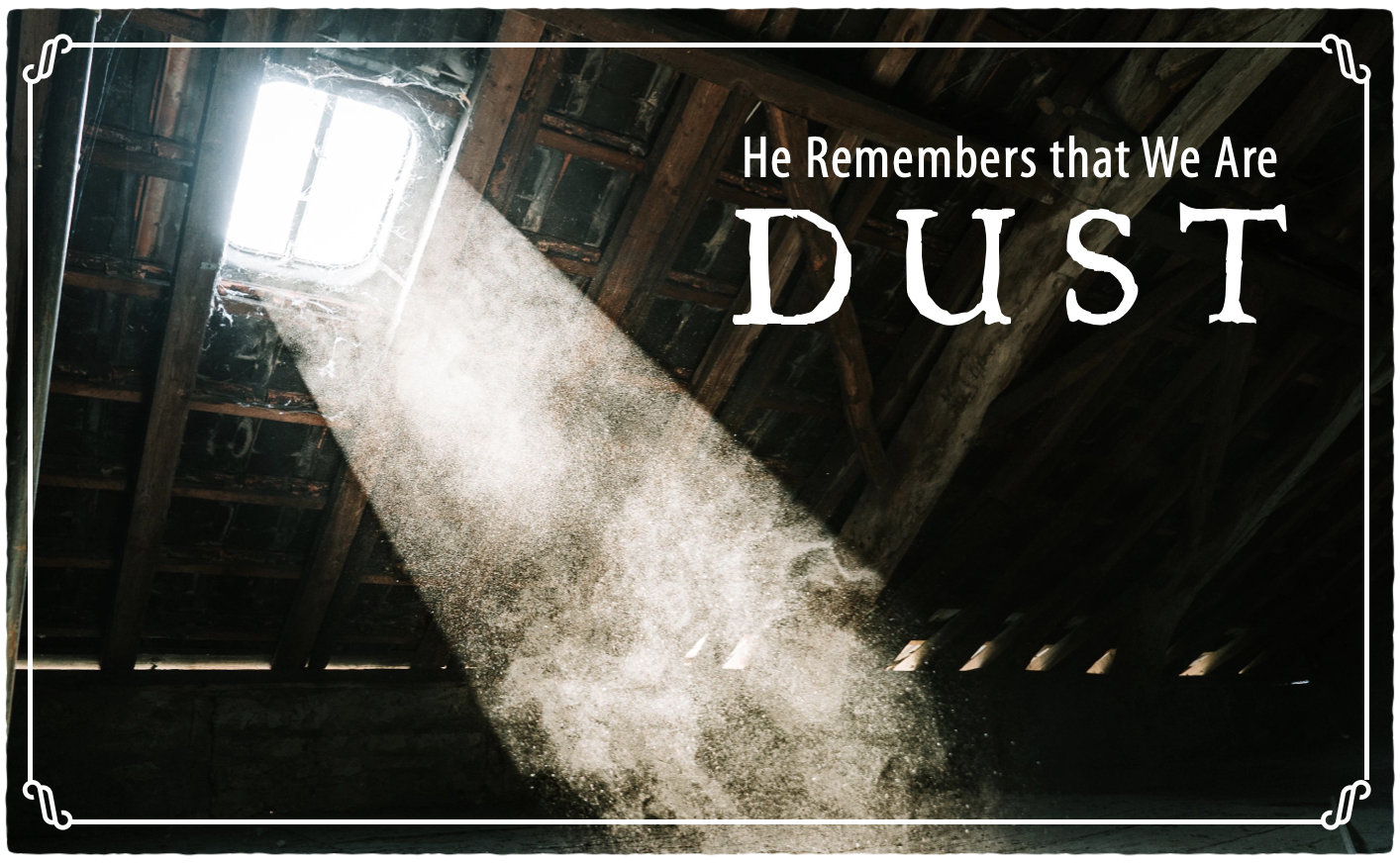
Psalm 103 is one of my favorites. It speaks forcefully of God’s mercy and steadfast love:
8 The LORD is merciful and gracious,slow to anger and abounding in steadfast love.9 He will not always chide,nor will he keep his anger forever.10 He does not deal with us according to our sins,nor repay us according to our iniquities.11 For as high as the heavens are above the earth,so great is his steadfast love toward those who fear him;12 as far as the east is from the west,so far does he remove our transgressions from us.13 As a father shows compassion to his children,so the LORD shows compassion to those who fear him.14 For he knows our frame;he remembers that we are dust.15 As for man, his days are like grass;he flourishes like a flower of the field;16 for the wind passes over it, and it is gone,and its place knows it no more.17 But the steadfast love of the LORD is from everlasting to everlasting on those who fear him,and his righteousness to children’s children,18 to those who keep his covenantand remember to do his commandments.19 The LORD has established his throne in the heavens,and his kingdom rules over all.(Psalm 103.8-19)
Fundamental to God’s nature is His mercy and grace. This is stated in Psalm 103.8 and is repeated in some form multiple times throughout the Old Testament (cf. Exodus 34.6; Numbers 14.18; Nehemiah 9.31; Psalm 86.15; Joel 2.13; Jonah 4.2). Because of His nature, God does not deal with us according to our sins, but instead removes them far from us: as far as the East is from the West.
This is beautiful and profound, but there is more. In addition to God’s inherent predisposition toward mercy and forgiveness, the Psalmist also tells us this in v. 14:
14 For he knows our frame;he remembers that we are dust.(Psalm 103.14)
God, as our Creator, knows us intimately. He remembers that we are dust.
In one sense, this has a literal meaning. Genesis 2.7 speaks of Yahweh forming “the man of dust from the ground” and breathing into his nostrils the breath of life. Later on, after the humans fail at the Tree of Knowledge of Good and Evil, as part of the curse that God pronounces, He tells Adam, “For you are dust, and to dust you shall return” (Genesis 3.19b).
We are formed of the same stuff as the rest of creation, and when we die, our bodies wither away and eventually decompose into dust.
But there is surely a metaphorical meaning here as well: God remembers our inherent frailty. While humankind is created in God’s image (Genesis 1.26-27) and given the significant vocation of bearing the divine image in creation, we are, ultimately, dusty creatures: we fall short and fail to live up to the potential that God has placed within us.
God knows this well. He knows, better than anyone, that we are “just human”, and it motivates His compassion and mercy toward us.
God knows we are dust. He knows, better than anyone, that we are “just human”, and it motivates His compassion and mercy toward us. Share on XThe reality is that ever since our original Dusty Ancestors, the sons and daughters of men have failed in the vocation that has been given to us, fallen victim to the siren call of sin, and found ourselves in desperate need of God’s compassion and mercy. And this, of course, is why God Himself became dust, and the Son of Man embodied human existence. Finally, there was one who, while still dust, perfectly bore the divine image, lived a sinless life, and effected God’s gracious desire to remove our sins as far as the East is from the West through His crucifixion and victory over death.
I am routinely frustrated that I am dust, both literally and metaphorically. But thanks to these words from Scripture, I can take comfort: God knows this about me better than I know it myself. When I fall short, He understands and personally makes up for my deficit.
God knows that I am dust, and when I fall short, He understands and personally makes up for my deficit. Share on X In this loose series of Scripture Reflections, I am sharing brief thoughts spurred on by my Bible reading. By way of reminder, my goal for these brief posts is two-fold:
(1) To remark on aspects of the biblical text that I find to be of interest that the reader may or may not have thought about previously.
(2) When possible, to point to the work and person of Jesus Christ. I believe the Bible is a unified story that points to Jesus, which means that He is frequently alluded to or foreshadowed in some way throughout the biblical canon.
 Several weeks back, I finished







