The online journal of Luke Dockery

Tag: Imago Dei

Two Pictures of Humanity

Creation Stories

It is commonly understood that the first two chapters of Genesis give us two creation accounts, but there is not much consensus as to how these two accounts are to be understood in relation to one another.

Some have suggested that these two accounts are from two different sources, presented side-by-side by a later editor, perhaps Moses or someone else. Of those who hold this view, some find the two accounts to be complementary, while others see them in great tension with one another. Others see the two accounts as coming from a single source and meshing seamlessly together, but with two different purposes: Genesis 1 takes the 30,000 foot view, providing a summary of the seven days and describing how God fashioned a good creation out of what was previously “formless and void”, while Genesis 2 zooms in, describing the creation of humanity in more detail.

I incline toward the latter view, though I don’t claim to know for certain. What I do feel confident about is that Genesis 1 and 2 give us two different perspectives on humanity that need to be held together in tension if we are to understand who we are.

In Genesis 1, humanity is presented as the pinnacle of God’s creation, formed on the sixth day. Male and female are “created in God’s image”, a theologically pregnant term that conveys great meaning. To be Imago Dei, means that we resemble our Father and that we are His representatives to rule over His creation in His name as He would have us to do. Creation is good, but when God reflects on humanity, He rates us as very good. What a glorious status we possess—God-imaging creatures.

But Genesis 2 tells us another aspect of the story, because humans are also…dirt. God forms the man out of the dust of the ground. This is actually where the name Adam comes from; he is formed from the ground (Hebrew: adamah). And what is it that humanity is called to do? If Genesis 1 gives us the lofty idea of ruling creation, in Genesis 2 it looks a lot more like…gardening. We are reminded of our earthy, creaturely nature, and it is fitting that, drawn from the dust of creation itself, we should be called to minister and serve in the context of that creation.[1]

In summary, we might say that Genesis 1 presents the grandeur of humanity, while Genesis 2 reminds us of our humility. If Genesis 1 raises us up to the heavens, Genesis 2 brings us back down to earth. This is the odd paradox of humanity—fashioned in the image of the Creator of the universe, but fashioned from dirt.

Genesis 1 presents the grandeur of humanity, while Genesis 2 reminds us of our humility. If Genesis 1 raises us up to the heavens, Genesis 2 brings us back down to earth. Share on X

Adam’s Story, Our Story, Christ’s Story

As we reflect on the nature of humanity, we can see this truth for ourselves, right? We catch glimpses of the glory of humanity—the capacity for extraordinary generosity or sacrifice, stunning creativity or beauty—but also of human frailty, failure, and folly. There are moments where we see marvelous things that other people accomplish, and we can feel immensely proud: “One of us did that!” But then there are other moments when we hang our heads in shame at the depths of human depravity.

In Prince Caspian, C.S. Lewis captures this seeming paradox in a conversation between Aslan and the young Caspian:[2]

“You come of the Lord Adam and the Lady Eve,” said Aslan. “And that is both honour enough to erect the head of the poorest beggar, and shame enough to bow the shoulders of the greatest emperor on earth. Be content.”

As the Narnia books so often do, this idea reflects biblical teaching. As the psalmist puts it in Psalm 84.4-6:

4 What is man that you are mindful of him,
and the son of man that you care for him?
5 Yet you have made him a little lower than the heavenly beings
and crowned him with glory and honor.
6 You have given him dominion over the works of your hands;
you have put all things under his feet…

Ultimately, this paradox, this tension baked into the creation narratives of Genesis 1-2, points ahead to and is fulfilled in Jesus Christ. This is made helpfully clear when the Hebrews writer takes the psalm quoted above and applies it directly to Jesus in Hebrews 2:

9 But we do see Jesus, who was made lower than the angels for a little while, now crowned with glory and honor because he suffered death, so that by the grace of God he might taste death for everyone.

Paul makes a similar point in Philippians 2.5-11, borrowing from what is believed by many to be an ancient Christian hymn:

5 Have this mind among yourselves, which is yours in Christ Jesus, 6 who, though he was in the form of God, did not count equality with God a thing to be grasped, 7 but emptied himself, by taking the form of a servant, being born in the likeness of men. 8 And being found in human form, he humbled himself by becoming obedient to the point of death, even death on a cross. 9 Therefore God has highly exalted him and bestowed on him the name that is above every name, 10 so that at the name of Jesus every knee should bow, in heaven and on earth and under the earth, 11 and every tongue confess that Jesus Christ is Lord, to the glory of God the Father.

Jesus perfectly images the Father, showing us exactly what it looks like to carry out our God-given vocation. But He does so as a lowly human, made of dust, subject to pain, fatigue, grief, and suffering.

Or, to use the words of Lewis once more: “The Son of God became a man to enable men to become sons of God.”[3]


In this loose series of Scripture Reflections, I am sharing brief thoughts spurred on by my Bible reading. By way of reminder, my goal for these brief posts is two-fold:

(1) To remark on aspects of the biblical text that I find to be of interest that the reader may or may not have thought about previously.

(2) When possible, to point to the work and person of Jesus Christ. I believe the Bible is a unified story that points to Jesus, which means that He is frequently alluded to or foreshadowed in some way throughout the biblical canon.


[1] Many scholars have pointed out that the “gardening” task of humanity is also a priestly task, and that Adam and Eve are given the job of ministering in the “Temple” of Eden. Indeed, the words translated “to work” (Hebrew: ‘abad) and “to keep” (Hebrew: shamar), are commonly used in religious contexts related to the ministerial work of priests and Levites. See Shara Drimalla and BibleProject Team, “Were Adam and Eve Priests in Eden?” BibleProject, April 12, 2021, https://bibleproject.com/articles/were-adam-and-eve-priests-eden/
[2] C.S. Lewis, Prince Caspian (New York: HarperTrophy, 1951), 233.

[3] C. S. Lewis, Mere Christianity (New York: HarperOne, 1952), 178.

“He Remembers that We Are Dust”

Psalm 103 is one of my favorites. It speaks forcefully of God’s mercy and steadfast love:

8 The LORD is merciful and gracious,
slow to anger and abounding in steadfast love.
9 He will not always chide,
nor will he keep his anger forever.
10 He does not deal with us according to our sins,
nor repay us according to our iniquities.
11 For as high as the heavens are above the earth,
so great is his steadfast love toward those who fear him;
12 as far as the east is from the west,
so far does he remove our transgressions from us.
13 As a father shows compassion to his children,
so the LORD shows compassion to those who fear him.
14 For he knows our frame;
he remembers that we are dust.
15 As for man, his days are like grass;
he flourishes like a flower of the field;
16 for the wind passes over it, and it is gone,
and its place knows it no more.
17 But the steadfast love of the LORD is from everlasting to everlasting on those who fear him,
and his righteousness to children’s children,
18 to those who keep his covenant
and remember to do his commandments.
19 The LORD has established his throne in the heavens,
and his kingdom rules over all.
(Psalm 103.8-19)

Fundamental to God’s nature is His mercy and grace. This is stated in Psalm 103.8 and is repeated in some form multiple times throughout the Old Testament (cf. Exodus 34.6; Numbers 14.18; Nehemiah 9.31; Psalm 86.15; Joel 2.13; Jonah 4.2). Because of His nature, God does not deal with us according to our sins, but instead removes them far from us: as far as the East is from the West.

This is beautiful and profound, but there is more. In addition to God’s inherent predisposition toward mercy and forgiveness, the Psalmist also tells us this in v. 14:

14 For he knows our frame;
he remembers that we are dust.

(Psalm 103.14)

God, as our Creator, knows us intimately. He remembers that we are dust.

In one sense, this has a literal meaning. Genesis 2.7 speaks of Yahweh forming “the man of dust from the ground” and breathing into his nostrils the breath of life. Later on, after the humans fail at the Tree of Knowledge of Good and Evil, as part of the curse that God pronounces, He tells Adam, “For you are dust, and to dust you shall return” (Genesis 3.19b).

We are formed of the same stuff as the rest of creation, and when we die, our bodies wither away and eventually decompose into dust.

But there is surely a metaphorical meaning here as well: God remembers our inherent frailty. While humankind is created in God’s image (Genesis 1.26-27) and given the significant vocation of bearing the divine image in creation, we are, ultimately, dusty creatures: we fall short and fail to live up to the potential that God has placed within us.

God knows this well. He knows, better than anyone, that we are “just human”, and it motivates His compassion and mercy toward us.

God knows we are dust. He knows, better than anyone, that we are “just human”, and it motivates His compassion and mercy toward us. Share on X

The reality is that ever since our original Dusty Ancestors, the sons and daughters of men have failed in the vocation that has been given to us, fallen victim to the siren call of sin, and found ourselves in desperate need of God’s compassion and mercy. And this, of course, is why God Himself became dust, and the Son of Man embodied human existence. Finally, there was one who, while still dust, perfectly bore the divine image, lived a sinless life, and effected God’s gracious desire to remove our sins as far as the East is from the West through His crucifixion and victory over death.

I am routinely frustrated that I am dust, both literally and metaphorically. But thanks to these words from Scripture, I can take comfort: God knows this about me better than I know it myself. When I fall short, He understands and personally makes up for my deficit.

God knows that I am dust, and when I fall short, He understands and personally makes up for my deficit. Share on X

In this loose series of Scripture Reflections, I am sharing brief thoughts spurred on by my Bible reading. By way of reminder, my goal for these brief posts is two-fold:

(1) To remark on aspects of the biblical text that I find to be of interest that the reader may or may not have thought about previously.

(2) When possible, to point to the work and person of Jesus Christ. I believe the Bible is a unified story that points to Jesus, which means that He is frequently alluded to or foreshadowed in some way throughout the biblical canon.

Scripture Reflections: God’s “Invitations” in Genesis 1

This year as part of my daily Bible reading I am doing some journaling and notetaking, and I thought it might be a useful discipline to share some of my reflections here on The Doc File. I use the word discipline because this is a habit I would like to cultivate that I hope will be beneficial for myself and readers alike (I did something similar several years ago but fizzled out after a few posts).

So, my goal for these brief posts will be two-fold:

(1) To remark on aspects of the biblical text that I find to be of interest that the reader may or may not have thought about previously.

(2) When possible, to point ahead to the work and person of Jesus Christ. I believe the Bible is a unified story that points to Jesus, which means that He is frequently alluded to or foreshadowed in some way throughout the biblical canon.


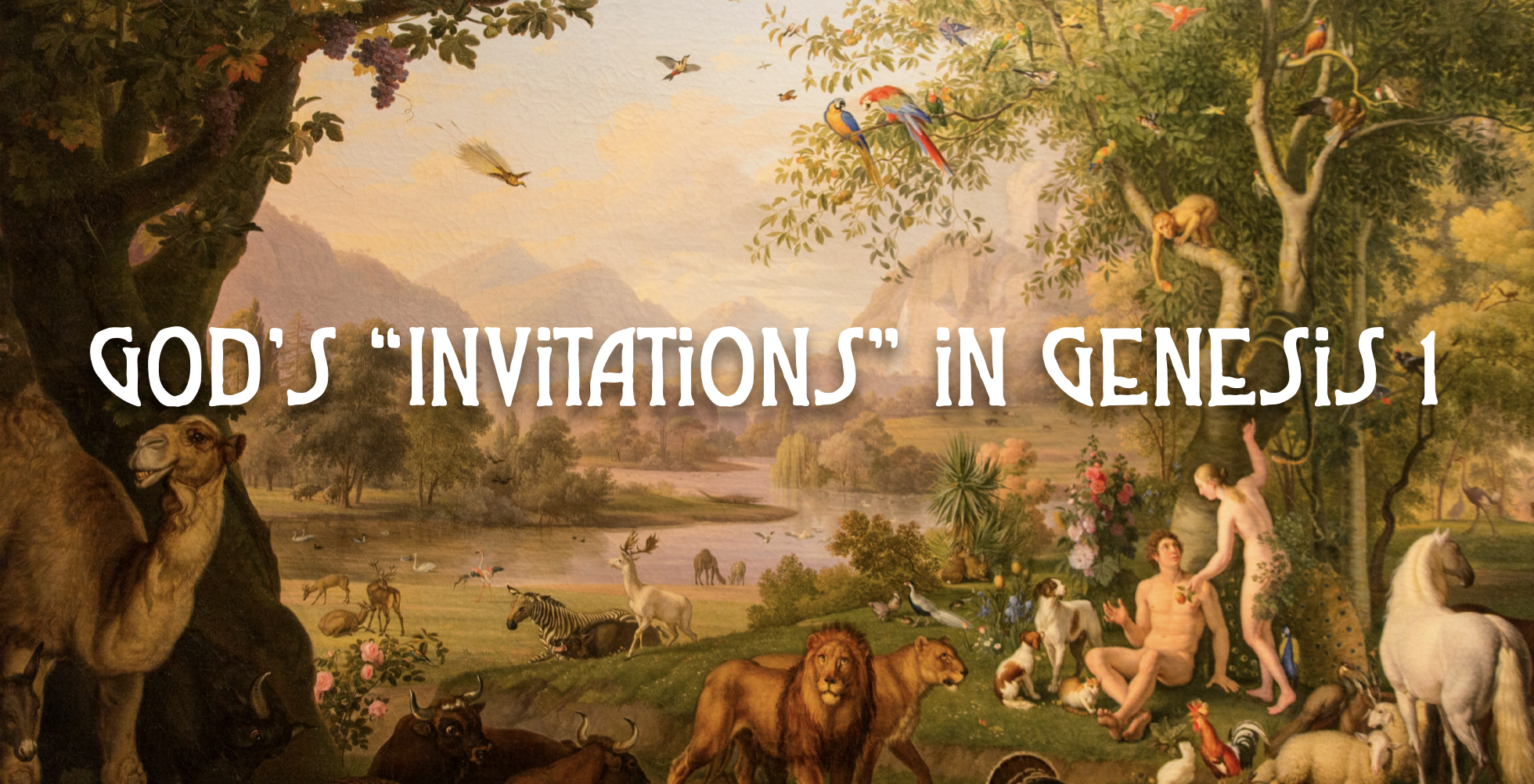
One of the things I love about reading Scripture is how you can notice something in a very familiar text that you had never noticed previously. Genesis 1 is one such text: I have no idea how many hundreds of times I have read it in my life, but its depths seem to be endless, constantly offering up new discoveries. This time, as I was reading through, I was struck by the rhythmic quality of the text: over and over again, God speaks, “Let there be” (light, an expanse, the sprouting of vegetation, etc), and over and over again, we have the repeated narrative comment, “And it was so.”

It is as if God is inviting creation to take place and unanimously, automatically, creation responds to the invitation of the Creator: God speaks, and it is so.

On the sixth day, God speaks into existence the pinnacle of creation: humanity, created in God’s own image. As image-bearers, humans are given a divine vocation: to rule over creation (under God’s authority), to fill the earth, master it, till and tend the garden of Eden, and give names to the animals (Genesis 1.26, 28; 2.15, 20).

Such creatures obviously possess enormous potential for cooperation in God’s good plans, but ironically, it is in this pinnacle of creation where we see a break in the pattern of the unanimous, automatic response to God’s invitation of how things are supposed to work. As we see in Genesis 3, rather than accepting God’s invitation to rule under His authority, Adam and Eve fail to reflect the divine image and seek to establish their own autonomy and authority instead. They eat of the forbidden fruit with disastrous consequences.

This has remarkable implications. That God allows His image-bearers to ignore His invitations of co-rule shows how He honors humanity with freedom. Far from an automatic response where God reveals His will and humans unanimously and immediately respond in accordance with that will, God invites us to reflect His wisdom and authority but does not force it upon us. He does all that can be done to bring us around to His side, but He allows us to pave the path to our own destruction. He is grieved by our poor choices, but He honors us too much to prevent them.

What a marvel to be given such ability with such freedom, such potential for good or evil!

As C.S. Lewis says in Prince Caspian:

“You come of the Lord Adam and the Lady Eve,” said Aslan. “And that is both honour enough to erect the head of the poorest beggar, and shame enough to bow the shoulders of the greatest emperor on earth. Be content.”

Or, in the words of George MacDonald:

“However bad I may be, I am the child of God, and therein lies my blame. Ah, I would not lose my blame! In my blame lies my hope.”

What humanity desperately needs is an exemplar, someone who will harness the dangerous gift of freedom, submit to the wisdom and authority of God, and in so doing, perfectly reflect the divine image.

Of course, we have such a Someone; His name is Jesus.

Incarnation & Human Involvement In God’s Transformative Work

Several weeks back, I finished my series on The Chronicles of Narnia, and now I am thoroughly enjoying reading through Paul Ford’s Companion To Narnia: Revised and Expanded. It is basically a reference work that discusses the process of C.S. Lewis writing the Chronicles, analyzes how they relate to the rest of his works, and provides encyclopedic entries for everything imaginable in the world of Narnia. I am just now in the Es, so I have a long way to go, but it has been a lot of fun to read.

A while back I read through the entry for Aslan, which, as you might expect, is incredibly lengthy, with the Great Lion being the central character of the Narnia series and Lewis’s imagined Christ Figure in the world of Narnia. In that entry, Ford makes an insightful comment on Lewis’s effort to point his readers to the implications of the incarnation:

[Aslan’s] encouragement of the now-revived lion with the phrase “us-lions” and his employment of the giant to break down the castle walls and the sheepdog to organize the creatures into a force that will be helpful in what will later be called the First Battle of Beruna are all instances of Lewis’s profound belief that one of the consequences of the incarnation (God’s desire to identify with us by becoming one of us) is that he wants our help in the process of transforming the world.[1]

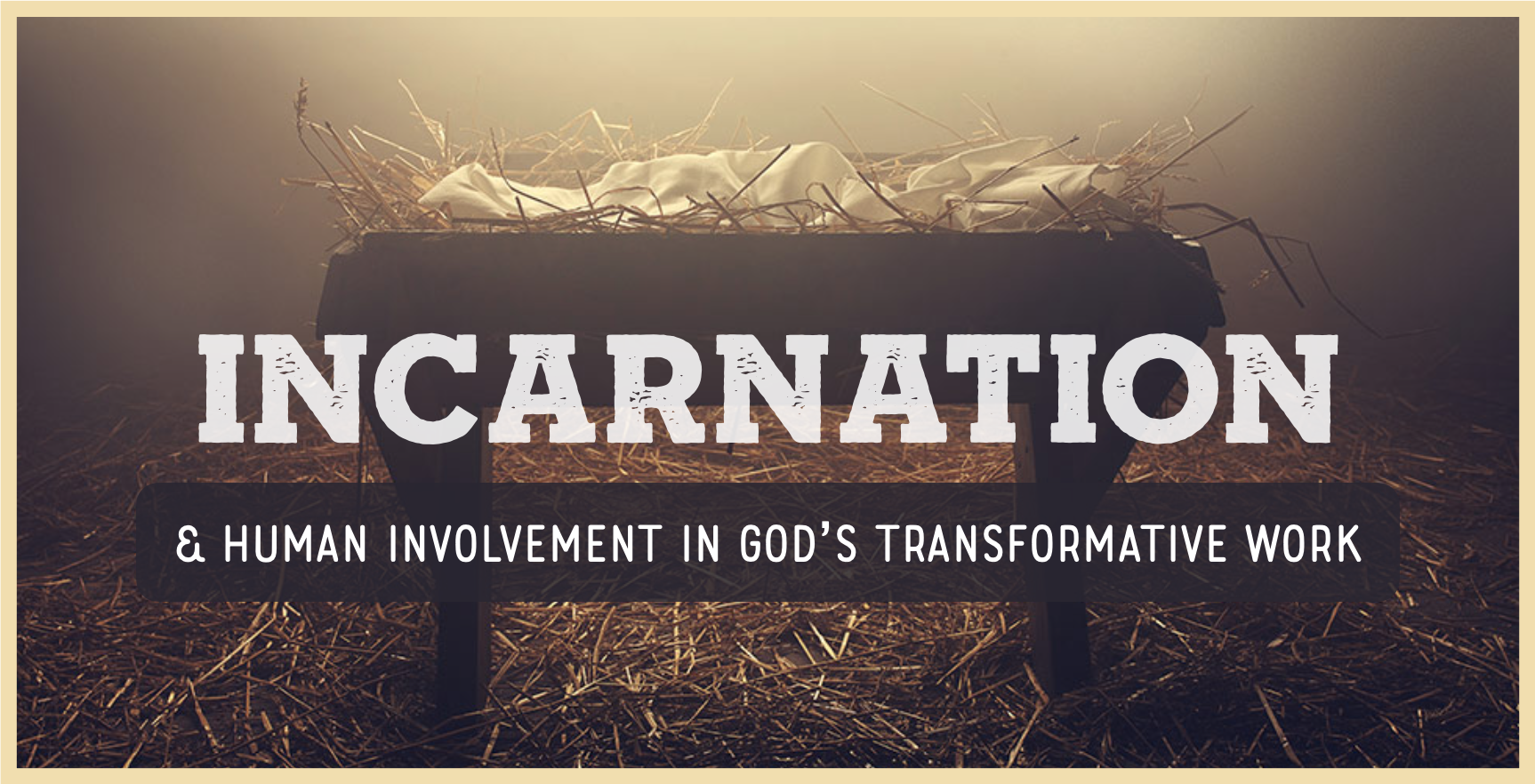
In the Incarnation, God identifies Himself with humanity through Jesus of Nazareth entering the world stage in the form of a baby. In so doing, God affirms the goodness of creation and also His intention to partner with humanity in bringing about His purposes for that creation.


This is, in large part, what it means to be created in God’s Image; we are God’s representatives, bearing His authority to carry out the task He has given us. This is the picture we have of Adam and Eve in the garden: God giving them the task to steward and cultivate His creation, partnering with Him, under His authority, to take care of it and develop it.

Tragically, Adam and Eve fail to live up to their vocation. In the bitterest of ironies, they clutch after the forbidden fruit hoping to become like God, failing to realize that they already were! And humans have similarly failed ever since then.

In the bitterest of ironies, Adam and Eve clutch after the forbidden fruit hoping to become like God, failing to realize that they already were! Share on X

In the Incarnation, Jesus comes to show us a different way. He perfectly reflects the divine image, obeying the Father’s will in all things. Rather than seeking after power or God-likeness, He willingly lays it down and lives as a servant, even to the point of dying on the cross.

Those of us who would follow Jesus are called to imitate His example. The vocation that God bestowed upon humanity in the garden has not changed: still, we are encouraged to take up our crosses and join in God’s mission. In The Lion, the Witch and the Wardrobe, the resurrected Aslan could have defeated all evil, established his reign and rule, and brought about the transformation of the world all on his own, but he chose not to. And this, as Ford points out, is no accident: Lewis was simply reflecting the biblical teaching that the all-powerful God chooses to bring about the redemption of all things in collaboration with human agents of new creation.

One of the great truths of the incarnation is that God brings about the transformation of the world—new creation—through His partnership with humanity.


[1]  Paul Ford, Companion to Narnia: Revised Edition (San Franciso: HarperCollins, 2005): 60.

© 2026 The Doc File

Theme by Anders Noren — Up ↑