The online journal of Luke Dockery

Tag: Inspire

2026 Harding University Lectureship Recap

One of my yearly traditions on The Doc File is to write a post that recaps Harding’s annual Bible Lectureship, which occurs in late September. This year’s lectureship occurred early in my sabbatical, and soon after it was over my wife and I took a 20th anniversary trip and then I returned and was buried (in a delightful way) in research and writing on my sabbatical project and I just never got around to writing about the Inspire Lectureship. It is now late enough that what I write here is somewhat dated, but it is helpful for me to reflect on the things I heard, so I will proceed anyway. Maybe there will be something here to benefit others as well.

This year’s theme was Psalms: Back to the Heart of Worship, and there was a significant focus on, well, Psalms and worship. Before I jump into a recap of the sessions I attended, here are a few summary thoughts:

  1. After the controversy surrounding last year’s Lectureship, I really didn’t hear much at all this year. This was nice.
  2. I thought one of the great strengths of this year’s program was the exposition of a bunch of different individual psalms. I felt like I came away having heard a lot of valuable biblical teaching, and I think that those who attended several of these sessions received a really good feel for the book of Psalms.
  3. This year, they brought back morning keynotes and actively discouraged Lectureship attendees from going to student chapel (which was the same time as the morning keynotes). I thought this was a really unfortunate move. Especially for a Lectureship themed on worship, denying participants the option of worshiping in chapel seemed like an obvious misstep to me (there were likely good reasons for this of which I am unaware).
  4. This was the second year that there was a great emphasis on multi-session tracks rather than standalone sessions. I understand reasons for this, but I personally dislike it. There are a lot of topics that I am interested in for one session, and far fewer that I want to stay around and listen to for three hours. And, depending on how tightly coherent the different sessions are, if you miss the first one, it may not be worth it to go to others. In short, the multi-session tracks are great if there is a track you love and there is nothing else you really want to go to at the same time; if either of these things is not true, it is problematic.

Now, on to the main thing!


I got to attend a variety of lectures and classes, and in what follows I will provide a brief recap of what I went to, along with some takeaway points and meaningful quotations:

His Presence: Psalm 100, Ammar Saheli: I had never gotten to hear Saheli before, who has been a minister at the West Oakland Church of Christ for 25 years. I thought he did a great job of introducing the theme for the week and also the Psalter itself, the “hymn book of Israel.” Saheli said that the Psalter shaped the culture of Israel and shaped the culture of Jesus, and that it would be great if it shaped the culture of our churches as well. He then looked at Psalm 100 in more detail, and emphasized the importance of worship and being in God’s presence as we navigate the difficulties of life:

“Regardless of what is going on in my life, when I enter His presence, God is still good!”

“‘I’m just going to do me.’ You don’t know you!”

“We worship our way through our hurts.”

This was not a profound lecture because it taught something new, but because it taught something fundamental so well: God is still good despite my problems, and worship and gratitude help to orient us to this reality.

Fearfully and Wonderfully Made, Justin Bland: I spent Monday morning (other than the morning chapel keynote) attending three sessions by Justin, who teaches Exercise Science at Harding and is one of my best friends. Justin excels at blowing your mind with fascinating human physiology, and then making insightful theological connections. I took tons of notes and it is hard to sum up here what he talked about, but I’ll try to provide a brief overview of the three sessions:

  • From the Womb: This session focused on the way a mother’s entire physiology adapts to support another life and what can be learned from that:
    1. We are fearfully and wonderfully made.
    2. Self-sacrifice is built into the mother’s physiology.
    3. We are deeply connected.
    4. An appreciation for the “mother” language God uses (Exod 34.6; Matt 23.27).
  • Sustained by the Heart: This session focused the heart, which is the servant of the body. Many of these observations are physiological, but the theological and ecclesiological implications are clear and powerful:
    1. The heart develops through challenge and adversity.
    2. The heart has several redundant systems to ensure continued beating.
    3. The heart takes on new function at birth.
    4. The heart receives oxygen and nutrients during rest.
    5. The heart responds to the needs of the body.
    6. A diseased heart signals muscle wasting.
    7. When your heart is full, you will thirst no more.
    8. The physical embodiment of love is the servant of the body.
  • Made to Work: This final session focused on the physiology of work, and the fact that we were made to move and are shaped by movement. Again, a lot of good takeaways here:
    1. We do things that are hard to get better for the sake of something bigger.
    2. Discussions of stress and mental health must include exercise!
    3. Stress is the perception of a physical threat, and your perception is shaped by what we believe; what if we actually believed that Jesus is the Good Shepherd?
    4. I do not worship this body, but with this body I worship!
    5. The heart of worship is embodied loyalty.

Justin crushed it! I was so proud of him and am so blessed to be his friend.

His Love Endures Forever: Psalm 136, Mac Sandlin: Mac is one of the excellent professors in the College of Bible and Ministry at Harding. He introduced Psalm 136 by talking about music and how the chorus makes the song—the most powerful and popular songs are those with catchy and moving choruses. Mac challenged us with this question: “If you were to write a story song about God, what would the chorus be?” After weighing some different options—How God Gives Success, How God Makes Me Feel, God Rules Over All, How Bad Our Enemies Are, God Is Transcendent—he put forth his thesis from Psalm 136: the chorus of the story of God is “His love endures forever.” This is the heartbeat of Scripture.

“God’s love burns but never burns out.”

Worshipping the Goodness of God, Part 1: In Good Places–Rest and Righteousness, Evertt Huffard: I first knew Dr. Huffard as the Dean of Harding School of Theology when I began my graduate work there when the school was still in Memphis, and more recently, as a member of the church where I work! He is a long-time expert on missions and church dynamics, and has also had a career interest in studying the kavod (כָּבוֹד) of God (often translated “glory,” but which Huffard believes is better translated “honor”). I was only able to go to the first session, but Dr. Huffard was presenting some of the arguments from his new book. The basic argument as I understand it (I haven’t read his book yet), is that God’s kavod is about His goodness (His character) in addition to His greatness (His power). This is important, because as we seek to be like God, we actually cannot approximate Him in power, but we can seek to emulate Him in character. In this session, Huffard focused specifically on ideas of rest and righteousness from Psalm 23, and left me with the following takeaways:

  1. Restoration cannot come without submission to spiritual authority.
  2. God equips others with spiritual gifts to restore my soul.
  3. Through the consensus of those who care about me, God restores me.
  4. Constructive criticism can be a tool for learning and restoration.
  5. Working in a church under spiritual authority gives structure to my restoration.

These were helpful thoughts to reflect on in the midst of my sabbatical!

Stop Whispering! Psalm 107, Kristopher K. DarDar, Sr.: DarDar serves as the Senior Minister for the East Pointe Church of Christ in Fort Worth and delivered the Tuesday morning keynote. Focusing on Psalm 107 (“Give thanks to the LORD, for He is good…”), DarDar emphasized that the redeemed ought to say so (v.2)—there should be nothing quiet when we reflect on the goodness of God. He then emphasized all the different kinds of people that God has gathered (v. 3), but that none of us is better than another because God has given a seat to all of us.

Archaeology in the Psalms: Artifacts, Dale Manor: I try to listen to Dr. Manor teach whenever I can, and the opportunities are rarer now that he has moved from Searcy to Arizona. He was in his wheelhouse in this session, showing us pictures and actual artifacts of various elements referenced in the Psalms—weapons, footstools, cherubim, musical instruments, and more. He taught with his typical knowledge and humor, but also with poignancy: particularly moving was when he discussed God’s bottles to collect our tears (Psalm 56.8–9). Dr. Manor got choked up at this point, as he lost his dear wife earlier this year. I am always deeply moved when I see the humanity and courageous faith of men that I deeply respect and admire. Dr. Manor is in that category, and this was one of the most powerful moments of this year’s lectureship for me.

What Is A Doctrinally Sound Church of Christ, Erik Tryggestad: Tryggestand works with The Christian Chronicle and this was part of a series that stemmed from his observations from different events he had attended associated with different “branches” of Churches of Christ. There were some interesting tidbits here, but, honestly, what struck me most was that for someone who had taken on as a major project trying to take the pulse of the spectrum of Churches of Christ, he seemed surprisingly unaware of the terrain.

Breathing Underwater: Spirituality and the 12 Steps, Monte Cox and Rachel Wisdom: At last year’s Lectureship, Dr. Cox (the Dean of COBAM) and Wisdom (his daughter) did some amazing presentations from The Anxious Generation, and I made the major mistake of only going to one of them. This year, they teamed up to talk about Alcoholics Anonymous from a spiritual perspective. I confess that I don’t have great interest in the 12 Steps, but I went because I thought the presenters would be compelling. They were—their chemistry is incredible (maybe not surprising since they are father and daughter; or maybe even more surprising?), but I still didn’t love the content enough to stay for the other two sessions. The session I attended went over the first two steps, and was sufficient to accomplish what I suspect was a major goal of the track: If I was before, I am not now leery of AA, and I certainly see how churches that host AA meetings could use these as an opening for spiritual conversations and a bridge to faith.

How the Psalms Shaped Early Christian Proclamation, Kevin Burr: Kevin is another of my best friends, and is the newly appointed Assistant Dean of the College of Bible and Ministry. In this track he was actually speaking along with a couple of his students, which I thought was neat, though I only stayed for his session. He basically looked at how the Psalms resonate throughout Christian preaching in the New Testament, and took a special look at Peter’s sermon in Acts 2, which was carefully crafted using Old Testament allusions and quotations—including from Psalms—in order to make the point that Jesus is Lord. In fact, Jesus’s eternal kingship is the theme that runs throughout the New Testament, and the Psalms are employed repeatedly to teach this motif.

How Can We Sing the Songs of the LORD in a Foreign Land? Psalm 137, Monte Cox: The Tuesday night keynote was special as it was delivered by Monte Cox, who is retiring this year as Dean of COBAM. I had heard Dr. Cox preach from this text before, and it is one of my favorite sermons. The context of Psalm 137 is that God’s people are lamenting as they are taken away in exile to Babylon while their captors mock them, demanding that they “Sing us one of the songs of Zion!” How is this possible, though? How can we sing the songs of the LORD in exile? In a world where Christians increasingly feel (or should feel) like exiles, it is a pressing question, and it seems like there are a few different possible responses:

  1. Sing really loudly! Blow them away! This is kind of the culture war approach—fight for our rights and do everything we can through legislation to make Babylon look like we think it should.
  2. Retreat quietly, don’t bother anyone, and sing quietly. This might be akin to the rise of the “nones,” those who increasingly disaffiliate from faith communities, while remaining “spiritual but not religious.”
  3. Learn to sing the songs of Babylon. This is basically salt losing its saltiness—we just blend in with our surroundings and adopt the values of the world.
  4. Learn to sing the songs of the LORD in Babylon. This is hard, but is the way forward for those in exile. It is the practice of Daniel, Hananiah, Mishael, and Azariah, who faithfully served the king in Babylon but also remembered who they were as servants of the LORD, and knew what their limits were. It is the way of Jeremiah, who encouraged Israel to seek the peace and prosperity of the city (Jer 29.4–7).

“A cozy relationship between church and state is good for the state and bad for the church.” (G.K. Chesterton)

“You’re going to worship gods you have to carry instead of the God who carried you?”

“False gods never fail to fail.” (Chris Wright)

“The antidote for idolatry is always worship.”

I strongly believe Christian need to embrace the paradigm of exile to help us process our place and perspective in the current cultural moment, and there was a lot of good wisdom to chew on in this lesson.

Praying the Psalms with Bonhoeffer: Lord, Teach Us to Pray, Mac Sandlin: This year has had a bit of a Bonhoeffer flavor for me, as I have read three books that either focused on Bonhoeffer or significantly engaged with his works, so I was interested to check out this session. Really, though, this session was less about Bonhoeffer or the Psalms (though both were touched on) and more about the task of prayer itself as illumined by the Lord’s Prayer. The key takeaway from this session is that prayer is hard! When Jesus’s disciples came to Him and said, “Lord, teach us to pray,” it’s not like they had never prayed before—these were people who grew up praying! The very fact that they are asking points to the reality that prayer is difficult. Jesus tells them, “Pray like this…” We learn to talk by mimicking others who know how to talk, and we learn to pray by mimicking Jesus.

“Prayer is not emptying the heart to God, but learning how to talk to God whether the heart is full or empty.”

Falling in Love with God’s Law: Psalm 119, Kevin Youngblood: Dr. Youngblood is a brilliant scholar, and his topic focused on the longest Psalm (or chapter) of the Bible, and the Torah that it praises. There was a lot of good content here, but I thought Dr. Youngblood’s four main points were great:

  1. God is not a policeman, but a liberator (Ps 119.32).
  2. Torah is not a tightrope, but a freeway (Ps 119.32, 45).
  3. Obedience is not a drudgery, but a delight (Ps 119.24; “Delight occurs 9x in Ps 119).
  4. Our pain is not pointless, but purifying (Ps 119.23, 98, 121, 157, 161).

“Torah lenses help us to see better—if we don’t get Torah right, we won’t get the Gospel right.”

“Salvation by grace is first taught in the Pentateuch.”

“On the Mount of Transfiguration, Moses and Elijah help us to clearly see Christ’s brilliance.”

The Psalms and the Life of Jesus Christ, Peter Rice: Peter is the Dean of Harding School of Theology, is a good friend, and is my favorite preacher to listen to. I try to hear him whenever I can. Peter focused on Jesus’s use of Psalms in His life. Jesus quotes from or alludes to the Psalms a lot, but what really stood out was that in all but four or five cases, Jesus quotes the Psalms during Holy Week, roughly half of the references are during the crucifixion, and over half of the references discuss Jesus’s suffering and rejection. Jesus’s use of Psalms helps explain his relationship to David as He is the messianic king who must suffer, and who takes on the pain and humiliation of the Psalms as His own. From this, we can learn at least one really important lesson:

“The Psalms are a resource for the darkest times of life.”

God’s Favorite Scripture: Psalm 23, Anthony Walker: Walker preachers at the Hwy 231 S Church of Christ in Murfreesboro, TN and also works with Renew.org, and closed out Lectureship with the Wednesday night keynote, talking about the most famous psalm of all. Walker emphasized parallels between Psalm 23 and Luke 15 that I had never noticed before (shepherd, father, banquet) but found really interesting. I really enjoyed the way he worked through Psalm 23 itself, and will try to provide a sense of that below:

  • The LORD is my shepherd, I shall not want: I am a sheep and my security is found only in God, but God cares for each sheep.
  • He makes me lie down in green pastures; He leads me beside still waters: God provides and protects, and thus I can have peace. He leads me to water that will sustain me, not startle me.
  • He restores my soul; He leads me in paths of righteousness for His name’s sake: God brings me back, and I need Him to get back. God leads me in the right paths.
  • Yea, though I walk through the valley of the shadow of death, I will fear no evil: Valleys are on the path and they must be addressed and faced. Gethsemane is the valley in the shadow of Calvary.
  • For You are with me; Your rod and Your staff, they comfort me: God is here with us. He protects me from enemies and keeps me.
  • You prepare a table before me in the presence of my enemies. You anoint my head with oil. My cup overflows: God prepares a table before me, in spite of my enemies, and hours me in a special way like a special guest.
  • Surely goodness and mercy will follow me all the days of my life, and I will dwell in the house of the LORD forever: I am followed by goodness when I return, forever and into the future.

I really enjoyed ending Lectureship with these thoughtful reflections from the most famous psalm.

The Inspire Lectureship was a bit strange for me this year, as it fell near the beginning of my sabbatical, and I struggled a little bit with how to balance things. Still, I got to hear a lot of good sessions and connect with old friends and professors. In the midst of a season of blessings, Harding Lectureship was one of them.
2025 Harding University Lectureship Recap

Every year, I write a post recapping Harding’s annual Bible Lectureship, which occurs in late September–early October. Since I am writing this post in November, I am a little behind, but it is still a helpful practice for me, and perhaps others will find something of interest here as well.

The theme of the Inspire Lectureship this year was Oneness: An Ancient Vision for Ageless Unity, and focused on the 7 Ones of Ephesians 4 as a source of unity among God’s people. As part of that emphasis on unity, the Lectureship Committee seemed to make a concerted effort to cross some traditional divides, inviting a large number of ethnically diverse presenters (African American, Latino, and Native American, among others), as well as some speakers from outside the fellowship of Churches of Christ (albeit, ones with broad theological kinship, like the Independent Christian Churches or a local nondenominational church). This latter move generated great controversy on social media, which I thought was unfortunate. Focusing on that controversy is not the main point of this post, but I feel I would be remiss if I ignored it and pretended it didn’t happen, so here are some brief thoughts:[1] 

  1. I coauthored a book earlier this year on the history of Churches of Christ and the American Restoration Movement, and how unity was an early and driving goal of that movement. I have written before how unity itself is a doctrine, a teaching of Jesus, and how we must take it seriously if we desire to follow Him. With that in mind, it is more than a little ironic that those purporting to be faithful caused an online uproar in response to a concerted effort to seriously reflect on the doctrine of unity.
  2. Many of the critics hold the opinion that only members of Churches of Christ should be allowed to speak at Harding’s Lectureship (and, to be more accurate, only members of the right kind of Churches of Christ). They are certainly entitled to that perspective, but objectively, it is a sectarian one.
  3. Some of the critics suggested that this Lectureship reflected a dangerous slide down the slippery slope to liberalism for Harding, and that they were not sure if they could continue to support the school. These warnings could be taken more seriously if the same critics had not been saying the same things for years; as it is, it comes across as disingenuous.
  4. For all of the controversy, I found this year’s Lectureship to be remarkably similar to previous ones. It did not seem to be edgy, and when I spoke to others in attendance, they agreed. Furthermore, for a school purportedly sliding into liberalism, it was surprising on the first night to hear the school president share Harding’s new Statement of Faith that requires alignment from faculty and staff on a historically Christian sexual ethic (Harding has never done this in the past, so this represents a markedly theological conservative move), the president affirm a continued commitment to a cappella worship and male spiritual leadership, and the keynote speaker reject theological progressivism as an exit to non-faith (see below).

Now, on to the main thing!


With the new format that was adopted last year, there is a greater emphasis on multi-session tracks than standalone lectures. For a variety of reasons (sometimes I wanted to be sure to stop in for a session to greet a presenter I knew; other times I had meetings that interrupted my schedule), I ended up often hopping around and catching bits and pieces of different tracks. I still heard good content, but overall I lament my haphazard approach because I know I would have gotten more out of the week if I would have stayed with a few of the tracks for their entirety.

I got to attend a variety of lectures and classes, and here is a brief recap of what I went to, along with some takeaway quotes:

One Body, Rubel Shelly: Shelly has been a longtime preacher and academic within Churches of Christ, and as you will see, I heard from him multiple times at this year’s lectureship. He offered the opening keynote and I thought did a great job at challenging us to appreciate the very notion of unity:

“Few topics in the Churches of Christ are as divisive as unity.”

“We are one body whether we like it or not.”

“The greater concern than accepting someone Jesus rejected is rejecting someone Jesus accepted.”

“It’s not about us being right and everyone else being wrong, but Christ being right and all of us being wrong.”

I thought one of the best parts of Rubel’s presentation was his warning against theological progressivism, which he referred to as the opening of the door for people to exit to non-faith. This warning might come as a surprise to many within Churches of Christ who consider Shelly himself to be a progressive, but this is kind of the point: there is a desperate need in our churches to be able to distinguish between orthodoxy and progressivism. For a variety of reasons, most within our churches are not well equipped see the difference between practices that go against our traditions and convictions (that we often label as “progressivism”) and true progressivism, which is faith-destroying. Maybe I’ll write more on this sometime, but I thought this was a valuable admonition.

S.R. Cassius and the Fight against Racism in America, Edward Robinson: Dr. Robinson is the preeminent historian of African American Churches of Christ, and did a three-part series on noted African American leaders in Churches of Christ. He was also a former professor of mine in grad school, and I loved his class on the American Restoration Movement.

I was only able to attend one of Robinson’s sessions, which was on S.R. Cassius, a bi-racial preacher in Churches of Christ in the late 1800s and early 1900s. Unlike the more famous Marshal Keeble who came after him, Cassius openly and consistently criticized racism, and worked more diligently than anyone else in Churches of Christ to lift up his race.

One Baptism, Scott Adair: Scott teaches in the College of Bible and Ministry at Harding, and offered the Monday morning keynote. Scott talked about how in the ancient world, the way you walked revealed something about who you were. Paul uses “walk” thirty times in the New Testament, and in Ephesians, addresses the idea of walking a lot. Unfortunately, after receiving our commission at baptism, we often walk like the world.

In Ephesians, Paul is not trying to baptize people; he’s talking to baptized people. And as baptized people, we should know that baptism is supposed to remind us of who we are:

  • At baptism, we make a confession of Jesus as one Lord. We are loyal servants of the crucified and risen Savior, so we should act accordingly.
  • We are baptized in the name of the Father, Son, and Holy Spirit—the one God. This reminds us that we are beloved children, and the one Spirit seals us with the one hope.
  • Baptism is a reenactment of the death, burial, and resurrection of Jesus, the core historical event the one faith rests upon.
  • We are baptized by someone else; someone else re-presents the church, the one body to us. The church is the presence of God in the world.

“Our calling: we are washed, resurrected sons and daughters of God who are empowered by the Spirit to re-present Christ to the world.”

The Future of Churches of Christ: Proposals for Unity, Keith Stanglin, Scott Adair, Rubel Shelly: This was a three-part series over the course of three days where each day one speaker would present his ideas and the other two would respond. Unfortunately, it was a popular series in a too-small room, and I wasn’t able to attend one of the presentations (Adair’s).

Keith Stanglin went first, and presented the common argument that the Restoration goal of achieving unity through restoration has not worked. Churches of Christ today represent significant diversity, but the tension between unity and restoration is still present. Furthermore, Stanglin argued that it wasn’t the Bible that united first-century Christians, because the New Testament wasn’t completed yet. Instead, it was the common belief in the core content of Christian proclamation, the common confession of the apostolic faith. Ultimately, Stanglin’s argument is that unity should be based on something like the Apostle’s Creed, which sums up the earliest proclamations of the gospel.

“The faith confessed at baptism should be a sufficient test of unity.”

“Everyone including God recognizes the difference between ignorance and willful disobedience.”

“Is there room for a category that is not essential but still worth defending?”

In Shelly’s session, what stood out to me was his suggestions that we need to start with Ephesians 4.1-3 before skipping ahead to the “seven ones” of Ephesians 4.4. Unity begins not with doctrine, but with a spirit of humility, gentleness, patience, and bearing with one another in love. The reality is that we can agree about the seven ones, but still violate Ephesians 4.1-3.

“We would do well to pray the prayer that Jesus prayed in John 17. It must be possible or Jesus wouldn’t pray for it.”

One Lord, Rodney Dulin: Rodney serves as the Senior Minister for the Central Pointé Church of Christ in Dallas and delivered the Monday evening keynote. Dulin emphasized that our salvation is centered on the person and work of the one Lord, Jesus Christ.

The early Christian confession that Jesus is Lord was significant and controversial no matter who you were—for Gentiles, it meant that Caesar was not Lord, and for Jews, it identified Jesus with the God of the Hebrew Scriptures. We reference Jesus as Lord and Savior; Him being Savior is what He did for us; Him being Lord is what we do for Him—we must respond to the rule and reign of our Lord.

“It doesn’t matter if you went to Penn State or the state pen, if you’ve been baptized…you belong to the one church.”

Where on Earth is Heaven? Rubel Shelly: This was a three-part series of which I was only able to catch the first session. Much of this was introduction where Shelly was laying the groundwork for what he was going to say next (which I missed), but he did a good job of showing how Plato’s views significantly affected Christian thought in a way that departed from biblical teaching:

  • The material world is deficient and negative to spirituality (in extreme forms, matter is evil)
  • The human soul is immortal (a necessary conclusion for Plato because of the transmigration of souls)
  • Our new bodies will be “ethereal” and escape the flesh (envisioned the world of “forms” beyond matter)
  • The goal of life is to escape Earth/flesh/matter (the biblical goal is quite the opposite!)

I wish I would have been able to take in more of this track, but ultimately, Rubel affirms what I argue for in this series (see especially this post on our resurrection bodies).

One Faith, Olu Shabazz: Shabazz serves as the Senior Minister and Evangelist for the Harlem Church of Christ in New York City, and delivered the Tuesday morning keynote. He emphasized how the “7 Ones” speak to the exclusivity of apostolic Christianity, which distinctly contrasts with the subjectivity of our own time. It is simply not possible to look at the “one faith” of Ephesians 4 and come away thinking that just any path will lead to God; when man rejects the one faith, he establishes his own religion instead.

“If your truth is not God’s truth, then it is no truth at all.”

The Anxious Generation: The Challenge of Collective Action, Monte Cox and Rachel Wisdom: Monte serves as the Dean of the College of Bible and Ministry at Harding, and Rachel, his daughter, is a school counselor in a nearby town. Their track focused on big ideas from Jonathan Haidt’s The Anxious Generation, a book I love and reviewed here.

Because I had already read the book and am very familiar with Haidt’s ideas, I decided not to attend this entire track, but just went to one session (so I could be with my wife, who attended this track). The session I went to, “The Challenge of Collective Action,” was great, and it made me regret missing the other sessions. Cox and Wisdom were a brilliant combination, and clearly enjoyed presenting together. They were witty and knew the material well. The material itself was not new for those who had read the book, but Wisdom’s insights from her school context were helpful, and it is always good to be reminded of important things that you already know.

One helpful reminder from Haidt is the metaphor of parenting as carpentry or gardening. Carpenters follow detailed plans with precise measurements, and if they follow the plans precisely, they get the result they desire. Gardeners realize that they are not ultimately in control of producing growth, but that instead their job is to create an environment where healthy growth can occur. Many people try to parent as carpenters, following the right plan and controlling all the variables to produce the perfect, ideal children, but parenting is more like gardening than carpentry: as parents, our job is to provide a healthy environment where children can thrive, and not try to micromanage the outcome. Though Haidt is not a person of faith, I think there is deep biblical wisdom in this admonition, as we know that we are ultimately in control of very little, and that our task to is to be faithful in our opportunities and trust God to yield the results that honor Him, including with our children! As a parent who is often inclined toward carpentry, this is a very helpful metaphor and reminder.

The Restoration of Israel, the Kingdom of God, and the Church in Luke–Acts, Mark Black: Mark Black is a long-time professor at Lipscomb University (His older brother Allen was one of my professors at HST). Black shared a ton of information, but ultimately was reflecting the work of Jacob Jervell, a Norwegian theologian who argued that the church in Acts is the beginning of the fulfillment of promises made to Israel. His views have largely won the day in the academy, but are not necessarily as widely understood in the church.

I couldn’t even begin to write down all that Dr. Black shared, but here were some concluding remarks (some of which are fairly provocative for a variety of reasons). If the church is essentially restored Israel…

  1. We shouldn’t call ourselves the New Israel.
  2. The Old Testament has not been abolished.
  3. God didn’t change His ways with the Messiah; His interactions with humanity have always been based on grace.
  4. The church does not replace Israel.
  5. The are no Christians outside of the church anymore than there are Jews outside of the people of Israel.
  6. The mission of the church remains the same mission of Israel—bless all the nations and bring them into God’s people.
  7. We should take kingdom language literally—the land itself will be restored.
  8. There is no “right” proscribed method of church leadership.

Some of these conclusions seem evident to me, and others less so; I wish there would have been more time for all of these to be unpacked! But this was a rich session with lots of important ideas that would help the average church member to better understand the story of Scripture and the implications of it.

Who Are You Really? Accepted and Secure in Christ (Eph. 1.3-14), Evan Todachine: Evan preaches at the Kayenta church of Christ on the Navajo Reservation in Northeast Arizona. I first met Evan when my former church began to support his work in Arizona, and I wanted to reconnect with him and support him as he spoke as part of the Youth Ministry track.

Evan talked about the idea of identity and what that looks like in a Navajo context (you introduce yourselves through your clan identity), and how we live in a world that is obsessed with identity, but according to the Bible, identity is God-declared rather than self-defined.

“Until we know who Christ is, we will always struggle with identity.”

Does a Man’s Color Matter? Olu Shabazz: I went to a couple sessions from this track, and it was fascinating—Bro. Shabazz shared his experience growing up in a family in the Nation of Islam and also discussed Black Hebrew Israelites. This was part of a larger discussion about ethnic identity and whether or how a person’s skin color matters. God created humans as “trichotomy beings,” or, in the words of Shabazz, “You are a spirit that has a soul that lives in a body.”

This is another session where I would have enjoyed being able to sit down and have a follow-up discussion with the speaker. I believe Bro. Shabazz would argue that our embodied experiences matter and that we should seek to understand one another based on those experiences, but that one’s skin color doesn’t give particular insight into spiritual truth or special access to God.

Does God Predestine Individuals to Salvation or Condemnation? Kevin Burr: Kevin is one of my best friends, and is now a Bible professor at Harding. He tackled a historically controversial question regarding predestination, and did a great job. His basic thesis is not particularly controversial to me: the Bible teaches predestination and free will. Here are some key points:

  • Scripture repeatedly affirms God’s election of Israel, and Paul knows this—He believes God’s election of those in Christ is based on this.
  • Choice and love are essential, necessary actions in establishing and continuing a relationship.
  • Paul understands a “corporate election” model for Israel, and preserves corporate election for the church. I have held to a model of corporate election for a long time, but it was new to me that Paul bases his understanding of this in God’s relationship with Israel. It seems obvious to me now!
  • God’s predestination has room for human agency; if your view of predestination rejects human agency, then Paul’s words are nonsense.

One Hope, Matt Love: Matt preaches for the Beebe Church of Christ and also teaches at Harding School of Theology, and wrapped up the Lectureship with the Wednesday evening keynote. Matt offered some poignant thoughts on hope as an essential element of the Christian faith that we are perhaps in danger of losing. Noting the increasing move toward happy funerals that avoid the heaviness of death:

“We have a big problem and it is death…but Jesus rose and we will too. Your entire life was supposed to point people to Jesus, and your final gift is to point people to Jesus one last time.”

Perhaps, one of our problems is that we have hoped in the wrong things…hoping that “our team” (Churches of Christ) would win, hoping that this Christian life would be easy, hoping that death wasn’t waiting for us at the end of this:

“When the time comes, will we let go of our other hopes for the sake of one hope?”

“When it comes to our faith, there is only one basket to put our eggs in…. Our hope is not in the idea of God, but God. Not church, doctrines, or religious systems; our hope is in a single person—the Lord Jesus Christ.”


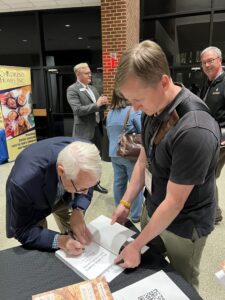
Dr. Black signing my copy of the new book in his honor.

In addition to attending all of the lectures described above, a highlight of Lectureship was a presentation of a festschrift (a book of essays in honor of someone) to Dr. Allen Black. Dr. Black, as mentioned above, was one of my professors at Harding School of Theology. He had a profound impact on my life, faith, and ministry, and several of his former students banded together to write and produce Teaching God’s Sons and Daughters: Essays in Honor of Allen Black. 

This was presented during one of the evening keynotes, and when prompted, dozens of Dr. Black’s former students stood up. Dr. Black was overjoyed and overwhelmed, and it was a touching moment.

As mentioned previously, I wish I would have done a better job planning out my week, but I still got to hear a lot of good sessions at Inspire this year, and it was a blessing to see so many old friends and professors. For me, autumn is a season of blessing, and the Harding Lectureship is one of the many great blessings I enjoy in my life.


[1] I am employed (albeit, in a very part-time fashion) by Harding University, so I should note that I am in no way speaking on behalf of the school in an official capacity. Furthermore, I had nothing to do with the planning of the Lectureship, so I was not responsible for anything that happened, and nor am I automatically defensive of it. My thoughts here are my own.

2024 Harding University Lectureship Recap

Every year, I write a post recapping Harding’s annual Bible Lectureship, which occurs in late September–early October. This year, due to significant busyness on my part, I did not get that done in a timely fashion. At this point, this post may not particularly relevant but it is still helpful to me to chronicle the event (and I don’t like leaving tasks unfinished).

Harding rebranded the Lectureship as “Inspire,” and with that came a slightly different approach with a greater emphasis on tracks rather than standalone lectures. The theme of this year was The Genesis of All Things, and focused on (surprise!) the book of Genesis.

I got to attend a variety of lectures and classes, and here is a brief recap of what I went to, along with some takeaway quotes:

Creation (Genesis 1-2), Devin & Elijah Swindle: Devin teaches Bible at Harding and directs the Center for Preaching, and his son Elijah is a senior Bible major. The evening keynotes traced the biblical metanarrative (Creation, Fall, Redemption, Mission), and the father-son duo tag-teamed the opening keynote of Lectureship and did a great job. They addressed how the biblical text provides answers to life’s big questions:

  1. God is the sovereign, only, benevolent Creator.
  2. We are royal priests made in God’s image.
  3. Our responsibilities are to promote God’s agenda, protect God’s creation, and provide blessing to God’s people.
  4. Of this He has given assurance to all through Jesus Christ, the incarnate Word of God and risen Lord.

Neller Preaching Workshop, John Walton: Walton is a renowned Old Testament scholar, influential for his work on Genesis and the Ancient Near East. I attended all three sessions he delivered at the Neller Preaching Workshop (“Preaching God’s Word from Genesis: Best Practices for Faithful Methodology,” “The Message of Scripture in Genesis 1-11,” and “The Message of Scripture in Genesis 12-50”), and two sessions that he gave the next day (“Recovering the Lost World of Genesis 1” and “Recovering the Lost World of Genesis 2-3”). I won’t try to review all of that material (I took pages and pages of notes), but instead just offer some general thoughts.

First, I should note that Harding came under some sharp criticism after Inspire for having Walton speak, purportedly because he was teaching theistic evolution. There were cries of lament that Harding had lost its way and no longer cared about the teachings of Scripture, and fervent appeals to Harding board members to straighten out the heresy. I don’t have the time or inclination to respond to all of that here, other than to say that I don’t have a lot of patience for the gatekeeping mentality that some (well-intentioned, I’m sure) believers have to always straighten out the (perceived) errors of others. I especially don’t have patience when that gatekeeping is based on false claims or, at the very least, on uncharitable takes. Speaking of Walton’s presentations specifically:

  1. Walton didn’t “teach theistic evolution.” He does, however, interpret Genesis 1-2 in such a way that it is not speaking of material origins, and thus, opens the door for alternate explanations (including theistic evolution).
  2. Walton takes the Bible very, very seriously. Part of what that means is that he is at great pains to read and interpret the biblical text the same way that the original audience would have heard and interpreted it. Literal reading of the English text divorced from its historical context is not the most faithful way to read it.
  3. Walton repeatedly stated that the strongest interpretation of a biblical text is the one with the most evidence. He encouraged his audience to test his own conclusions in their own study rather than blindly accept them.

I have read Walton’s material before and been blessed by it (he made my Top 10 book list in 2020), and I heard a lot of good content at the five lectures I attended. I also heard numerous things that made me scratch my head, and a few that I disagreed with and rejected. And such is the task of legitimate Bible study, or any exercise in critical thinking. We learn by being exposed to new ideas, wrestling with those, and ultimately, either (a) altering our previous perspectives to accommodate those new ideas, or (b) shoring up our previous perspectives through the process of examining those new ideas. Walton helped me do both of those things, and I was glad that I had the opportunity to hear him speak.

Fall (Genesis 3), Orpheus Heyward: Bro. Heyward speaks at a large and growing congregation in the Atlanta area, and delivered the Monday keynote. Heyward’s treatment of the fall was helpful, as he emphasized that salvation represents both a rescue and a recovery. Death being introduced into human existence as a result of the fall means that there is now something over which man does not have dominion; humanity needs someone who can recover that which was lost, and that someone has to conquer death. Jesus is the one who does this, tasting Death on our behalf, and destroying it as the last enemy, giving us back what we lost.

The Ink Is Dry, Rubel Shelly: Shelly has been a longtime preacher and academic within Churches of Christ, and he did three sessions related to his recent book, The Ink Is Dry, which basically holds to a historically orthodox Christian sexual ethic in dialogue with the wildly divergent sexual views in 21st-century America. This is a topic I have read quite a bit on, so there wasn’t too much here that was new, but these were excellent presentations, grounded in solid biblical and historical study.

“No one has ever made a positive case for same sex behavior from Scripture.”

“Christianity advances by persuasion, not civic legislation.”

“Holiness is to live with the grain of God’s own character.”

Jesus-Centered Youth Ministry, Daniel Parrish: Daniel is a friend and an excellent young minister, and spoke as part of the youth ministry track. He offered some really helpful principles to resist the temptation to “be God” in our own stories (this is something that youth ministers can certainly be susceptible to, building youth ministries that are centered on ourselves rather than Jesus):

  1. Check your posture. We can put ourselves under the illusion that we are higher than God, and feel like we can do youth ministry without trusting God. Spiritual disciplines help us to maintain a correct posture.
  2. Embrace your weaknesses. It is important for us to share our weaknesses in community—our message begins with our mess (1 Corinthians 12.9).
  3. Know who you are. We don’t have anything to prove if we trust that God values us. Serving did not cause Jesus to question His value; He knew the value He had in His Father’s eyes.

“Ultimately, youth ministry is about following Jesus and asking people to come with you.”

Best Practices for Fostering Lasting Faith in Children, Alicia Williamson: Alicia is a new member of the Bible faculty at Harding, and teaches a variety of courses including spiritual formation and children’s ministry. Her doctoral research focuses on spiritual formation in children and adolescents, and she used this session to highlight and summarize some of her research. I went to this session to learn, and also to support Alicia, who is one of my youth group parents. (Can I tell you how blessed/spoiled I am to have a resource like Alicia as we constantly work to improve our youth ministry?!)

Alicia’s class was excellent, and talked about the role that parents, grandparents, the church, and God’s creation all play in the spiritual formation of children.

“God has huge shoulders; He can handle our hard questions.”

Mission (Genesis 12), Nathan Bills: Nathan is the dean of the School of Human Development and associate professor of theology and ministry at Heritage Christian University College in Accra, Ghana. Nathan concluded the lectureship by speaking on the biblical theme of mission, emphasizing that blessing is the most used keyword in the story of the call of Abram in Genesis 12—blessing was always God’s goal. However, although God’s call to Abraham is about blessing, it begins with a departure—Abram is told to go! And so are we. As we are involved as agents in God’s mission of blessing the world, it necessitates that we go into the world to bring that blessing about.


In addition to attending all of the lectures described above, I also had the opportunity to speak on a panel discussion about Adult Education and Discipleship.

I got to hear a lot of good material at Inspire this year; I’m not sure how I feel about the new format, as I found it to be pretty exhausting to take in so many multi-part tracks. As always, it was a blessing to get to see so many old friends. Lectureship…er, I mean, Inspire, is always a highlight of my autumn.

© 2026 The Doc File

Theme by Anders Noren — Up ↑