The online journal of Luke Dockery

Tag: Joshua

God’s Provision, Not Our Power

At the end of the book of Joshua, the people of Israel find themselves in the promised land of Canaan, and their mission has been largely successful. Joshua, knowing that his time as Israel’s leader is growing short, renews the covenant with the people:

1 Joshua gathered all the tribes of Israel to Shechem and summoned the elders, the heads, the judges, and the officers of Israel. And they presented themselves before God. 2 And Joshua said to all the people, “Thus says the LORD, the God of Israel, ‘Long ago, your fathers lived beyond the Euphrates, Terah, the father of Abraham and of Nahor; and they served other gods. 3 Then I took your father Abraham from beyond the River and led him through all the land of Canaan, and made his offspring many. I gave him Isaac. 4 And to Isaac I gave Jacob and Esau. And I gave Esau the hill country of Seir to possess, but Jacob and his children went down to Egypt. 5 And I sent Moses and Aaron, and I plagued Egypt with what I did in the midst of it, and afterward I brought you out.

6 “‘Then I brought your fathers out of Egypt, and you came to the sea. And the Egyptians pursued your fathers with chariots and horsemen to the Red Sea. 7 And when they cried to the LORD, he put darkness between you and the Egyptians and made the sea come upon them and cover them; and your eyes saw what I did in Egypt. And you lived in the wilderness a long time. 8 Then I brought you to the land of the Amorites, who lived on the other side of the Jordan. They fought with you, and I gave them into your hand, and you took possession of their land, and I destroyed them before you. 9 Then Balak the son of Zippor, king of Moab, arose and fought against Israel. And he sent and invited Balaam the son of Beor to curse you, 10 but I would not listen to Balaam. Indeed, he blessed you. So I delivered you out of his hand. 11 And you went over the Jordan and came to Jericho, and the leaders of Jericho fought against you, and also the Amorites, the Perizzites, the Canaanites, the Hittites, the Girgashites, the Hivites, and the Jebusites. And I gave them into your hand. 12 And I sent the hornet before you, which drove them out before you, the two kings of the Amorites; it was not by your sword or by your bow. 13 I gave you a land on which you had not labored and cities that you had not built, and you dwell in them. You eat the fruit of vineyards and olive orchards that you did not plant.’

(Joshua 24.1-13)

Joshua recounts for the people their story since God had called their ancestor Abraham, a pagan, and guided him to Canaan where He blessed him with land and offspring. Abraham begets Isaac, and Isaac begets Jacob. Jacob and his children end up down in Egypt where they are eventually oppressed, but God provides for them by raising up Moses and Aaron, bringing plagues upon Egypt and freeing His people. He parts the Red Sea and saves them from the Egyptian army. The people live in the wilderness for a long time, where God takes care of them and helps them overcome their enemies. Then, God leads them into the promised land, and God drives out their enemies before them—it is not by their sword or bow that they have success, but God’s provision for them.

Joshua rehearses this story to remind the people that it is God’s provision, not their power, that has led them to the blessings they currently enjoy. It was not something they did; it was not based on some remarkable quality within the people of Israel themselves.

Joshua knows that his time as their leader is drawing to a close, and he wants to motivate them to faithfulness after he is gone. It is essential that the people realize their dependence on God—their welfare as a nation depends on their faithfulness to a God who provides for them.

This idea—that it is not our power, but God’s provision, that leads to our well-being—is not unique to Joshua or this particular time period. Rather, it is a consistent theme of Scripture that comes to its fulfillment in Jesus. As Paul famously states:

8 For by grace you have been saved through faith. And this is not your own doing; it is the gift of God, 9 not a result of works, so that no one may boast.

(Ephesians 2.8-9)

Our salvation is God’s gift, made possible by the work of Jesus Christ. It is not our own doing. There is no cause for us to boast, because we have done nothing. It is all about God’s provision; not our own power.


In this loose series of Scripture Reflections, I am sharing brief thoughts spurred on by my Bible reading. By way of reminder, my goal for these brief posts is two-fold:

(1) To remark on aspects of the biblical text that I find to be of interest that the reader may or may not have thought about previously.

(2) When possible, to point to the work and person of Jesus Christ. I believe the Bible is a unified story that points to Jesus, which means that He is frequently alluded to or foreshadowed in some way throughout the biblical canon.

Is God On Our Side?

“God is on our side.”

It’s a phrase you hear often (or something like it) in Christian books, music, and teaching. It’s a popular notion, and why wouldn’t it be? Of course we like the idea of having God on our side! But is it biblical?

The Book of Joshua recounts the efforts of the Israelites (God’s chosen, set-apart people) as they work to accomplish their (divinely-appointed) mission to conquer the land of Canaan (the land which God had promised to give to them). If there was ever a time of God being on “our” side, you’d expect to find it here.

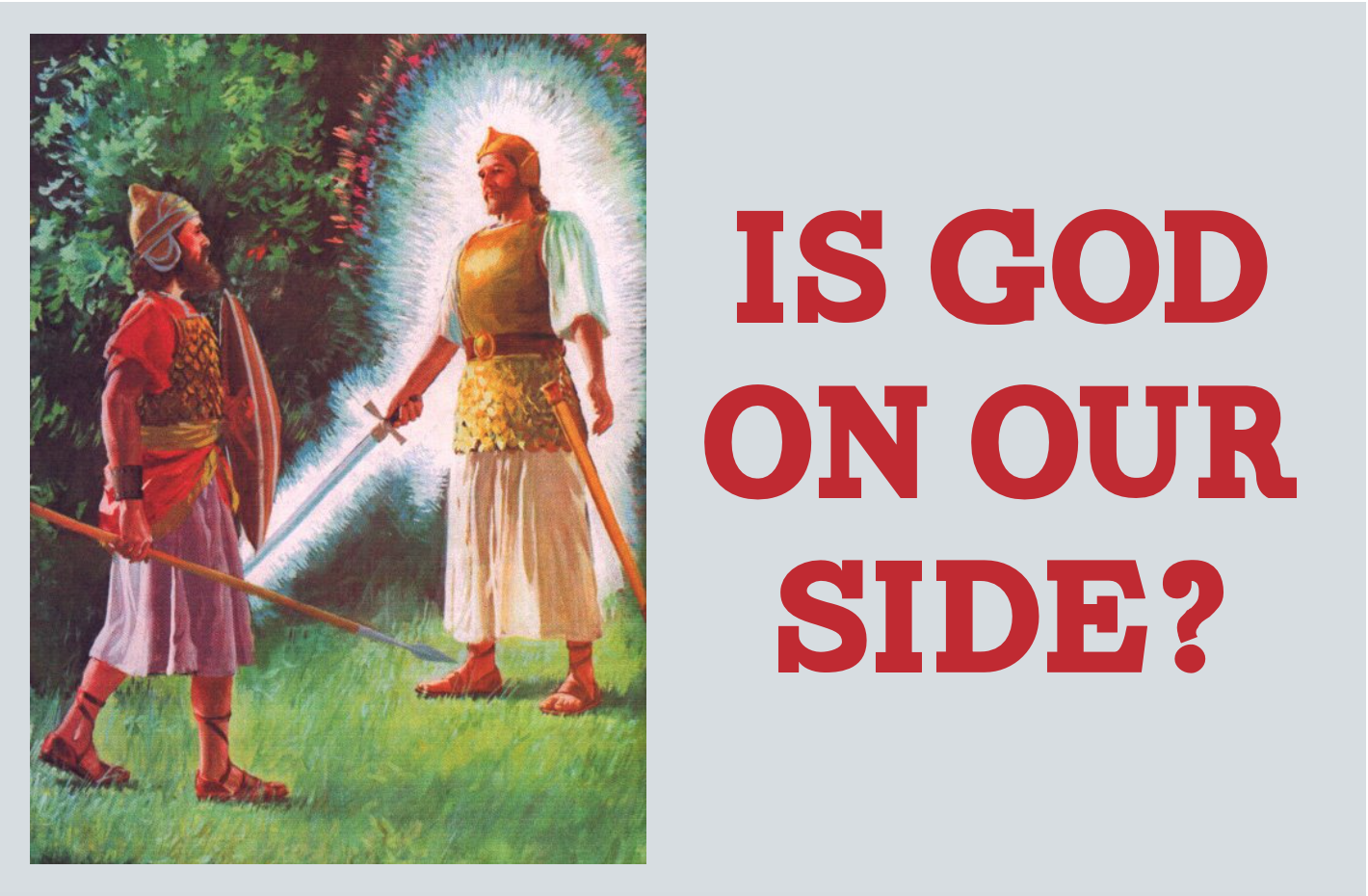
As Joshua is about to lead the people over the first big hurdle of the Conquest, the defeat of the city of Jericho, he has an interesting encounter (Joshua 5.13-15):

“When Joshua was by Jericho, he lifted up his eyes and looked, and behold, a man was standing before him with his drawn sword in his hand.
And Joshua went to him and said to him, ‘Are you for us, or for our adversaries?’ And he said, ‘No; but I am the commander of the army of the LORD. Now I have come.’
And Joshua fell on his face to the earth and worshiped and said to him, ‘What does my lord say to his servant?’ And the commander of the LORD’s army said to Joshua, ‘Take off your sandals from your feet, for the place where you are standing is holy.’ And Joshua did so.”

It’s interesting to me: Joshua asks the man if he is on the side of the Israelites, or on the side of Jericho, and in response, he says, “Neither; I’m on God’s side, not yours.”

Later on in Joshua 24, Joshua, advanced in age, addresses the people. He knows that he is near death, and is concerned about what the people will do after he is gone (Joshua 24.15-20):

“‘…Choose this day whom you will serve, whether the gods your fathers served in the region beyond the River, or the gods of the Amorites in whose land you dwell. But as for me and my house, we will serve the LORD.’
Then the people answered, ‘Far be it from us that we should forsake the LORD to serve other gods, for it is the LORD our God who brought us and our fathers up from the land of Egypt, out of the house of slavery, and who did those great signs in our sight and preserved us in all the way that we went, and among all the peoples through whom we passed. And the LORD drove out before us all the peoples, the Amorites who lived in the land. Therefore we also will served the LORD, for he is our God.’
But Joshua said to the people, ‘You are not able to serve the LORD, for he is a holy God. He is a jealous God; he will not forgive your transgressions or your sins. If you forsake the LORD and served foreign gods, then he will turn and do you harm and consume you, after having done you good.’”

In response to Joshua’s concern, the people basically say, “Don’t worry about it Joshua—we’ll serve the LORD. After all, He’s always been on our side.”

But Joshua isn’t convinced; he believes that the people won’t be faithful to God and that then they’ll find that He isn’t on their side at all—where He once provided for them and fought for them, He will now withhold blessings and actively fight against them.

And how well Joshua knows his people! Within a generation, they will fall away from following God and as a result, will experience a long period of turmoil and suffering as God allows their neighbors to conquer and oppress them (the Book of Judges, which recounts this time period, is one of the lowest points in all of Scripture!).

So, having said all that, back to the original question: is God on our side? I’d have to answer with a qualified “no.”

First, the qualifications:

I’m not doubting God’s love for us, His interest in our condition, or His saving work on our behalf. I’m not doubting that we can cast all our anxiety on Him, because He cares for us (1 Peter 5.7). I’m not doubting that God is “for us” in a Romans 8 sort of way, or that God doesn’t root for us to be successful (where success is defined in terms of faithfulness).

So what am I saying? Here’s my big point:

Jesus didn’t come to earth to live and die for us because God was on our side. He came so that we could be on God’s side. 

Maybe it sounds like I’m just arguing semantics, but really, I think there’s more to it than that. One perspective is centered on mankind, while the other is centered on God: if God is on our side, then all the focus is on us, instead of on God. But the focus should be on God, not us.

This helps to explain the Israelites in the Old Testament. When they were on God’s side and followed Him faithfully, He blessed them with prosperity and victory over their enemies. When they ceased to be on His side, the blessings ceased as well.

This also helps to put the Incarnation into proper perspective. The Incarnation wasn’t about Jesus becoming a man because humanity is the focus of everything; the Incarnation was about God becoming a man in order that men could become more like God, because God is the focus of everything!

So, with this God-centered perspective in mind, let’s ask the question one last time: is God on our side? According to Scripture, we don’t even have a side; we have to choose a side! The real question is, are we going to choose to be on God’s side, or will we side with the world?

© 2026 The Doc File

Theme by Anders Noren — Up ↑






