The online journal of Luke Dockery

Tag: Paul (Page 3 of 3)

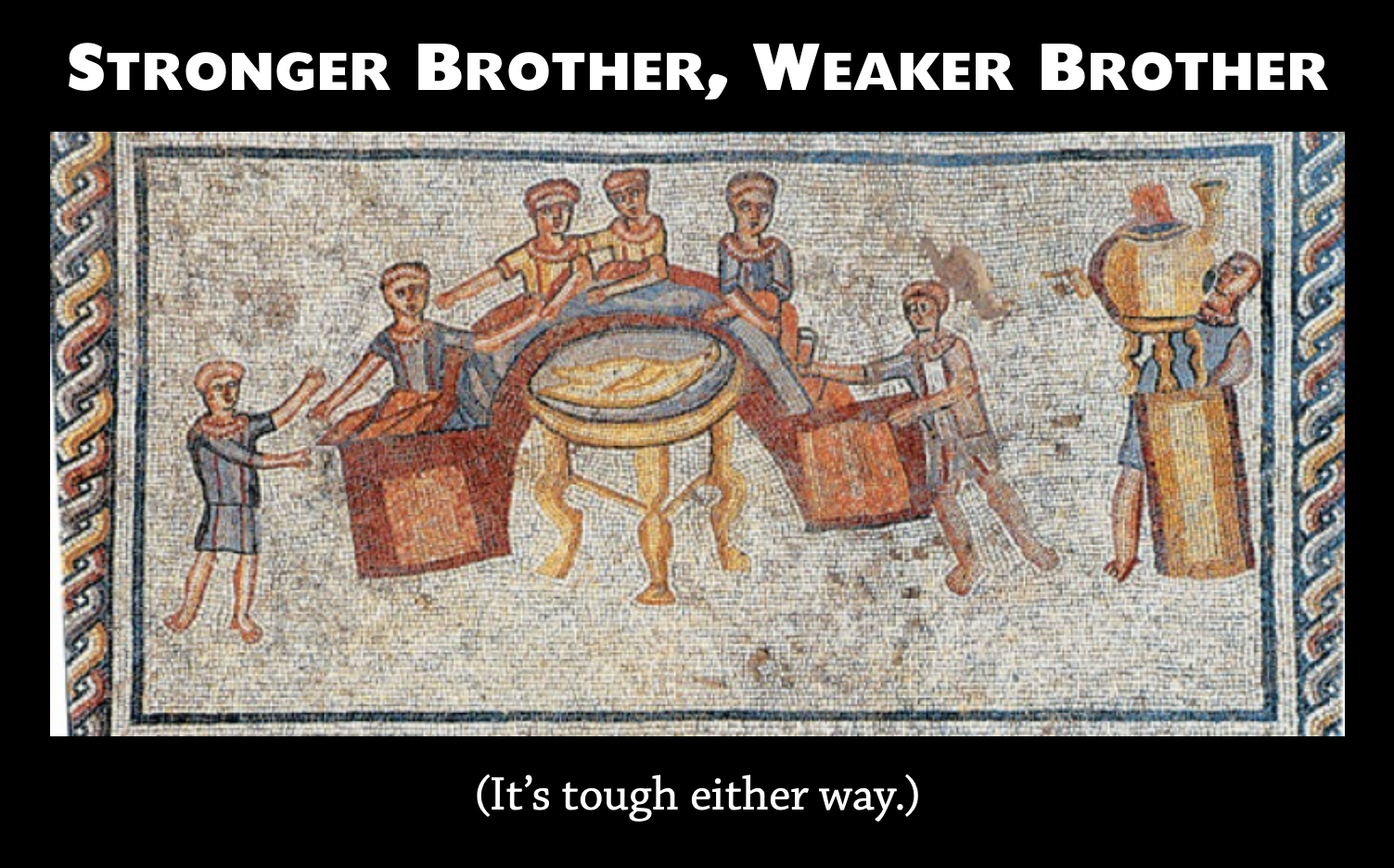
Stronger Brother, Weaker Brother: It’s Tough Either Way

There are a few places in the New Testament where  Paul addresses the idea of the stronger brother and the weaker brother, usually in the context of the issue of eating meat that had formerly been sacrificed to idols (Romans 14; 1 Corinthians 8.4-13; 1 Corinthians 10.25-32).

It’s a fairly complex issue, but basically, Paul says that since idols are nothing (because they represent gods which don’t actually exist), eating food that had previously been offered to them is no big deal. Stronger, more mature Christians would be able to realize this, and would see that eating such meat would not be inherently wrong.

However, weaker, newer Christians, especially those who had been recently converted from a pagan background, could struggle with the idea of eating meat that had been sacrificed to an idol, and could feel like they were compromising their faith by doing so. For these Christians, it would be wrong for them to eat because doing so would violate their conscience.

Paul’s real focus in these passages is less on giving specific instructions on which activities should be partaken in and which should be abstained from, and more about teaching the stronger and weaker brothers how to interact with one another. Basically, they should treat one another with love: the stronger brother should be willing to give up meat forever in order to avoid leading his weaker brother to sin against his conscience, and the weaker brother shouldn’t try to bind his stronger brother’s actions by his own conscience.

In many ways, Paul’s thoughts are summed up in Romans 14.3:

“Let not the one who eats despise the one who abstains, and let not the one who abstains pass judgment on the one who eats, for God has welcomed him.”

Depending on the issue, I think I have been both the weaker and stronger brother at different times, and what Paul commands in Romans 14.3 is challenging to both groups.

The stronger brother is not to despise the weaker. I’ve seen this happen a lot, and it can be tempting to do. We grow frustrated at the qualms of our weaker brethren and so it gets easy to ridicule them as hopelessly backward and just write them off completely. Maybe make jokes about their limited understanding and speak with condescension to and about them.

The weaker brother is not to pass judgment on the stronger. This is tempting as well. Since our brothers are doing something that our own consciences won’t permit us to do, we are tempted to view them as less holy or less devoted to their faith than we are. Perhaps we even cease to think of them as faithful Christians.

As Paul points out in the verse above, both of these attitudes are wrong. Regardless of which side we find ourselves on, we have to be careful about how we treat each other: love and respect for our brethren should always be our primary response.

Influence and…Faux Hawks

The Idolatry of Solomon, by Franz Francken II, 1622
Influence is a powerful force—both the influence that we have on other people and the influence that others have on us. This is by no means a new or ground-breaking statement, but it is an idea that was hammered home to me last night in an unusual way.
I was standing in front of the bathroom mirror after taking a shower, when I realized that the way my hair was laying pretty closely resembled a faux hawk. And here’s the shocking part: I caught myself thinking, “You know, that really doesn’t look too bad.” This completely blew me away, because when faux hawks first became popular a couple of years ago, I thought they were irredeemably stupid. I don’t ever remember consciously changing my opinion on the matter, but apparently, seeing one faux hawk after another for the last couple of years gradually influenced me to think of it as a normal and acceptable haircut (Don’t worry, I have since returned to my senses and there is no danger that you will see me sporting a faux hawk—ever.).
This shocking event illustrates an important point about influence—you can gradually, subtly be influenced to completely change the way you think about a certain behavior, practice, or way of life, and it can happen without you even realizing it. Sometimes you might change your mind about something relatively innocent or unimportant (like a hairstyle), but influence can also change us in much more significant (and sometimes negative) ways.
I’m currently reading a book called Sticky Faith, which addresses the alarming rate at which Christian teenagers tend to drop out of the church about the time they graduate from high school. There are a lot of reasons why this happens, but a major one is influence—when teens leave home and move off to college, they are largely freed from the greatest influence in their lives (parents), and are especially susceptible to new influences that they encounter. Often, these new and different influences push them to places where they never thought they would end up—most faithful Christian teenagers don’t plan to go to college, drop out of church, and become involved in a lifestyle of binge-drinking and sexual promiscuity, but it happens as they are influenced to change the way they look at things and to fit in with their surroundings.
Although this phenomenon always seems to be surprising to youth ministers and parents when they witness it in individual cases, it’s really shouldn’t surprise us at all, because the Bible explicitly teaches us that the influences of others can lead us to sin:
  • King Solomon was influenced by his foreign wives and concubines to turn away from following God and build places of worship to idols instead (1 Kings 11.1-13).
  • Herod’s stepdaughter was influenced by her mother to ask that John the Baptist be beheaded (Matthew 14.1-12).
  • In Galatians 2.11-21, Paul describes how certain men had influenced Peter and Barnabas to withdraw from fellowshipping with Gentiles.
  • In 1 Corinthians 15.33, Paul comes right out and says, “Do not be deceived: ‘Bad company ruins good morals.’”
The good news is that influence works both ways—good influences have a lot of power as well:
  • “You are the light of the world. A city set on a hill cannot be hidden. Nor do people light a lamp and put it under a basket, but on a stand, and it gives light to all in the house. In the same way, let your light shine before others, so that they may see your good works and give glory to your Father who is in heaven.” (Matthew 5.13-16)
  • “Let no one despise you for your youth, but set the believers an example in speech, in conduct, in love, in faith, in purity.” (1 Timothy 4.12)
  • “Keep your conduct among the Gentiles honorable, so that when they speak against you as evildoers, they may see your good deeds and glorify God on the day of visitation.” (1 Peter 2.12)
Ultimately, when talking about influence, I think it all boils down to a couple of important points:
(1) All of us are susceptible to outside influences, so it is important that we monitor those influences closely. What kind of people do you surround yourself with? What music do you listen to? What movies or TV shows do you watch? If you are a parent, answer those same questions about your children. Don’t be naive—if you surround yourself with bad influences, no matter who you are, they are affecting you negatively.
(2) All of us influence others as well, so it is important that we are aware of the kind of example we are setting. You never know who might be watching you and who might be influenced by what you do. As a youth minister I do a lot of things, but I have long thought that the most important thing I can do is to be a good example of Christian living for the young people I minister to. Certainly I don’t always succeed, but I always try to be aware that I am broadcasting an influence—for good or bad— at all times.

Conflicting Natures

I read a children’s version of The Strange Case of Dr. Jekyll and Mr. Hyde when I was about 10 years old, and it is a story that has fascinated me ever since.

Robert Louis Stevenson, of Treasure Island fame, penned the novella in 1885. Stevenson’s body of work was criticized and largely dismissed by modern writers because it was so popular (and therefore perceived to be too commonplace), but in recent years, critics have begun to appreciate him as a man of prodigious artistic talent.

That talent is never more evident than in Dr. Jekyll and Mr. Hyde, which features impressive character development despite being a novella, clever framing, and most importantly, an insightful investigation of the dualistic nature of man.

In the story, Dr. Jekyll is a respected and talented medical doctor who wants to live a good and pure life but is plagued by his own evil desires.

Jekyll’s problem is experienced by all of us to some degree, and is one which the Apostle Paul describes in Romans 7.18-21:

“For I know that nothing good dwells in me, that is, in my flesh; for the willing is present in me, but the doing of the good is not.

For the good that I want, I do not do, but I practice the very evil that I do not want. But if I am doing the very thing I do not want, I am no longer the one doing it, but sin which dwells in me.

I find then the principle that evil is present in me, the one who wants to do good.”

In Stevenson’s story, Jekyll recognizes the good and evil natures warring within himself, and, by means of a chemical potion, decides to separate those natures with the hope of purging himself of his evil desires and the guilt that accompanies them.

Jekyll’s potion leads to the creation of Hyde, his despicable and wholly evil alter ego, who ultimately brings about his downfall.

Continuing in Romans 7.24-25 and 8.1-2, Paul points out a different solution to the problem of sin:

“Wretched man that I am! Who will set me free from the body of this death?

Thanks be to God through Jesus Christ our Lord!

Therefore there is now no condemnation for those who are in Christ Jesus. For the law of the Spirit of life in Christ Jesus has set you free from the law of sin and of death.”

Sin is dangerous and seductive, and has the power to enslave us. No chemical potion or medical doctor can loosen the bonds of that slavery; only The Great Physician can set us free.

The 1895 photograph above pictures Richard Mansfield, an American actor who was best known for playing the dual roles of Dr. Jekyll and Mr. Hyde.

Newer posts »

© 2026 The Doc File

Theme by Anders Noren — Up ↑







