The online journal of Luke Dockery

Tag: Poor

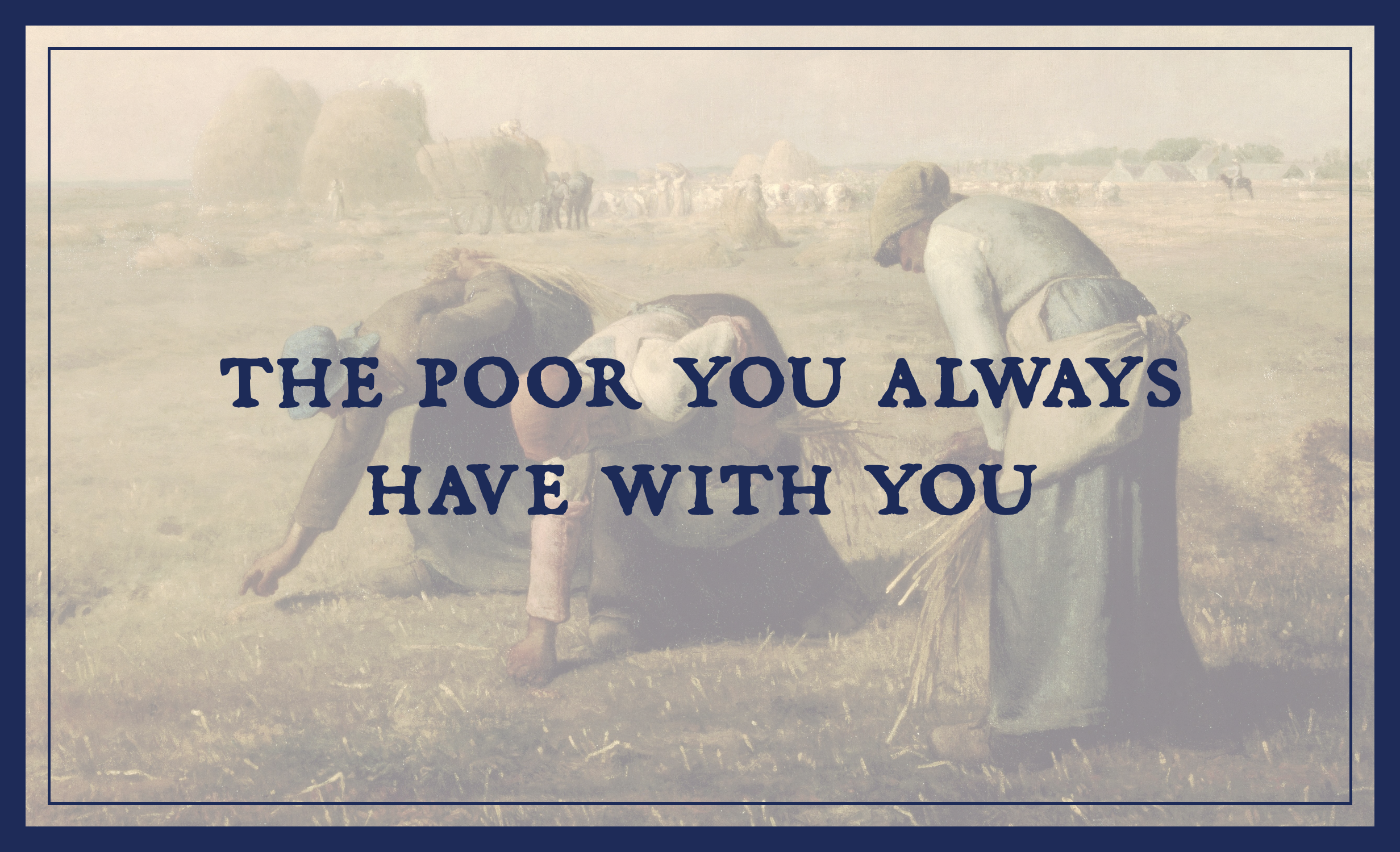
The Poor You Always Have With You

In a recent reading of Deuteronomy, I was struck by the following passage, specifically because of how it connected to other passages in the New Testament:

If among you, one of your brothers should become poor, in any of your towns within your land that the LORD your God is giving you, you shall not harden your heart or shut your hand against your poor brother, but you shall open your hand to him and lend him sufficient for his need, whatever it may be.

Take care lest there be an unworthy thought in your heart and you say, “The seventh year, the year of release is near,” and your eye look grudgingly on your poor brother, and you give him nothing, and he cry to the LORD against you, and you be guilty of sin. You shall give to him freely, and your heart shall not be grudging when you give to him, because for this the LORD your God will bless you in all your work in all that you undertake.

For there will never cease to be poor in the land. Therefore I command you, “You shall open wide your hand to your brother, to the needy and to the poor, in your land.”

(Deuteronomy 15.7-11)

One of the repeated themes of Torah is God’s concern for those on the margins of society, especially the poor, widows, orphans, and immigrants. Out of that concern, God clearly and repeatedly shares His expectation that His people will seek to take care of the poor in their land. This is to be accomplished in many ways, from the practice of gleaning, to levirate marriage, to sabbath years where debts are forgiven, to the general practice of prohibiting interest when loans are given.

But it was the beginning of the last verse that caught my attention—“For there will never cease to be poor in the land”—because of its similarity to something Jesus says in the Gospels. Matthew and John seem to recount versions of the same incident.[1] Jesus is eating a meal in Bethany when a woman (in John’s account, she is identified as Mary, the sister of Martha and Lazarus) comes in and anoints Jesus with expensive ointment, and wipes His feet with her hair.

The disciples see this and respond indignantly, suggesting how wasteful this was—the money spent for this ointment could have been given to the poor instead.[2] Jesus tells His disciples to leave her alone, praising the beautiful and extravagant thing that Mary has done for Him: “For the poor you always have with you, but you do not always have Me.”

I’ve heard these passages discussed before in a way that almost seems to make Jesus uncaring toward the poor, i.e., “You can help the poor anytime, so it’s really not a big deal,” but I think that really misses the mark. Jesus is talking here in terms of urgency, rather than importance: He is about to be crucified, and there won’t be a later opportunity to do what Mary has done. It’s not that helping the poor is unimportant; it’s just that the only opportunity to do so isn’t right now, unlike the opportunity to anoint Jesus.

This is further underscored when you realize how closely Jesus’ words seem to be based directly on this passage in Deuteronomy. Poverty is a real, persistent problem, and this side of eternity, there will always be people in need. This shouldn’t cause us to despair or somehow make us less inclined to help. Rather, the opposite is true: the ever-presence of the needy should make us ever-ready to help. It may not always present as an urgent issue (because you will have constant, repeated opportunities to help those mired in poverty), but it is certainly important: God’s heart for the needy is revealed repeatedly in the Torah, and Jesus affirms the same idea Himself. The poor will always be with us, so God’s people should always be for them.

The ever-presence of the needy should make us ever-ready to help. Share on X The poor will always be *with* us, so God’s people should always be *for* them. Share on X

In this loose series of Scripture Reflections, I am sharing brief thoughts spurred on by my Bible reading. By way of reminder, my goal for these brief posts is two-fold:

(1) To remark on aspects of the biblical text that I find to be of interest that the reader may or may not have thought about previously.

(2) When possible, to point to the work and person of Jesus Christ. I believe the Bible is a unified story that points to Jesus, which means that He is frequently alluded to or foreshadowed in some way throughout the biblical canon.


[1] There is some disagreement about whether or not Matthew 26.6-13 and John 12.1-8 recount the same incident. There are differences: Matthew locates the event at the home of Simon the Leper, while John implies (but does not state) that the location is the home of Mary, Martha, and Lazarus. Furthermore, John identifies Mary as the one who anoints Jesus’ with perfume, while Matthew leaves the anointer unnamed. In Matthew, Jesus’ head is anointed, while in John, it is His feet. There are other, small differences as well. Nevertheless, the overall similarity between the two incidents is striking, and the differences can be accounted for in plausible ways. For the sake of this post, I will just treat it as one event described in two different Gospels.

[2] John informs us that it was Judas Iscariot who spoke out in criticism, but that his concern was not really for the poor, but rather, his own greed: as the treasurer for the group, he had access to the money bag and used to steal from it. Selling the ointment and giving the money to Jesus—ostensibly to care for the poor—would have benefited the thieving Judas.


The Sin(s) of Sodom

Genesis 18-19 recounts the destruction of the cities of Sodom and Gomorrah, which God determined to destroy “Because the outcry against Sodom and Gomorrah is great and their sin is very grave” (Genesis 18.20). This verse makes it clear that these two cities were places of wickedness. The Bible doesn’t say much about Gomorrah specifically, but instead tends to focus on Sodom (cf. Genesis 13.12-13), probably because that was where Abraham’s nephew Lot decided to live with his family.

It may surprise you to learn that in recent years, the destruction of Sodom has become somewhat controversial because of its relation (or not) to the issue of homosexuality. In light of this, it is a worthwhile question to ask, “For what sin was the city of Sodom destroyed?”

The Traditional View

Under the traditional interpretation of the passage, the wickedness of Sodom is exemplified in the story of the two angels (who appeared as men) who came to visit Lot in Genesis 19. The men of the city of Sodom, both young and old, become aware of these visitors, surround Lot’s house, and demand that he send the visitors out to them so that they may have sex with them.

Lot tries to dissuade the men of Sodom from this course of action, instead offering his own virgin daughters to satisfy their carnal lusts, and ultimately the angels intercede, striking the men with blindness and then telling Lot and his family to evacuate the city before its imminent destruction.

In this understanding, the sin of Sodom was homosexual activity. This is the origin of the word sodomy, a word which isn’t used much anymore but is still used in legal codes in some countries.

The Revisionist View

In more recent times, as homosexual practice has become more widespread and there has been a push for the normalization of homosexuality as a lifestyle, there has been a corresponding effort in some circles to reinterpret portions of Scripture which apparently condemn it. Genesis 18-19 and the sin of Sodom is a prime example of this sort of revisionist interpretation.

Through this lens, it has been suggested that the sin for which Sodom was destroyed was a lack of hospitality. The angels visited the city intending to stay in the town square (Genesis 19.2). Instead, Lot invited them to stay in his house, but the men of the city prevented Lot’s efforts at hospitality and tried to rape the angelic visitors instead. Essentially, the men of Sodom violated sacred cultural values by being terrible hosts, and thus, deserved destruction.

Examining the Views

To interpret Scripture carefully and correctly, it is important to pay attention to context, and using this text as a test case, there are multiple types of context which need to be considered: the canonical context provided by the rest of Scripture, the material in surrounding chapters,  and the historical and cultural context of the incident in question:

  • The canonical context reveals that in several places in Scripture, both in the Old and New Testaments, the practice of homosexuality is condemned as sin. The story clearly reveals that the men of Sodom intend to commit this sin, and Lot’s insistence that the angelic visitors not stay in the public square perhaps suggests that this was habitual behavior on the part of his neighbors. It really does take an impressive display of interpretative gymnastics to argue that homosexuality was not at least part of the wickedness of Sodom for which it was condemned.
  • The context of the surrounding chapters as well as the historical and cultural context should cause us to pause before dismissing the lack-of-hospitality view as nonsense. We live in a society where people eat at restaurants and stay in hotels when they travel, and the concept of hospitality has been significantly minimized. In the Ancient Near East, however, the practice of hospitality was a major moral value. It was a significant part of the Law of Moses as well, as the Israelites were commanded to care for sojourners/travelers since they themselves had been sojourners in the Land of Egypt. In the immediate context, the hospitality of Abraham (Genesis 18.1-8) and of Lot (Genesis 19.1-3) to the angels is placed in sharp contrast to the inhospitality of the men of Sodom. That the travelers were not safe to stay in the city square, or even in the home of Lot, is an indictment against the entire city, and this sinful violation of a major cultural value was also part of the wickedness which led to Sodom’s destruction.

Removing the Safety of the Story

I think this case provides a good example of the problem that arises when we force either/or conclusions on a text that does not require them. Certainly there are texts with multiple possible but mutually exclusive interpretations where only one can be correct, but this is not one of them.

Rather than speaking of the sin of Sodom, it would be more precise to speak of the sins of Sodom, because based on the limited biblical information we have, there were many:

  • Homosexuality (the Traditional View)
  • Inhospitality (the Revisionist View)
  • Violence (trying to break into Lot’s house by force)
  • Rape (or at least attempted rape, but again, based on Lot’s behavior, this seems like repeated behavior)
  • Pride, Gluttony, and Neglect of the Poor and Needy (Ezekiel 16.49-50)

In other words, if you were taking a multiple choice quiz about the sins of Sodom, the answer would be “E. All of the Above”. It was a wicked place. No wonder God said that the outcry against it was very great.

To conclude, I think it is appropriate to look at the story of the destruction of Sodom and in it see the condemnation of the practice of homosexuality, but it is inappropriate to use it as proof that homosexuality brings out a particular or special form of judgment from God. Instead, the message of the story of Sodom is straightforward: Eventually, God will bring judgment on sin.

And so here is my point: a lot of times I think we look at the story of the destruction of Sodom and Gomorrah as a story of judgment against “them”—wicked people who commit sins that, perhaps, are far removed from our own experiences. That makes it a “safe” story. But if we are honest with the full context, I think it requires that we look at our own lives a little more carefully.

In the context of our churches and our families, we may not be engaged in homosexuality or rape or violence, but what about the sins of inhospitality, pride, gluttony, and neglect of the poor? Are we equally innocent of these? Suddenly, the story cuts a little closer to home. It’s not as “safe” anymore. Because as the story of the Sin(s) of Sodom shows us, they all bring judgment from God.

© 2026 The Doc File

Theme by Anders Noren — Up ↑







