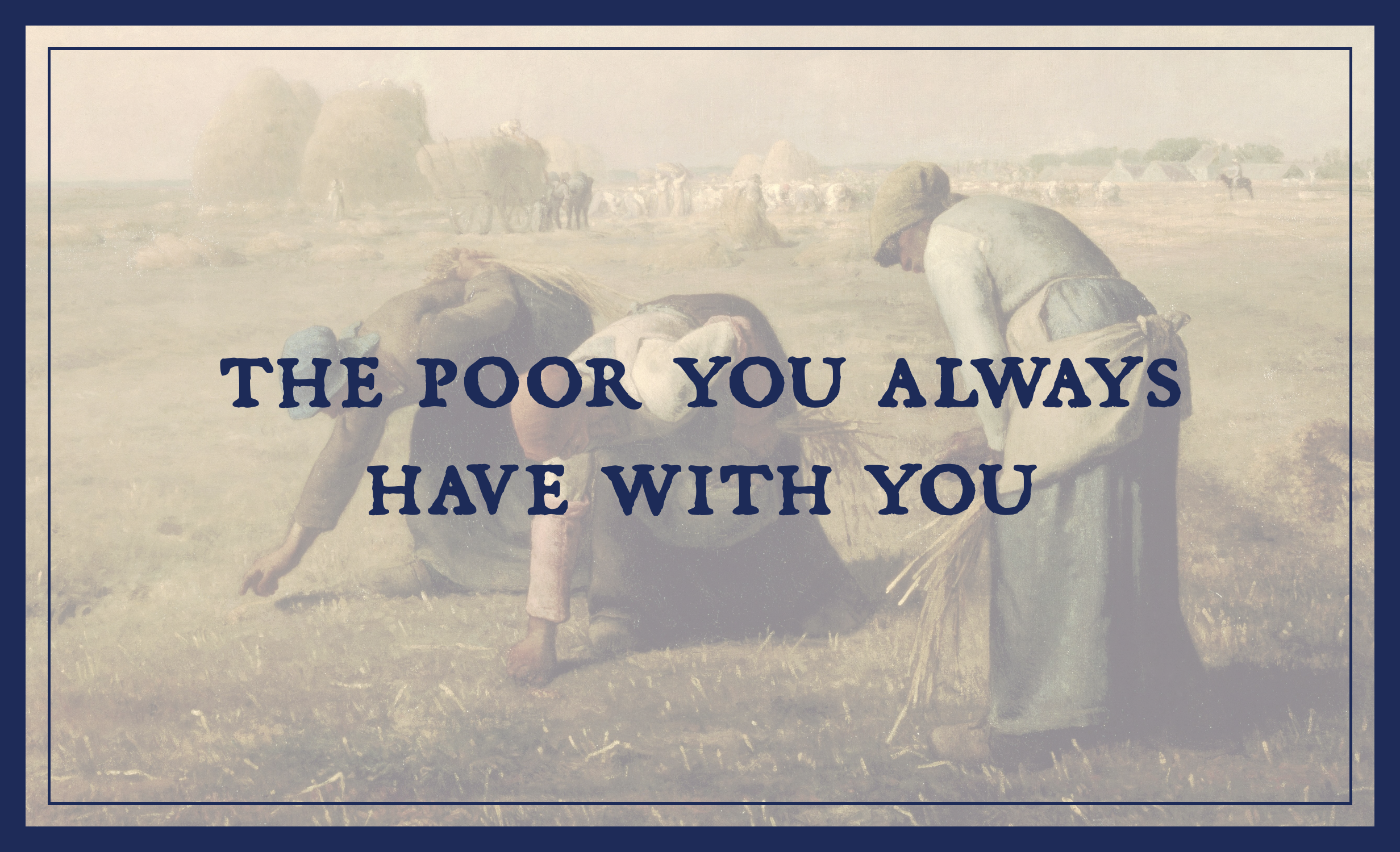
In a recent reading of Deuteronomy, I was struck by the following passage, specifically because of how it connected to other passages in the New Testament:
If among you, one of your brothers should become poor, in any of your towns within your land that the LORD your God is giving you, you shall not harden your heart or shut your hand against your poor brother, but you shall open your hand to him and lend him sufficient for his need, whatever it may be.
Take care lest there be an unworthy thought in your heart and you say, “The seventh year, the year of release is near,” and your eye look grudgingly on your poor brother, and you give him nothing, and he cry to the LORD against you, and you be guilty of sin. You shall give to him freely, and your heart shall not be grudging when you give to him, because for this the LORD your God will bless you in all your work in all that you undertake.
For there will never cease to be poor in the land. Therefore I command you, “You shall open wide your hand to your brother, to the needy and to the poor, in your land.”
(Deuteronomy 15.7-11)
One of the repeated themes of Torah is God’s concern for those on the margins of society, especially the poor, widows, orphans, and immigrants. Out of that concern, God clearly and repeatedly shares His expectation that His people will seek to take care of the poor in their land. This is to be accomplished in many ways, from the practice of gleaning, to levirate marriage, to sabbath years where debts are forgiven, to the general practice of prohibiting interest when loans are given.
But it was the beginning of the last verse that caught my attention—“For there will never cease to be poor in the land”—because of its similarity to something Jesus says in the Gospels. Matthew and John seem to recount versions of the same incident.[1] Jesus is eating a meal in Bethany when a woman (in John’s account, she is identified as Mary, the sister of Martha and Lazarus) comes in and anoints Jesus with expensive ointment, and wipes His feet with her hair.
The disciples see this and respond indignantly, suggesting how wasteful this was—the money spent for this ointment could have been given to the poor instead.[2] Jesus tells His disciples to leave her alone, praising the beautiful and extravagant thing that Mary has done for Him: “For the poor you always have with you, but you do not always have Me.”
I’ve heard these passages discussed before in a way that almost seems to make Jesus uncaring toward the poor, i.e., “You can help the poor anytime, so it’s really not a big deal,” but I think that really misses the mark. Jesus is talking here in terms of urgency, rather than importance: He is about to be crucified, and there won’t be a later opportunity to do what Mary has done. It’s not that helping the poor is unimportant; it’s just that the only opportunity to do so isn’t right now, unlike the opportunity to anoint Jesus.
This is further underscored when you realize how closely Jesus’ words seem to be based directly on this passage in Deuteronomy. Poverty is a real, persistent problem, and this side of eternity, there will always be people in need. This shouldn’t cause us to despair or somehow make us less inclined to help. Rather, the opposite is true: the ever-presence of the needy should make us ever-ready to help. It may not always present as an urgent issue (because you will have constant, repeated opportunities to help those mired in poverty), but it is certainly important: God’s heart for the needy is revealed repeatedly in the Torah, and Jesus affirms the same idea Himself. The poor will always be with us, so God’s people should always be for them.
The ever-presence of the needy should make us ever-ready to help. Share on X The poor will always be *with* us, so God’s people should always be *for* them. Share on X In this loose series of Scripture Reflections, I am sharing brief thoughts spurred on by my Bible reading. By way of reminder, my goal for these brief posts is two-fold:
(1) To remark on aspects of the biblical text that I find to be of interest that the reader may or may not have thought about previously.
(2) When possible, to point to the work and person of Jesus Christ. I believe the Bible is a unified story that points to Jesus, which means that He is frequently alluded to or foreshadowed in some way throughout the biblical canon.
[1] There is some disagreement about whether or not Matthew 26.6-13 and John 12.1-8 recount the same incident. There are differences: Matthew locates the event at the home of Simon the Leper, while John implies (but does not state) that the location is the home of Mary, Martha, and Lazarus. Furthermore, John identifies Mary as the one who anoints Jesus’ with perfume, while Matthew leaves the anointer unnamed. In Matthew, Jesus’ head is anointed, while in John, it is His feet. There are other, small differences as well. Nevertheless, the overall similarity between the two incidents is striking, and the differences can be accounted for in plausible ways. For the sake of this post, I will just treat it as one event described in two different Gospels.
[2] John informs us that it was Judas Iscariot who spoke out in criticism, but that his concern was not really for the poor, but rather, his own greed: as the treasurer for the group, he had access to the money bag and used to steal from it. Selling the ointment and giving the money to Jesus—ostensibly to care for the poor—would have benefited the thieving Judas.







