The online journal of Luke Dockery

Tag: Poverty (Page 1 of 2)

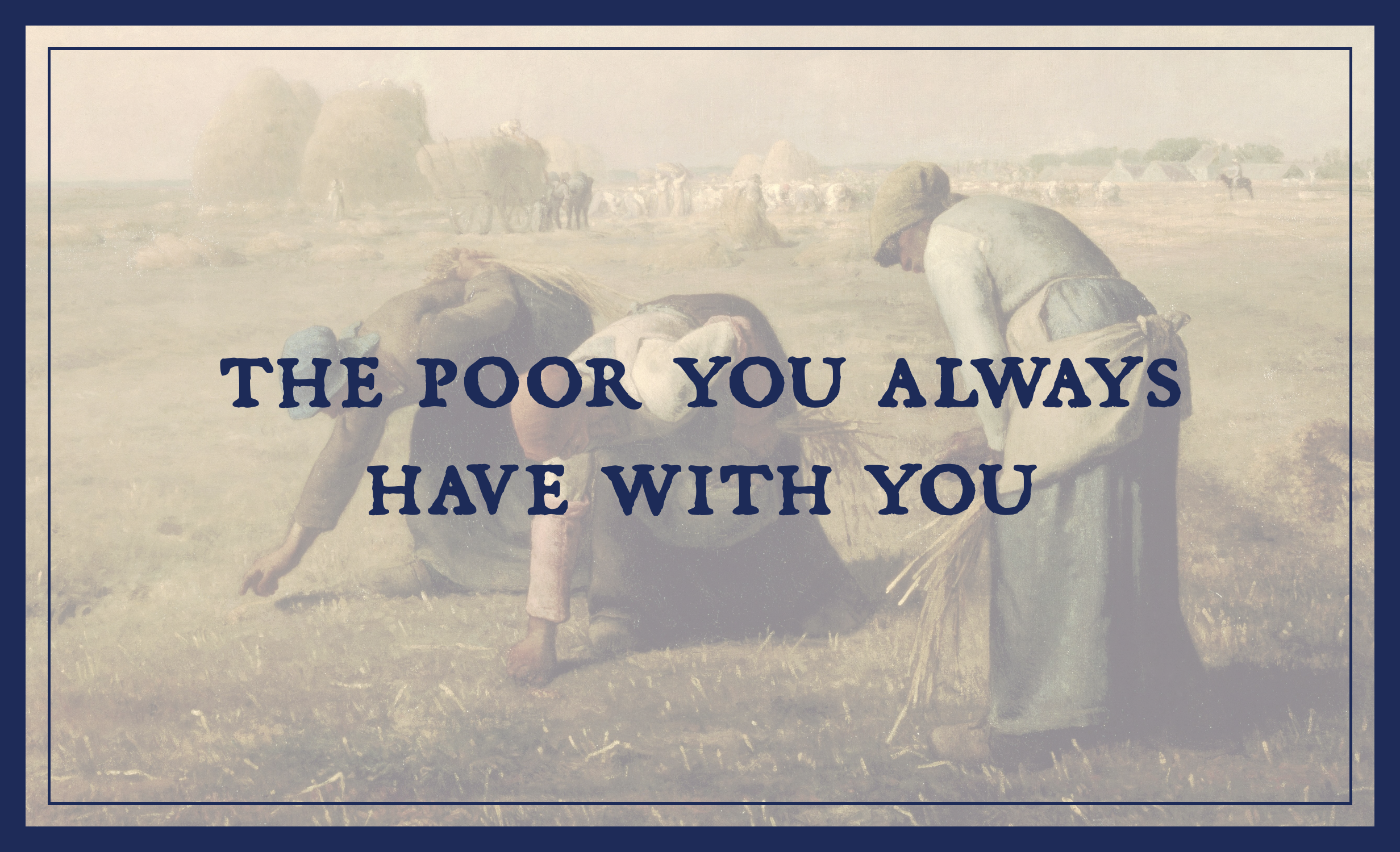
The Poor You Always Have With You

In a recent reading of Deuteronomy, I was struck by the following passage, specifically because of how it connected to other passages in the New Testament:

If among you, one of your brothers should become poor, in any of your towns within your land that the LORD your God is giving you, you shall not harden your heart or shut your hand against your poor brother, but you shall open your hand to him and lend him sufficient for his need, whatever it may be.

Take care lest there be an unworthy thought in your heart and you say, “The seventh year, the year of release is near,” and your eye look grudgingly on your poor brother, and you give him nothing, and he cry to the LORD against you, and you be guilty of sin. You shall give to him freely, and your heart shall not be grudging when you give to him, because for this the LORD your God will bless you in all your work in all that you undertake.

For there will never cease to be poor in the land. Therefore I command you, “You shall open wide your hand to your brother, to the needy and to the poor, in your land.”

(Deuteronomy 15.7-11)

One of the repeated themes of Torah is God’s concern for those on the margins of society, especially the poor, widows, orphans, and immigrants. Out of that concern, God clearly and repeatedly shares His expectation that His people will seek to take care of the poor in their land. This is to be accomplished in many ways, from the practice of gleaning, to levirate marriage, to sabbath years where debts are forgiven, to the general practice of prohibiting interest when loans are given.

But it was the beginning of the last verse that caught my attention—“For there will never cease to be poor in the land”—because of its similarity to something Jesus says in the Gospels. Matthew and John seem to recount versions of the same incident.[1] Jesus is eating a meal in Bethany when a woman (in John’s account, she is identified as Mary, the sister of Martha and Lazarus) comes in and anoints Jesus with expensive ointment, and wipes His feet with her hair.

The disciples see this and respond indignantly, suggesting how wasteful this was—the money spent for this ointment could have been given to the poor instead.[2] Jesus tells His disciples to leave her alone, praising the beautiful and extravagant thing that Mary has done for Him: “For the poor you always have with you, but you do not always have Me.”

I’ve heard these passages discussed before in a way that almost seems to make Jesus uncaring toward the poor, i.e., “You can help the poor anytime, so it’s really not a big deal,” but I think that really misses the mark. Jesus is talking here in terms of urgency, rather than importance: He is about to be crucified, and there won’t be a later opportunity to do what Mary has done. It’s not that helping the poor is unimportant; it’s just that the only opportunity to do so isn’t right now, unlike the opportunity to anoint Jesus.

This is further underscored when you realize how closely Jesus’ words seem to be based directly on this passage in Deuteronomy. Poverty is a real, persistent problem, and this side of eternity, there will always be people in need. This shouldn’t cause us to despair or somehow make us less inclined to help. Rather, the opposite is true: the ever-presence of the needy should make us ever-ready to help. It may not always present as an urgent issue (because you will have constant, repeated opportunities to help those mired in poverty), but it is certainly important: God’s heart for the needy is revealed repeatedly in the Torah, and Jesus affirms the same idea Himself. The poor will always be with us, so God’s people should always be for them.

The ever-presence of the needy should make us ever-ready to help. Share on X The poor will always be *with* us, so God’s people should always be *for* them. Share on X

In this loose series of Scripture Reflections, I am sharing brief thoughts spurred on by my Bible reading. By way of reminder, my goal for these brief posts is two-fold:

(1) To remark on aspects of the biblical text that I find to be of interest that the reader may or may not have thought about previously.

(2) When possible, to point to the work and person of Jesus Christ. I believe the Bible is a unified story that points to Jesus, which means that He is frequently alluded to or foreshadowed in some way throughout the biblical canon.


[1] There is some disagreement about whether or not Matthew 26.6-13 and John 12.1-8 recount the same incident. There are differences: Matthew locates the event at the home of Simon the Leper, while John implies (but does not state) that the location is the home of Mary, Martha, and Lazarus. Furthermore, John identifies Mary as the one who anoints Jesus’ with perfume, while Matthew leaves the anointer unnamed. In Matthew, Jesus’ head is anointed, while in John, it is His feet. There are other, small differences as well. Nevertheless, the overall similarity between the two incidents is striking, and the differences can be accounted for in plausible ways. For the sake of this post, I will just treat it as one event described in two different Gospels.

[2] John informs us that it was Judas Iscariot who spoke out in criticism, but that his concern was not really for the poor, but rather, his own greed: as the treasurer for the group, he had access to the money bag and used to steal from it. Selling the ointment and giving the money to Jesus—ostensibly to care for the poor—would have benefited the thieving Judas.


The Fall of Man and the Sociological Consequences of Sin

In our continuing discussion of the Fall of Man in Genesis 3 and the widespread devastation of sin, we have already covered the theological and personal consequences of Adam and Eve’s misdeed; in this post we turn to the sociological fallout of that sin, or the way that sin affects our relationships with one another.

Returning to our text, we can see this dimension clearly played out in verses 11-13:

“[God] said, ‘Who told you that you were naked? Have you eaten of the tree of which I commanded you not to eat?’ The man said, ‘The woman whom you gave to be with me, she gave me fruit of the tree, and I ate.’ Then the Lord God said to the woman, ‘What is this that you have done?’ The woman said, ‘The serpent deceived me, and I ate.’”

People were created to live in community with one another. Specifically, Eve was created to be the perfect partner for Adam (Genesis 2.18-25). But when God confronts Adam and Eve with their sin, something very significant (and unfortunate) happens: the unity that had previously existed between Adam and Eve is shattered as Adam immediately blames his wife for the sin which they had committed together.

This brings a conflict and disharmony between them that would be passed down over time (Genesis 3.16), and we can see it unfold in the pages of Genesis in the accounts of numerous broken relationships—Cain’s murder of his brother, the depraved society of Sodom and Gomorrah, the distorted relationships between Sarah and Hagar, Jacob and Esau, Jacob and Laban, Joseph and his brothers, and more. But the problems certainly don’t stop there—this same conflict and disharmony continue to darken and distort our world today.

Our world is deeply flawed by sin, and this manifests itself everyday sociologically, as we treat one another in a wide array of horrible, messed up ways:

  • On an international level, countries wage war and kill because of conflict over ideology or resources.
  • Systemic evils such as poverty, abortion, racism, sex trafficking, government corruption, lotteries, and more stem from our exploitation of our neighbors in order that we might obtain our own selfish desires.
  • Horrific acts of incomprehensible violence fill our news cycles. Mass shootings at elementary schools, the use of passenger airliners as terrorist missiles, bombings at marathon finish lines and incomprehensible barbarity at soccer matches shock and dismay us and cause us to weep.
  • Our interpersonal relationships are also a mess. Dishonesty, reckless ambition, and violence abound. The (supposedly) lifelong bonds of marriage are broken on a whim.

And the sum result: our society as a whole stagnates and decays, as people live lives marked by self-interest and fear of one another. The community for which we were created is broken.

Sin destroys our relationships with one another.

Destroying the Works of Satan

A couple of weeks ago I had the opportunity to speak at a youth rally and my topic was the purpose of the church. I talked about how the church is God’s vehicle for saving the world today (through the preaching of the gospel), for influencing the world and trying to make it a better place (through service), and equipping Christians for those first two tasks (through education and discipleship).

And those are all pretty standard ideas—we hear about those things a lot when we talk about what the church should do. But the church has another important purpose that is often neglected in such discussions: the mission of the church is to oppose and destroy the works of Satan.

In 1 John 3.8, John said that Jesus came to earth so that “He might destroy the works of the devil.” In Ephesians 6.12, Paul says that our struggle as Christians is not against flesh and blood, but against the forces of darkness.

These verses make it clear that as the church, we are a part of a spiritual battle against Satan and his influence. Moral corruption and sin are the works of the Devil (and we focus on things like that a lot),  but so are things like disease, starvation, poverty, terrorism, and racism.

When you look at all the sad and messed up stuff that happens in our world—do you think God likes that stuff? Of course not! Children starving to death in the developing world, or innocent people being killed because of racial wars, or bombs going off at marathon finish lines—those are works of Satan, and when we take part in efforts to fight against those things, we are fulfilling the purpose of the church in opposing and destroying the works of the Devil.

To me, realizing that when we fight against evil, we’re part of a cosmic struggle and are fighting against Satan himself gives us a whole new level of motivation for doing it. The decisions we make each and every day are important because we have the opportunity to stand up against evil.

A cosmic struggle against evil: think about that the next time one of your friends tells a racist joke—are you going to sit there and laugh at the works of Satan, or realizing that God loves all people regardless of race and that racism comes from Satan, are you going to speak up and put a stop to it?

Or the next time you have an opportunity to give to people, maybe people living on the other side of the world who have less than you do—are you going to be willing to use what you have to fight against the works of Satan like poverty and starvation, or are you going to hold onto those things so you can continue to pursue the idolatry of the “American dream”?

Studies show that a whole bunch of teens leave the church after high school, and I think a big reason for that is because it just doesn’t seem like the work of the church is all that important. After all, if we narrow down what church is to only a couple hours of activity a week, of course its importance is going to be diminished. But when we realize the cosmic nature of the struggle we are involved in—saving the world, serving the world, training Christians to do those things, and opposing the works of Satan—we see that the church is absolutely a cause worth giving our lives to.

Ice Cream Offsets

Several months ago, in a post about how Christians should use their blessings to bless others, I mentioned that Americans spend $20 billion each year on ice cream, which is enough money to provide everyone in the world with food and clean water for a year.

That statistic blew me away when I first heard it, and after I referenced it in a sermon (shortly before I included it in the blog post), it became particularly convicting to me—I just couldn’t get over the amount of good that could be done if the collective money we threw away on ice cream could be channeled into helping others.

After being bothered about it for a while, I came up with the idea of “Ice Cream Offsets”. Based loosely on the (somewhat humorous) notion of carbon offsets, Caroline and I decided that we would scrupulously keep track of the amount of money we spent on ice cream for the remainder of the year, and then donate that same amount to an organization dedicated to fighting hunger.

Certainly I realize that this is not the most efficient way to combat world hunger—after all, I could just cut out ice cream altogether and donate even more money. However, I felt like this was a tangible way for us to take part in the solution of a problem, and theoretically, if every American did the same, world hunger would cease to be an issue (besides, we like to eat ice cream!).

So, here are our ice cream expenditures since late March of 2011, when I began to keep track (You’ll notice that Caroline and I are particular fans of Cold Stone Creamery):

  • Shake at Steak n’ Shake (3/27)—$3.00
  • Maggie Moos (5/14)—$4.50
  • Klondike bars from Wal-Mart (Uncertain date)—$3.00
  • Cold Stone Creamery (Uncertain date)—$9.32
  • Cold Stone (7/1)—$9.32
  • Cold Stone (7/14)—$9.44
  • Cold Stone (7/31)—$9.32
  • Cookies and Cream from Wal-Mart (8/23)—$2.00
  • Andy’s (9/4)—$6.00
  • Cold Stone (9/9)—$9.32
  • Cold Stone (12/31)—$9.32
  • Total for the year—$74.54

To “offset” the amount of money we spent on ice cream in 2011, we made a $75 donation to Lifebread, which is a neat organization that helps to fight hunger and poverty in Africa in a unique way, while also spreading the good news of Jesus Christ.

One final note: the intention of this post wasn’t to make you think how generous we are for doing this—a $75 donation didn’t require a great sacrifice from us and we don’t deserve any praise for making it. However, as Christians, I believe we are to look for ways to give more and more of ourselves all the time (including our time, our efforts, and our money), and this was one way for us to do this. Maybe it will encourage someone else to do something similar.

Using Our Blessings To Bless Others

As Americans, how blessed are we?

Here’s a staggering statistic: each year, Americans spend roughly $20 billion on ice cream. That sounds like a lot of money (because it is), but it’s such a big number that it’s hard to understand or quantify. So what could you do with $20 billion, the amount that Americans spend each year on ice cream?

That amount of money would be enough to provide everyone in the world with food and clean water for a year.1

Wow. That blows me away (and makes me feel a little sick to my stomach).

Recently, I read Crazy Love by Francis Chan—you may have heard of it because it’s a super trendy Christian book at the moment. Honestly, I wasn’t all that impressed (which is my general reaction to super trendy Christian books), but Chan did have some good things to say, and this quotation alone may have been worth the price of the whole book:

“Remember the story where Jesus fed thousands of people with one boy’s lunch? In that story, according to Mathew, Jesus gave the loaves to His disciples and then the disciples passed them out to the crowd. Imagine if the disciples had simply held onto the food Jesus gave them, continually thanking Him for providing lunch for them. That would’ve been stupid when there was enough food to feed the thousands who were gathered and hungry.

But that is exactly what we do when we fail to give freely and joyfully. We are loaded down with too many good things, more than we could ever need, while others are desperate for a small loaf. The good things we cling to are more than money; we hoard our resources, our gifts, our time, our families, our friends. As we begin to practice regular giving, we see how ludicrous it is to hold on to the abundance God has given us and merely repeat the words thank you.”2

As Christians, we’re pretty good about being thankful for what we have, but probably not as good as we should be at sharing what we have with others—and it should be pretty obvious that just saying “thank you” falls short of the standard that Jesus sets for His followers when there are others around us in desperate need (see James 2.14-17).

As Rob Bell puts it:

“The best question isn’t, ‘What can I get?’ To take the way of Jesus seriously, is to realize that the best question is, ‘What can I give?’ Because all of us can give something—here, now, today, and then tomorrow and then the next day. What can you do to be more generous? What is the next step for you? You have been blessed. What can you give? Who are you going to bless?”3

It is imperative that we as Christians learn to move beyond saying “thank you” to getting to the point where we consciously and intentionally think about how we can use what we have to bless others.


• • •

1Rob Bell, “Rich,” NOOMA 13 (2006).
2Francis Chan, Crazy Love (Colorado Springs, CO: David C. Cook, 2008), 120-21.

3Bell, “Rich.”

« Older posts

© 2026 The Doc File

Theme by Anders Noren — Up ↑







