The online journal of Luke Dockery

Tag: Scripture Reflections (Page 7 of 7)

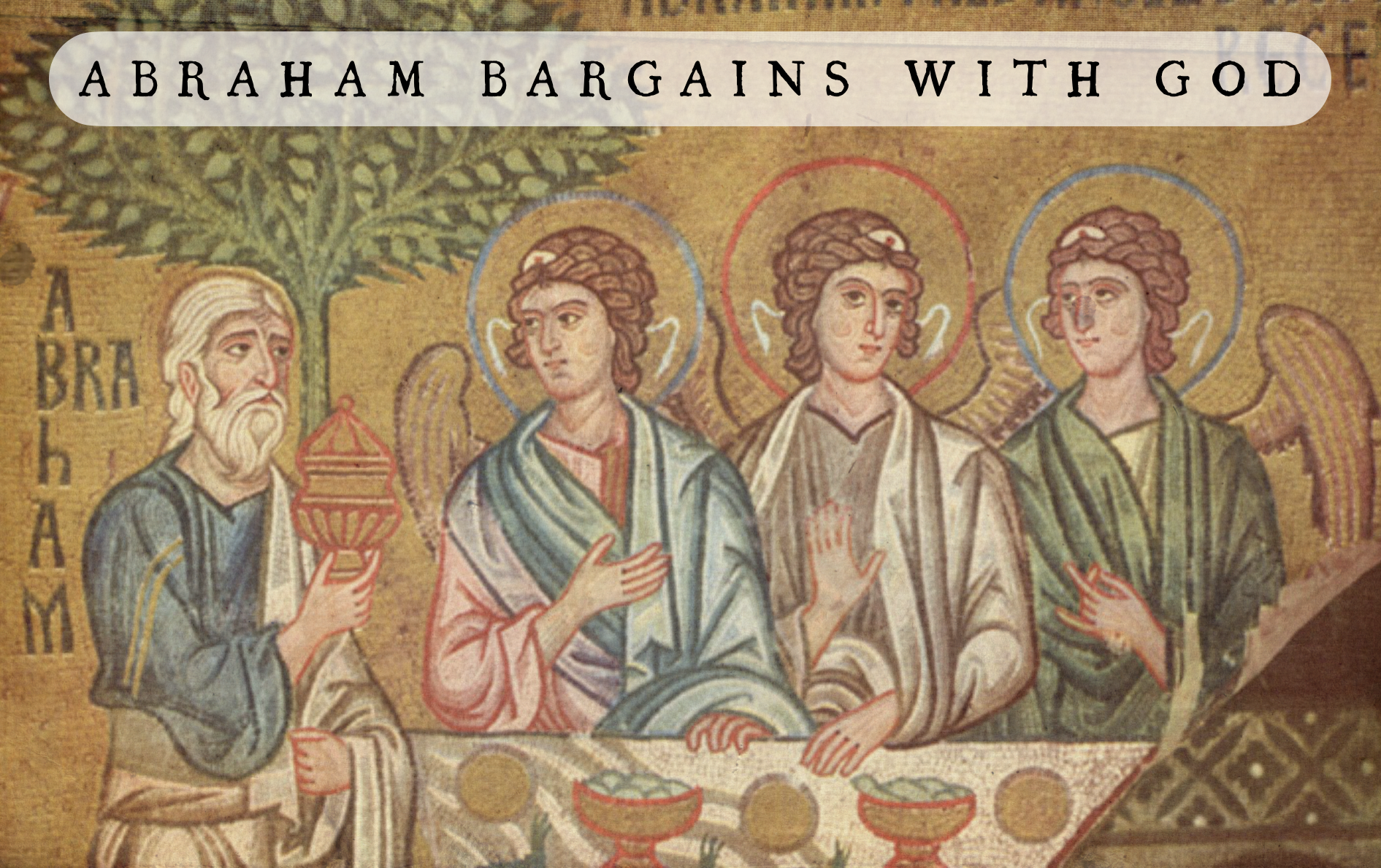
Abraham Bargains With God

The end of Genesis 18 contains an interesting interaction between Abraham and God: after Abraham learns that God intends to destroy the wicked city of Sodom, he decides to intercede for Sodom, asking the LORD, “Will you indeed sweep away the righteous with the wicked?”, implying that there are some righteous people in Sodom who don’t deserve to be destroyed with the rest of the city.

And so, a bargaining process begins (my paraphrase of Genesis 18.24-32):

Abraham: God, will you destroy Sodom if there are 50 righteous people in it?

God: If there are 50, I will spare the city.

Abraham: Hmm, it’s not my place to tell you how to do things, but what if there are 45 righteous people? Five can’t make much of a difference, right?

God: If there are 45, I will spare the city.

Abraham: What about 40?

God: If there are 40, I will spare the city.

Abraham: Don’t be angry with me for haggling, God, but what if there are 30 righteous people?

God: If there are 30, I will spare the city.

Abraham: Be patient with me: what about 20?

God: If there are 20, I will spare the city.

Abraham: OK, let me ask one more time: what if there are 10 righteous people?

God: If there are 10 righteous, I will spare the city.

And at that point, the haggling comes to an end.

This episode is interesting to me for at least three reasons.

First, it is interesting to me that in Genesis 18.23, Abraham seems to mildly reprove God for being willing to destroy an entire city that might contain righteous people, and yet, it seems that Abraham’s mercy was exhausted before God’s was. At least, Abraham quit asking to lower the bar for how many righteous people would save the city. Would God have been willing to spare the city if five righteous people were found? Or three? Or one person? We don’t know, because Abraham quit asking before God quit agreeing. It’s a helpful reminder to me that God is always more merciful than I am.

Related to the first point, the things we ask of God have the potential to change His plans. Depending on where you are on the spectrum of how God’s sovereignty works this is a debatable point, but a straightforward reading of the text certainly indicates that Abraham’s requests were influencing God’s plans regarding the destruction of Sodom. And again, it seems possible that Abraham could have continued to bargain with God until He relented from destroying the city altogether. So this is helpful as well, because it brings about a certain degree of resolve in my life: if the deep desires of my heart are denied to me, it won’t be because I am not asking God for them.

And finally, I’m left to wonder: why is it that we assume that God grows impatient with our repeated requests of Him? Abraham certainly assumed and feared God’s impatience: four times he apologized or asked for patience in some way. I think we often do the same thing. But over and over again God tells us to come to Him in prayer, and in the New Testament, Jesus praises the persistence of a widow and uses her as an example of how we should repeatedly come to the Father in prayer. So I am also reminded by this narrative that I should not project my impatience on God: he patiently (and eagerly) hears my repeated requests. 

I love this narrative episode, because it is so revealing of the nature of God: as Father, God is merciful toward His children, influenced by their desires, and wants to hear their requests. I am a father, and this totally makes sense to me when I think of my own children, but when I see these characteristics portrayed in the Creator of the universe, I am driven to my knees in praise and thanksgiving.

God is a Father: He is merciful toward His children, influenced by their desires, and wants to hear their requests. Share on X

In this loose series of Scripture Reflections, I am sharing brief thoughts spurred on by my Bible reading this year. By way of reminder, my goal for these brief posts is two-fold:

(1) To remark on aspects of the biblical text that I find to be of interest that the reader may or may not have thought about previously.

(2) When possible, to point ahead to the work and person of Jesus Christ. I believe the Bible is a unified story that points to Jesus, which means that He is frequently alluded to or foreshadowed in some way throughout the biblical canon.
Making a Name for Ourselves

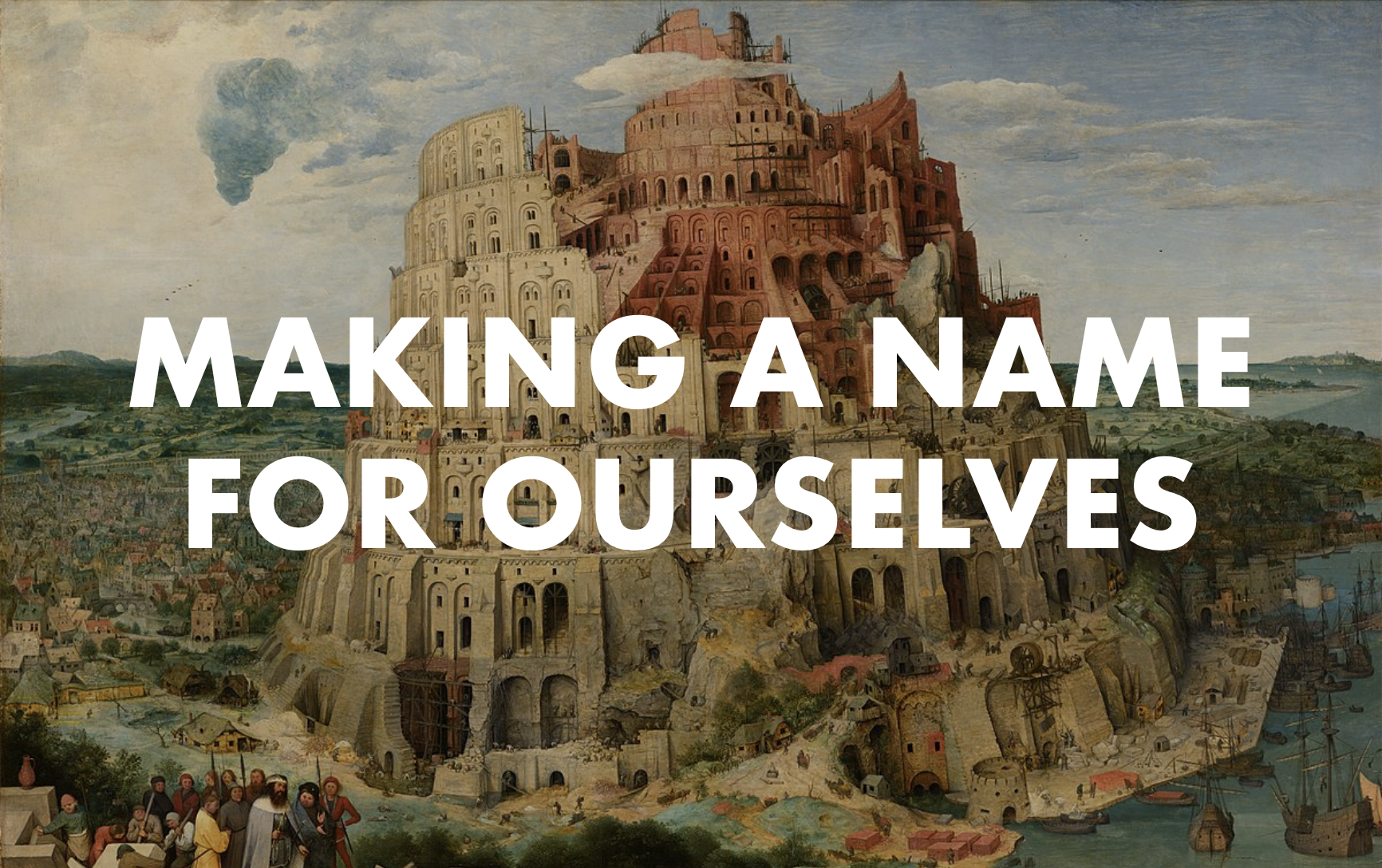
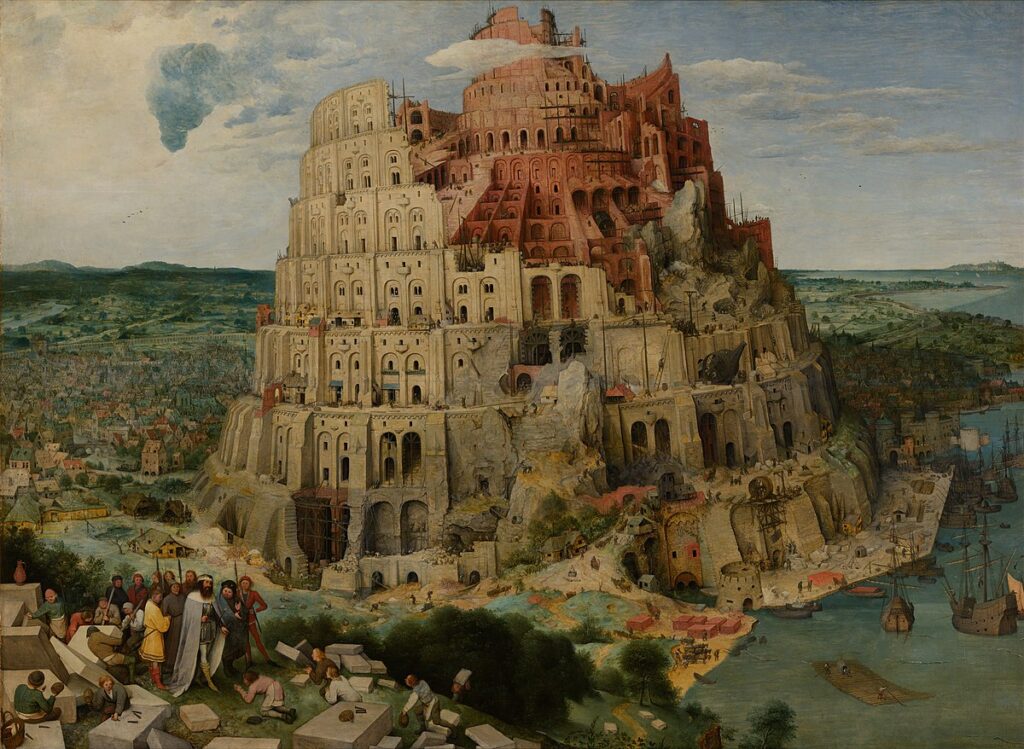
Genesis 11.1-9 relates the fascinating story of the Tower of Babel. You are probably familiar with it: in those days, everyone spoke the same language, and people settled in a plain in the land of Shinar. There they decide to build a city with a tower that would stretch into the heavens. God does not approve of these plans, and so He confuses the language of the people so they cannot understand one another, with the end result being that the building project is suspended and the people are dispersed throughout the earth.

What was the big deal about people building a tower? Why did God act so decisively to frustrate their plans?

Part of God’s strong negative reaction to the Tower of Babel was certainly located in the disobedience of the people: in Genesis 9, God had instructed Noah and his sons to be fruitful and multiply and fill the earth, and Genesis 11 makes it clear that the people did not want to carry out that command, as 11.4 indicates that they wanted to establish a city “lest we be dispersed over the face of the whole earth.” It seems that they no longer wanted to obey God’s command to disperse and instead decided to try it their own way instead.

Furthermore, in light of the sad realities that had plagued the world since the failure of Adam and Eve in the Garden of Eden (Genesis 3), this also seems to have been an effort on God’s part to limit the potential for human oppression and domination. Human wickedness was so bad that it prompted God to flood the earth (Genesis 6), but this “reboot” of the system didn’t actually resolve the evil taint in humanity (Genesis 8.21). What if human ingenuity, human power, and, yes, human malevolence were all concentrated in one urban center? Clearly, this would have been undesirable, and God prevents it from happening.[1]

But there was also a significant amount of pride involved in the Babel tower project, and God would have taken exception to this attitude as well. Again in Genesis 11.4, the people say, “Come, let us build ourselves a city and a tower with its top in the heavens, and let us make a name for ourselves…” Did you catch that? Part of the motivation to build a tower to heaven was self-glorification, as the people wanted to make a name for themselves—a permanent, lasting legacy.[2]

It occurs to me that people have been wanting to make a name for themselves ever since. Surely this is a universal impulse, but I think it is especially exaggerated in individualistic cultures. The ambition of making yourself into something impressive and praiseworthy isn’t even looked down upon in our society; you could argue that it’s a significant aspect of the American Dream: “Make a name for yourself! Accomplish something that others will admire you for! Turn yourself into something special!”

As someone who has lived his entire life in the United States, I cannot help but drink deeply from my cultural surroundings, and I would suggest that, in this particular respect, my cultural surroundings have been harmful to my Christian identity. After all, as far as I can tell, the Bible teaches that I shouldn’t worry about magnifying my name at all.

In Romans 15.20-21, Paul says something interesting:

“And thus I make it my ambition to preach the gospel, not where Christ has already been named, lest I build on someone else’s foundation, but as it is written, ‘Those who have never been told of him will see, and those who have never heard will understand.’”

These verses display Paul’s keen missionary mindset, as he desired to preach to those who did not know about Jesus, but they also show something about the central task of the Christian life: our lives should be centered on the proclamation and magnification of the name of Jesus Christ. We should be all about making Him known to those who do not know Him.

The impulse that was prominent in the Tower of Babel incident remains prominent in our world today, but all of our efforts of self-glorification will lead to a similar end: meaningless babble with no lasting effects. Better then, to dedicate our lives to the spreading of Jesus, the Name above all names.

May God be praised and glorified, and may the name of Jesus be known.

As Christians, our lives should be centered on the proclamation and magnification of the name of Jesus Christ. Share on X

The Tower of Babel, Pieter Bruegel the Elder (1563)


In this loose series of Scripture Reflections, I am sharing brief thoughts spurred on by my Bible reading this year. By way of reminder, my goal for these brief posts is two-fold:

(1) To remark on aspects of the biblical text that I find to be of interest that the reader may or may not have thought about previously.

(2) When possible, to point ahead to the work and person of Jesus Christ. I believe the Bible is a unified story that points to Jesus, which means that He is frequently alluded to or foreshadowed in some way throughout the biblical canon.



[1] See John C. Nugent, Endangered Gospel: How Fixing the World is Killing the Church (Eugene, OR: Cascade Books, 2016): 47-48.

[2] In our last post, we talked about the tragic reality of death as a part of the human experience. One very common response to the reality of death is the obsessive striving for a sort of immortality through the building of legacy, the making of a name for ourselves. Of course, God understands our quest for immortality and promises it to those who belong to Him; but it is of a very different sort than human accomplishment and the remembrance of a legacy.

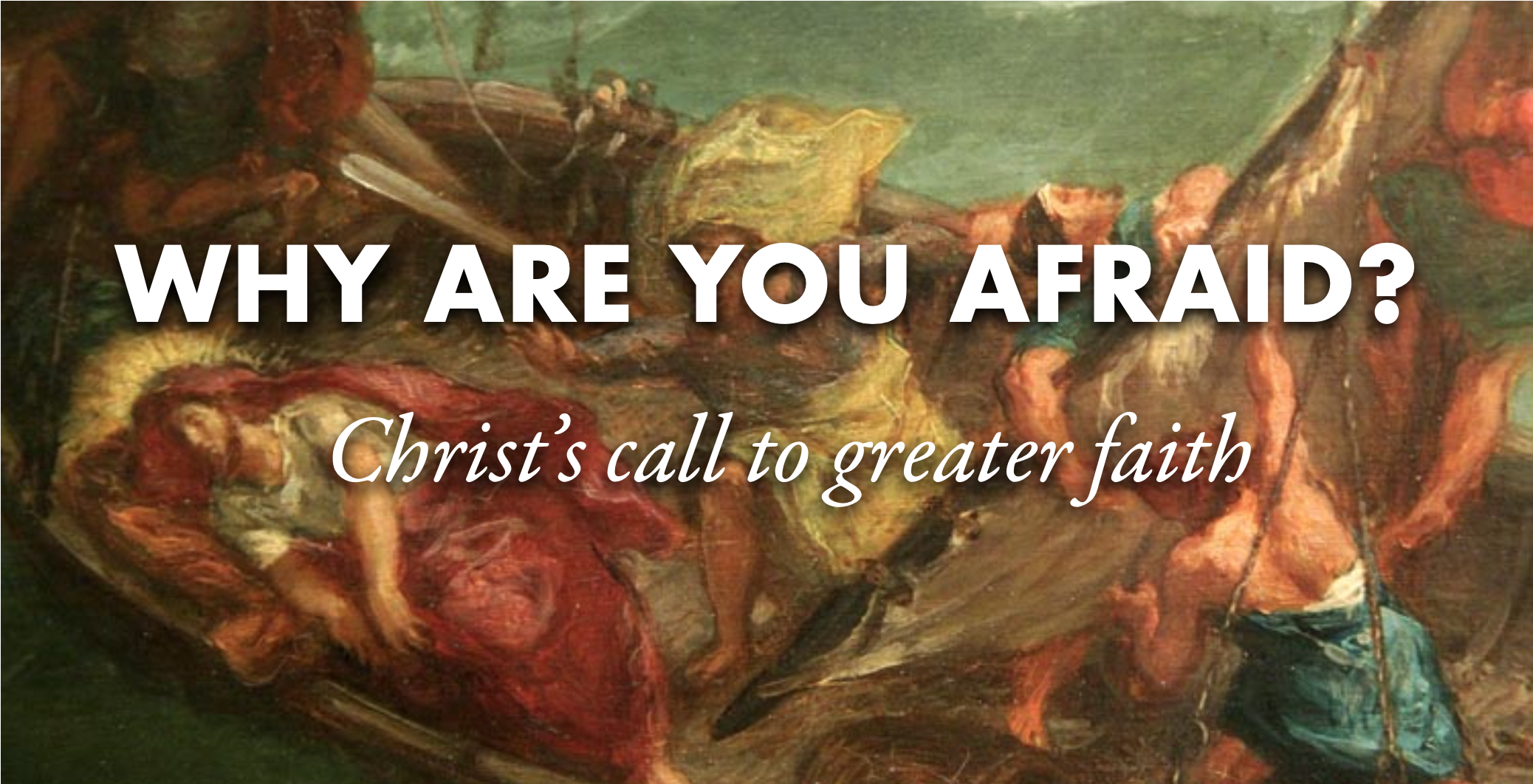
Why Are You Afraid?

In Matthew’s gospel, he follows the Sermon on the Mount in chapters 5-7 with his account of some of the extraordinary miracles that Jesus performs in chapters 8-9. The power of Christ overcomes a variety of maladies: He cleanses lepers, heals paralysis, casts out demons, restores the blind and mute, and brings a little girl back from the dead.

It is in this context that Matthew tells the story of Jesus miraculously calming a storm:

And when He got into the boat His disciples followed Him. And behold, there arose a great storm on the sea, so that the boat was being swamped by the waves; but He was asleep.

And they went and woke Him, saying, “Save us Lord; we are perishing.”

And He said to them, “Why are you afraid, O you of little faith?” Then He rose and rebuked the winds and the sea, and there was a great calm. And the men marveled, saying, “What sort of man is this, that even winds and sea obey Him?”

(Matthew 8.23-27)

There are several lessons we could take from this remarkable event, but I just want to focus on one. Jesus’ disciples are so terrified that they wake Him up in fear of their lives. His response is astounding: “Why are you afraid?” He asks. At first glance, it seems that Jesus is being incredibly obtuse—a great storm had arisen and the boat was being swamped by the waves; obviously the disciples are afraid because of the storm!

But Jesus was not obtuse; indeed, He was the most perceptive of all men. He certainly understood why His disciples were afraid, and so His question must have been about something else. He wasn’t seeking information; rather, He was prompting transformation.

When Jesus asked His disciples why they were afraid, He wasn’t seeking information; He was prompting transformation. Share on X

The second part of Jesus’ statement is telling, as He calls His disciples “you of little faith.” Tied to His question in this way, the implication is clear: if the disciples had more faith, they would not be afraid! Jesus’ disciples had just witnessed His marvelous power in a variety of different situations. This should have bolstered their faith and enabled them to realize that their Teacher was more powerful than the storm which threatened them!

Currently, our world is under siege by a viral pandemic. Millions are sick; hundreds of thousands have died. Millions more have lost jobs, or at least had their incomes diminished. Virtually all of us have had our lives altered in some way. Our plans have been canceled, we are stuck in our homes, we are having to distance ourselves from family and friends. Our worship routines have been disrupted.

What is unique about the current situation is only the scope of the storm; the reality is that, in a variety of ways, we are constantly buffeted by the storms of this life, and the waves threaten to swamp us:

  • A middle-aged man learns that he has been laid off from his job and is plagued by financial uncertainty as he wonders how he will provide for his family.
  • A woman learns that her husband of twenty years, the love of her life, has been carrying on an affair with another woman.
  • Two young parents learn that their infant son has a genetic condition which will greatly limit his life.
  • A single mother of two teenage boys is diagnosed with stage four cancer and told that there is no hope.
  • A house fire destroys a family’s home and all of their earthly possessions.

When the storms of life come, like the disciples, our tendency is to run to Jesus and ask Him to save us. And I wonder if He responds similarly: “Why are you afraid, O you of little faith?”

It’s not that Jesus doesn’t understand our storms—the good news of the Incarnation is that Jesus stepped into the human condition in a unique way. He understands our fears, our trials, and our heartaches. He sympathizes with our weaknesses (Hebrews 4.15). But the same Jesus also says, “In the world you will have tribulation. But take heart; I have overcome the world.” (John 16.33b).

The Christ who calms storms knows what frightens us, but He also asks us to realize: truly, ultimately, with Jesus on our side, the scary things of life aren’t scary! He is more powerful than the storm!

Lord, increase our faith!


In this loose series of Scripture Reflections, I am sharing brief thoughts spurred on by my Bible reading this year. By way of reminder, my goal for these brief posts is two-fold:

(1) To remark on aspects of the biblical text that I find to be of interest that the reader may or may not have thought about previously.

(2) When possible, to point ahead to the work and person of Jesus Christ. I believe the Bible is a unified story that points to Jesus, which means that He is frequently alluded to or foreshadowed in some way throughout the biblical canon.
Mocking Jesus

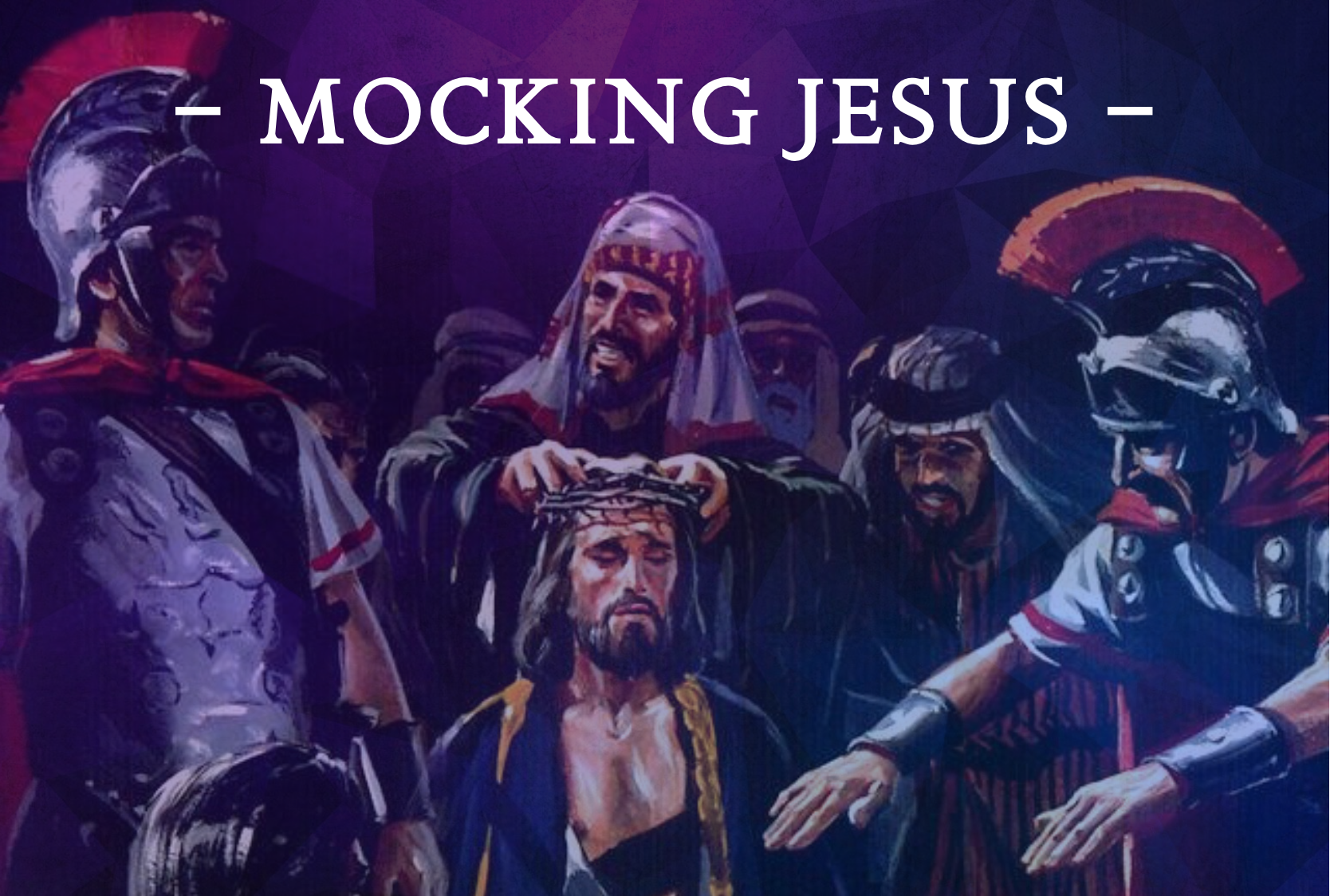
In Mark 15, in the narrative of the crucifixion of Christ, there is the following description of the Roman soldiers mocking Jesus:

And the soldiers led him away inside the palace (that is, the governor’s headquarters), and they called together the whole battalion. And they clothed him in a purple cloak, and twisting together a crown of thorns, they put it on him. And they began to salute him, “Hail, King of the Jews!” And they were striking his head with a reed and spitting on him and kneeling down in homage to him. And when they had mocked him, they stripped him of the purple cloak and put his own clothes on him. And they led him out to crucify him.

(Mark 15.16-20)

When I read these words and let my imagination drift back to that scene, one clear emotion springs to the surface of my thoughts: anger! I am outraged at the way my Savior is openly mocked by sinners for whom He is about to die! How dare these lowly soldiers make fun of God’s Son and spit in the face of the Creator of the universe? If they had any idea Who this was they were dealing with, surely they would not treat Him with such contempt!

But then, I begin to wonder…

The favorite title for Jesus in the early church was Lord (2 Corinthians 4.5). This was a title of ownership. The master of a slave or the owner of a vineyard was called Lord. It was also a title of authority. Army commanders and judges were called Lord. It was the official title of the Roman Emperor. All laws, edicts, and decrees were signed Lord Caesar.

Out of this background, we begin to understand what early Christians were saying when they spoke of Jesus as Lord. They meant that He was the absolute owner of their lives: He was the One who had the right to decide what they would be, what they would do, and where they would go. They meant that He was the final authority over every thought, emotion, and action of life. Above all, they meant that He was the King of Kings to whom they gave their highest loyalty and obedience.

That is what it means to call Jesus Lord.

Returning to the story from Mark 15, I am outraged when I read of these soldiers openly mocking Jesus. But then I wonder: do we mock Jesus any less than the Roman soldiers did when we call Him Lord but then comfortably ignore any demands He makes of our lives?

Jesus: “Why do you call me ‘Lord, Lord,’ and not do what I tell you?” (Luke 6.46)

Do we mock Jesus any less than the Roman soldiers did when we call Him “Lord” but then comfortably ignore any demands He makes of our lives? Share on X

In this loose series of Scripture Reflections, I am sharing brief thoughts spurred on by my Bible reading this year. By way of reminder, my goal for these brief posts is two-fold:

(1) To remark on aspects of the biblical text that I find to be of interest that the reader may or may not have thought about previously.

(2) When possible, to point ahead to the work and person of Jesus Christ. I believe the Bible is a unified story that points to Jesus, which means that He is frequently alluded to or foreshadowed in some way throughout the biblical canon.
Scripture Reflections 4: Jacob, Rachel, and Leah

One of our yearly fellowship events at church is our “Sweetheart Banquet”, which occurs each February in conjunction with Valentine’s Day. We come together and have a meal, play games, hear a speaker, and celebrate marriage. An added wrinkle to this year’s banquet was that couples were encouraged to dress up as famous couples: we had a Joseph and Mary, a Mr. and Mrs. Potato Head, and a Phil and Kay Robertson among many others.

Caroline and I dressed up as the biblical characters of Jacob and Rachel, and then we also dressed up a puppet to serve as Jacob’s other wife, Leah. Throughout the night I lugged Leah around, always introducing her last and in general, showing my preference for Rachel over her. It was all in good fun, but it was based on real biblical events that really weren’t fun at all.

The beginning of this story is found in Genesis 29 where Jacob falls in love with Rachel the daughter of Laban and wants to marry her. Laban gives his consent, but then tricks Jacob into marrying Leah, Rachel’s older sister, instead. Ultimately, Rachel becomes Jacob’s second wife, but Laban’s dishonest trickery results in a lifetime of contentiousness and unhappiness for both of his daughters.

We can see this play out in Genesis 29.31-30.24. All of that is worth reading, but to just give you an idea of what is there, check out the Genesis 30.1-13:

When Rachel saw that she bore Jacob no children, she envied her sister. She said to Jacob, “Give me children, or I shall die!” Jacob’s anger was kindled against Rachel, and he said, “Am I in the place of God, who has withheld from you the fruit of the womb?” Then she said, “Here is my servant Bilhah; go in to her, so that she may give birth on my behalf, that even I may have children through her.” So she gave him her servant Bilhah as a wife, and Jacob went in to her. And Bilhah conceived and bore Jacob a son. Then Rachel said, “God has judged me, and has also heard my voice and given me a son.” Therefore she called his name Dan. Rachel’s servant Bilhah conceived again and bore Jacob a second son. Then Rachel said, “With mighty wrestlings I have wrestled with my sister and have prevailed.” So she called his name Naphtali.

When Leah saw that she had ceased bearing children, she took her servant Zilpah and gave her to Jacob as a wife. Then Leah’s servant Zilpah bore Jacob a son. And Leah said, “Good fortune has come!” so she called his name Gad. Leah’s servant Zilpah bore Jacob a second son. And Leah said, “Happy am I! For women have called me happy.” So she called his name Asher.

The contest between Rachel and Leah to secure the favor of Jacob through the bearing of sons is tragic. It leads to lifelong competition and enmity between the two sisters, and ultimately causes them to use their personal servants as sex slaves.

This passage reinforces a few ideas to me:

(1) The terrible dynamics of polygamy. It was God’s plan in the beginning for one man and one woman to be united in marriage for one lifetime. This is not the plan that Jacob followed, and the Bible records the suffering of Jacob, Rachel, Leah, and Joseph (and you could argue Bilhah and Zilpah as well) as a direct result. In our culture today, polygamy has largely died out, but there are still shows like Sister Wives which try to present this as an acceptable practice that can lead to happy, well-adjusted family life. Our knowledge of human nature suggests that the biblical account is the much more accurate one.

(2) The Bible at times describes practices which are clearly contrary to God’s will without rejecting them right there.  In Genesis 29-30, polygamy is not specifically condemned, but as mentioned above, monogamy was God’s plan from the beginning, and Jesus reiterated that in His teachings in the New Testament. This is just the way the Bible is: sometimes it records events and practices that are not pleasing to God without specifically condemning them in that context. That’s one reason why it’s important to understand the teachings of Scripture as a whole. If you want more examples of this, read the Book of Judges: there are a lot of terrible things which are recounted there that are not explicitly condemned in that context, but they are still wrong.

(3) God uses human foolishness to accomplish His will. If there is a ray of hope in the sad story of Jacob, Rachel, and Leah, this is it! I don’t think that God wanted Jacob to take multiple wives and for those wives to bitterly strive with one another for the rest of their lives, but God was still able to use that situation to bring about the spread of Abraham’s descendants and the continuance of His plan to make Himself known to the world. I am foolish, and I make many mistakes; it is comforting to know that God can work despite my mistakes (and even through them!) to accomplish His will.

Newer posts »

© 2026 The Doc File

Theme by Anders Noren — Up ↑