The online journal of Luke Dockery

Tag: Sermon on the Mount (Page 2 of 4)

The Beatitudes: Blessed Are Those Who Hunger and Thirst for Righteousness

As discussed in the introductory post of this series, Jesus’s Beatitudes in the Sermon on the Mount are basically a description of what a good life really looks like from God’s perspective. Jesus redefines what blessedness is, and provides an alternative set of values for His followers, those who desire to be a part of His alternative community. Here are the Beatitudes we have discussed thus far:


Blessed Are Those Who Hunger and Thirst for Righteousness

“Blessed are those who hunger and thirst for righteousness, for they shall be satisfied.”

(Matthew 5.6)

When we think of “righteousness,” we primarily think of it as a spiritual or religious word that refers to our moral condition and our relationship with God. That is not incorrect, but in both Hebrew and Greek, the words translated as “righteousness” in our Bibles also convey the meaning “justice.” Those two ideas—righteousness and justice—seem fairly distinct to us, but it is significant that in both of the primary original languages of Scripture, they are closely connected.[1]

Righteousness and justice seem fairly distinct to us, but it is significant that in both of the primary original languages of Scripture, they are closely connected. Share on X

So when Jesus discusses hungering and thirsting for “righteousness,” He is most likely referring to those who are seeking to live in a way that results in right relationship with both God (righteousness) and other people (justice). This also makes a lot of sense in the context of Jesus saying that the two greatest commandments are loving God with everything we have and loving our neighbors as ourselves (Matthew 22.37-39). When we place these two commandments at the center of our lives, then we are pursuing righteousness. Or, put differently, a good way to think of righteousness is that Jesus is “calling for any and all action that attempt[s] to make things right in the world.”[2]

When we place the two greatest commandments at the center of our lives, then we are pursuing righteousness. Share on X

Another key idea to this beatitude is the idea of having “hunger and thirst” for righteousness. Living in the financially-blessed conditions of the United States, most of us really know very little about what it means to be hungry or thirsty. The hunger of the ancient world was not a gentle growling of the stomach reminding us that we haven’t eaten for a few hours. Indeed, most people barely had enough to eat to get by, and meals of more than enough (like what I get any time I go to a fast food restaurant) were very rare indeed. Similarly, whenever I am thirsty, I can generally get access to clean drinking water within a matter of minutes. Again, this was not the case in the ancient world.[3] So the idea here is not someone who has a mild desire for righteousness, but rather, someone who desperately craves it.

There’s an old story about a young man who went to see a wise old man to ask him about the right way to live.[4] The wise man led him down to a river, and together they walked out into it. When the water was deep enough, the wise man suddenly grabbed the young man, pushed him under the water and held his head submerged! Naturally, the young man began to struggle with all his might to escape and get his head above water again. He finally managed to get free, and broke the surface of the water, gasping for breath. As he gulped down the precious air, the wise man said, “When you thought you were about to drown, what did you want more than anything else?” “Air!” the young man responded. The old man replied: “When you want righteousness as much as you wanted air just now, it will become a possibility for you. But not before.”

How much do you desire to be right with God and other people? As much as a starving person wants food? As much as a drowning person wants air? Because that is the characteristic of citizens of the kingdom that Jesus is describing here.

Undoubtedly, that is a high standard to set, but there should also be some comfort to us in this verse because it affirms the virtue of the pursuit of righteousness rather than simply attaining it. Because of our imperfect natures, we often fall short of what we desire to achieve, but it is important to notice here that Jesus pronounces blessing on those who seek righteousness.[5] In other words, don’t beat yourself up over your failings; instead, pick yourself up and continue the pursuit for righteousness, because it is that pursuit that Jesus calls “blessed.” Hunger and thirst for it.

God promises that if you do, you will be satisfied.

If you enjoyed this post, you might enjoy my book on the Sermon on the Mount, Counter Culture: A Study of the Sermon on the Mount. 

Although this book was written specifically as an aid to teaching the Sermon on the Mount to junior high and high school students, it is also useful for personal Bible study, and the depth of the material makes it a great resource for adult Bible classes.


[1] Larry Chouinard, Matthew, The College Press NIV Commentary (Joplin, MO, College Press, 1997), 98, suggests that justice is more on Jesus’ mind in this instance, but I am not sure that there is anything to suggest that both (closely-related) ideas could not be what He was communicating.

[2] Chris Seidman and Joshua Graves, Heaven on Earth: Realizing the Good Life Now (Nashville, TN, Abingdon Press, 2012), 58.

[3] William Barclay, The Gospel of Matthew Volume 1, The Daily Study Bible (Philadelphia, Westminster Press, 1956), 94.

[4] See Rubel Shelly, The Beatitudes: Jesus’ Formula for Happiness (Nashville, TN, 20th Century Christian, 1982), 47-48.

[5] Ibid., 96.

The Beatitudes: Blessed Are the Meek

As discussed in the introductory post of this series, Jesus’s Beatitudes in the Sermon on the Mount are basically a description of what a good life really looks like from God’s perspective. Jesus redefines what blessedness is, and provides an alternative set of values for His followers, those who desire to be a part of His alternative community. Here are the Beatitudes we have discussed thus far:


Blessed Are The Meek

“Blessed are the meek, for they shall inherit the earth.”

(Matthew 5.5)

This beatitude is challenging for us to understand because the word “meek” is not one that we commonly use or understand very well. A lot of times when we think of meekness, we associate it with people who are quiet, mild-mannered, and weak-willed, but meekness, at least in the Bible, does not mean weakness or cowardice.[1] To better understand the meaning here, it would help us to look at the word itself, and the Old Testament context from which Jesus borrows it.

In Greek, the word translated “meek” (πραυς/praus) is also used to describe a wild horse that has been tamed.[2] So the idea is not people of weak character or no backbone, but rather, those who, “having been tamed by God, are the masters of their spirits.”[3] Also, Jesus was a Jewish teacher instructing a Jewish audience, and when He talks about the meek inheriting the earth, He is actually quoting from Psalm 37.11, a text His audience would have known well. In that context, the psalm refers to the righteous poor, who are being threatened and oppressed by the wicked wealthy. In the face of such oppression, the meek do not worry about evildoers, but instead trust in God, knowing that He will root out the wicked.[4] In many ways, this beatitude seems to parallel the first one, with meekness and being poor in spirit essentially referring to the same characteristic of those who radically trust in God, and both are promised an inheritance from God.[5]

Meekness describes those who, in the face of insult and injury, are able to remain patient and composed rather than flying off the handle. Share on X

In light of all this, meekness actually suggests strength of character, not weakness. It describes those who, in the face of insult and provocation, are able to remain calm and composed rather than flying off the handle. Meekness is not the surrender of our rights, but it is the ability to overlook slights, knowing that God is in charge and will ultimately vindicate us. As one commentator states:

“[Meekness] is proof of true greatness of soul. It comes from a heart too great to be moved by little insults. It looks upon those who offer them with pity. He that is constantly ruffled; that suffers every little insult or injury to throw him off his guard and to raise a storm of passion within, is at the mercy of every mortal that choose to disturb him.”[6]

Again, we can see how the characteristics that Jesus describes in the Beatitudes are radically counter-cultural. We live in a highly anxious society where so many people seem to be constantly offended by everything. In such a climate, it may seem a brave thing to constantly complain about how everyone is annoying and offending you, but when you think about it, this is actually a very weak position to be in: you are admitting that other people have constant control over your emotions and responses. Those who are meek, on the other hand, boldly refuse to give others control over their emotions and responses. Instead, empowered by the knowledge that God is in control and will ultimately vindicate them, the meek are strong enough in character to shake off the slights and insults of others, even from those who, from a worldly perspective, might be in a position of superiority over them.

Those who are meek boldly refuse to give others control over their emotional responses. Share on X

In God’s eyes, those who are meek are living the good life, and they are promised an inheritance from the Father.


If you enjoyed this post, you might enjoy my book on the Sermon on the Mount, Counter Culture: A Study of the Sermon on the Mount. 

Although this book was written specifically as an aid to teaching the Sermon on the Mount to junior high and high school students, it is also useful for personal Bible study, and the depth of the material makes it a great resource for adult Bible classes.


[1] Larry Chouinard, Matthew, The College Press NIV Commentary (Joplin, MO, College Press, 1997), 97.

[2] Jack P. Lewis, The Gospel According to Matthew, Part I, The Living Word Commentary (Austin, TX: Sweet Publishing, 1976), 81.

[3] Lewis, 81.

[4] Ibid., 81; Warren Carter, “Power and Identities: The Contexts of Matthew’s Sermon on the Mount,“ in Preaching the Sermon on the Mount: The World It Imagines, ed. David Fleer and Dave Bland (St. Louis: Chalice Press, 2007), 18.

[5] Chouinard, 96; Francis Wright Beare, The Gospel According to Matthew: A Commentary (Oxford: Basil Blackwell, 1981), 130.

[6] Albert Barnes, Matthew and Mark, Notes on the New Testament (Grand Rapids, MI: Baker Book House, 1949), 44.

The Beatitudes: Blessed Are Those Who Mourn

As discussed in the introductory post of this series, Jesus’s Beatitudes in the Sermon on the Mount are basically a description of what a good life really looks like from God’s perspective. Jesus redefines what blessedness is, and provides an alternative set of values for His followers, those who desire to be a part of His alternative community:


Blessed Are Those Who Mourn

“Blessed are those who mourn, for they shall be comforted.”

(Matthew 5.4)

This seems like one of the most paradoxical statements of the Beatitudes: in what sense can those who mourn somehow be happy? What kind of mourning is Jesus talking about here? There are multiple aspects of life about which we could mourn:

  • Mourning for the general sorrows of life. Sad and heartbreaking things occur in life, and citizens of God’s kingdom are not immune from these tragedies. There is a sense in which we can learn a lot from sorrow in our lives:

  • Mourning for the sin in our lives. Sin grieves the Father and cost the Son His life. As citizens of the kingdom, an appropriate view of sin will cause us to grieve over its presence in our lives and seek to repent of it.
  • Mourning for the suffering of others in our broken world. Scripture presents our world as being a place where Satan, sin, and death currently reign, and because of that, people suffer in a variety of ways. “Participants in the kingdom of God are genuinely grieved by the general tyranny of sin characteristic of this present evil age.”[1]

So, which of these different types of mourning is Jesus actually talking about here? Probably all of them.[2] For citizens of God’s kingdom, there are many things in this present life worth mourning about. We are not spared from the sorrows that others face, but we experience additional sources of mourning because we grieve the sin in our lives and are aware of and lament the deep brokenness of the world in which we live.

Jesus promises, however, that those who mourn will be comforted.

I think that God is especially near when we mourn, even though at those times it might not seem like He is close at all. We see over and over again in Scripture that God Himself mourns. Jesus was prophesied to be a Man of sorrows who was acquainted with grief (Isaiah 53.3), and He was also supposed to be the Comforter of Israel who would bind up the brokenhearted (Isaiah 61.1; cf. Luke 2.25). God is close to those who mourn, and seeks to comfort us when we do. Currently, I believe this comfort comes from the presence of His Spirit in our lives, the balm of Christian community, and the hope of resurrection.

Ultimately, though, this comfort will come when Jesus returns, God’s kingdom is fully established, and sin and death are abolished. When that happens, we will find comfort because the causes of our mourning will be no more.


If you enjoyed this post, you might enjoy my book on the Sermon on the Mount, Counter Culture: A Study of the Sermon on the Mount. 

Although this book was written specifically as an aid to teaching the Sermon on the Mount to junior high and high school students, it is also useful for personal Bible study, and the depth of the material makes it a great resource for adult Bible classes.


[1] Larry Chouinard, Matthew, The College Press NIV Commentary (Joplin, MO, College Press, 1997), 96.

[2] William Barclay, The Gospel of Matthew Volume 1, The Daily Study Bible (Philadelphia, Westminster Press, 1956), 88-90; J.W. McGarvey, Matthew and Mark, The New Testament Commentary (Delight, AR: Gospel Light Publishing Company, 1875), 49; Jack P. Lewis, The Gospel According to Matthew, Part I, The Living Word Commentary (Austin, TX: Sweet Publishing, 1976), 80. James Burton Coffman, Commentary on the Gospel of Matthew, (Austin, TX: Firm Foundation Publishing House, 1968), 51.

The Beatitudes: Blessed Are the Poor in Spirit

As discussed in the introductory post of this series, Jesus’s Beatitudes in the Sermon on the Mount are basically a description of what a good life really looks like from God’s perspective. Jesus redefines what blessedness is, and provides an alternative set of values for His followers, those who desire to be a part of His alternative community.


Blessed Are the Poor in Spirit

“Blessed are the poor in spirit, for theirs is the kingdom of heaven.”

(Matthew 5.3)

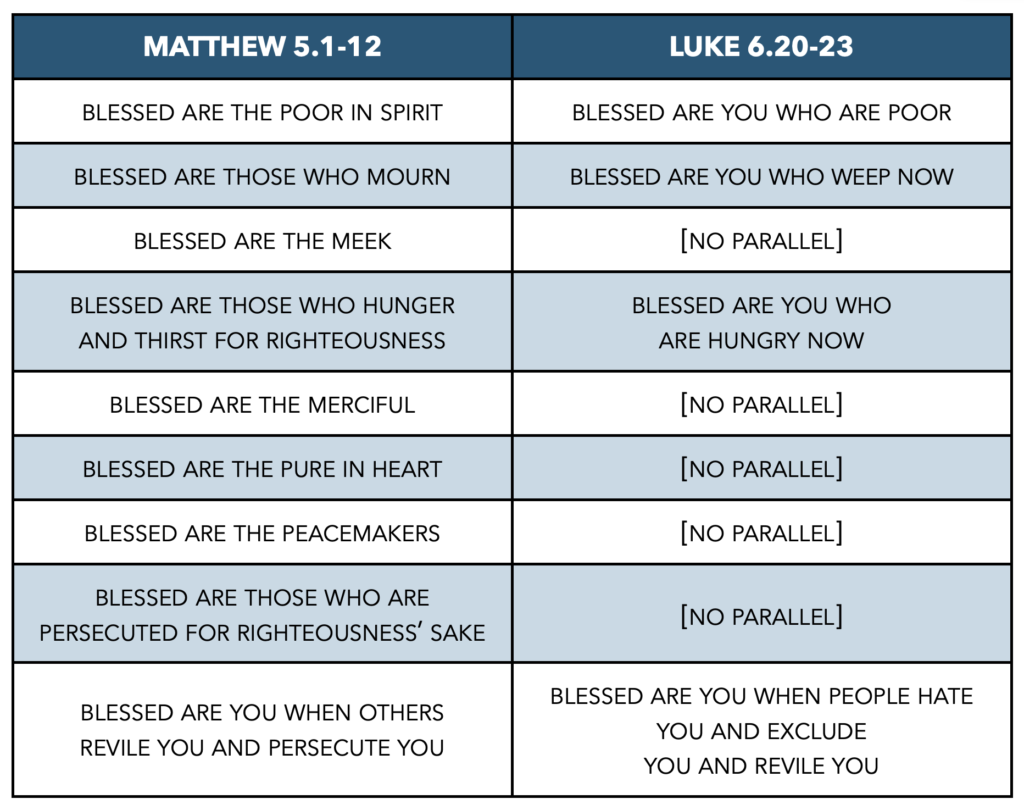
This first beatitude is a good example of something we discussed in the previous post, the “over-spiritualizing” of Jesus’s statements. In this instance, some people try to interpret “poor in spirit” to be a spiritual condition having nothing to do with literal poverty.[1] But, in his version of the Beatitudes, Luke simply refers to “the poor” (see chart), and there is no reason to assume that Matthew is talking about something completely different.

Instead, I think what is going on here is that Matthew focuses on the spiritual or psychological condition of those who are physically poor: being “poor in spirit” is the internal frame of mind of those who suffer from oppression and economic hardship.[2] The Hebrew Bible discusses the same idea in numerous places (Psalm 9.18, 34.6, 37.14, 69.29; Isaiah 57.15, 61.1, 66.2), and the equivalent term in Hebrew conveys the idea of a lack of status and social rights in addition to financial poverty.[3]

Jesus lived (and Matthew wrote) at a time when Judea was a backwater province of Rome, and approximately 97% of the population of the Roman Empire suffered from literal poverty, relegated to varying degrees of hunger and poor health.[4] The vast majority of people had little money, low status, and limited rights. Also, while the New Testament does mention some followers of Jesus who were wealthy, the early church overwhelmingly consisted of the poor and socially outcast.

As a Christian living in the United States of America, I have to acknowledge that this is a very different context from what I am familiar with. In the United States (the location of most of the readers of this blog), for the most part, Christians are a pretty middle-class crowd, and to be honest, don’t we like it that way? Speaking for myself, I will readily admit that I am in no hurry to be financially destitute, oppressed in some way, or a social outcast.

Still, just because we are financially better off than the original audience for Jesus’s teaching here doesn’t mean that we cannot relate to the idea of “poor in spirit.” All of us have, at one time or another, felt like we were the lowest of the low, completely beaten down by the circumstances of life, and that feeling of helplessness and powerlessness is closely tied to the idea of being poor in spirit.

And here is the shocking claim: Jesus says that people who feel like this are blessed!

Roman society viewed the wealthy elite who lived in ease and had all the power as the ones who live the blessed life, and our culture aligns itself closely with Roman values in this regard. American culture places great value on wealth, prosperity, and power, and even in the church and the individual lives of Christians, wealth can at times be pursued as an unqualified good, and power as something that should be sought after rather than laid aside.

But Jesus challenges this pursuit and presents a very counter-cultural idea: God’s favor extends to all people, including the poor in spirit, those that are beaten down and cast aside by society at large. And more than that, these people are specifically blessed: since they have no earthly resources, they know they can’t rely on themselves, and can therefore more easily put their trust in God and depend entirely upon Him.[5]

Jesus challenges the pursuit of wealth and power and presents the counter-cultural idea that God’s favor extends to all people, including those that are beaten down and cast aside by society at large. Share on X

The kingdom of heaven belongs to people like this. They are right at home in Jesus’s alternative community, the different sort of world that He invites us to imagine and be a part of.


If you enjoyed this post, you might enjoy my book on the Sermon on the Mount, Counter Culture: A Study of the Sermon on the Mount. 

Although this book was written specifically as an aid to teaching the Sermon on the Mount to junior high and high school students, it is also useful for personal Bible study, and the depth of the material makes it a great resource for adult Bible classes.


[1] See, for example, Francis Wright Beare, The Gospel According to Matthew: A Commentary (Oxford: Basil Blackwell, 1981), 128; Rubel Shelly, The Beatitudes: Jesus’ Formula for Happiness (Nashville, TN, 20th Century Christian, 1982), 12.

[2] Larry Chouinard, Matthew, The College Press NIV Commentary (Joplin, MO, College Press, 1997), 95.

[3] Chouinard, 95-96; Jack P. Lewis, The Gospel According to Matthew, Part I, The Living Word Commentary (Austin, TX: Sweet Publishing, 1976), 80. Though our own society is different in many ways from the cultures of the biblical narratives, it remains very similar at least in this regard: the financially poor also tend to be disadvantaged socially, politically, medically, educationally, and in other ways as well.

[4] Warren Carter, “Power and Identities: The Contexts of Matthew’s Sermon on the Mount,“ in Preaching the Sermon on the Mount: The World It Imagines, ed. David Fleer and Dave Bland (St. Louis: Chalice Press, 2007), 14-15.

[5] Chouinard, 95; William Barclay, The Gospel of Matthew Volume 1, The Daily Study Bible (Philadelphia, Westminster Press, 1956), 85-86.

The Beatitudes: Kingdom Character

I don’t remember what the driving force was at the time, but about seven years ago, I got into the Sermon on the Mount. I mean, really got into it. I taught it to my teenagers. I taught an adult Bible class on it. I spoke in a summer series on it. I published a book on it. I directed a youth conference on it. It was pretty much an obsession—I had come to realize that this was Jesus’s Kingdom Manifesto, where He declared what living in His kingdom is all about, to those who desire to be a part of that kingdom.[1] As someone who desired to be a part of that kingdom, it seemed really important to me that I take Jesus’s words very seriously.

What I found was that, as I really got into the Sermon on the Mount, it actually really got into me. Not overnight, but gradually, as I read it and taught it more and more, it began to change me from the inside out. I began to pray the Lord’s Prayer more. The way I interacted with people online began to change—I was not as quick to rush in to straighten someone out, or as defensive when someone was critical of me. I tried to be more generous in my judgments of other people. My views on how Christians are to interact with and influence the world changed significantly. It’s not an overstatement to say that the Sermon on the Mount gradually became the default lens through which I viewed the world.[2]

What I found was that, as I really got into the Sermon on the Mount, it actually really got into me. Share on X

With all that in mind, I’d like to do a series on the first part of the Sermon on the Mount, the sayings that Jesus presents known as the Beatitudes.


Our English word “beatitude” comes from beatitudo, which is the Latin equivalent of the Greek word μακαριος/makarios, a word that means “happy” or “blessed,” and this is how all of the Beatitudes start: “Blessed are the _________.”[3] We live in a world where people desperately do anything they can think of in order to be happy, but what Jesus is talking about here is not a pleasant emotional response that comes to us based on outward circumstances. Instead, the sense of this word is something like, “God is pleased with” or “God’s favor rests upon” the people who possess the characteristics that Jesus goes on to describe.[4] Jesus is telling us what a good life really looks like from God’s perspective.

In the Sermon on the Mount, Jesus is setting up an alternative community, where people live by values and principles that are dramatically different from those of the world, and we clearly see this in the Beatitudes. First, the people who Jesus describes as being happy or blessed are not the people who the world would describe in that way.[5] Jesus redefines what blessedness is and provides an alternative set of values for His followers. Also, the word μακαριοι/makarioi that we have already discussed that Jesus uses repeatedly here is plural. This means that Jesus’ beatitudes are not directed at individuals, but are to be the practices of the community that Jesus is establishing.[6] So Jesus’s beatitudes will describe the same group of people in multiple ways: God’s kingdom, an alternative community made up of His disciples.

Matthew’s record of these beatitudes bears some similarity to the shorter beatitudes recorded in Luke’s Sermon on the Plain:

Some biblical scholars have made a big deal about the differences between Luke’s beatitudes and Matthew’s, suggesting that Luke focuses on physical characteristics (poor, hungry, etc.), while Matthew emphasizes spiritual characteristics instead (poor in spirit, hunger for righteousness, etc.). These interpreters sometimes “spiritualize” Matthew’s beatitudes so much that they no longer have any connection to the historical context in which Jesus is speaking.[7]

I don’t think it is necessary to make such a sharp distinction, though. It seems unlikely that Jesus would present two different, unconnected sets of beatitudes, one focused on physical characteristics and the other on spiritual characteristics. What makes more sense is that in both places Jesus presents characteristics of those who God calls “blessed”, but in Matthew, He emphasizes that certain physical characteristics have spiritual implications.

With that in mind, we want to be balanced as we look at these traits. While it is true that the Sermon on the Mount doesn’t portray Jesus as a political revolutionary who is advocating for social or economic upheaval, He does address social and economic problems that are a result of the political realities of His day. In a real sense, Jesus invites His audience (including us) to imagine a different sort of world: the kingdom of God. And God’s kingdom is an upside-down kingdom, which reverses the conditions of people where the poor, hungry, and persecuted are called “blessed.”[8]

I hope you’ll read along as we examine the Beatitudes one by one.

Jesus invites His audience—including us—to imagine a different sort of world: the kingdom of God. Share on X

If you enjoyed this post, you might enjoy my book on the Sermon on the Mount, Counter Culture: A Study of the Sermon on the Mount. 

Although this book was written specifically as an aid to teaching the Sermon on the Mount to junior high and high school students, it is also useful for personal Bible study, and the depth of the material makes it a great resource for adult Bible classes.


[1] J. Oswald Dykes, The Manifesto of the King: An Exposition of the Sermon on the Mount (London, J. Lisbet, 1881).

[2] In many ways, this seems providential to me, in light of all that has gone on in the world over the last several years: the rise of Trump, the COVID-19 pandemic, Black Lives Matter and racial unrest, QAnon, the January 6 uprising, increased political polarization; the list goes on and on. I cannot pretend that I responded perfectly to all of these developments, but I truly believe that my deep immersion in the Sermon on the Mount helped me to have a kingdom perspective on these events that saved me from a lot of unhealthy responses.

[3] Jack P. Lewis, The Gospel According to Matthew, Part I, The Living Word Commentary (Austin, TX: Sweet Publishing, 1976), 79.

[4] Warren Carter, “Power and Identities: The Contexts of Matthew’s Sermon on the Mount,” in Preaching the Sermon on the Mount: The World It Imagines, ed. David Fleer and Dave Bland (St. Louis: Chalice Press, 2007), 17.

[5] J.W. McGarvey, Matthew and Mark, The New Testament Commentary (Delight, AR: Gospel Light Publishing Company, 1875), 51: “The world’s conception of the man who is superlatively blessed has always been the reverse of what is here taught.” Randy Harris, Living Jesus: Doing What Jesus Says in the Sermon on the Mount (Abilene, TX, Leafwood, 2012), 31: “Jesus’ idea of the blessed life and our idea of the blessed life have almost nothing in common.”

[6] Carter, 17.

[7] Francis Wright Beare, The Gospel According to Matthew: A Commentary (Oxford: Basil Blackwell, 1981), 133, is a good example of someone who emphasizes the supposed distinctions between Matthew and Luke in the Beatitudes. McGarvey, 51, spiritualizes Matthew’s Beatitudes, to where, for example, “poor in spirit” has nothing to do with actual poverty.

[8] Beare, 127; Larry Chouinard, Matthew, The College Press NIV Commentary (Joplin, MO, College Press, 1997), 94.

« Older posts Newer posts »

© 2026 The Doc File

Theme by Anders Noren — Up ↑