The online journal of Luke Dockery

Tag: The Prodigal Son

Jesus Cooked Breakfast: The Materialistic Nature of Christianity

This is the third and final post in a short series based on a rereading of Tim Keller’s The Prodigal God. Although I liked the book well enough the first time, I found it to be particularly insightful the second time I read it; you can read the previous posts, “The Elder Brother We Need” and “Exiled from Home.”


Something that I have observed frequently in my life as a Christian is the elevation of “spiritual” things in a way that trivializes things that are material. This seemed normal and right to me for a long time, until I became a better student of theology and Christian history and realized that attempts to downplay “physical” and “material” things as unimportant are actually echoes of ancient Christian heresies like gnosticism or reflect influence from Greek platonism rather than being a genuine representation of the historic Christian faith, which emphasizes the goodness of creation and God’s intention to redeem it.

One of the things I loved about The Prodigal God was Keller’s section, “Salvation Is Material.”[1] In this section, he makes a brief but strong case for the material nature of Christianity. In fact, Keller claims that Christianity is perhaps the most materialistic of the world’s faiths. Here he does not mean materialism in the sense of being focused on wealth and possessions, but rather that the Christian faith values what is created and tangible.

Keller begins with the significance of meals in the Christian faith, and then traces God’s love for the material world through the biblical narrative (words in bold reflect my own emphasis):

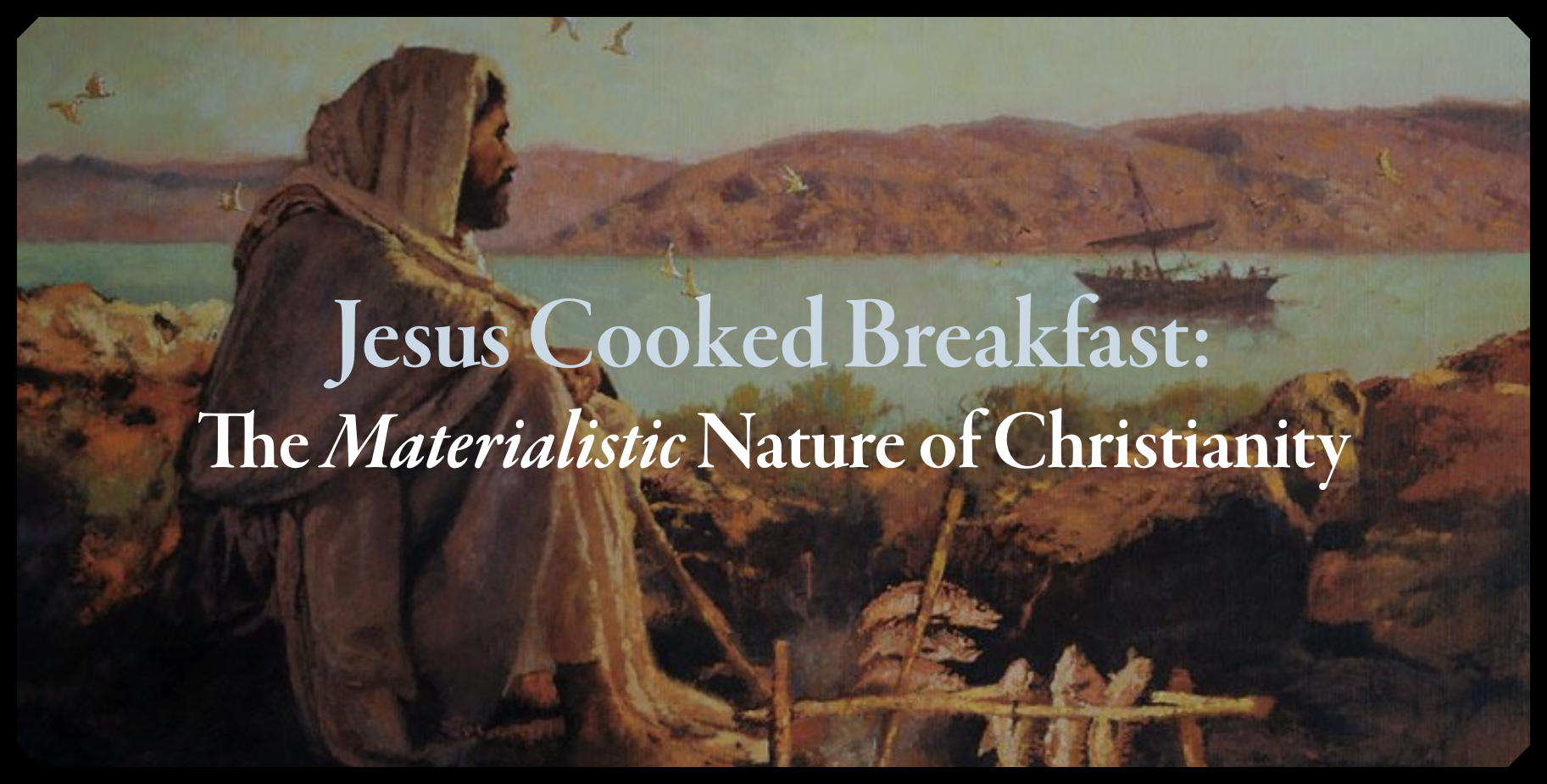
A meal is a very physical experience. Jesus left a meal, the Lord’s Supper, to be remembered by, and the final goal of history is a meal, the wedding supper of the Lamb (Revelation 19). The resurrected Christ ate with his disciples when he met with them (Luke 24:42–43; John 21:9). What does it all mean? It is a sign that, for Jesus, this material world matters.

The book of Genesis tells us that when God made this world he looked upon the physical creation and called it “good.” He loves and cares for the material world. The fact of Jesus’s resurrection and the promise of a new heavens and new earth show clearly that he still cares for it. This world is not simply a theater for individual conversion narratives, to be discarded at the end when we all go to heaven. No, the ultimate purpose of Jesus is not only individual salvation and pardon for sins but also the renewal of this world, the end of disease, poverty, injustice, violence, suffering, and death. The climax of history is not a higher form of disembodied consciousness but a feast. God made the world with all its colors, tastes, lights, sounds, with all its life-forms living in interdependent systems. It is now marred, stained, and broken, and he will not rest until he has put it right.

Distinct from other world religions and philosophies, ministry of Jesus emphasized his care and concern for what happened to people in this material existence:

If the material world were only an allusion, as Eastern philosophy says, or only a temporary copy of the real, ideal world, as Plato says, then what happens in this world or in this life would be unimportant. All that would matter would be issues of soul or spirit. However, Jesus was not simply saved “in spirit” but was resurrected in body. God has made both soul and body and is going to redeem both soul and body. Everything about the ministry of Jesus demonstrated this fact. Jesus not only preached the world, but also healed the sick, fed the hungry, and cared for the needs of the poor.

In Matthew 25, Jesus describes Judgment Day. Many will stand there and call him “Lord,” but Jesus says, stunningly, that if they had not been serving the hungry, the refugee, the sick, and the prisoner, then they hadn’t been serving him (Matthew 25:34–40). This is no contradiction to what we have heard from Jesus in the Parable of the Prodigal Son. He is not saying that only the social workers get into heaven. Rather, he is saying that the inevitable sign that yo know you are a sinner saved by sheer, costly grace is a sensitive social conscience and a life poured out in deeds of service to the poor. Younger brothers are too selfish and elder brothers too self-righteous to care for the poor. 

I love what Keller says about the miracles of Jesus: rather than somehow overwhelming natural law and the way things are supposed to work, they were actually revelations of the way things are supposed to work—a restoration of the way God designed things from the beginning. And indeed, Jesus reveals a determination to deal with the broken aspects of life on earth, and his followers should have a similar determination:

Christianity, therefore, is perhaps the most materialistic of the world’s faiths. Jesus’s miracles were not so much violations of the natural order, but a restoration of the natural order. God did not create a world with blindness, leprosy, hunger, and death in it. Jesus’s miracles were signs that someday all these corruptions of his creation would be abolished. Christians therefore can talk of saving the soul and of building social systems that deliver safe streets and warm homes in the same sentence. With integrity.

Jesus hates suffering, injustice, evil, and death so much, he came and experienced it to defeat it and, someday, to wipe the world clean of it. Knowing all this, Christians cannot be passive about hunger, sickness, and injustice. Karl Marx and others have charged that religion is “the opiate of the masses.” That is, it is a sedative that makes people passive toward injustice, because there will be “pie in the sky bye and bye.” That may be true of some religions that teach people that this material world is unimportant or illusory. Christianity, however, teaches that God hates the suffering and oppression  of this material world so much, he was willing to get involved in it and to fight against it. Properly understood, Christianity is by no means the opiate of the people. It’s more like the smelling salts. 

The Christian faith, as revealed and embodied in Jesus of Nazareth, doesn’t pretend that suffering doesn’t matter or that it doesn’t exist. Rather, it helps wake us up to the reality of the brokenness of the world in which we live, and stirs us to action as representatives of a different sort of world where evil will be defeated and suffering will be no more.[2]

Tim Keller: Properly understood, Christianity is by no means the opiate of the people. It’s more like the smelling salts. Share on X

[1] The quoted portions are from Timothy Keller, The Prodigal God: Recovering the Heart of the Christian Faith (New York: Dutton, 2008), 110-13.

[2] In The Silver Chair in the Chronicles of Narnia, Puddleglum sticks his foot into the fire, and the suffering he experiences breaks the enchantment of evil that has overshadowed he and his companions. I believe C.S. Lewis was making a similar point to Keller, that suffering through a Christian lens “wakes us up” to the reality of the brokenness of our world.

Exiled from Home

This is the second in a short series of posts based on a rereading of Tim Keller’s The Prodigal God. As I mentioned in the first post, although I liked the book the first time I read it, I suspect that I wasn’t quite at the place in life to fully appreciate it and I enjoyed it much more the second time around.


In The Prodigal God, Keller describes how all of us can identify with the younger brother. This doesn’t mean that we have dramatic departures from home, characterized by reckless, sinful living in the far country. Indeed, I personally don’t identify with this aspect of the younger son; it has always been the elder brother that strikes a little too close to home for me.

But there is another sense that we are like the younger brother: we feel like we are away from home, and there is a yearning that nothing quite seems to meet. Indeed, this element of being exiled from home is a key feature of the biblical narrative:[1]

We are all exiles, always longing for home. We are always traveling, never arriving. The houses and families we actually inhabit are only inns along the way, but they aren’t home. Home continues to evade us.

Why would “home” be so powerful and yet so elusive for us? The answer can be found as we examine one of the most pervasive themes of the Bible. The experience we have been describing is the trace in our souls of this larger story.

In the beginning of the book of Genesis we learn the reason why all people feel like exiles, like we aren’t really home. We are told there that we were created to live in the garden of God. That was the world we were built for, a place in which there was no parting from love, no decay or disease. It was all these things because it was life before the face of God, in his presence. There we were to adore and serve his infinite majesty, and to know, enjoy, and reflect his infinite beauty. That was our original home, the true country we were made for.

However, the Bible teaches that, as in Jesus’s parable, God was the “father” of that home and we chafed under his authority. We wanted to live without God’s interference, and so we turned away, became alienated from him, and lost our home for the same reason the younger brother lost his. The result was exile.

So, this is another element of tragedy that comes from the story of rebellion and fall in the Garden of Eden. In addition to the devastating effects of sin, the feeling of being exiled from home becomes a defining characteristic of our lives. Like the younger son, we rebel against our father, and like the younger son, we suffer from homelessness as a result.

The Bible says that we have been wandering as spiritual exiles ever since. That is, we have been living in a world that no longer fits our deepest longings. Though we long for bodies that “run and are not weary,” we have become subject to diseases, aging, and death. Though we need love that lasts, all our relationships are subject to the inevitable entropy of time, and they crumble in our hands. Even people who stay true to us die and leave us, or we die and leave them. Though we long to make a difference in the world through our work, we experience endless frustration. We never fully realize our hopes and dreams. We may work hard to re-create the home that we have lost, but, says the Bible, it only exists in the presence of the heavenly father from which we have fled.

Here, Keller comes to the crux of our existential crisis: we have been living in a world that no longer fits our deepest longings. Keller mentions three aspects of this:

  1. The physical decay of our bodies, ultimately resulting in death
  2. The disintegration of our valued relationships
  3. The ultimate futility of our desire to leave a legacy or make a difference in the world

This is straight out of the book of Ecclesiastes: the hebel or vanity of life.

This is an element of The Prodigal of God that resonates much more deeply as I read this now than when I was in my mid-20s. I am aware of the physical decay of my body and the overall fragility of life. I am not as fast as I used to be, I have to work harder to be strong, I get injured more easily, and it takes longer to recover. I am too keenly aware of people whose lives are snuffed out at a young age through accident, illness, or tragedy, and I have witnessed more and more people that I care about pass away.

In my mid-20s, my friendships seemed so healthy and even “old friendships” seemed very recent, but since then I have seen how they are “subject to the inevitable entropy of time.” I have witnessed the dissolution of the marriages of couples that I have loved, and the ending of many of my friendships—sometimes abruptly through events I don’t even understand, sometimes through a change in lifestyle and values, and sometimes just the slow fade caused by geographical distance. And, as Keller points out, even the very best and most faithful relationships end in death (theirs or ours).

In my mid-20s, it seemed like my whole life was ahead of me, and I had plenty of time to make my mark on the world (whatever that would look like). Now, I am days away from my 42nd birthday, decidedly middle-aged, and keenly aware that I am not going to find lasting significance in my work or accomplishments and that I will be forgotten shortly after I die (echoes of Ecclesiastes again). I am incapable of accomplishing everything I want to, regardless of how hard I work.

And these are universal feelings: 

This theme is played out again and again in the Bible. After Adam and Eve’s exile from the ultimate home, their son Cain was forced to restlessly wander the earth because he murdered his brother Abel. Later Jacob cheated his father and brother and fled into exile for years. After that, Jacob’s son Joseph and his family were taken from their homeland into Egypt because of a famine. There the Israelites were enslaved until, under Moses, they returned to their ancestral home. Centuries after this, David, before he became king, lived as a hunted fugitive. Finally the whole nation of Israel was exiled again, taken captive to Babylon by King Nebuchadnezzar.

It is no coincidence that story after story contains the pattern of exile. The message of the Bible is that the human race is a band of exiles trying to come home. The parable of the prodigal son is about every one of us.

Now, all of this sounds depressing, but none of this should drive us to despair. It should, however, help us “come to our senses” (Luke 15.17), realize how good things are with our Father, and come home to Him!

Or, in the words of C.S. Lewis: “If we find ourselves with a desire that nothing in this world can satisfy, the most probable explanation is that we were made for another world.”[2] These longings that we have are not inappropriate or outrageous, but we will not find them here.

So, the Christian is like the prodigal son: there is an uneasy realization that we are exiles far from home, and we are trying to get home to our Father (and the Elder Brother that we need). And one glorious day, we will be exiled no longer.


[1] The quoted portions are from Timothy Keller, The Prodigal God: Recovering the Heart of the Christian Faith (New York: Dutton, 2008), 95-98.

[2] C.S. Lewis, Mere Christianity (San Francisco: HarperOne, 2001), 136-37.

The Elder Brother We Need

Rereading books is such an interesting enterprise for me. Multiple times, I have been surprised at how much more I appreciate a book the second time I read it, and that is certainly the case with Timothy Keller’s The Prodigal God. I first read this book over 15 years ago when I was still a new minister, and back then, I thought it had some good things to say but wasn’t overly impressed. I reread it earlier this year, and several things have changed significantly since I first read it, including that I am now a father, I have been in the trenches of ministry for nearly two decades, I have developed a deep appreciation for the ministry and wisdom of Tim Keller, and I have developed a keen awareness of my own sinfulness. Taken together, this means that The Prodigal God struck me differently the second time through—I loved it.


In The Prodigal God, Keller uses Jesus’s famous parable of the Prodigal Son as a lens to examine the heart of the Christian gospel. It is a short book—less than 150 pages—and can easily be read in a few hours, but it is packed with wisdom and insight. I’d like to write a few short posts to focus on some of the ideas that struck me most.

In popular tellings of the Prodigal Son, much of the attention is given to the younger son, who demands his share of his father’s inheritance, moves off to a far country, squanders everything he has, and then returns home to his father when he is destitute. When he returns, his father welcomes him back and throws a party for him, and this element of the story emphasizes key aspects of the gospel story—our sinfulness and lack of gratitude, and the love, generosity, mercy, and forgiveness of God.

All of this is important, but of course, in Jesus’s telling of the story, there are two sons, and they are both important if we are to understand the nature of humanity and the truth of the gospel. There is also an elder brother who stays at home dutifully working for his father, and who is embittered when his younger brother returns and is celebrated by his dad. If the younger brother represents the “tax collectors and sinners” that Jesus spent so much time with, the elder brother represents the Pharisees and religious leaders who were dutiful but hard-hearted and misunderstood the nature of God.

From Keller:

By putting a flawed elder brother in the story, Jesus is inviting us to imagine and yearn for a true one.

And we have him. Think of the kind of brother we need. We need one who does not just go to the next country to find us but who will come all the way from heaven to earth. We need one who is willing to pay not just a finite amount of money, but, at the infinite cost of his own life to bring us into God’s family, for our debt is so much greater. Either as elder brothers or as younger brothers we have rebelled against the father. We deserve alienation, isolation, and rejection. The point of the parable is that forgiveness always involves a price—someone has to pay. There was no way for the younger brother to return to the family uniless the older brother bore the cost himself. Our true elder brother paid our debt, on the cross, in our place.

There Jesus was stripped naked of his robe and dignity so that we could be clothed with a dignity and standing we don’t deserve. On the cross Jesus was treated as an outcast so that we could be brought into God’s family freely by grace. There Jesus drank the cup of eternal justice so that we might have the cup of the Father’s joy.  There was no other way for the heavenly Father to bring us in, except at the expense of our true elder brother.[1]

Jesus is the elder brother we so desperately need: He goes to great lengths to pursue us, assumes our debt Himself, and celebrates our return.


[1] Timothy Keller, The Prodigal God: Recovering the Heart of the Christian Faith (New York: Dutton, 2008), 84-85.


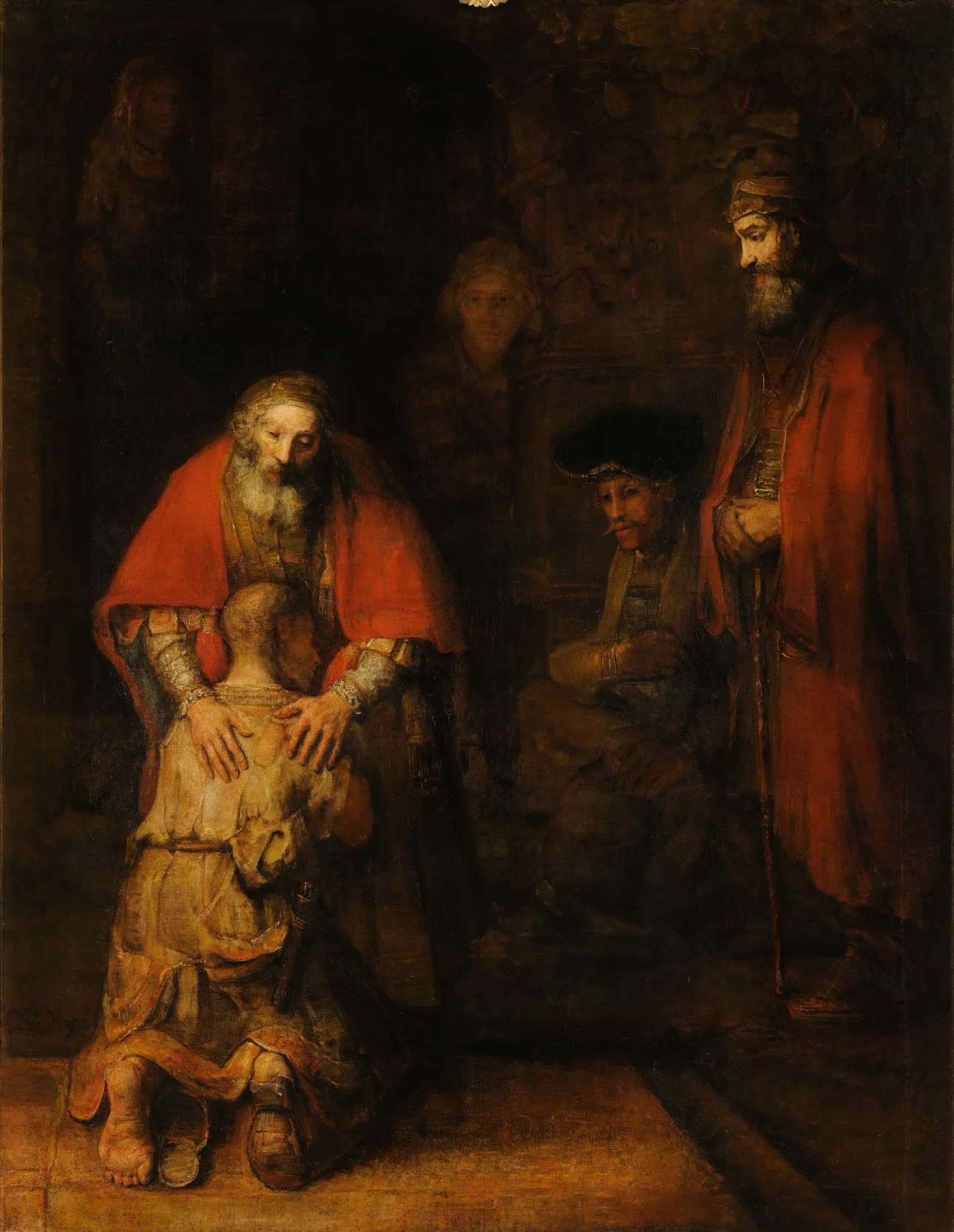
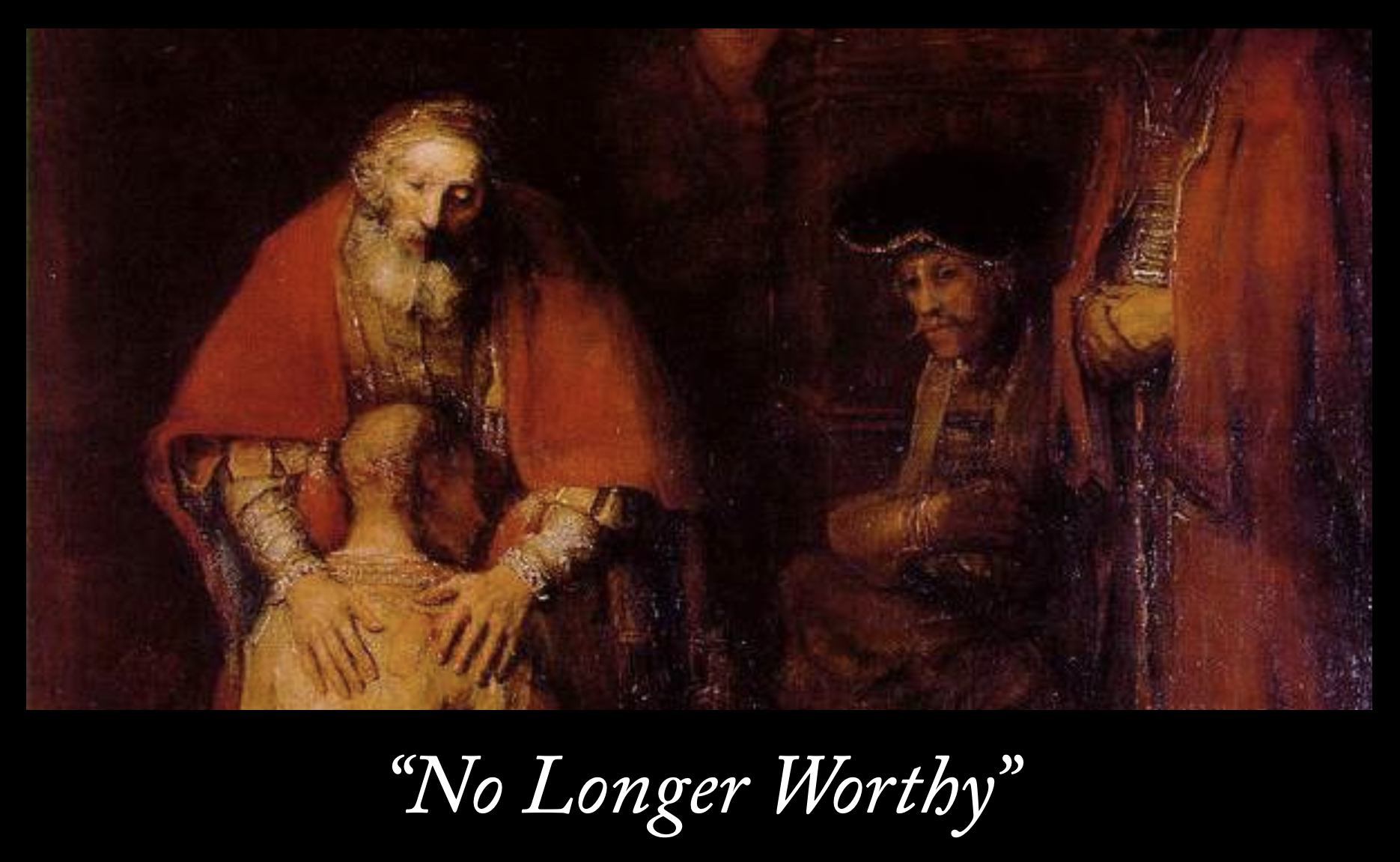
The image above is from Rembrandt’s 1669 masterpiece, “The Return of the Prodigal Son.” The elder brother stands on the right, literally and figuratively looking down on his younger brother.

The Elder Brother of Luke 15

I recently finished reading Will God Run?, a book of sermons on Luke 15 by Charles Hodge, and I’ve also taken another look (after reading it previously) at Timothy Keller’s The Prodigal God: Recovering the Heart of the Christian Faith, which also examines the Parable of the Prodigal Son.

When writing about or speaking on Luke 15, there is a tendency amongst many people to focus only on the Prodigal Son himself, while ignoring the Elder Brother. Doing this misses out on a key part of Jesus’ teaching, and one of the best characteristics of both of these books is that the authors focus extensively on the Elder Brother.

First, to some degree, both authors make the point that despite the fact that typical church-goers tend to view the Prodigal Son as the hero of the story, it’s actually the Elder Brother who they more likely resemble (throughout these quotations, emphasis is mine):

“…It is very hard to find one’s self in the elder son. Yet, the readers of this book are not prodigals; you readers are people at home. Your problem is not that of the far country but home. And really the lesson for brethren is not that of the prodigal but that of the elder son! The prodigal to us is the hero of this story and the elder son is the villain. Perhaps the man that we hiss as the villain is the very man we are and the very man we exemplify.”[1]

“Jesus’s teaching consistently attracted the irreligious while offending the Bible-believing, religious people of his day. However, in the main, our churches today do not have this effect. The kind of outsiders Jesus attracted are not attracted to contemporary churches, even our most avant-garde ones. We tend to draw conservative, buttoned-down, moralistic people. The licentious and liberated or the broken and marginal avoid church. That can only mean one thing. If the preaching of our ministers and the practice of our parishioners do not have the same effect on people that Jesus had, then we must not be declaring the same message that Jesus did. If our churches aren’t appealing to younger brothers, they must be more full of elder brothers that we’d like to think.”[2]

In the context of Jesus’ parable, both sons are lost, but Hodge writes that in the church, we tend to ignore that in the case of Elder Sons:

“If the elder son could not rule, he would ruin. He was a product of his time and thinking. Perhaps our preaching has been harder on lusts than lovelessness, harder on stealing than covetousness. It is easier to change actions than attitudes! Herein is another lesson to be gained concerning church officers. We put prodigals out of the church because of scandal, but we put elder sons in the church as officers because of their outward rule keeping!”[3]

The Elder Brother had no love for his brother, which also damages his relationship with his father:

“You cannot love a father while not loving a brother. You cannot love a father while hating his son. John said we cannot love God whom we have not seen when we dislike the brother that we do see…Our problem as sons is learning how to be brothers.”[4]

And perhaps the biggest danger of all is that the Elder Brother exemplifies a type of works righteousness. The New Testament teaches that while good works are a vital part of the Christian’s lifestyle, all of us are saved by grace. If we aren’t careful, we can fall into the trap of thinking that our good works obligate God to treat us a certain way, and this was the problem of the Elder Brother:

“Now the prodigal son did the wrong thing for the wrong reason while the elder did the right thing for the wrong reason. And that’s the difference. Right deeds for wrong reasons. Now the truth has come out. All these years this son has not been a son. He had been a slave. He offered his work but not himself. Yet, these sons who appear so basically different are, in reality, basically alike. They are alike because both wanted to have his own way. Now to have own way the prodigal thought that he had to go to the far country, and he did. He wanted to have his way in the way of the living as he pleased. But the elder son also wants to have his own way—at home in the church. He is religious profession. A man who takes pride in his own religious accomplishments.”[5]

“The elder son is a hireling; he thought he could obligate heaven. He thought God and the church owed him something. Perhaps this is one of the hardest lessons a preacher has to learn—that he is serving God and not the church. And since he cannot obligate God, then the church owes him nothing. What if a man gives his life to God? What if the church does not appreciate him? The church has sinned in not showing gratitude and appreciation, yes. But God and heaven owe no man anything!”[6]

“If, like the elder brother, you believe that God ought to bless you and help you because you have worked so hard to obey him and be a good person, then Jesus may be your helper, your example, even your inspiration, but he is not your Savior. You are serving as your own Savior.”[7]

These are some hard-hitting quotations, and for me, some of them strike a little too closely to home. There is room for both Prodigals and Elder Brothers in God’s family, but both of them must have restored and healthy relationships with the Father. The selfish and self-righteous attitudes of the Elder Brother can disrupt that relationship as easily as the selfish and wild behaviors of the Prodigal can.


[1] Charles B. Hodge, Jr., Will God Run? (Searcy, AR: Resource Publications, 2002), 74.

[2] Timothy Keller, The Prodigal God: Recovering the Heart of the Christian Faith (New York, NY: Dutton, 2008), 15-16.

[3] Hodge, Will God Run?, 78.

[4] Ibid., 80, 82.

[5] Ibid., 77.

[6] Ibid., 78.

[7] Keller, The Prodigal God, 38.

“No Longer Worthy”

Luke 15 is a favorite Bible chapter for many people because it contains one of the most famous parables of Jesus, The Prodigal Son.

It’s a parable that many are familiar with. It begins with a father who has two sons. The younger son demands his portion of the inheritance while his father is still alive and then takes the money he receives, moves to a distant country, and squanders all he has on riotous living. With all his money gone, he is forced to take a job working with pigs until he finally comes to his senses and decides to return to his father, realizing that even the servants in his father’s house enjoy better lives than he currently has. But when the son returns home, his father greets him with open arms and celebrates his return with a feast. The older son resents the warm reception that his younger brother receives, and is rebuked by his father:

“My son,” the father said, “you are always with me, and everything I have is yours. But we had to celebrate and be glad, because this brother of yours was dead and is alive again; he was lost and is found.”

It’s a wonderful parable, and there are multiple lessons that can be learned from it: the freedom that God gives us to leave Him or follow Him, His eagerness to welcome us back and forgive our sins, the perils of being the older brother, the false promises of the “far country”, and more.

But a while back while reading the parable, I was struck by something I had never thought about before. In Luke 15.21, when the Prodigal returns to his father, he launches into the speech he has prepared:

“Father, I have sinned against heaven and against you. I am no longer worthy to be called your son.”

The son describes himself as “no longer worthy.”

I have felt similarly before at times when I run from God, when I commit sin and then return to Him.

But it’s not the proper mindset to have. Not because the unworthiness aspect is inaccurate—certainly we are unworthy of being God’s children. No, the inaccuracy comes from the words “no longer”, which imply that at some point we were worthy of being God’s children, and that simply isn’t true.

The Prodigal Son wasn’t a son because he somehow earned or deserved that relationship, but because he was born into it, and his father chose to treat him as a son whether he deserved it or not.

Similarly, our relationship with God doesn’t depend on our worthiness; it depends on His love. We are not his children based on how much good we’ve done, but based on His willingness to have a relationship with us at all.

We feel guilty when we stumble, and we rightly feel that we don’t deserve a relationship with our Heavenly Father. But we must remember that we never deserved that relationship in the first place.

That’s the great thing about God—He loves us despite our unworthiness.

© 2026 The Doc File

Theme by Anders Noren — Up ↑