
The online journal of Luke Dockery

Category: Christian Living (Page 9 of 36)

About That Graphic Going Around…

There is an infographic that has been making the rounds on social media regarding the problem of kids leaving the church after they turn 18, and steps that can be taken to prevent this from happening.
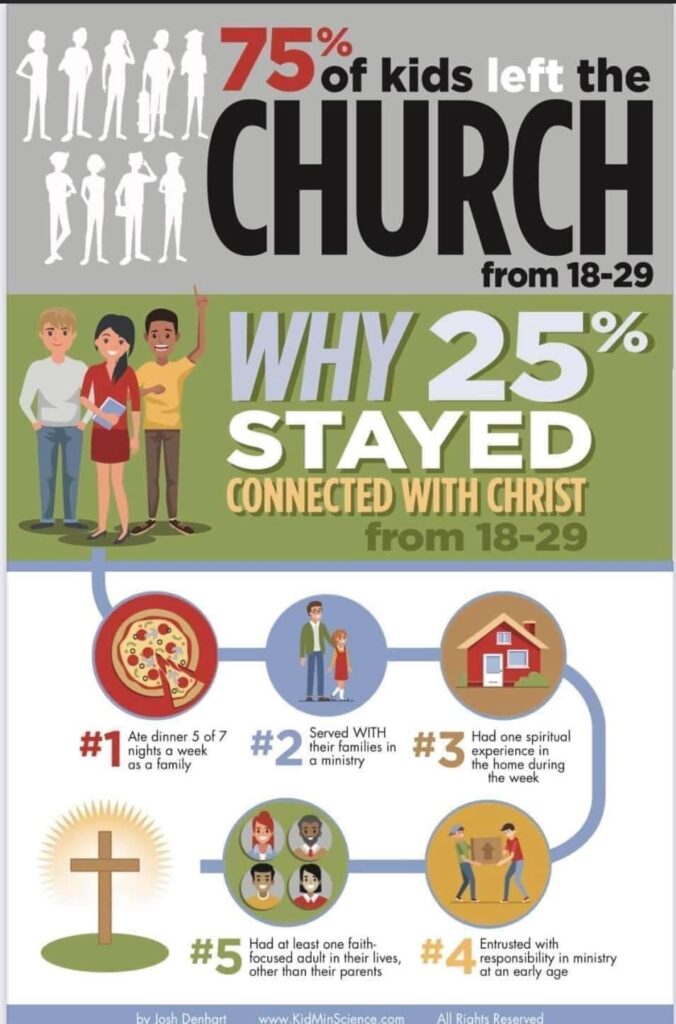
I have felt very conflicted when I have seen this shared over and over again, but have refrained from saying anything publicly about it until now. In short, I do have some significant concerns with this infographic the way it is presented, and because of that, it is not something I would share.

First, I want to acknowledge the good aspects of it. Young people leaving the church after high school is a major problem, and I appreciate that the creator of this is calling attention to that. I have written and spoken a lot about the same phenomenon—I literally wrote a book on it—so I am obviously aware of this problem and sympathetic toward the need to address it.

Furthermore, there is an abundance of research out there that would affirm that the five practices listed all correlate with long-term faith outcomes in adolescents to one degree or another (for example, Soul Searching by Smith and Denton, Sticky Faith by Powell and Clark, Growing Young by Powell, Mulder, and Griffin, and Hurt 2.0 by Clark, among others).

Having said that, I think there are some significant issues with the way this is presented that make it misleading.

First, there is no citation of anything. I would love to see verification of the 75% figure, which is significantly higher than, well, any of the valid studies I have seen. The 18-29 age range is also a red flag to me, as this comprises a wide range of development and, thus, it is unusual to see data for this group. What is possible is that this is based on survey results of young people who are tracked over time at various ages, but again, we just don’t know without any sort of citation. The only sort of citation given is a website address at the bottom of the graphic, but when you visit that site, you do not find verification of this, but rather a promotional site for using science in ministry and for selling a science-based VBS.

Second, “leaving the church” does not exactly equate with disconnecting from Christ, especially in the current cultural context. I will affirm the importance of belonging to a local church as loudly as anyone, but the church is not Christ; the church is the Bride of Christ. I do believe that involvement in the church is crucial to our connection with Christ, but we have to acknowledge in the present context that there are Christians who are not currently connected to a local church. That happens for a wide variety of reasons. In some places in the world where persecution is rampant, it is simply not possible to meet with other Christians. Some people became disconnected from church due to shutdown during COVID, and have struggled to reconnect (this is true of some who have been Christians for decades; how much more for those who are still young in their faith!). Some cling to a faith in Christ but struggle with church due to trauma from past experiences. Some have work situations that prevent involvement in the local church. Some are, well, lazy. The list goes on and on. None of these situations are ideal, and, again, we should always affirm the importance and centrality of the church in God’s plan for His people. Furthermore, it is right to mention connection to church as a measure of one’s spiritual vitality and connection to Christ. But, equating Christ and the church, as this graphic does, is theological error.

Finally, the five practices this graphic mentions are all helpful and supported by research that I have read. It is good for parents to do these things with their kids and for youth ministries to reinforce these same values and practices. But, this graphic gives the impression that these are steps to take on a guaranteed path to faithfulness. The reality is that there are no guarantees. Children are not robots to be programmed; they have their own minds and will make their own choices. I am aware of so many scenarios where children are raised in identical contexts (with all of the practices mentioned in the graphic above) who make very different choices and, thus, have very different faith outcomes.

That doesn’t mean we should ignore the things suggested by the graphic—they are still wise practices with some degree of research-based support and we would do well as parents and church leaders to follow them—but we should acknowledge that we are not in control of things. We desperately want to be in control, and it is comforting to think that if we just follow a certain formula, we are guaranteed that our children will have spiritual success. It’s not that easy, though. The reality is that, as parents and churches who are responsible for raising God’s kids, we do the best we can and seek to be faithful in passing faith on to our children while acknowledging that they are individuals created in God’s image who make their own choices. We bathe the process of parenting in prayer, asking God to help our kids be faithful, and to work through our own feeble efforts toward that end.

We bathe the process of parenting in prayer, asking God to help our kids be faithful, and to work through our own feeble efforts toward that end. Share on X


Seeking a Homeland

In the midst of a discussion of various heroes of faith, the Hebrew writer says:

These all died in faith, not having received the things promised, but having seen them and greeted them from afar, and having acknowledged that they were strangers and exiles on the earth. For people who speak thus make it clear that they are seeking a homeland. If they had been thinking of that land from which they had gone out, they would have had opportunity to return. But as it is, they desire a better country, that is, a heavenly one. Therefore God is not ashamed to be called their God, for he has prepared for them a city.

(Hebrews 11.13-16)

Above, these people of faith are described as “seeking a homeland.” This was true in a physical sense for Abraham and Sarah, who left their homeland to go to the place which God directed them, but in a deeper sense, it is true (or should be true) of all of God’s people.

The older I get, the more keenly aware I am that this world, which was created “good” but was broken and cursed by the plague of sin, is not a suitable homeland for me. I yearn for a better, kinder, more whole place. And this is a normal feeling (or at least, it should be): the New Testament in several places indicates that Christians are sojourners who are out of place in this world, and citizens of another (John 15.18-19, John 17.16, Philippians 3.20, 1 Peter 2.11). As Christians, we long for Jesus to return, mend the brokenness in His good creation, and bring about cosmic redemption.

Unfortunately, I think our modern world—with all of its distractions and comforts—frequently makes Christians forget that this isn’t, in fact, our homeland. We obsess over the things of this life and arrange our lives based on worldly priorities. Then, we aren’t content with those lives and, what’s more, we’re surprised that we aren’t content, missing the point that we’re not supposed to be content and at peace with a life that is so anchored to this world in its current, cursed state.

And the irony is, by being so focused on this world, we don’t actually benefit the world much at all. In Mere Christianity, C.S. Lewis said:

If you read history you will find that the Christians who did most for the present world were precisely those who thought most of the next. It is since Christians have largely ceased to think of the other world that they have become so ineffective in this.

We desperately need to recover our sense of being pilgrims in this world and longing for the next. It enables us to have contentment in our lives, and to better benefit those around us. Remember, we are people who are “seeking a homeland.”


In this loose series of Scripture Reflections, I am sharing brief thoughts spurred on by my Bible reading. By way of reminder, my goal for these brief posts is two-fold:

(1) To remark on aspects of the biblical text that I find to be of interest that the reader may or may not have thought about previously.

(2) When possible, to point ahead to the work and person of Jesus Christ. I believe the Bible is a unified story that points to Jesus, which means that He is frequently alluded to or foreshadowed in some way throughout the biblical canon.

Teaching Youth Ministry in College

It has been a dream of mine to teach at the college level for a long time, and this past semester, for the first time I had the privilege of teaching a youth ministry class at Harding University. It was a great experience! I have enough college professors in my life that I expected prepping a brand new course to be a lot of work and grading to not be much fun (both of these expectations were correct, by the way), but I was pleasantly surprised to enjoy teaching even more than I thought I would.


I learned a lot from my first semester as an adjunct college professor, but here were a few of the major takeaways:

College Students Are Awesome

My “first day of school” photo

I love teenagers. If I didn’t, I would be in a different line of work. I confess, though, that as a general rule, I tend to enjoy my students more as they get older, and I have lamented before that about the time my students get really interesting, they leave me and go on to college! I had about 35 students in class, most of them juniors and seniors, and they were such a joy to be around. As a group, they were talented, passionate, and engaged, but also vulnerable, open-minded, and desperate for Jesus. I really enjoyed getting to know them through class discussions and assignments.

College Students Are What the Research Says They Are

Over the last several years, I have read a ton of youth ministry-related research. I have taught on that research in churches and at lectureships and workshops, and have even written a book on it. That research touches on a lot of topics, including:

  • The high percentage of Christian teens who check out of the church and shelve their faith after high school
  • The fact that youth groups tend to isolate teens from the Body of Christ rather than integrating them into it
  • The way that teens largely feel abandoned and ignored by their youth groups and churches after high school
  • The sad reality that Christian families often neglect practicing faith in the home
  • The incongruence between what Christian teens believe and the historic beliefs of Christianity
  • The lengthening of the developmental stage of adolescence

My class of students served as a sort of focus group, and confirmed each of these findings. Since these findings are largely negative, this wasn’t exactly a happy discovery, but it is still helpful: problems have to be clearly identified before they can be fixed. Getting to see the spiritual development of students a few years down the road from my own youth ministry students and hearing about their hurts and struggles encourages me to do better (in very specific ways) with the kids in my youth group.[1]

College Students Are Hurting

At this point, it is fairly well established that Generation Z students (which would include college students and the students in my youth group) are physically safer than ever, but more at risk than ever in other ways as anxiety and depression are at unprecedented levels in teens and young adults. I witnessed this clearly with a lot of my students: they are concerned about so many things going on in the world, unbelievably stressed out, and entirely too busy. They are hurting. The root causes for all of this are beyond the scope of this post (although, you can check out two excellent books that address this problem from two different angles here and here), but being aware of this reality enables those of us who interact with this age cohort to offer support, encouragement, and love. It was a blessing for me to have the opportunity to do that with my students this past semester.

As you can perhaps discern from the points above, teaching was not all fun and games. We had some tough conversations last semester, and I was touched by many of the things students shared with me. The church has a lot of work to do in being better stewards of God’s children. It is my prayer to engage in that work in my efforts in youth ministry, and teaching at HU was a wonderful complement to that. I look forward to doing it again.

The church has a lot of work to do in being better stewards of God’s children. Share on X

Class photo with my youth ministry scholars before we took our final exam: a great group!


[1]As a side note, I should mention that, in many ways, I was teaching the cream of the crop, spiritually speaking: students who actually chose to attend a Christian university and stayed there long enough to be juniors or seniors. If these findings were true for them, you can only imagine the situation for those in less fortunate circumstances.

Churches as “Embassies of Heaven”

I am currently reading through Rediscover Church: Why the Body of Christ Is Essential by Collin Hansen and Jonathan Leeman; it is basically an examination of the church and why it is important, especially in light of nearly two years of COVID-related policies that have led many to largely check out on involvement with a local congregation. It has been a solid read so far, and I really liked the extended metaphor they used, saying that gathered churches are embassies of heaven (bolded emphasis below is mine):

An embassy is an officially sanctioned outpost of one nation inside the borders of another nation. It represents and speaks for that foreign nation. It represents its government. For instance, if you ever visit Washington, DC, you can walk down Embassy Row, where embassy after embassy from around the world is lined up. You’ll see the Japanese flag and embassy, then the United Kingdom’s, then Italy’s, then Finland’s. Each embassy represents a nation of the world and its government. Were you to enter one of these embassies, you would hear the language of the nation it represents. Among its staff, you would experience its culture. If you attended an embassy dinner, you’d taste its delicacies. And if you sneaked into the back offices—we assume—you’d learn about its diplomatic business.

What’s a gathered church? It’s an embassy of heaven. Step inside your church or ours, and what should you find? A whole different nation—sojourners, exiles, citizens of Christ’s kingdom. Inside such churches, you’ll hear the King of heaven’s words declared. You’ll hear heaven’s language of faith, hope, and love. You’lll get a taste of the end-time heavenly banquet through the Lord’s Supper. And you’ll be charged with its diplomatic business as you’re called to bring the gospel to your nation and every other nation.

(Hansen & Leeman, Rediscover Church, 54)

I like this metaphor, as it emphasizes the way that, as Christians, we are in the world but not of it. We are fully present but remain distinct. This is a different picture than C.S. Lewis’s metaphor of Christianity as an Invasion into enemy-occupied territory; both metaphors point to different aspects of biblical teaching.

Saltless Christians

In Matthew 5.13, early in the Sermon on the Mount, Jesus says,

“You are the salt of the earth, but if salt has lost its taste, how shall its saltiness be restored? It is no longer good for anything except to be thrown out and trampled under people’s feet.”

This is obviously a well-known passage, but what struck me about it this time is just how absurd the metaphor Jesus uses is and how harsh the implication of that metaphor is.

First, the absurdity: can you imagine sitting down at a restaurant with a plate of bland food and reaching for the salt only to discover that the salt had lost its flavor and was itself completely tasteless? Of course not: salt is inherently salty; it can’t be anything else. In the same way, it is absurd for someone to claim to be a Christian, and yet not “taste” anything like Christ. A saltless Christian should be an oxymoron.

And the harshness: did you catch what Jesus said about salt that had lost its taste? He said it was worthless and ought to be thrown out. So while it is absurd to have someone who claims to be a Christian but fails to exhibit the character of Christ, if that absurdity actually happens (and it does, all the time), then those “Christians” are worthless—“no longer good for anything.” Ouch.

It is very tempting for me to soften the words I just typed, but I’m not going to, because Jesus certainly didn’t soften them in the Sermon on the Mount. These words, which come right at the beginning of that sermon, are serious and weighty, and they provide sobering reminders for those of us who claim to be disciples of Jesus: (a) it is absurd for us to call ourselves Christians and then fail to resemble Him in our lives, and (b) if we do that, we are “no longer good for anything.”

According to Jesus, it is absurd for us to call ourselves Christians and then fail to resemble Him in our lives, and if we do that, we are “no longer good for anything” (Matthew 5.13). Share on X

In this loose series of Scripture Reflections, I am sharing brief thoughts spurred on by my Bible reading this year. By way of reminder, my goal for these brief posts is two-fold:

(1) To remark on aspects of the biblical text that I find to be of interest that the reader may or may not have thought about previously.

(2) When possible, to point ahead to the work and person of Jesus Christ. I believe the Bible is a unified story that points to Jesus, which means that He is frequently alluded to or foreshadowed in some way throughout the biblical canon.

« Older posts Newer posts »

© 2026 The Doc File

Theme by Anders Noren — Up ↑