
As discussed in the introductory post of this series, Jesus’s Beatitudes in the Sermon on the Mount are basically a description of what a good life really looks like from God’s perspective. Jesus redefines what blessedness is, and provides an alternative set of values for His followers, those who desire to be a part of His alternative community.
Blessed Are the Poor in Spirit
“Blessed are the poor in spirit, for theirs is the kingdom of heaven.”
(Matthew 5.3)
This first beatitude is a good example of something we discussed in the previous post, the “over-spiritualizing” of Jesus’s statements. In this instance, some people try to interpret “poor in spirit” to be a spiritual condition having nothing to do with literal poverty.[1] But, in his version of the Beatitudes, Luke simply refers to “the poor” (see chart), and there is no reason to assume that Matthew is talking about something completely different.
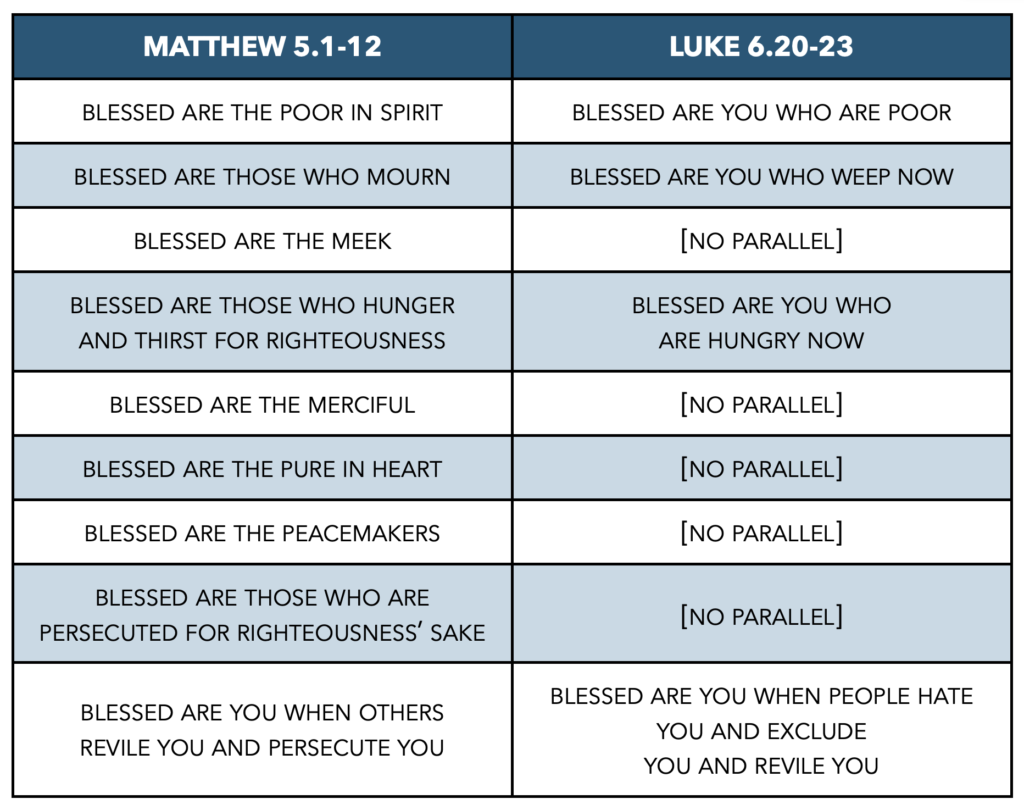
Instead, I think what is going on here is that Matthew focuses on the spiritual or psychological condition of those who are physically poor: being “poor in spirit” is the internal frame of mind of those who suffer from oppression and economic hardship.[2] The Hebrew Bible discusses the same idea in numerous places (Psalm 9.18, 34.6, 37.14, 69.29; Isaiah 57.15, 61.1, 66.2), and the equivalent term in Hebrew conveys the idea of a lack of status and social rights in addition to financial poverty.[3]
Jesus lived (and Matthew wrote) at a time when Judea was a backwater province of Rome, and approximately 97% of the population of the Roman Empire suffered from literal poverty, relegated to varying degrees of hunger and poor health.[4] The vast majority of people had little money, low status, and limited rights. Also, while the New Testament does mention some followers of Jesus who were wealthy, the early church overwhelmingly consisted of the poor and socially outcast.
As a Christian living in the United States of America, I have to acknowledge that this is a very different context from what I am familiar with. In the United States (the location of most of the readers of this blog), for the most part, Christians are a pretty middle-class crowd, and to be honest, don’t we like it that way? Speaking for myself, I will readily admit that I am in no hurry to be financially destitute, oppressed in some way, or a social outcast.
Still, just because we are financially better off than the original audience for Jesus’s teaching here doesn’t mean that we cannot relate to the idea of “poor in spirit.” All of us have, at one time or another, felt like we were the lowest of the low, completely beaten down by the circumstances of life, and that feeling of helplessness and powerlessness is closely tied to the idea of being poor in spirit.
And here is the shocking claim: Jesus says that people who feel like this are blessed!
Roman society viewed the wealthy elite who lived in ease and had all the power as the ones who live the blessed life, and our culture aligns itself closely with Roman values in this regard. American culture places great value on wealth, prosperity, and power, and even in the church and the individual lives of Christians, wealth can at times be pursued as an unqualified good, and power as something that should be sought after rather than laid aside.
But Jesus challenges this pursuit and presents a very counter-cultural idea: God’s favor extends to all people, including the poor in spirit, those that are beaten down and cast aside by society at large. And more than that, these people are specifically blessed: since they have no earthly resources, they know they can’t rely on themselves, and can therefore more easily put their trust in God and depend entirely upon Him.[5]
Jesus challenges the pursuit of wealth and power and presents the counter-cultural idea that God’s favor extends to all people, including those that are beaten down and cast aside by society at large. Share on XThe kingdom of heaven belongs to people like this. They are right at home in Jesus’s alternative community, the different sort of world that He invites us to imagine and be a part of.
 If you enjoyed this post, you might enjoy my book on the Sermon on the Mount, Counter Culture: A Study of the Sermon on the Mount.
Although this book was written specifically as an aid to teaching the Sermon on the Mount to junior high and high school students, it is also useful for personal Bible study, and the depth of the material makes it a great resource for adult Bible classes.
[1] See, for example, Francis Wright Beare, The Gospel According to Matthew: A Commentary (Oxford: Basil Blackwell, 1981), 128; Rubel Shelly, The Beatitudes: Jesus’ Formula for Happiness (Nashville, TN, 20th Century Christian, 1982), 12.
[2] Larry Chouinard, Matthew, The College Press NIV Commentary (Joplin, MO, College Press, 1997), 95.
[3] Chouinard, 95-96; Jack P. Lewis, The Gospel According to Matthew, Part I, The Living Word Commentary (Austin, TX: Sweet Publishing, 1976), 80. Though our own society is different in many ways from the cultures of the biblical narratives, it remains very similar at least in this regard: the financially poor also tend to be disadvantaged socially, politically, medically, educationally, and in other ways as well.
[4] Warren Carter, “Power and Identities: The Contexts of Matthew’s Sermon on the Mount,“ in Preaching the Sermon on the Mount: The World It Imagines, ed. David Fleer and Dave Bland (St. Louis: Chalice Press, 2007), 14-15.
[5] Chouinard, 95; William Barclay, The Gospel of Matthew Volume 1, The Daily Study Bible (Philadelphia, Westminster Press, 1956), 85-86.
 In this loose series of







