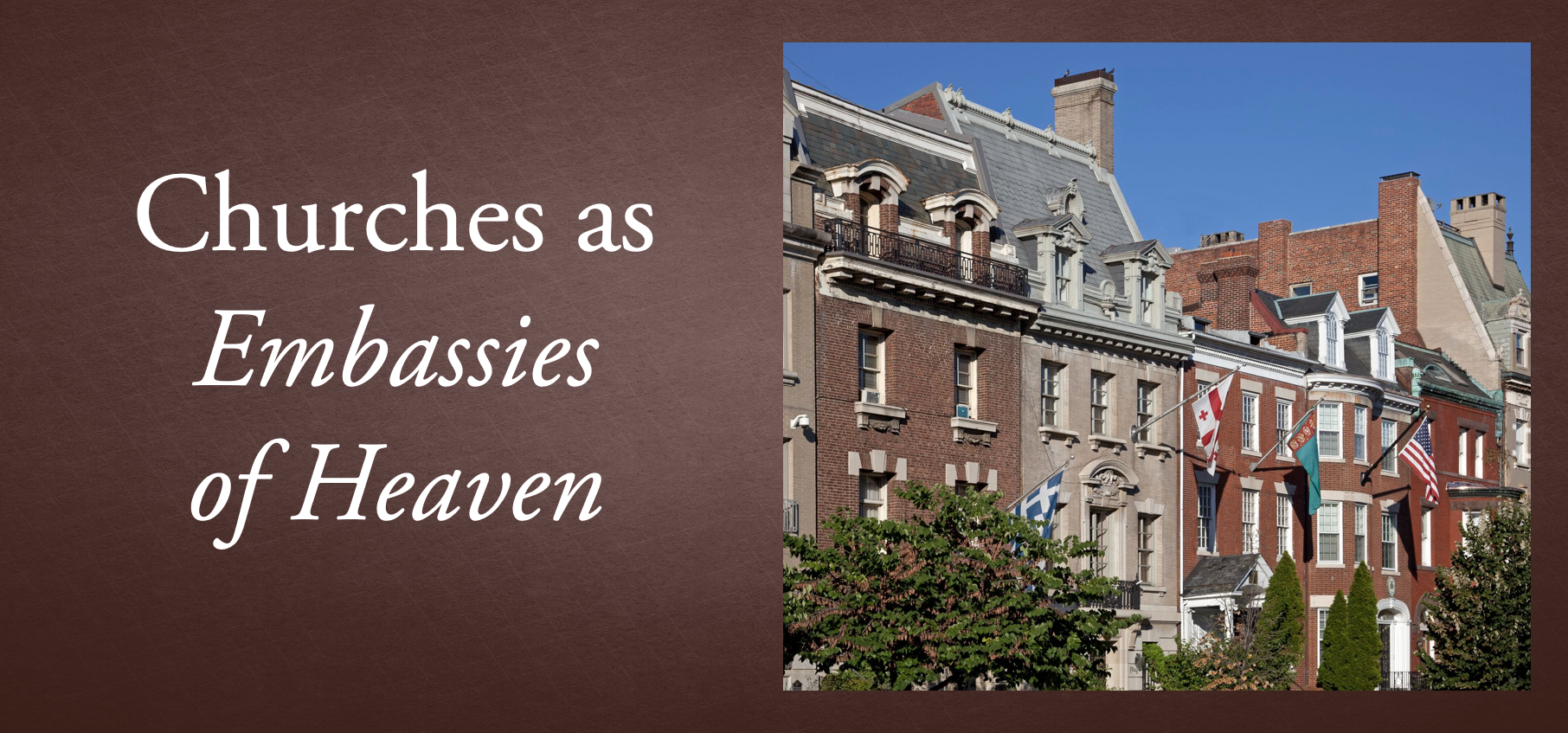
I am currently reading through Rediscover Church: Why the Body of Christ Is Essential by Collin Hansen and Jonathan Leeman; it is basically an examination of the church and why it is important, especially in light of nearly two years of COVID-related policies that have led many to largely check out on involvement with a local congregation. It has been a solid read so far, and I really liked the extended metaphor they used, saying that gathered churches are embassies of heaven (bolded emphasis below is mine):
An embassy is an officially sanctioned outpost of one nation inside the borders of another nation. It represents and speaks for that foreign nation. It represents its government. For instance, if you ever visit Washington, DC, you can walk down Embassy Row, where embassy after embassy from around the world is lined up. You’ll see the Japanese flag and embassy, then the United Kingdom’s, then Italy’s, then Finland’s. Each embassy represents a nation of the world and its government. Were you to enter one of these embassies, you would hear the language of the nation it represents. Among its staff, you would experience its culture. If you attended an embassy dinner, you’d taste its delicacies. And if you sneaked into the back offices—we assume—you’d learn about its diplomatic business.
What’s a gathered church? It’s an embassy of heaven. Step inside your church or ours, and what should you find? A whole different nation—sojourners, exiles, citizens of Christ’s kingdom. Inside such churches, you’ll hear the King of heaven’s words declared. You’ll hear heaven’s language of faith, hope, and love. You’lll get a taste of the end-time heavenly banquet through the Lord’s Supper. And you’ll be charged with its diplomatic business as you’re called to bring the gospel to your nation and every other nation.
(Hansen & Leeman, Rediscover Church, 54)
I like this metaphor, as it emphasizes the way that, as Christians, we are in the world but not of it. We are fully present but remain distinct. This is a different picture than C.S. Lewis’s metaphor of Christianity as an Invasion into enemy-occupied territory; both metaphors point to different aspects of biblical teaching.








Interesting metaphor. Just as there are embassies I would hesitate to enter out of personal bias, many unbelievers refuse to enter our buildings because of negative experiences with our members. It is imperative that we treat everyone as Christ treats us! We must show love and compassion for those whose lifestyle offends us. I am thinking specifically of my oldest son. He refuses to attend church because he has seen how we treat those who struggle with sins we find particularly repulsive. He has many friends living alternative lifestyles and unfortunately Christians ( myself included)have pushed him toward loyalty to them rather than loyalty to Christ. As Christ’s ambassadors, we need to have open conversations about our inconsistent reactions to sin. Again, when I say “our” I mean “my own”. You have given me a great deal to think about.
Alison,
Thank you for the comment; yes, absolutely!
I didn’t want to have a monstrously-long quotation in the original post, but on the next page from where I quoted, the book goes on to say:
“Sadly, our churches won’t always declare and embody heaven well. We’ll disappoint you and say insensitive things. We’ll even sin against you. Our assemblies are merely signs and foreshadowing of that future heavenly assembly, just as the little wafers we receive in the Lord’s Supper are signs of a heavenly banquet. They aren’t the things themselves. Yet we aspire to point you to the heart of heaven, who is Christ himself. He never sins or disappoints.”
Ultimately, there are many in the world who will reject the message of Jesus no matter how well we represent Him (after all, Jesus Himself was rejected and crucified), but we never want that rejection to come because we represent Him poorly. And, as you stated, that can occur when we are inconsistent on sin: emphasizing certain sins greatly while we wink at others.
Here is a post I wrote on that a few years ago: https://lukedockery.com/2014/10/02/myths-about-homosexuality-america-and-the-kingdom-of-god
Another reason we need the church is that it is the body of Christ, and only when we gather collectively, can we hear, view and experience the image of Christ before us. Collectively we become that which we seek after most.
Keith,
Amen!
I lament that the church gets so much “bad press”, and sometimes we certainly bring it upon ourselves. Nevertheless, connection to the body of Christ is essential, for so many reasons. Thanks for your comment.