The online journal of Luke Dockery

Category: Christianity (Page 55 of 64)

Marriage is Humanity’s “Restoration to Wholeness”

Dr. Dwight Small on marriage:

“When a man and a woman unite in marriage, humanity experiences a restoration to wholeness. The glory of the man is the acknowledgment that woman was created from him; the glory of the woman is the acknowledgment that man is incomplete without her. The humility of the woman is the acknowledgement that she was made for man; the humility of the man is the acknowledgement that he is incomplete without her.

Both share an equal dignity, honor, and worth. Yes, and each shares a humility before the other, also, Each is necessarily the completion of the other; each is necessarily dependent upon the other.”

Daring and Determination: Essential Characteristics of Christianity

As any regular readers of The Doc File know, I am a huge fan of Jackie Robinson. In addition to being a world-class athlete, Hall of Fame baseball player, and, behind Martin Luther King Jr., the most influential player in the American Civil Rights Movement, he was also a man of great personal character.

I recently came across the photo at the top of the page of Jackie on the base paths. It’s a picture I love because I think it so well captures two of Jackie’s characteristics which were integral to his success and are also necessary in the daily life of the Christian: daring and determination.

Daring

Integrating Major League Baseball left Robinson open to constant torment and abuse. Racist fans heckled and berated him constantly, opposing managers would threaten not to play the Dodgers if Jackie was in the lineup, and baserunners from other teams would try to spike him with their cleats. None of that was a surprise—Dodgers GM Branch Rickey had warned Robinson in detail of the kind of abuse he would face if decided to take part in the “Great Experiment” and become the player to break the color barrier in Major League Baseball—but Jackie Robinson was willing to take the risk.

In addition to his daring in integrating the big leagues in the first place, Robinson was also daring in the way he played he game. Bringing the style of the Negro Leagues to Major League Baseball, Robinson was a terror on the basepaths, stealing bases, distracting pitchers, and stealing signs.

Christians need to be daring as well. To a large degree, I believe a Christian’s influence in the world is nullified when she or he refuses to be daring. Doing things that make you feel uncomfortable like sharing your faith with a friend or co-worker or taking an unpopular moral stand when others refuse to requires daring. Being willing to attempt great things that you’re not sure you are capable of doing like adopting a child or teaching a Bible class also requires daring. Attempting to fulfill the mission given to us by Christ of seeking and saving the lost requires a great deal of daring!

Author John Augustus Shedd once famously said, “A ship in harbor is safe, but that is not what ships are built for.” It is a great quotation! Too often, I think that Christians look at the church as a safe harbor, and because they like the safety, they fail to venture outside of its (figurative) walls. Certainly the church is a safe place, but it should be a place where Christians are equipped to engage, change, and save the world, not where they can hide from it.

It’s not “safe” out in the world, but it is where our light is most needed. Christians must be daring!

Determination

In the picture above, the look in Jackie’s eyes oozes focus and determination. On the basepaths, he was completely locked in to his psychological and physical battle with the pitcher, and was determined to defeat him.

It’s interesting—baseball really wasn’t Robinson’s best sport. In college at UCLA, Jackie lettered in four different sports. In track and field, he won the national championship in the broad jump in 1940. In football, he led the nation in punt return average in 1939 and 1940 and led UCLA in rushing, passing, total offense, scoring, and punt returns in 1940. In basketball, Robinson led the Southern Division of the Pacific Coast Conference in scoring in both 1940 and 1941. Baseball was his fourth best sport! 

Later on, after spending some time in the military during WWII, Robinson honed his baseball skills playing in the Negro Leagues, but here’s the point I’m getting at: I’m really not sure that Jackie Robinson should’ve been a Hall of Fame caliber baseball player, but he was just so determined to succeed! Robinson knew that he carried the weight of the hopes of Black America on his shoulders, and he was determined that he would not let them down. So his determination led to great success.

Christians also need to be people of determination. You can’t accidentally live a faithful Christian life—it requires the determination on a daily basis to live a life of discipleship regardless of cost or consequence.

That’s counter-intuitive for us today (especially the part about cost or consequence) because we live in a consumer culture where different products are constantly vying for our attention and loyalty—if you’re not losing enough weight on your diet, quit it and try a new one. If you don’t like your cell phone plan, drop it and switch over to a competitor. If going to church doesn’t seem to be improving the quality of your life, cut it out and try something else…when taken to the extreme, we become people devoid of commitment or determination, and, quite simply, people who give up too easily.

It is not easy to be a Christian, but Jesus never promised that it would be. Faithful discipleship requires determination!

Jackie Robinson’s ability to change the world certainly involved his natural talents and abilities, but equally if not more important were his character traits of daring and determination. If Christians, as citizens of the Kingdom of God are going to engage the world and change it for good, then we have to possess those same characteristics in abundance.

Role Players in the Body of Christ

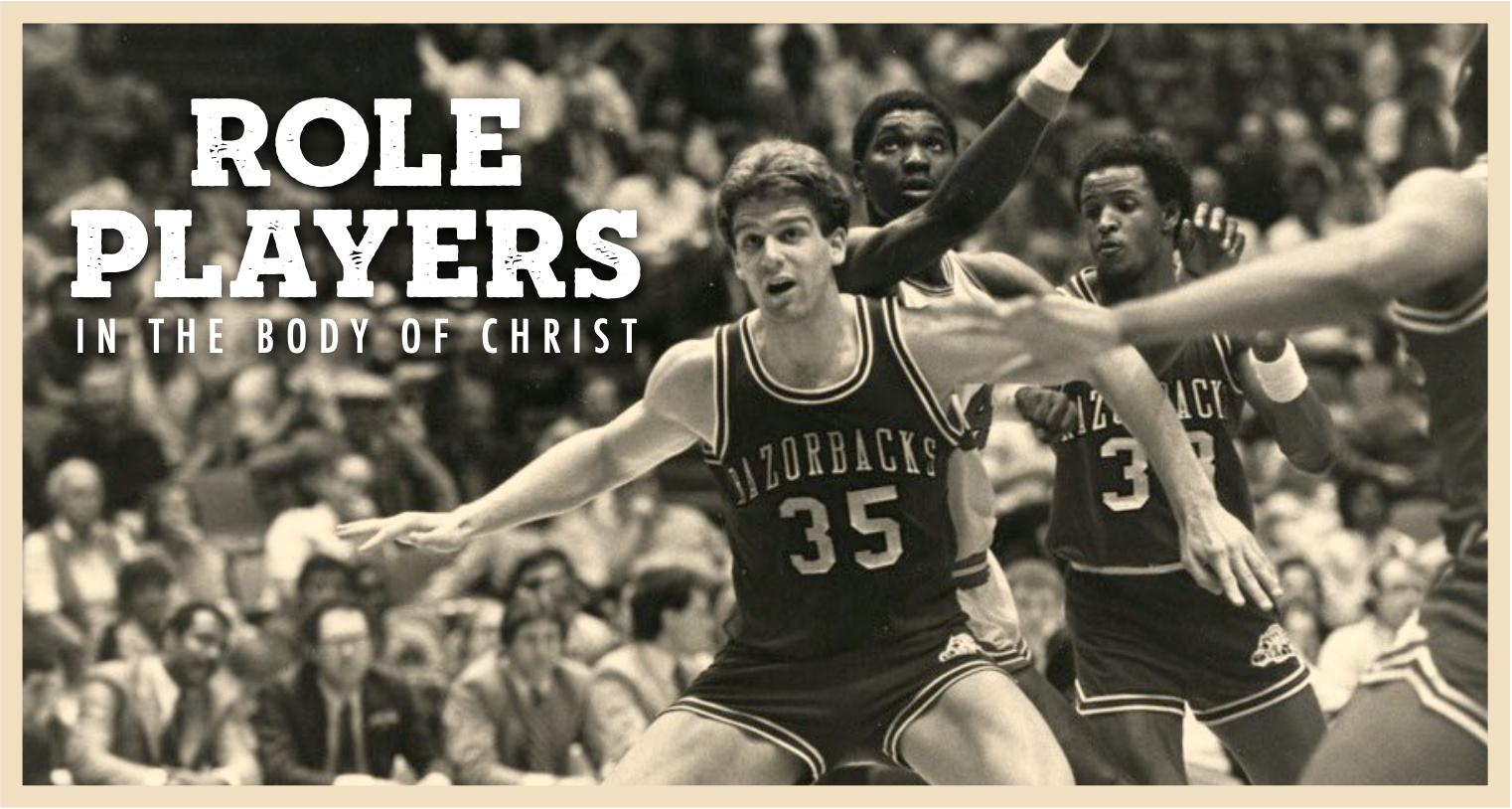
Joe Kleine was one of the best basketball players in Arkansas Razorback history. An All-Conference Selection in 1984 and 1985, and Kleine also played on the 1984 Gold Medal U.S. Olympic team. In a game against the 2nd-ranked Houston Cougars in 1984, Kleine led the Razorbacks to victory, snapping Houston’s 31-game conference winning streak and outscoring future Hall of Famer Hakeem Olajuwon 22-10. During his career at Arkansas, Kleine averaged 18 points per game—more than Michael Jordan averaged during his career at the University of North Carolina.

But, after completing his collegiate career and joining the NBA in 1985, Kleine went from being a stand-out all-star to an average, backup, role player. In the late 80s and early 90s, Kleine played for the Boston Celtics. While he was there, he was overshadowed by a number of very famous and very good players—Larry Bird, Kevin McHale, Reggie Lewis, and Robert Parrish. Parrish in particular overshadowed Kleine, because Parrish played the exact position that Kleine did—center. Robert Parrish is considered by basketball experts to be one of the greatest centers who has ever played the game, so Joe Kleine got to be Parrish’s backup.

It’s not easy being a backup, a second-teamer. Backups are called things like “substitutes” and “bench-warmers” and “role players”. Backups don’t get to play on the Dream Team; they don’t get to play in All-Star games. Their basketball cards aren’t worth very much, and they don’t get to make many commercials. It would seem that being a backup isn’t a very important job.

Nothing could be further from the truth, however. Consider the following description of Joe Kleine from an article by a Celtic sportswriter a few years back:

“He is what he is. And he knows exactly what that is—the backup center on an NBA team. Every NBA team would love to have Kleine be what he is, which, in addition to being a competent NBA center, includes being a first-rate person.”

The article goes on to quote one of Kleine’s former coaches:

“When we had him here, Joe was our lug. Now, he’s your lug. But you know what? He’s a good lug, I wish we still had him.”

Why is Joe Kleine, a second-string backup center, the kind of player that every coach wants on his team? Why is he the kind of player that coaches don’t want to give up? Because he is willing to accept the role he is given, and do his best performing in that role, even if it is not exciting or glamorous. 

Paul talked about role players in 1 Corinthians 12.14-18:

“Now the body is not made up of one part but of many. If the foot should say, ‘Because I am not a hand, I do not belong to the body,’ it would not for that reason cease to be a part of the body. And if the ear should say, ‘Because I am not an eye, I do not belong to the body,’ it would not for that reason cease to be a part of the body. If the whole body were an eye, where would the sense of hearing be? If the whole body were an ear, where would the sense of smell be? But in fact, God has arranged the parts in the body, every one of them, just as He wanted them to be.”

We don’t each fill the same role, but Paul goes on to tell us that we each have a role to fill. Moreover, he tells us that God bestows an extra measure of honor upon those who fill roles that seem unglamorous:

“The eye cannot say to the hand, ‘I don’t need you!’ And the head cannot say to the feet, ‘I don’t need you!’ On the contrary, those parts of the body that seem to be weaker are indispensable, and the parts that we think of as less honorable we treat with special honor. And the parts that are unpresentable are treated with special modesty, while our presentable parts need no special treatment. But God has combined the members of the body and has given greater honor to the parts that lacked it, so that there should be no division in the body, but that its parts should have equal concern for each other.”

Just as role players are an integral part of any NBA team, they are also indispensable within the church. Unfortunately, this is often a difficult lesson for Christians to learn. Even some of Jesus’ apostles struggled with this concept—in Mark 10, James and John asked to sit at the right and left hand of Jesus so that they could receive special recognition. This request was made because they did not understand the role that God had given them. In Mark 10.43-45, Jesus explained to them that “whoever wishes to become great among you shall be your servant, and whoever wishes to be first among you shall be slave of all. For even the Son of Man did not come to be served, but to serve, and to give His life as a ransom for many.”

Are you willing to be a role player in the Body of Christ? Because that’s the kind of player that God is looking for on His team.

Friday Summary Report, February 15

It’s been a while since I’ve done one of these, but I have read some good articles lately that I would like to share with you:

(1) This article, “Top 10 Reasons our Kids Leave Church”, has been talked about a lot over the last few days, but it is an important one. The author makes some outstanding observations. One of his important points is about the church always trying to be “relevant” (notice the quotation marks). The church should always be relevant because the Gospel is relevant, but we have to be careful of trying to be trendy, (which is what churches often try to be instead). Being relevant is crucial; being trendy is lame.

(2) This post is now a month old, but is hilarious: it stereotypes youth ministers based on the type of facial hair they sport (or don’t).

(3) Here is an excellent post and video for parents on how to teach priorities to your children using a family calendar. Don’t be alarmed by the attention-grabbing title of the post—this is an excellent and practical idea for Christian families. Listen to the video all the way through, as some of the best stuff is his discussion on priorities leading to identity and the realization that sometimes living according to our values will come with consequences.

(4) This post I wrote on Hashtag Media has gotten some attention. If you haven’t yet gone to check out the good work these guys are doing, please do so.

Controlling the Flames of our Tongues

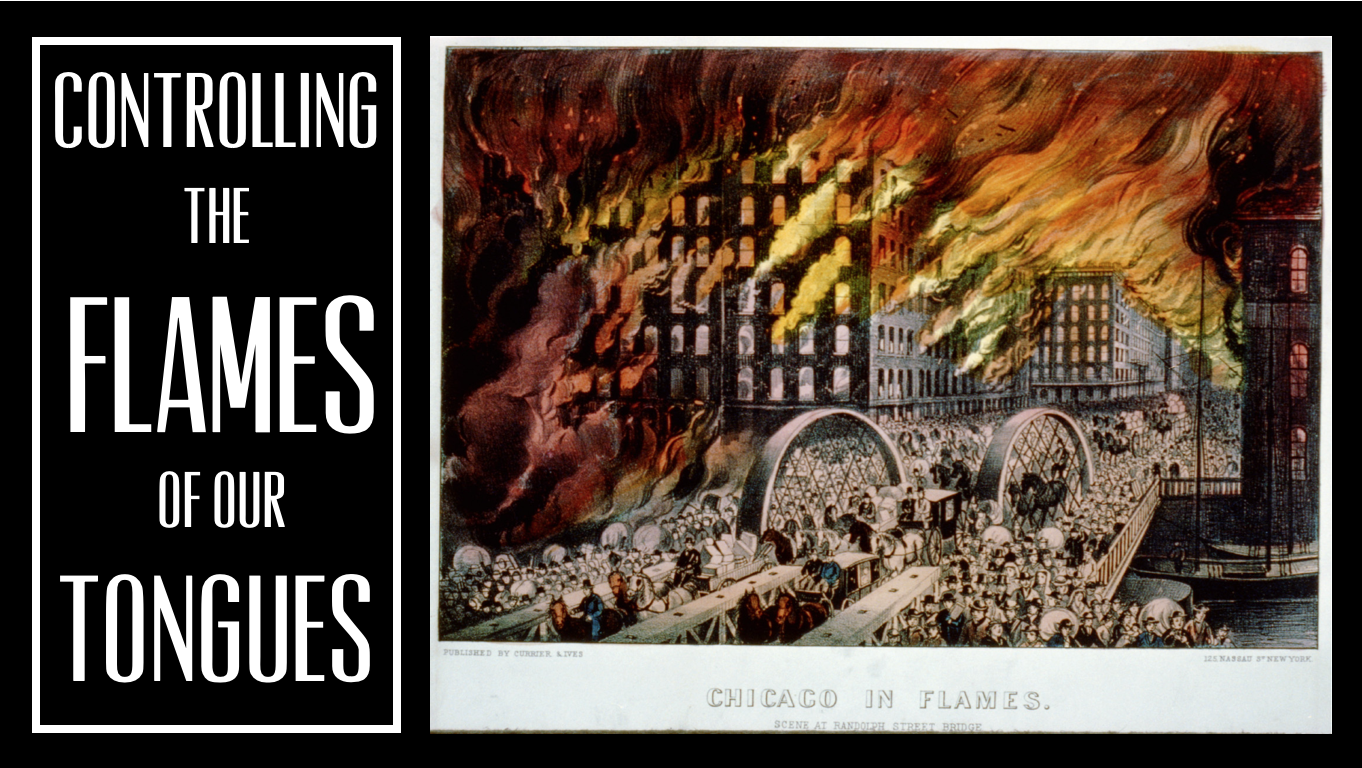
On Sunday, October 8, 1871, a fire broke out in Chicago, Illinois. It started in a small shed (no one really knows how) and quickly spread throughout the city. The heavy use of wood for construction at that time, a drought that had occurred prior to the fire, strong winds from the southwest that carried burning rubble toward the heart of the city, and poor reaction by city officials and citizens all combined to create a devastating inferno. The fire burned for two days, but even when it was over, the smoldering remains were still too hot for a survey of the damage to be completed for days.

Eventually, the vast destruction from the fire was determined:

  • An area four miles long by three-quarters of a mile wide, or more than 2,000 acres
  • More than 73 miles of roads and 120 miles of sidewalks
  • 17,500 buildings
  • $222,000,000 in property, which was about 1/3 of the city’s total value
  • Of 300,000 inhabitants, 90,000—30% of the city’s population—were left homeless
  • 200-300 people were killed

What began as such a small flame was transformed into a catastrophe.

In James 3.5-10, James compares the human tongue to a raging fire:

“Likewise the tongue is a small part of the body, but it makes great boasts. Consider what a great forest is set on fire by a small spark. The tongue also is a fire, a world of evil among the parts of the body. It corrupts the whole person, sets the whole course of his life on fire, and is itself set on fire by hell. All kinds of animals, birds, reptiles and creatures of the sea are being tamed and have been tamed by man, but no man can tame the tongue. It is a restless evil, full of deadly poison. With the tongue we praise our Lord and Father, and with it we curse men, who have been made in God’s likeness. Out of the same mouth come praise and cursing. My brothers, this should not be.” 

James compares the tongue to fire because just like fire, if our tongues are out of control, they can cause a great deal of damage. Gossiping, talking behind people’s backs, saying hurtful things, putting others down, spreading falsehood…all of these actions of the tongue can cause far-reaching damage. When we’re careless with our words, we can destroy a friendship or a reputation.

A lot of times when we talk about moral problems, especially with teens, we tend to focus on the “big” issues: things like drinking, drugs, sex, etc. Those issues need to be talked about, but the harm we do with what we say is a much more common problem—I hear people using their fiery tongues all the time (even in church!) with little regard for the collateral damage they could be causing.

Read James 3.9-10 again:

“With the tongue we praise our Lord and Father, and with it we curse men, who have been made in God’s likeness. Out of the same mouth come praise and cursing. My brothers, this should not be.” 

Our speech can be a problem or it can be pleasing to God. What’s it going to be for you? Your tongue can be as dangerous and destructive as a fire. Use it carefully.

« Older posts Newer posts »

© 2026 The Doc File

Theme by Anders Noren — Up ↑