
The online journal of Luke Dockery

Category: Ministry (Page 12 of 17)

Big Lessons from the First Day of School

Today is the first day of school for a lot of people. As a youth minister, I’m very aware of this because my students were (generally) bummed about it yesterday at church. As a grad student, I’m also very aware of it because today I have taken the plunge and started the process of learning Hebrew. And if I wasn’t already aware that today was Back to School Day, I would’ve figured it out quickly once I checked Facebook this morning, as my newsfeed was blowing up with everyone’s pictures of their kids dressed up and ready for the First Day of School.

So for a lot of folks, today is a big day, and it got me thinking about some important lessons that the First Day of School reminds us of:

(1) We need to be prayerful on behalf of our students. As a youth minister, this is something that I’m very aware of, but it is hard to overemphasize how difficult it is to be a young person today and to cling to Christian values, and how much our young people need our prayers and support.

I am not trying to make a political statement or start a debate on the issue of prayer in schools or anything like that; I am simply making the observation that our society is an increasingly dark place, and this darkness is absolutely manifested in our schools. Teens (and even those who aren’t yet teens) are exposed to all sorts of things that are contrary to a Christian worldview, and resisting those things can be difficult.

But there’s good news as well: a shining light makes the biggest difference in a dark place! Pray not only that our students resist the darkness, but that they shine their lights and point others to Jesus Christ.

(2) We should be thankful for educators. On the whole, I think teachers tend to get a bad rap. Certainly, some teachers are not as good, or as caring, or as dedicated as they could be, but on the whole, teachers are people who care about young people and want to do what they can to help them (come to think of it, that entire last sentence could probably be applied to youth ministers as well!).

And really, they have pretty tough jobs: they have to do a lot of work to stay current in their field, they have to deal with children with significant behavior problems (and the parents who produced them!), they get to work long hours before and after school grading papers, working on lesson plans, and going to school activities, and often they spend significant portions of their (not always great) salaries to buy additional resources for their classrooms and students.

Be thankful for educators! Encourage them, tell them you appreciate their efforts, and try to be cooperative when they need something from you (helping your child with homework, getting a paper signed, coming to a parent/teacher conference, etc.).

(3) We should realize how quickly our lives pass by. My first day of Kindergarten was 25 years ago, a quarter of a century. But seriously, I can remember it like it was just yesterday! A repeated theme I saw on Facebook today was parents who couldn’t quite believe that their kids had gotten so old so fast!

I mentioned this a couple of weeks ago, but it really is amazing how quickly time flies. The Bible says that our life is like a mist, something that is here for a short time and then vanishes. And as I see pictures on my news feed of college students who I think should still be in high school, high school students who should still be in grade school, and kindergarteners who should still be in diapers, it really hits home.

Our lives will be gone before we know it; we must make the most of the time we have!

(4) We need to never stop being students. I’m not talking about formal education here, but rather that we need to always have the attitude of being learners—we should never think of ourselves as knowing all there is to know on a given subject and always be willing to learn more.

This is one of my favorite things about the preaching minister that I work with. He is in his 50s and has decades of experience in ministry, but he is always looking to learn new things so he can stay current. He reads constantly and is always interested in examining things that I come across in my studies. What a great example that is!

I know so much more about life, ministry, and theology than I did two, five, and ten years ago. But I am by no means I finished product, and I hope and expect to know a lot more in two, five, and ten years down the road than I do now.

One of these days, if the Lord wills, I will finish my grad school education. But that won’t mark the end of my learning, as I plan to continue doing that until the end of my life.

What do you think? Agree or disagree? Did you think of an important Back to School Lesson that I left out?

How to Have a Great VBS

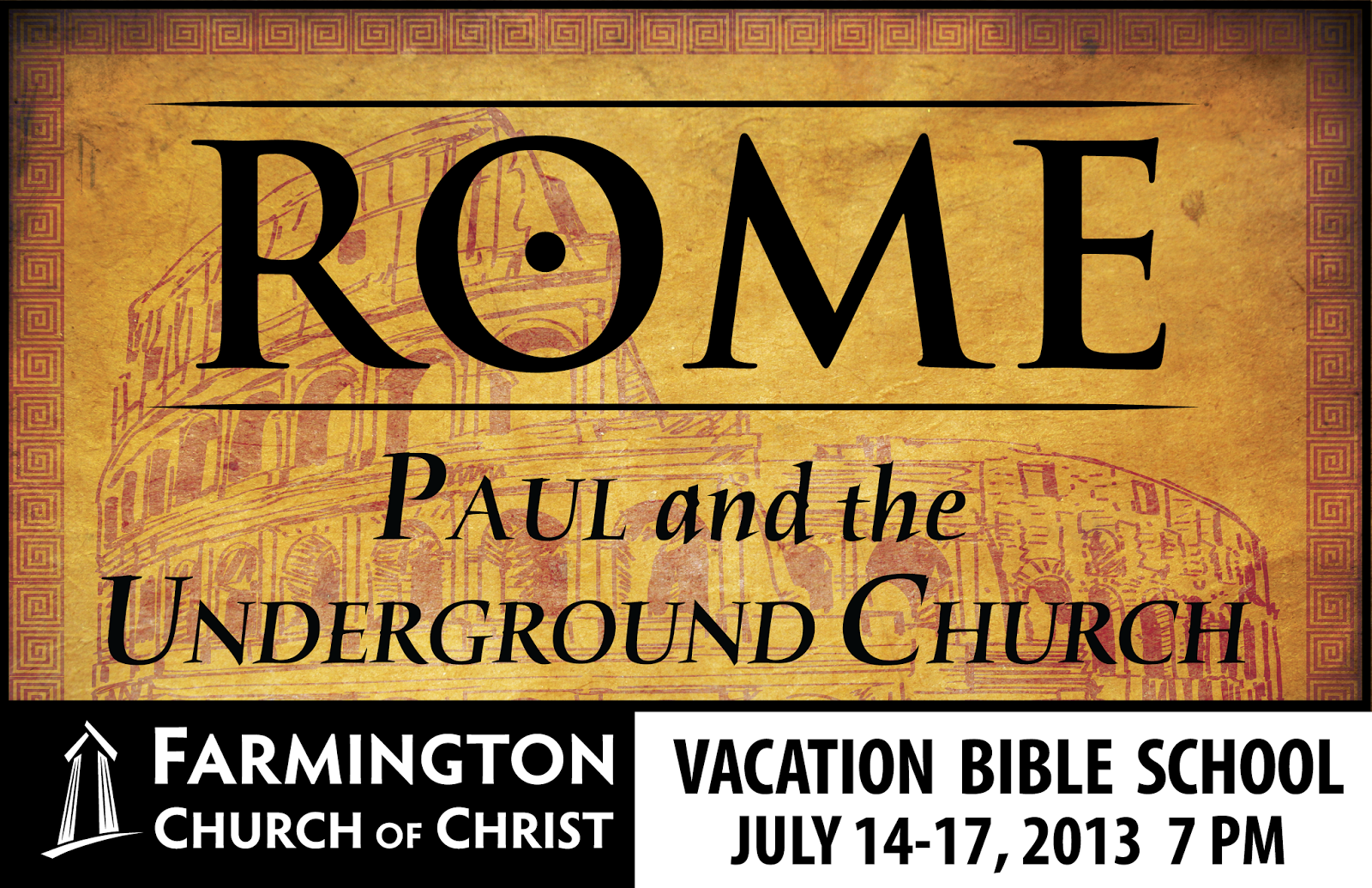
This past Wednesday, we wrapped up our 2013 Vacation Bible School at Farmington. If I have done my math correctly, this was my ninth consecutive year to help direct VBS, and although it is a lot of work, it is a lot of fun as well.

I think some people have the idea that VBS is a hopelessly outdated program from a bygone era. I do think that some congregations have a VBS like this, but I don’t think it has to be this way. VBS is one of the highlights of the year for our congregation, and while what we do is by no means perfect, I thought I would share some of the things that have made it successful.

What Does “Successful” Mean?

Before you have a VBS (or any program really), it’s important that you have specific goals, or at the very least, a general idea of what it is that you are shooting for. If you don’t have any idea of what a successful VBS will look like for your congregation, then it’s impossible to know if you’ve had one or not when you are finished.

For us, Vacation Bible School provides a lot of benefits, and I generally consider our VBS to be a success if these things happen:

(1) Kids have fun. Vacation Bible School is supposed to be fun. If kids from the community come and are then bored out of their minds, then all your hard work has been for naught (at least with that particular child).

(2) The church gets excited. The summer months can be somewhat of an energy drain on a congregation. A lot of people travel, so attendance and giving sags. Sometimes it seems that you go for weeks and weeks without seeing people that you care about and are used to seeing on a weekly basis. For us, VBS is an antidote to the summer slump, as every year it provides an energy boost to our congregation. A lot of people pool their talents and abilities for a common purpose, and then get to experience the satisfaction of watching their plans and efforts come to fruition. This is an important thing.

(3) Our reputation in the community is enhanced. Vacation Bible School provides a great opportunity for your congregation to increase its visibility and reputation in the community. If you get visitors from the community to come and then put on a quality Bible school, children and their parents will leave with a good impression of your church.

(4) A lot of people come. Numbers aren’t the most important thing (which is why I listed this one last), but they are important. After all, what does it matter if you have the most amazing VBS in the world if no one is there to see it? Attendance of visitors is especially important, as the church should always be trying to reach out to bring more people in. This year we were blessed with the largest attendance we have had in my time year (Also, related to the second point, if a lot of people come it definitely adds to the excitement factor of your congregation).

Tips for a Successful VBS

Now that you know how I define a successful VBS, here are some tips for bringing it about:

(1) Recruit a lot of talented helpers to do what they are good at. If you do it right, VBS takes a lot of work. So, you can either have a few people try to do everything, or you can recruit a lot of people who can focus on specific tasks. I have tried it both ways, and believe me, the second way is preferable. When you do it the second way, you end up having a better product, fewer burned-out people, and more church involvement. For example, this year we had:

  • A coach in charge of our outdoor games and activities
  • Someone who had studied theater in college working with our skits
  • Teens with years of experience doing Puppet Theater at Lads to Leaders doing the puppet shows
  • A talented song-leader directing our time in the auditorium
  • People with strong organizational skills doing registration and refreshments
  • Some very talented ladies doing decorations and crafts

All of these people used specific skills they possessed to enhance our VBS. And as a result, I got to do less work!

(2) Provide something for the adults to do. Kids may be the primary focus of VBS, but that doesn’t mean you should ignore your adults. Some parents will drop off their kids and leave, but others live far enough away that they would rather stay if there was a reason for them to. And what about adult members of the congregation who aren’t helping to run things? Shouldn’t they get to be around the fun as well? We have had good classes for adults in the past, but this year we focused on it more, bringing in one speaker for all four nights to present a topic that was different from what people generally get to hear (biblical archaeology). The class was excellent, our adult numbers swelled, and I heard from members and guests alike how much they enjoyed the class and how it strengthened their faith.

(3) Get teens involved on the service side. Several years ago we made the decision that, rather than having the teens come and sit through a Bible class, we would get them involved in serving during VBS, and I think it was one of the best decisions we could have made. Our teens spend hours at the building the week before VBS moving furniture, decorating, and cleaning. During VBS itself, they are the primary characters and teachers in the story rooms, they do puppets, they help lead the kids around from place to place, and they help run games outside. Not only do our teens really enjoy these roles, it also provides opportunities for them to interact with all generations of the congregation: they get to work alongside those who are older than they are, and teach and lead those who are younger (this is hugely important!).

(4) Provide a variety of activities for the kids. Our hi-tech digital society does not cultivate long attention spans in children. Just the opposite. So if your VBS schedule calls for children to sit in class for 90 minutes listening to a teacher, then it will probably be hard for the teachers and rough on the kids. I absolutely believe that biblical instruction is important, and that is at the center of what we do. But the lessons are taught through skits in decorated rooms and then reinforced in craft time and puppet skits. Kids also get to play games outside, sing, have refreshments, and buy trinkets in the VBS store with coins they have earned by bringing guests and answering questions in class.

(5) Choose good material. Not all VBS material is created equally. Some of it looks really nice; some of it looks as if it was made in 1975. Some of it looks like it was made for children; some of it seems like it was made by someone who had never even seen children before. We have found some VBS curriculum that we like, but even it isn’t good every year. This year we actually re-used (good) curriculum from 2009 rather than use the new (not-as-good) stuff. Personally, I am a fan of VBS themes that try to transport the kids to Bible time and places (this year our theme was “Rome: Paul and the Underground Church”) rather than those odd topical themes that don’t make sense and seem incredibly lame to me (things like “VBS Pirates: Searching for Buried Treasure in God’s Word” or “Tropical VBS: Learning Lessons from God’s Word in an Island Paradise”).

(6) Advertise. Honestly, I didn’t do a great job advertising this year; if I had, we might’ve had even more people. There are a lot of ways to advertise. You can send out flyers to area congregations. If your VBS is early in the summer, you can see about sending home flyers at local elementary schools. You can hang attractive banners outside of your church building for those who drive by. For us, the best method of advertising is contacting those parents from our community whom we already know through Thursday Bible School. If you have a similar program at your congregation, these are exactly the sort of people who would be interested in participating in your VBS.

(7) Follow up with the guests who come. We have, admittedly, been weak on this in the past, but are trying to do better this year. If you have registration information on all of the children who came, then you should have contact information for those whose parents are not members. Send a card thanking them for their attendance. Send a letter or brochure telling them more about your church family and the programs you have available.

(8) Plan for next year. Soon, we will have a follow-up meeting to reflect on things that worked well, and things that we could improve for next year. It’s important that we do this now, while this year’s VBS is still fresh on our minds. No matter how successful things were this year, there’s always something that could be done better or more people who could be involved.

Vacation Bible School can be a powerful ministry for your congregation if only you put the necessary time, planning, and effort into it. The ideas I have suggested above might not be the only “right” way to do VBS, but it certainly works for us!

Book Review: Why They Left


For quite some time I’ve wanted to read, “Why They Left: Listening to Those Who Have Left Churches of Christ,” by Flavil R. Yeakley Jr. This week I finally got around to doing so, and am glad that I did—it’s a great book.

The title is pretty self-explanatory, but basically, Dr. Yeakley (a long-time preacher, university professor, and statistician) conducted 325 surveys of people who had left the fellowship of Churches of Christ and then categorized and responded to the reasons they had for doing so.

The insights gleaned from those who left are helpful, but equally useful (if not more so) in the book are Yeakley’s brief but thoughtful responses to some of the issues which those who have left brought up. The book is an easy read, and I was surprised at how good of a writer Yeakley was (I don’t know why I was surprised; I guess I assumed that a statistician would produce a boring book, but it was an excellent read overall).

Here are some of my favorite quotations from the book (with random thoughts by me in brackets):

“When the average parents in the congregations attend regularly and have specific church work assignments, their children are much more likely to remain in Churches of Christ after they grow up and leave home. The retention rate in those churches was around 75 to 80 percent. In congregations where the average family has one parent who is an active and involved member but the other is not, the retention rate was around 50 percent. In churches where the typical family was one in which neither parent was active and involved, the retention rate was around 20 to 25 percent.” (40) [The youth ministers reading this are amen-ing out loud and trying to figure out the best way of sharing this quotation with all of their parents.]

“…We should recognize that campus ministries are partners in Christian higher education. We should support the few campus ministries that Churches of Christ already operate, and we should establish many more.” (44)

“The conclusion based on these positive and negative references to judging [in the New Testament] seems obvious to me. Christians should judge to distinguish between truth and error, right and wrong, or good and evil. It is acceptable for Christians to judge to settle disputes between or among brethren. Christians must judge the conduct of other Christians who sin and refuse to repent in spite of repeated admonitions. Christians must judge doctrines and practices. But we are not supposed to judge the heart, the motives or the eternal destiny of another person. We must leave it to God to pronounce the final judgment.” (62-63). [This is excellent. Yeakley’s discussion of NT passages on judging and his synthesis of them is almost an aside to the book, but the book would be worth reading just for this.]

“Grace must never be used as an excuse for failing to correct known errors in our lives or in our understanding of God’s will.” (63) [I love this. It is almost worthy of a t-shirt or a bumper sticker.]

“Churches of Christ reject…‘Once saved always saved’…but a doctrine of ‘If saved, barely saved’ is just as wrong.” (70)

“My personal observation is that in far too many Churches of Christ, the elders are doing deacons’ work; the deacons have very little to do; and the church-supported ministers do most of the pastoral work. If strategic planning is done at all, it is done by ministers.” (141) [I think this is an accurate statement. I am thankful that the leaders of my congregation are working hard to get away from this mindset.]

“Christ did not accept us on the basis of our perfect understanding or our perfect obedience. He accepted us because of our acceptance of Him.” (201)

“The more friends new members make in the church the less likely they are to leave the church…the sooner new converts get involved in some area of ministry the more likely they are to stay in the church.” (208)

If you are a member of a church of Christ and are concerned about the future of Churches of Christ and are interested in doing what you can to help minister to the people in our churches, I highly recommend this book.

“You Did Well That It Was In Your Heart”

After the death of King Saul, there is a struggle between David and Saul’s son, Ish-bosheth, for the throne of Israel. With God’s support, David eventually wins out, things settle down, and everything seems to be okay.

But David isn’t happy. He isn’t happy because he realizes that while he lives in a nice, comfortable house made of cedar, the Ark of God is kept in a tent!

This doesn’t seem right to David, so he determines that he wants to build a temple for the Ark to be housed in. That sounds like a good idea, but God rejects his offer in 1 Chronicles 22.8-10:

“But the word of the Lord came to me, saying, ‘You have shed much blood and have waged great wars; you shall not build a house to My name, because you have shed so much blood on the earth before Me. Behold a son will be born to you, who shall be a man of rest; and I will give him rest from all his enemies on every side; for his name shall be Solomon, and I will give peace and quiet to Israel in his days. He shall build a house for My name, and he shall be My son and I will be his father; and I will establish the throne of his kingdom over Israel forever.’”

Later, Solomon talks about his father’s desire to build a temple for God in 1 Kings 8.17-19:

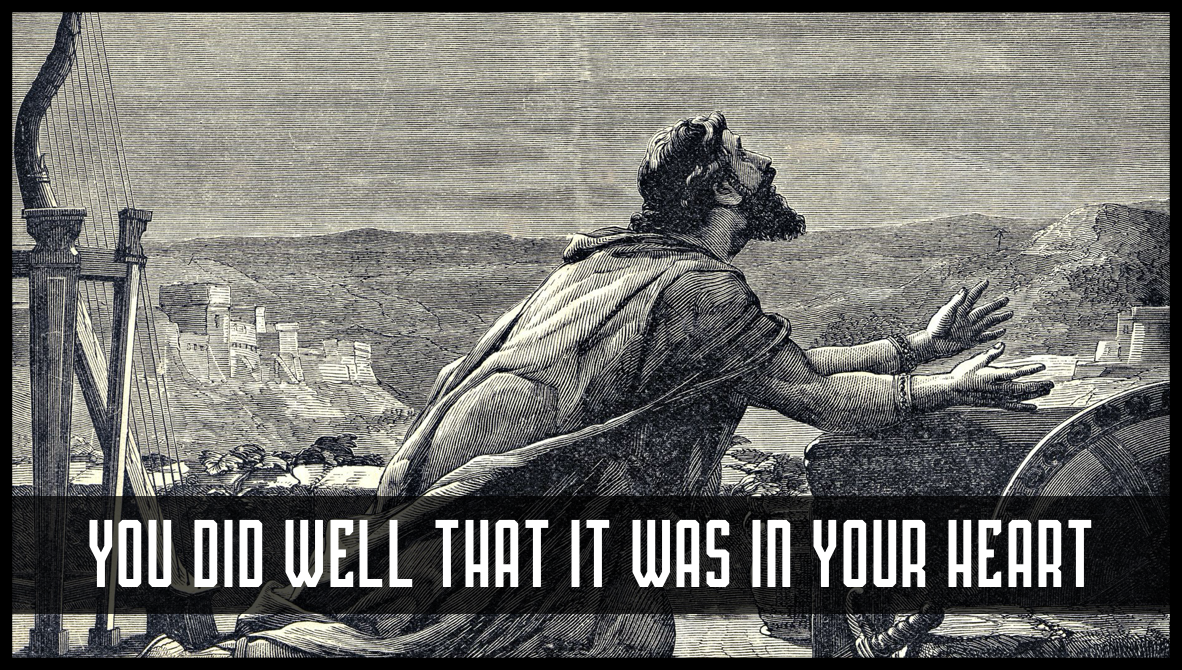
“Now it was in the heart of my father David to build a house for the name of the Lord, the God of Israel. But the Lord said to my father David, ‘Because it was in your heart to build a house for My name, you did well that it was in your heart. Nevertheless you shall not build the house, but your son who will be born to you, he will build the house for My name.’”

Did you catch that? God tells David, “You did well that it was in your heart.”

Even though David wasn’t going to be able to accomplish his goal of building the temple, God still appreciated and honored David’s intentions. Because he had been a man of war, David was told that he would not be the one to build a temple for the Lord—but God still appreciated that David had the desire to do so.

“It’s the thought that counts” is a common saying that we tend to throw around when we receive a gift we don’t like. It’s somewhat of an ironic saying since often the reason we receive bad gifts is specifically because very little thought was put into it, but I think it’s still a true statement, and it’s basically what God tells David in this story: “It’s the thought that counts.”

By extension, this passage means that God cares about our intentions as well. And to me, as a Christian and as a minister, that is incredibly encouraging—while our actions certainly matter, the thoughts behind our actions matter as well. We can’t always control how things turn out, but we can control our intentions.

When we try to do something big for God, as David did, and we fail and our plans don’t pan out, I’m thankful to know that we have a God who says, “You did well that it was in your heart!”

I don’t know what your exact situation is…

  • Maybe you try to help a friend with a problem like substance abuse or financial or marital difficulties, but your assistance is refused…God looks at your “failure” and says, “You did well that it was in your heart!”
  • Maybe you try to influence others for good and try to be salt and light in the world, but your influence is ignored and they continue to embrace darkness…You did well that it was in your heart!
  • Maybe you’re a youth minister and you’ve got that teen who you’ve poured yourself into— teaching, going to athletic events, modeling the Christian life, praying for them and lying awake at night worrying about them—but they choose to follow the world…You did well that it was in your heart!
  • Maybe you try to share your faith with someone, perhaps a family member or close friend, but it simply falls on deaf ears…You did well that it was in your heart!

Realize that you are going to fail in life. Your results won’t always match up with your intentions and your plans. But our God is someone who sees our hearts and appreciates our best efforts. With that in mind, let us attempt great things for Him!

Destroying the Works of Satan

A couple of weeks ago I had the opportunity to speak at a youth rally and my topic was the purpose of the church. I talked about how the church is God’s vehicle for saving the world today (through the preaching of the gospel), for influencing the world and trying to make it a better place (through service), and equipping Christians for those first two tasks (through education and discipleship).

And those are all pretty standard ideas—we hear about those things a lot when we talk about what the church should do. But the church has another important purpose that is often neglected in such discussions: the mission of the church is to oppose and destroy the works of Satan.

In 1 John 3.8, John said that Jesus came to earth so that “He might destroy the works of the devil.” In Ephesians 6.12, Paul says that our struggle as Christians is not against flesh and blood, but against the forces of darkness.

These verses make it clear that as the church, we are a part of a spiritual battle against Satan and his influence. Moral corruption and sin are the works of the Devil (and we focus on things like that a lot),  but so are things like disease, starvation, poverty, terrorism, and racism.

When you look at all the sad and messed up stuff that happens in our world—do you think God likes that stuff? Of course not! Children starving to death in the developing world, or innocent people being killed because of racial wars, or bombs going off at marathon finish lines—those are works of Satan, and when we take part in efforts to fight against those things, we are fulfilling the purpose of the church in opposing and destroying the works of the Devil.

To me, realizing that when we fight against evil, we’re part of a cosmic struggle and are fighting against Satan himself gives us a whole new level of motivation for doing it. The decisions we make each and every day are important because we have the opportunity to stand up against evil.

A cosmic struggle against evil: think about that the next time one of your friends tells a racist joke—are you going to sit there and laugh at the works of Satan, or realizing that God loves all people regardless of race and that racism comes from Satan, are you going to speak up and put a stop to it?

Or the next time you have an opportunity to give to people, maybe people living on the other side of the world who have less than you do—are you going to be willing to use what you have to fight against the works of Satan like poverty and starvation, or are you going to hold onto those things so you can continue to pursue the idolatry of the “American dream”?

Studies show that a whole bunch of teens leave the church after high school, and I think a big reason for that is because it just doesn’t seem like the work of the church is all that important. After all, if we narrow down what church is to only a couple hours of activity a week, of course its importance is going to be diminished. But when we realize the cosmic nature of the struggle we are involved in—saving the world, serving the world, training Christians to do those things, and opposing the works of Satan—we see that the church is absolutely a cause worth giving our lives to.

« Older posts Newer posts »

© 2026 The Doc File

Theme by Anders Noren — Up ↑