The online journal of Luke Dockery

Category: Quotations (Page 11 of 17)

Different Types of Maps: Read (and Preach, and Teach) the Whole Bible

In 2 Timothy 3.16-17, Paul writes:

“All Scripture is breathed out by God and profitable for teaching, for reproof, for correction, and for training in righteousness, that the man of God may be complete, equipped for every good work.”

Based on Paul’s words here, I think it should be obvious that we should give attention to all of Scripture, rather than just study the parts that we like over and over again. Some people focus on Paul’s writings; others spend a lot of time in the Gospels. Some folks obsess over the accounts of the early church in Acts, while others never stray far from the wisdom literature or the historical books of the Old Testament.

And it’s okay to have favorites, but if we emphasize our favorites to the point that we neglect the other portions of Scripture, then we aren’t taking Paul’s words from 2 Timothy 3.16-17 very seriously.

In Reading the Gospels Wisely: A Narrative and Theological Introduction, Jonathan T. Pennington puts it very well:

“…For Jefferson County, Kentucky, where I live, we could look at a topographical map that shows terrain and elevations or a road map; at a map that records annual rainfall or one that indicates historical landmarks and points of scenic interest; or we could consult a survey that shows where property lines begin and end. These are all different maps, and they would look very different if set beside one another. But of course they don’t contradict one another. They are complementary and beneficial. They are different discourses of truth—or different ways of approaching and presenting knowledge.

If this is true for maps of Jefferson County, Kentucky, how much more for theology and Holy Scripture. We need to think of the Bible not as a single map that just gives us doctrinal statements or moral commands, but we must realize that the Bible is like an atlas—a collection of maps/books that shows us the way, the truth, and the life but in a variety of languages or discourses or ways of communicating. To privilege—or worse, to rely exclusively on—only one form is detrimental to apprehending truth; a topographical map helps little when we’re seeking the best restaurants.”

What a great analogy this is! The Bible is true, but it presents truth in a variety of ways. In Matthew, truth might be presented through a parable. In 1 Kings or Acts, it might be presented in historical narrative. In Psalms, truth is presented through poetry, and in Proverbs through pithy sayings. In books like Romans, Paul often presents truth in direct theological or doctrinal statements, and in Revelation, John presents truth through bizarre and sometimes frightening visions.

All of these different “maps” are a vital part of the entire “atlas” of the Bible. Some are more useful for certain purposes than others, but all contain truth and none should be neglected.

I think all people of faith would do well to be more well-rounded in our Bible study.

Football Teams and Church Commitment

More good stuff from Mark DeVries’ Family-Based Youth Ministry, Rev. Ed., pp. 148-49 (emphasis added):

“I have often wondered what would happen if football coaches approached their work like most youth ministers are expected to. For example, I wonder what would happen if, when a player was too busy to show up for practice, the understanding coach simply said, “We’ll miss you. I hope you’ll be able to make it next week sometime. ” Imagine the players leaving practice and hearing the smiling coach say, “Thanks for coming. I hope you’ll come back tomorrow.”

If a football team operated like a typical youth ministry, we might expect concerned parents to call the coach, saying, “Can you tell me what’s been going on in practice? My son says it’s boring, and he doesn’t want to come anymore. I was wondering, could you make it a little more fun for them? And by the way, you might want to talk to the coach at the school across town. He seems to have the right idea.” The coach might send out quarterly questionnaires about what the players would like to change about the team. (I can just imagine the answers: “shorter practices,” “more winning”).

Responding like a typical youth minister, this coach might first feel guilty that the practices were not meeting the boy’s needs, and he would try to adjust his program to suit this boy (and every other boy who complained). Between trying to keep everybody happy and giving every student a good experience, the coach would squeeze in a little football practice. And what kind of season would this coach have? It’s a safe bet that the coach wouldn’t be the only one who felt like a loser.

But this is the very way that most churches expect to run their youth ministries. To expect that youth be committed to the church with the same level of commitment that would be expected of them on an athletic team would draw the charge of legalism and insensitivity. Our culture has been so carried away by the current of religious individualism that the expectation of commitment to the church has become implausible to most Christians in our culture. Because the god of individualism pressures us to program to the lowest common denominator, we seldom raise the expectations high enough for teenagers to experience real community.

Real community means real responsibility for each other. It means a commitment to be there for each other even when the schedule is tight and the motivation is low. But the typical Christian adult in our culture knows little about commitment to community.”

How true this is! I would love to be able to count on the same sort of commitment that a football coach expects. An unfortunate by-product of the extreme individualization of Christianity is a de-emphasis on the importance of Christian community, specifically in the context of the local church body.

The Christian life was never meant to be lived in isolation.

Historical World Cultures + Christianity

A good quotation on the interaction of Christianity with the dominant cultures of Western Civilization from Richard Halverson, former chaplain of the U.S. Senate:

“When the Greeks got the gospel, they turned it into a philosophy; when the Romans got it, they turned it into a government; when they Europeans got it, they turned it into a culture; and when the Americans got it, they turned it into a business.”

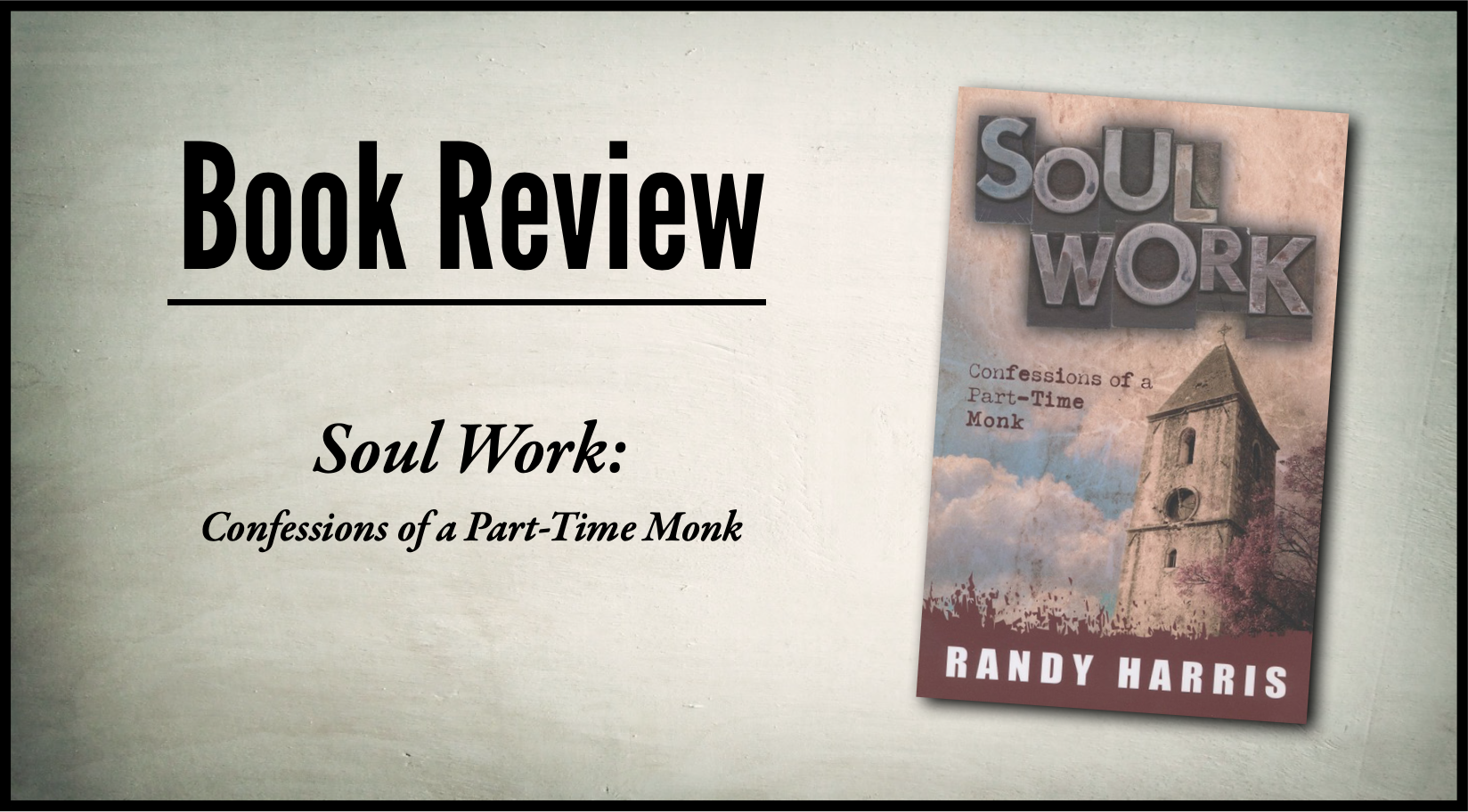
Book Review: Soul Work

As I mentioned in this post, I intend to do somewhat better in 2013 in regards to writing about books which I read. I really don’t enjoy writing book reviews (probably because it reminds me too much of school), but from time to time I will try to write very informal reviews and share some quotations which I found to be helpful or insightful.

I recently finished reading Soul Work: Confessions of a Part-Time Monk, by Randy Harris, which focuses on prayer and spiritual living. Harris has spent considerable time among monks and religious hermits (making him somewhat of an oddity for a Church of Christ minister and professor) to gain insight on the disciples of prayer, silence, and solitude, and in Soul Work, he shares some of the lessons he has learned.

Harris has an easy-to-read style, is full of humor, and doesn’t take himself too seriously at all. Parts of the book were a little mystical for me, but he had a lot of good things to say. Here are some of my favorite quotations (with random thoughts by me in brackets):

“One of the reasons that I think we struggle with prayer so much is that we think we need it so little.” (p. 13) [Ouch.]

“If you’re willing to walk and talk and spend time with God, he’ll start to remake your life even when you don’t know what’s going on.” (17)

“Obedience and submission aren’t really tested until you have to submit or obey in situations where you’re pretty sure you know a better way.” (56)

“We often give ourselves credit for obedience when we do what we’ve already wanted to do anyway—when the real test of obedience is doing what we don’t want to do.” (57) [Ouch, again.]

“Optimism depends on human beings and hope depends on God. And while I don’t see any reason to be optimistic, I see every reason to be hopeful.” (66)

“We would get healthier if we committed to fewer things over longer periods of time.” (72)  [Our obsessed-with-activity culture would benefit greatly from this wisdom.]

“Things are learned in suffering that can be learned in no other way.” (99)

“What would we lose if we lost all suffering in the world? There’s no longer any courage. There’s no longer any compassion. There’s no one to be compassionate towards. There’s no longer any patience. There’s no longer any endurance. There’s no longer the love that doesn’t give up when life goes badly. I don’t know about you, but it sounds like you give up an awful lot.” (100) [Great perspective on suffering.]

“Many of the most important events in your life are going to be ones over which not only do you have no control but which you’re not even going to see coming. And there is nothing like one of those events to burst your illusion about being one of those people who’ve got things under control. Nobody expects that their children will die before them. No one looks for that debilitating disease.” (102-103) [Wow, this really rang true to me.]

“Often the greatest ministry you do is while you’re on the way to do what you think is the important ministry.” (147) [I have found this to be true in my ministry as well.]

“The goal is not to have us praying more. The goal is to have us aware of and practicing God’s presence every moment of every day.” (154)

If you are interested in examining your prayer life and looking at prayer from several perspectives that you likely haven’t before, I recommend this book.

God Is The One Upon Whom We Should Rely: Lipscomb On Human Government

David Lipscomb was a very influential leader within Churches of Christ in the late 19th and early 20th centuries. Lipscomb served as a minister, an educator (a co-founder of the Nashville Bible School, which exists today as Lipscomb University), and an editor of the very influential Gospel Advocate.

Lipscomb was also a pacifist, and in some sense, a Christian anarchist: he believed that Christians had no business interacting with government, including voting in elections or serving on juries. My own views on government are not as extreme as Lipscomb’s, but I do think his thoughts serve as a helpful corrective to what I see from a lot of people.

It has been distressing to me during this election cycle to see so many Christians who (based on their comments on Facebook or Twitter) seem to be placing so much of their hope for the betterment of our world in political candidates (regardless of which party they happen to support). To these folks, Lipscomb offers some helpful words:

“Everyone who honors and serves the human government and relies upon it, for good, more than he does upon the Divine government, worships and serves the creature more than he does the Creator.”

On Civil Government, 50

With all due respect to Lipscomb, I believe that it is appropriate for Christians to vote and that, ideally, Christians should use their vote to reinforce the values of the Kingdom. And sometimes it can be easy to get pretty wrapped up in the political process because those values can mean a lot to us.

But I think he is right on the money about this: let us never think that the president we elect or the government we put into place is the ultimate source to which we should look for guidance, protection, or good. Those things come from God, and He still sits firmly on His throne, in control of all the things we debate and worry about.

« Older posts Newer posts »

© 2026 The Doc File

Theme by Anders Noren — Up ↑