The online journal of Luke Dockery

Category: Quotations (Page 12 of 17)

Dealing With Interruptions

This post has nothing to do with ESPN’s Pardon the Interruption. It’s a good show though.
In response to a post I wrote about time management where I mentioned having interruptions at work, one reader pointed me to a great quotation from Spiritual Leadership: Principles of Excellence for Every Believer by J. Oswald Sanders (thanks Karen!):
“One busy man told me how he mastered the problem of interruptions. ‘Up to some years ago,’ he testified, ‘I was always annoyed by them, which was really a form of selfishness on my part. People used to walk in and say, ‘Well, I just had two hours to kill here between trains, and I thought I would come and see you.’

That used to bother me. Then the Lord convinced me that He sends people our way. He sent Philip to the Ethiopian eunuch. He sent Barnabas to see Saul. The same applies today. God sends people our way.

So when someone comes in, I say, ‘The Lord must have brought you here. Let us find out why He sent you. Let us have prayer.’ Well this does two things. the interview takes on new importance because God is in it. And it generally shortens the interview. If a visitor knows you are looking for reasons why God should have brought him, and there are none apparent, the visit becomes pleasant but brief.

So now I take interruptions as from the Lord. They belong in my schedule, because the schedule is God’s to arrange at His pleasure.’”

I think it’s a great quotation, and it underscores the fact that sometimes, interruptions happen for a real reason. I say sometimes and not always because I don’t believe the popular mantra that “Everything happens for a reason.” But a lot of things do happen for a reason, and a little bit of probing and discernment can usually help you to see that.
It also underscores the fact that, if someone has interrupted by schedule with a real need, their need is more important than my schedule. If we claim to be servants of God, then we need to serve Him in all areas of life, and that means to serve Him with my schedule as well.
One last note on “ministry interruptions”: a wise and experienced minister once told me that when church members come by randomly just to shoot the breeze (and thus, interrupting his study time), he will enlist their aid in some ministry responsibility (making a visit, working on some project, etc.). In his experience, this has either led to productive visits where work is completed, or a reduction in those kinds of visits!
“The Myth of our Cultural Superiority”

In Christianity in Culture: A Study in Biblical Theologizing in Cross-Cultural Perspective, author Charles Kraft offer a stinging critique of western society:

“When one turns to the weaknesses of our culture, the myth of our cultural superiority falls to pieces. For example, we have poured so much of our resources into technological development that we have created social disorientation and disruption at every level of our society. Many families fall apart because they are unable to compete with our so-called educational system. The latter, for the sake of some imaginary ‘better’ future (defined in technological and materialistic terms) indoctrinates our youth against the past in general and their parents in particular (including any religious commitment they may have). Our quest for freedom and individualism, not to mention our mobility, mitigates against the development of close friendships, strong family ties, neighborliness, and stable marriages. Our extreme competitiveness, expressed interpersonally, intergenerationally, economically, vocationally, politically, and even between churches, is ripping our society apart. The naturalistic worldview at the center of our culture, the depersonalization of our people, the uncontrolled competitiveness between the various segments of our society, the choice usually to value the unknown and untried above the known but imperfect—these and so many other features to our society point not to its superiority but to its sickness.”

I am not one who holds that all creatures are inherently equal, and there are many things about western society that I greatly appreciate, but I think Kraft blows to pieces the perspective of those who hold that it is the pinnacle of everything.

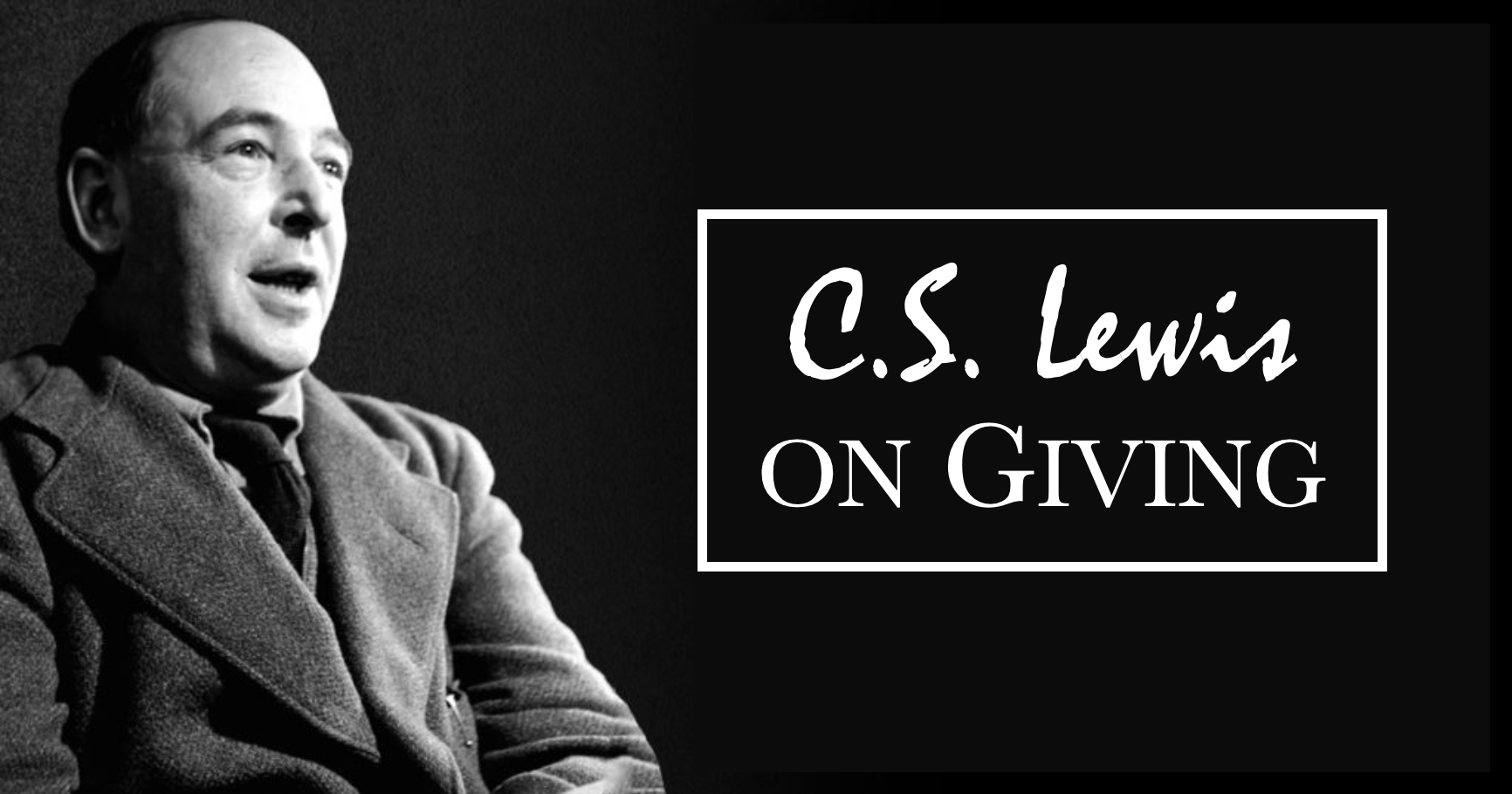
C.S. Lewis on Giving

“I do not believe one can settle how much we ought to give. I am afraid the only safe rule is to give more than we can spare. In other words, if our expenditure on comforts, luxuries, amusements, etc., is up to the standard common among those with the same income as our own, we are probably giving away too little. If our charities do not at all pinch or hamper us, I should say they are too small. There ought to be things we should like to do and cannot do because our charitable expenditures exclude them.”
–C.S. Lewis, in Mere Christianity

Does this step on anyone else’s toes a bit? I am convinced that the greatest sin of American Christianity is the way we spend our money.

Wayne Grudem on Penal Substitution and Baptism

Wayne Grudem is an evangelical theologian, and a smart man—I have read stuff from him before in the course of research—but this quotation of his on the idea of theological disagreements blows my mind (and not in a good way):

“I’m thankful that believers who differ on the issue of baptism can still have wonderful fellowship with one another across denominational lines, and can have respect for each other’s sincerely held views. I certainly do not put the question of baptism in the same category as the denial of penal substitutionary atonement…because that seems to me to be a denial of the heart of the Gospel…But differing views on baptism…do not have serious consequences of that type.”

So basically, accepting a view of the atonement that centers on penal substitution is more important than baptism. What?
It has become a trendy thing for Christians to want to distance themselves from penal substitutionary atonement, which I think is unfortunate, because the Bible definitely and repeatedly affirms that Jesus Christ was punished in our place as part of the atonement (John 1.29, Romans 3.21-26, 2 Corinthians 5.21, Galatians 3.13, Hebrews 9.29, 1 Peter 2.24).
However, I am aware of nowhere in the New Testament where possessing the single, correct understanding of the atonement is tied to an individual’s salvation or the forgiveness of sins (which is a good thing, because although Christ’s substitution for us was part of the atonement, the Bible indicates that there was more to it than just that). On the other hand, there are plenty of scriptures that link baptism to salvation and the forgiveness of sins (Acts 2.38, Acts 22.16, Romans 6.1-4, 1 Peter 3.21).
I think Grudem is mixed up on this one.

Dwight D. Eisenhower on D-Day

Today marks the 68th anniversary of D-Day, the Allied Armies’ invasion of Europe in World War II.
Giving the order to the troops on June 6, 1944, General Dwight D. Eisenhower said,

“You will bring about the destruction of the German war machine, the elimination of Nazi tyranny over the oppressed peoples of Europe, and security for ourselves in a free world. Your task will not be an easy one. Your enemy is well trained, well equipped, and battle-hardened. He will fight savagely. The free men of the world are marching together to victory. I have full confidence in your courage, your devotion to duty, and skill in battle. We will accept nothing less than full victory. Good luck, and let us all beseech the blessings of Almighty God upon this great and noble undertaking.”

Today, I am thankful to all those who did not shrink from the difficult task that lay before them.
« Older posts Newer posts »

© 2026 The Doc File

Theme by Anders Noren — Up ↑







