The online journal of Luke Dockery

Category: Restoration Movement (Page 2 of 6)

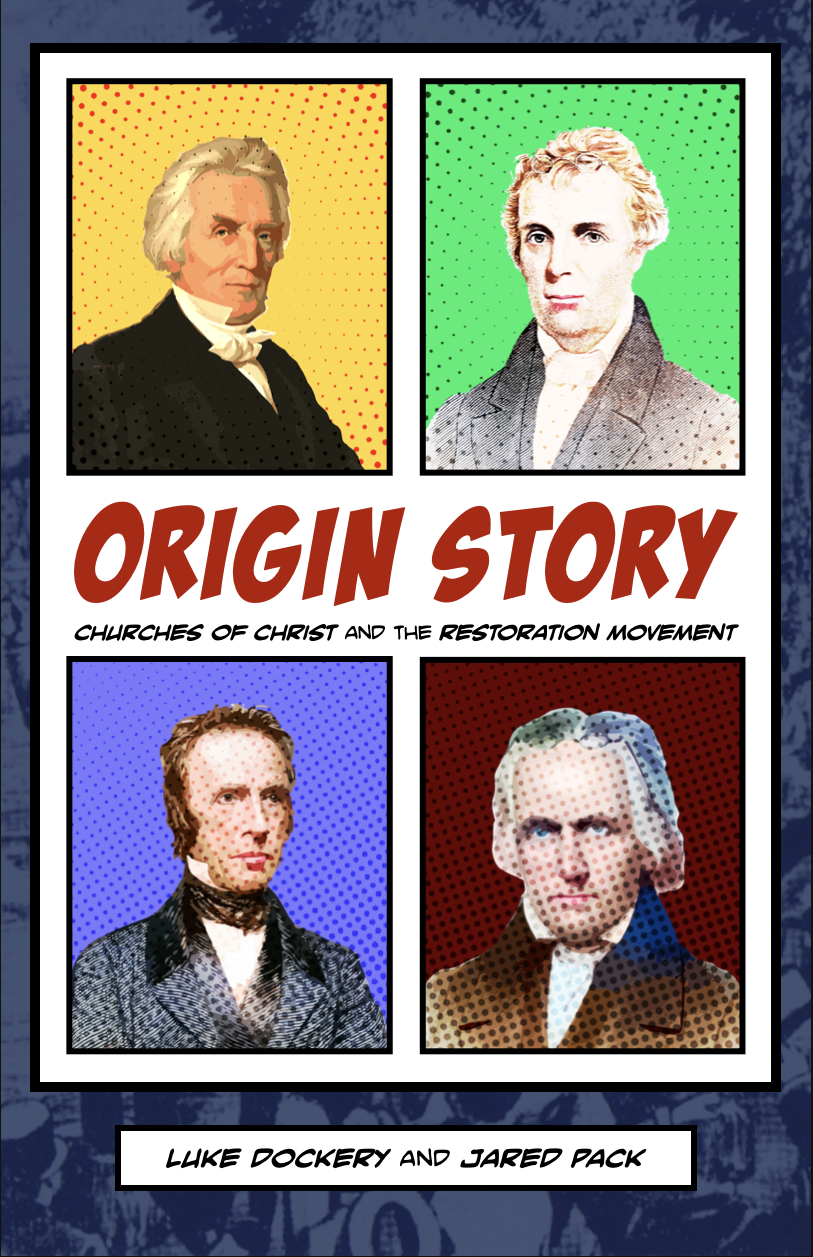
Origin Story: Churches of Christ and the Restoration Movement

I wrote a while back that I had taught a series of lessons to the students in my youth group regarding the Stone-Campbell Restoration Movement and how it affects our heritage and identity in Churches of Christ. I am pleased to announce that this study has now been compiled and formatted as a book that is now available in print and digitally. I won’t go into detail here why I think a study like this is need (I did that in the previous post), but I do want to say a couple of things and share some more detail about the book, before concluding with the summary information from the back cover.

First, this is a special project to me because it was done in conjunction with my good friend Jared Pack, and in many ways represents our friendship and the fruitful years of ministry we shared together. Jared is a historian by training and serves as Associate Professor of History and Chair of the History Department at York University in York, NE. I am a youth minister by trade and am decidedly not a trained historian, but I am an amateur enthusiast of Restoration History. Early in our friendship, Jared and I discovered a similar interest in the Restoration Movement and how it affects us today, and we co-taught a class together with our young adults group at the Farmington Church of Christ. Later, after I had moved to work with my current congregation, Jared taught the class again and added and expanded it. When I taught the material to my own students last year, I refined it further.

What all of that means is that this current product truly represents our combined work over a decade. Jared and I work so well together and think so similarly in many ways that with much of this book, at this point we are not sure who wrote which part! In many ways, this book is a perfect representation of and tribute to our friendship.

Second, this was a challenging project because I really was trying to push my creativity. Sadly, most teenagers do not find history to be an enthralling subject, and so I worked hard to make these lessons engaging. One way I sought to do this was by providing relevant discussion questions throughout the lessons to break up the lecture portions, but also, as the title suggests, I tried to tap into the notion of the origin story, a motif that has become very well understood in our society over the last twenty years with the proliferation of various movie franchises that center characters with remarkable abilities and comparing backstories (think MCU, the Harry Potter series, Star Wars, etc.). With this idea being central, Origin Story very much has the feeling of a comic book, completed with AI-generated images of the authors as superheroes!


Here is the Table of Contents, to give you an idea of the layout of the series:

Series Introduction

(1) Why Study the Restoration Movement?

(2) Background: Early Church to Reformation

(3) Background: European and American Influences

(4) The Big Four

(5) Unity and Division

(6) Churches of Christ after the Split

(7) Restoration Movement Slogans and Theology

(8) The Restoration Plea and Legacy

Appendix A: A Brief Overview of Calvinism

Appendix B: A Brief Overview of Millennialism


Purchase the Book

Paperback: Amazon $12.99

Digital: Deeper Youth Ministry $10


You can see the cover below, as well as some sample pages to give you a feel for the book (including the silly image of me as a superhero!).


From the back of the book:

Origin stories provide the background narrative that explains why characters are the way they are. When you know a character’s origin story, you also know important things about their feelings and motivations for why they do what they do. Churches of Christ have historical roots in the Stone-Campbell Restoration Movement, but teens in Churches of Christ tend to be largely ignorant about any of this history. This is a problem, because in a real sense, if we don’t know our history, we don’t know who we are.

The early Restoration leaders desired to bring about unity among God’s people by adhering to the clear teachings of Jesus and the apostles and the practices of the early church. In a world of bitter division and incredibly shaky notions of truth, that is a compelling idea, and one that is worth communicating to teenagers.

Origin Story is an eight-lesson series written specifically for teens.

“Teaching Restoration Movement history is tricky business, especially in church contexts. How best can we communicate the ups and downs, the successes and shortcomings, of our religious predecessors in a way that deepens rather than destroys faith? A lack of accessible educational resources for young Christians only compounds the problem. Fortunately, Luke Dockery and Jared Pack demonstrate both ministerial concern and scholarly acumen in this short volume which will help anchor the youth of the Churches of Christ more fully in their religious heritage and, even more importantly, point them back to the cross.”

—John Young, Associate Professor in the Turner School of Theology at Amridge University and historian of the Stone-Campbell Movement

Where Do Churches of Christ Come From? Teaching Restoration Movement History…to Teenagers

As regular readers of The Doc File likely know, I serve as a youth minister at the Cloverdale Church of Christ in Searcy, Arkansas. That reality is reflected quite often in this space, as I write frequently about youth ministry and also about the Stone-Campbell Restoration Movement, a Christian movement that emerged in the Second Great Awakening and in which Churches of Christ are historically rooted.

A major part of my job as a youth minister is teaching.[1] I get to teach teenagers dozens and dozens of times each year, and I put a lot of work and effort into developing a comprehensive curriculum map that plans out what students will study over their six years in our youth ministry, hoping to instill in them a clear understanding of Jesus Christ, a solid grasp of the biblical narrative and canon, an awareness of Christian theology and doctrine, and a Christian perspective on a variety of relevant topical issues. If that sounds like a challenging task, it’s because it is!

One topic that I have had on my curriculum map for the last couple of years but had not taught yet was an overview of Restoration history. It has been my experience that members of Churches of Christ are, generally, woefully ignorant of our history. And that’s the adults—teens are even less aware. This is really problematic, though, because in a real sense, if we don’t know our history, we don’t know who we are.


One of the best action movie franchises of my young adulthood was the Jason Bourne series. The first film in the series, The Bourne Identity, begins when the titular character is fished out of the Mediterranean Sea with gunshot wounds and a bad case of amnesia. Because Jason Bourne has lost his memory, in a real sense he has no identity, and the whole premise of the series is that Bourne is trying to piece together his past in order to figure out who he really is.

In Churches of Christ, the situation that we find ourselves in may not be as dramatic as Jason Bourne’s, but it is still an identity crisis of sorts. What are the identifying characteristics of Churches of Christ? Increasingly, that is a difficult question to answer as beliefs and practices vary widely across the theological spectrum of our churches in a way that was uncommon just a few decades ago. And I think it is directly tied to our general ignorance of our own history. That ignorance is likely caused by several factors, but a major one is competing ideologies that exist across the spectrum of Churches of Christ.


It is generally accepted that, from a sociological perspective, Churches of Christ largely shifted from a sect to a denomination during the latter half of the 20th century (something I write about more here).[2] However, this analysis describes a broad general phenomenon; the reality is that there are a great number of people in Churches of Christ who are distinctly sectarian in their thinking and many others who are thoroughly denominational (and, hopefully, many who are neither, but that is a subject for a different post).

For more sectarian circles within Churches of Christ, the assumption is that we represent the one true church, possessing some sort of unbroken line tracing all the way back to AD 30. Historical studies that show our very direct ties to a 19th-century movement obviously complicate this narrative, and so there is some degree of incentive for ignoring our history. On the other hand, for more ecumenical circles within Churches of Christ, the assumption is often that one church is just as valid as another, with differences coming down largely to personal preference (this is the denominational mindset). For many with this perspective, studies about our specific historical background fall somewhere between “unnecessary” and “embarrassing.”

In other words, if you view Churches of Christ from a sectarian or denominational lens, Restoration History isn’t likely to be a topic of central study.[3] And, sure enough, it hasn’t been for most of our people.

But what if there were another way to look at things? Is it possible to avoid being sectarian or denominational in our outlook? Well, that question is actually at the heart of the Restoration Plea—the driving force behind the Stone-Campbell Movement. That plea was a desire to bring about unity among God’s people by adhering to the clear teachings of Jesus and the apostles and the practices of the early church. And in a world of bitter division and incredibly shaky notions of truth, I think that’s still a compelling idea, and one that is worth communicating to teenagers.

A sectarian mindset would say that Churches of Christ have the market cornered on truth; we are the true Christians, all other churches are in error. A denominational mindset would say different churches are just different flavors of the same basic thing and it all comes down to personal preference; one church is just as good as another. But I reject those as the only two options. Looking at our history, it’s clear that we haven’t always gotten it right and that we have made some pretty big missteps. At the same time, we have gotten some really important things right and have made some significant contributions to the global understanding of what following Jesus looks like.

Reflective of the Restoration Plea, I would suggest that this is a better lens: neither sectarian nor denominational, we seek to be Christians only who deliberately follow the clear teachings of Scripture while maintaining an instinctive desire for unity with other believers whenever possible. These two impulses must remain at the center of our identity as we live as disciples of Jesus in the modern world. If anything, this is the lesson of the Restoration Movement. Our history shows us that men like Alexander Campbell and Barton W. Stone, men who devoted their lives to studying God’s word and living it out to the best of their abilities, could be united while not agreeing about everything because they believed they had gotten right the things that mattered most. In an age of unfriending, blocking, and muting people who don’t agree with us on every single issue, this approach to equally pursuing both truth and unity is perhaps more important than ever, and as members of Churches of Christ, it should be part of our DNA.

Neither sectarian nor denominational, we seek to be Christians only who deliberately follow the clear teachings of Scripture while maintaining an instinctive desire for unity with other believers whenever possible. Share on X

I believe this is a sustainable identity worth passing onto the next generation, and it is an identity that we really only get from historical study.

The series I ended up teaching to my teens was called “Origin Story,” and had a sort of superhero/comic book vibe.


[1] In fact, I consider teaching to be one of the six “Essential Elements of Effective Youth Ministry.”

[2] In religious studies, a sect is a religious organization that insists that it—and it alone—constitutes the entirety of the kingdom of God. Typically, a sect stands in judgment both on other religious organizations and on the larger culture in which it exists. On the other hand, a denomination in the American context is a church that recognizes it is only a part of the universal body of Christ. A denomination has typically made its peace with the dominant culture in which it exists. These definitions come from Richard T. Hughes, Reviving the Ancient Faith: The Story of Churches of Christ in America (Abilene, TX: ACU Press, 1996), xii-xiii.

[3] Because, again, from a sectarian perspective, Restoration History isn’t “our” history; “our” history is found in the book of Acts. From a denominational perspective, “our” history is largely unimportant.

A Final Week at Harding School of Theology

Back in October, I was blessed to be able to spend a week on the campus of Harding School of Theology in Memphis, where I audited a week-long intensive course, “Christian Formation of Children.” This was a great blessing to me for multiple reasons.

First, I was a student there from 2010-2018 (yes, I know it was a long time) before receiving my MDiv, and it was an incredibly formative place for me (more on that below). Second, I got to spend the week with my wife Caroline, who was enrolled in the same class as a credit student. In all my time as a student at HST, I always left my wife at home with the kids while I would go to Memphis for intensive course weeks, and I felt like I finally got to share this part of my life with her. We sat next to each other in class during the day, ate at all my favorite Memphis restaurants, did homework in the library, and walked through the neighborhoods around campus together. Third, it seems quite possible that this will be my last opportunity to spend any significant time on the HST campus in Memphis, with the announcement that HST will be moving to Searcy in Fall 2024. Finally, it was a great class!

Much has been written and said about HST moving from Memphis to Searcy, and I’m not sure I have anything of significance to add to that conversation. I remain personally unconvinced that this move is what is best for the school, but I also acknowledge that I am not an insider in this discussion and that there are many factors and variables of which I am probably unaware. I do know that, in a climate where seminaries associated with Churches of Christ are closing (see Austin Graduate Seminary and Oklahoma Christian Graduate School of Theology), I am grateful that HST is not closing its doors, and I am confident that God will continue to use the school to bless churches and train ministers in its new location.


As I mentioned above, HST was a deeply formative place for me. I went to Harding University for undergrad and had a wonderful experience there. I met Caroline there as many lifelong friends. It was at Harding that I developed my deep love for ultimate frisbee, and also where I began to make my faith my own. I learned a lot of things in various classes, but I would also say that I didn’t make deep connections with faculty members or older mentors (largely my own fault). I entered and graduated HU with very little idea of what I wanted to do in life.

Harding School of Theology was different. I began there later in life (I was 27), and had already been in youth ministry for a few years. Honestly, I began my degree because I was seeking credentials so I could teach at the college level someday. My plan was to get in and get out as soon as possible and move on to the next thing. That is not at all what happened, but I got so much more in the bargain:

  • I have very fond memories of my intensive course weeks in Memphis, which were some of the most challenging weeks of my life, but also some of the best weeks of my life. There I met a new set of lifelong friends, and many of these were friends who were similarly “in the trenches” of ministry and knew about its challenges, but also its value. Somewhere along the way, I largely forgot about the dream of teaching, and developed my love for congregational ministry. More specifically, it was work for classes at HST that led to the youth ministry-related research that would ultimately change my life in profound ways.
  • There, I met a set of mentors who would pour into me both in and out of the classroom. They would push me academically, spiritually, and theologically, but always in ways that were respectful and affirming to my faith. I have written before about the idea of “deconstruction,” which is a very slippery concept, but it would be fair to say that HST significantly contributed to the deconstruction of my faith in the healthiest sense: it became my own, mature faith.
  • When I began at HST, Caroline and I were still relatively newlyweds and weren’t parents yet. Life would get real for us soon after, though. My HST community would mourn a miscarriage with us, celebrate the birth of our first daughter, and then pray faithfully for her and us as we learned that she had a rare genetic condition and began the life-altering journey of being parents to a precious daughter with special needs.

As I was reflecting on my time at Harding School of Theology, I realized that, through all of what I mentioned above, HST gave me the twin gifts of humility and confidence. That may seem like a strange pair, but they actually fit together quite well. Regarding humility, my graduate school training helped me to understand how little I really knew and convinced me of the need to be a lifelong learner. Regarding confidence, my time at HST helped me to develop a really solid foundation of biblical, theological, and ministerial skills. I didn’t know everything, but there were some things I did know, really important things that I could build my life around. And even though I’m never going to master Scripture or ministry, I developed skills to study Scripture well and do ministry faithfully. Humility and confidence are wonderful gifts that I received and which I have tried to use faithfully in service of God’s Kingdom, and I can confidently say that I wouldn’t still be in ministry without my training at HST.

For all these reasons and more, the HST campus in Memphis is hallowed grounds for me. It was a great blessing, albeit a bittersweet one, to spend a week there with my wife whose sacrifices made it possible for me to attend graduate school in the first place, and who has been my partner in ministry and in all things.


The HST Mansion serves as the administration building of the school and is also where chapel is held. I took this photo after one of my early morning walks before class. October was a beautiful time to be in Memphis.

My very favorite person in one of my very favorite places!

Raising Up Ministers: Six Unhelpful Trends in Churches of Christ

If you pay any attention to these sorts of things, by now you are well aware that there is a ministry crisis in churches: there are far more churches seeking ministers than there are ministers seeking churches. This is a widespread phenomenon in churches (of various groups and denominations) within the United States, as indicated by a much-discussed Barna study. Looking more specifically at Churches of Christ, The Christian Chronicle has covered this multiple times. I even blogged about it myself in a roundabout way last year.

Despite all of the attention given to this very real problem, much of the focus has been on reasons why people leave ministry. An examination of those reasons is really important, but I think we also need to examine reasons why we are not training nearly as many ministers as we once did. There are groups out there that are working hard to encourage and train young people who have an interest in ministry (Harding’s Kerusso Experience is a great example of that; Lads to Leaders/Leaderettes and Leadership Training for Christ ostensibly do this as well), but I think a key aspect in this discussion—at least within the context of Churches of Christ—is for us to acknowledge some trends that have developed over several decades that are working against us when it comes to instilling interest in ministry in people at a young age.

So, why is it that we don’t train as many ministers as we once did? I’m sure there are lots of reasons, and what I am about to suggest is not intended to be an exhaustive list, but it is a start. For each trend I discuss, I’ll offer a question to prompt reflection on how we might respond, in light of these trends.

To be clear, I am not suggesting that these trends are inherently negative in and of themselves. They have had the effect, however, of making the practice of raising up ministers within the local congregation more difficult. 


1. Transitioning Away from a Small Church Fellowship

Historically, Churches of Christ have been a small church fellowship. As of 2015, nearly 90% of congregations within Churches of Christ had less than 200 members (see chart below).
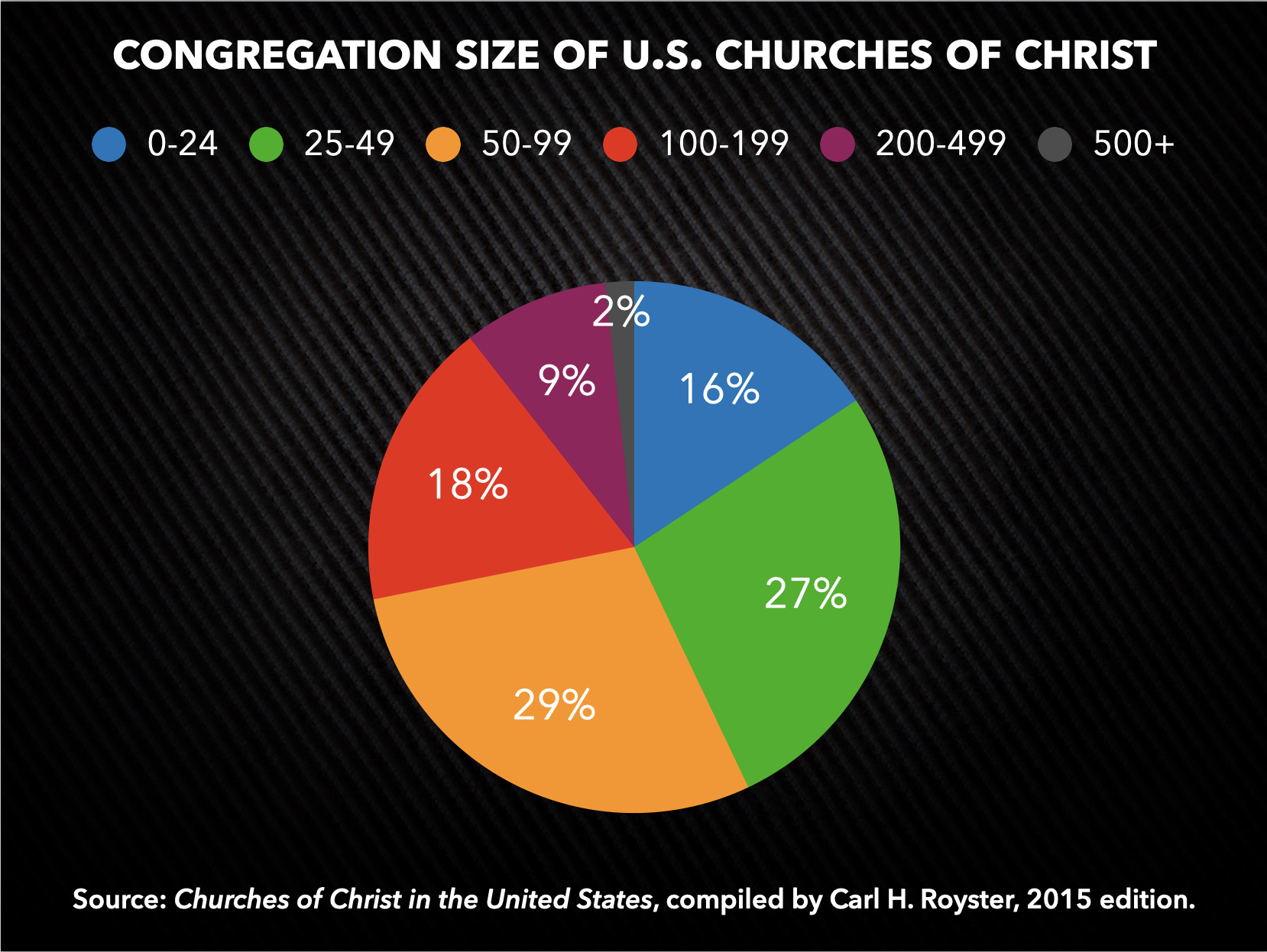
Over time, though, this trend is slowly changing. The United States is becoming increasingly urbanized, where small towns shrink and dry up as people move off for other opportunities, and as this happens, the small churches in those small towns dwindle as well. You probably hear statistics about “X number of churches close their doors every week/month/year….” Well, those churches are overwhelmingly small churches. It’s not that all of the Christians are disappearing and it’s certainly not that all of our churches are growing larger, but there is a shift that is occurring of members from smaller churches consolidating with larger ones as they move to cities, or as their previous congregations shrink beyond the point of sustainability.

Why does trend matter? Because small churches produce a disproportionate amount of preachers. This occurs because it is in small churches where young men receive opportunity to serve and lead. This comes out of necessity—there are jobs to be done and tasks to be performed, and no one else to do them. On the other hand, at larger churches, there are many more people willing to serve and lead, and you actually have to look for opportunities to get young people involved.[1]

In a context where more of our churches are larger, how can we create spaces for young people to have opportunities to lead in worship?

2. The Transformation (or Elimination) of Sunday Nights

I do not know the full history of the traditional Sunday night worship services in Churches of Christ. I know that for many years, it was essentially a carbon copy of what we did on Sunday mornings, but that they also tended to be less formal: men were less likely to wear suits, women were less likely to wear dresses, men who didn’t normally make it into the Sunday morning rotation got to lead singing, and in many churches, you would have occasional singing nights or youth worship nights where young men would have opportunity to serve. At the previous congregation where I worked, we had a monthly Youth-Led Worship where we would meet early to help young men practice and prepare, and then kids and teens would lead the entire service (prayers, songs, Lord’s Table, lesson, etc.).

Over the course of my lifetime, though, I have increasingly become aware of churches moving away from a traditional Sunday night service. Some churches have moved from a combined worship service to a small group model, and meet in members’ homes. Other churches have moved from a worship service to a Bible class format. Others have canceled evening services and replaced them with service projects. Others have canceled them and replaced them with nothing.

And, anecdotally, I would say that larger churches (i.e. the ones that already struggle to give young people a place to lead and be trained in leading worship) tend to be the most likely to abandon the traditional Sunday night service (removing yet another opportunity for training).

These Sunday night changes might be quite beneficial on the whole for the congregations in which they are occurring, but realistically, it still represents a lost venue for young people to have opportunity to lead.

In a context where the Sunday night service is disappearing, when and where can young people have opportunities to lead in worship?

3. Transition from Sect to Denomination: the Loss of Confidence and Importance

These next two trends have been developing for decades, but are helpful, I believe, in understanding so many things about Churches of Christ, especially in the 20th century and beyond.[2] First, a couple of definitions:

Sect: A religious organization that insists that it—and it alone—constitutes the entirety of the kingdom of God. Typically, a sect stands in judgment both on other religious organizations and on the larger culture in which it exists.

Denomination: In the American context, a church that recognizes it is only a part of the universal body of Christ. A denomination has typically made its peace with the dominant culture in which it exists.[3]

In other words, a sect is a group that emphasizes distinction: the call is to be radically different from the world, and to view other religious groups somewhat antagonistically. A denomination, on the other hand, tends to emphasize (or at least accept), being part of a larger whole: one “type” of Christianity amongst others, living in the context of the world.

This is a sociological description rather than a theological prescription: I’m not making the claim that this is a good development, but rather, that it is an accurate description of what has largely (not universally) happened within Churches of Christ over the last 100 years.[4] There was a time that Churches of Christ largely believed that “they were the only ones going to heaven” and that other believers, while they may be sincere, were sincerely mistaken, and not “true Christians.”[5] That still exists, but is much less prevalent than it once was. There are many in Churches of Christ today who have little to no appreciation of Restoration history or theology and would broadly claim that one church is as good as another. Others would hold strongly to certain doctrinal teachings, but still show a greater degree of both self-critique and approval of other groups than was true in the past. All of this reflects the shift from sect to denomination described above.

This is relevant to the issue at hand, I think, because this transition reflects a shakiness in our self-understanding: at one point, we were convinced that we taught the truth, while others were in error. This gives confidence in the importance of the preaching task: not only do we need to let the unchurched know about Jesus; but we also need to let the incorrectly churched know the truth about the importance of baptism, acceptable worship, and proper church governance. Virtually everyone is in error and, thus, in trouble, and we know the answer. This confidence and importance provide great motivation for dedicating a life to preaching.

On the other hand, if we are less confident in the rightness of our belief, and maybe many of our neighbors in other Christian groups don’t really need us to straighten them out, a life of preaching seems less important and less desirable.

In a context where we are less certain of our exclusive access to the truth, how can we still convey the value of preaching and other forms of ministry?

4. Transition from Sect to Denomination: at Home in the World

The other part of this transition is a feeling of comfort and belonging the world. In the early 20th century, this did not describe Churches of Christ. The early 1900s witnessed the growing split between the less educated, lower class, and theologically conservative Churches of Christ and the more educated, higher class, theologically liberal Disciples of Christ. As the split spread and then formalized, the Disciples often found themselves with the nice church buildings (now adorned with pianos) and standing in society, while the Churches of Christ were left with little in capital, real estate, and social standing.

Most members of Churches of Christ were not wealthy, and had no expectation of being so. This began to change in the economic boom following World War II, as wealth increased across virtually all demographics in the United States. Economic blessings led to nice, new church buildings, prestige in society, and changing expectations.

Those in ministry will tell you that a common barrier to young people entering ministry is discouragement from their parents because of financial concerns. The feeling is that ministry does not pay well (often true), and parents will often emphasize financial security over God’s call. My suspicion is that this parental discouragement stems from this broader transition to affluence: back when all of us were poor, being poor as a preacher was no worse than anything else. As our bank accounts have swelled, the desirability of preaching has diminished.

In a context where we value and respect financial security, how can we better compensate those in ministry so it is a more desirable option? How can we disciple all of our people to place less value upon financial security?

5. Secularization and the Loss of the Minister’s Prestige

Another major transition that has been going on in our society for a long time is increasing secularization. We have increasingly carved out spaces where God is not allowed (physically and metaphorically), a higher percentage of people no longer claim faith of any kind, and even people who are Christians increasingly view the world through secular lenses.[6]

In our increasingly post-Christian society, being a preacher (or some other type of minister) doesn’t bring the same sort of respect and prestige that it once did. In frontier America, where formal education was sparse, people tended to be self-taught, and many were illiterate, the preacher was often the most educated person in the community. It was naturally assumed that this was a person who had done some serious learning, and had something to say that was worth listening to.

This is no longer widely assumed. Many people are highly educated, and have access to tools that allow them to study Scripture in sophisticated ways. More than that, in a highly-secularized society, a minister may be well-educated, but the assumption may be that his or her education is fundamentally not valuable: if the Christian faith is ultimately a fairy tale, why should we be impressed that you are well-versed in it?[7]

In a context where ministers are not respected within society, how can we raise the level of respect they are shown in our churches? How can we disciple all of our people to place less value on the opinions of others?

6. Disquiet around Gender Roles

You are likely aware that the debate about gender roles is raging in Churches of Christ. This is certainly not unique to us, but what is relatively distinct is our practice of congregational autonomy: there is no denominational hierarchy dealing out an official position on female inclusion in church leadership, so individual churches have the task of interpreting the teachings of Scripture and applying them in their own contexts. In practice, this means that Churches of Christ are kind of like the wild west, where different churches have their own rules and understanding. Thus, you can find a variety of practices within Churches of Christ, ranging from full egalitarianism to full patriarchalism to all sorts of shades and variations in between.

Historically, this was not the case. Until fairly recently, for a long time, the broad consensus was that church leadership was for men, and the concept of “church leadership” was defined in such a way that it included any sort of up-in-front role during the worship assembly. Things are much different now: you really can’t assume where a given church is on this issue without doing some research, and honestly, a lot of churches themselves aren’t sure where they are on the issue.

My goal here is not to adjudicate this issue or tell you what you should think about it; rather, I am simply acknowleding that the landscape of Churches of Christ is much more confusing in this area than it once was, and I think it has ramifications for our actual topic at hand, helping to plant the seed of ministry within young people in our churches.

For churches that are clear about their positions on this (at one end of the spectrum or the other), it’s not really a problem, but for the large (and growing) number of churches that are somewhere in the middle and are trying to figure out what is permissable and what isn’t, it becomes a lot more complicated, and special worship services led by young people tend to bring a controversial issue front and center.[8]

In a context where gender roles are such a controversial topic, how can we seek to train young people in a way that doesn’t foster division and strife?


[1]This is easier said than done: we get nervous in front of people, and the larger the group of people, the more nervous we tend to get. So a young man who might be willing to present a lesson in front of 50 people will likely be less willing to do the same lesson in front of 500 people. Expectations of quality and professionalism tend to increase in larger congregations as well, placing a greater burden and barrier on young people who are inherently inexperienced and less skilled.

[2]What I present here will naturally be simplified and reductive. For fuller expositions on this topic, see David Edwin Harrell, “Emergence of the “Church of Christ” Denomination” (1972), and Richard T. Hughes, Reviving the Ancient Faith: The Story of Churches of Christ in America (Abilene, TX: ACU Press, 1996). Harrell and Hughes are two of the most respected historians within the Stone-Campbell Restoration Movement. Theologically, they were at different ends of the theological spectrum of Churches of Christ, but their sociological analyses of the transition of Churches of Christ from sect to denomination are closely in sync.

[3]These definitions come from Hughes, Reviving the Ancient Faith, xii-xiii.

[4]Indeed, I would argue that both of these categories fall short of how Jesus would have citizens of His kingdom envision themselves.

[5]There is good reason to argue that this sort of sectarianism betrayed the unifying vision of the early leaders of the Stone-Campbell Restoration Movement, but that is beyond the scope of this article. The point is simply that there was a time when this was a widespread and common belief amongst those in Churches of Christ.

[6]As famously argued in Charles Taylor’s A Secular Age.

[7]It should be added that some of the loss of respect felt toward those in ministry is self-inflicted: the constant drumbeat of those in various forms of ministry, across denominational affiliation and the theological spectrum, who abuse that position through sexual sin, financial dishonesty, or other types of abusive behavior have greatly diminished the public trust in those in ministry.

[8]This may seem counterintuitive to some readers: why would it be problematic to have a youth-led worship service that reflected the same gender roles that a regular worship service would have in that context? I understand the question, but it does seem to make a difference, for at least three reasons. First, young people, especially teens, tend to be more rebellious and push the envelope more than those of older generations. So, you might have lots of women who are very comfortable in traditional gender roles in the church, but that doesn’t mean that teenage girls are. Second, you may have parents who are generally okay with the ways things are for themselves, but feel the need to advocate for greater opportunities for their daughters. Third, there are some people who are fine listening to a sermon from a well-trained male preacher but start to ask questions when listening to a 12-year-old boy offer a fairly shallow (and sometimes theologically heterodox) lesson.

The Doctrine of Unity

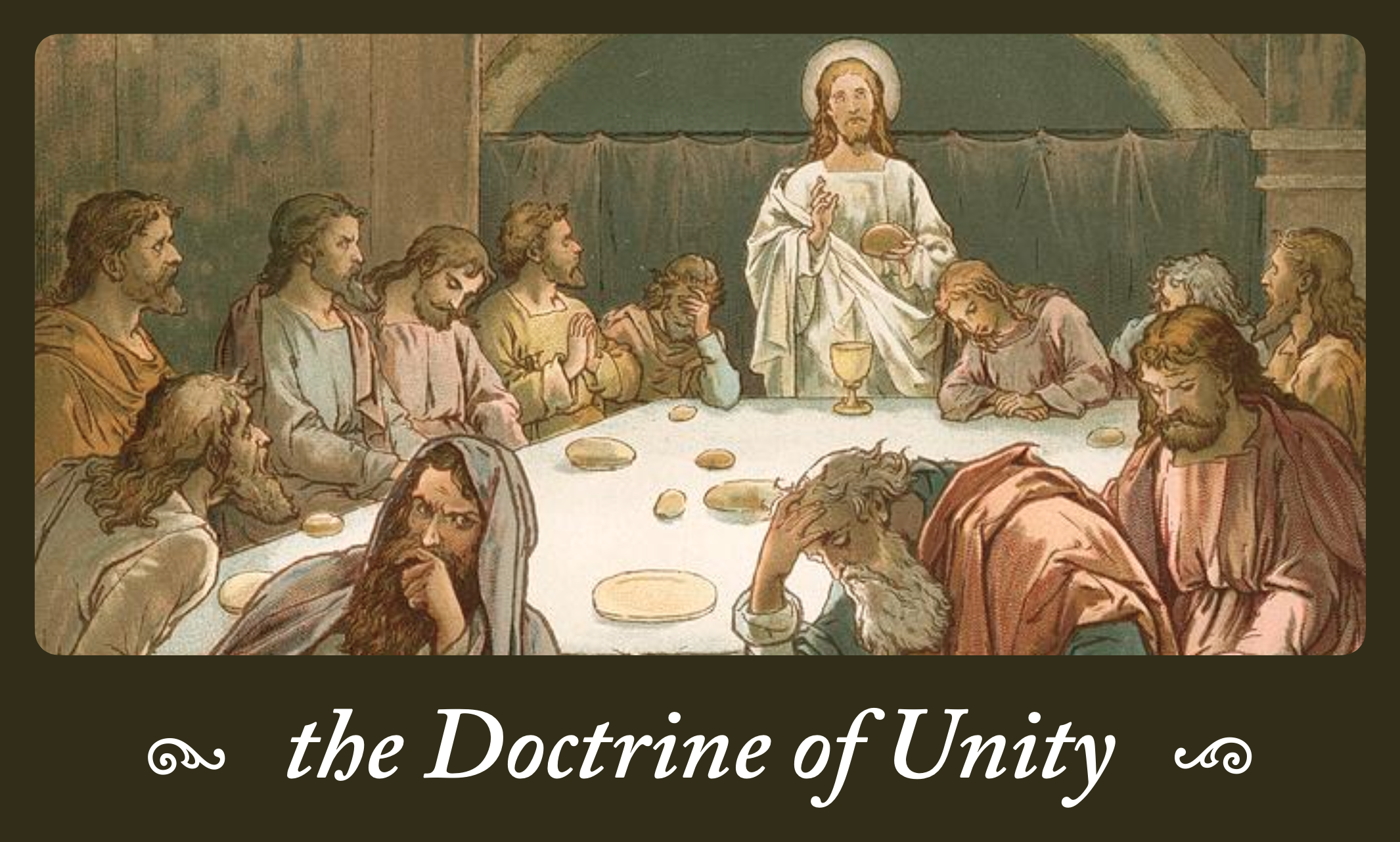
The Gospel of John differs from the other gospels in various ways, but one significant difference is John’s inclusion of the extensive time Jesus spends with His disciples on the night of His betrayal and arrest. This section spans John 13-17, and includes Jesus washing the disciples’ feet, His impending betrayal and Peter’s denial, His promise of the coming of the Holy Spirit and the accompanying revelation that He will be leaving them soon, and a repeated emphasis on the importance of love.

Near the end of this section, Jesus also teaches on the subject of unity:

“I do not ask for these only, but also for those who will believe in Me through their word, that they may all be one, just as You, Father, are in Me, and I in You, that they also may be in Us, so that the world may believe that You have sent Me. The glory that You have given Me I have given to them, that they may be one even as We are one, I in them and You in Me, that they may become perfectly one, so that the world may know that You sent Me and loved them even as You loved Me.”

(John 17.20-23)

Here, near the end of the “High Priestly Prayer”, Jesus prays for unity among His followers. When you think about it, this places followers of Jesus in an interesting position: generally, we pray to God asking Him to answer our prayers; in this instance, it seems remarkable to me that we have the opportunity to answer His. 

Furthermore, the unity that Jesus prays for is not arbitrary—it is both formative and practical. It is formative in the sense that, when followers of Christ are unified, we reflect the very nature of the Triune God who exists in perfect unity while displaying diversity. In other words, practicing and displaying unity forms us into the likeness of God. Additionally, unity is practical in the sense that it leads the world to realize the truth of the identity of Jesus Himself.

I have spent my life in Churches of Christ, a group of autonomous congregations of believers that have historical ties to the American Restoration Movement of the 1800s. This movement sought to strip away man-made traditions and restore the Church that they read about in the pages of the New Testament.

The American Restoration Movement (also called the Stone-Campbell Movement) was, significantly, a unity movement. Although the restoration of the New Testament Church was seen as important in its own right, it was also viewed as a means of bringing unity to a fragmented world of Christian denominations: if Christ-followers of different varieties could all just agree to follow the beliefs and practices described in the New Testament, then the elusive unity among His disciples for which Jesus prayed could finally be achieved. To an extent, it worked, as thousands of people left their respective denominations and linked up with the new movement, wanting to be known only as Christians and recognizing only the authority of the Bible. Alas, the unity did not last. Restoration congregations began to divide in the late 19th century, and in 1906, the U.S. Census recognized a formal division between Churches of Christ and Disciples of Christ.

I am proud of the initial focus on unity among my spiritual ancestors, and saddened by the degree to which that strain of our religious DNA later weakened—in the 20th century, Churches of Christ split and divided over all sorts of doctrinal issues (real or imagined), and a passion for unity was not something for which we were generally known. This is really unfortunate, though, because the reality is that more than just a good idea or a noble goal, unity is a doctrine—it is a clear teaching of Jesus. It is one of the last things He emphasized to His disciples before He went to the cross, and He said that it should be one of their defining characteristics.

More than just a good idea or a noble goal, unity is a doctrine. Share on X

This doesn’t mean that we should ignore all other doctrines for the sake of unity, but I do think that doctrinal disagreements that lead us to break unity with other believers should be at least as clearly taught or as central as the doctrine of unity is.

To put it another way, I want to be obedient to the teachings of Jesus. However, if my desire to properly understand and follow the teachings of Jesus has led me, in practice, to minimize the importance of seeking unity with others who proclaim Jesus as Lord, then it is important for me to realize that I am not actually being obedient. Because unity is a doctrine.

Doctrinal disagreements that lead us to break unity with other Christians should be at least as clearly taught or as central as the doctrine of unity is. Share on X

In this loose series of Scripture Reflections, I am sharing brief thoughts spurred on by my Bible reading. By way of reminder, my goal for these brief posts is two-fold:

(1) To remark on aspects of the biblical text that I find to be of interest that the reader may or may not have thought about previously.

(2) When possible, to point to the work and person of Jesus Christ. I believe the Bible is a unified story that points to Jesus, which means that He is frequently alluded to or foreshadowed in some way throughout the biblical canon.

« Older posts Newer posts »

© 2026 The Doc File

Theme by Anders Noren — Up ↑