The online journal of Luke Dockery

Tag: Baseball History (Page 1 of 2)

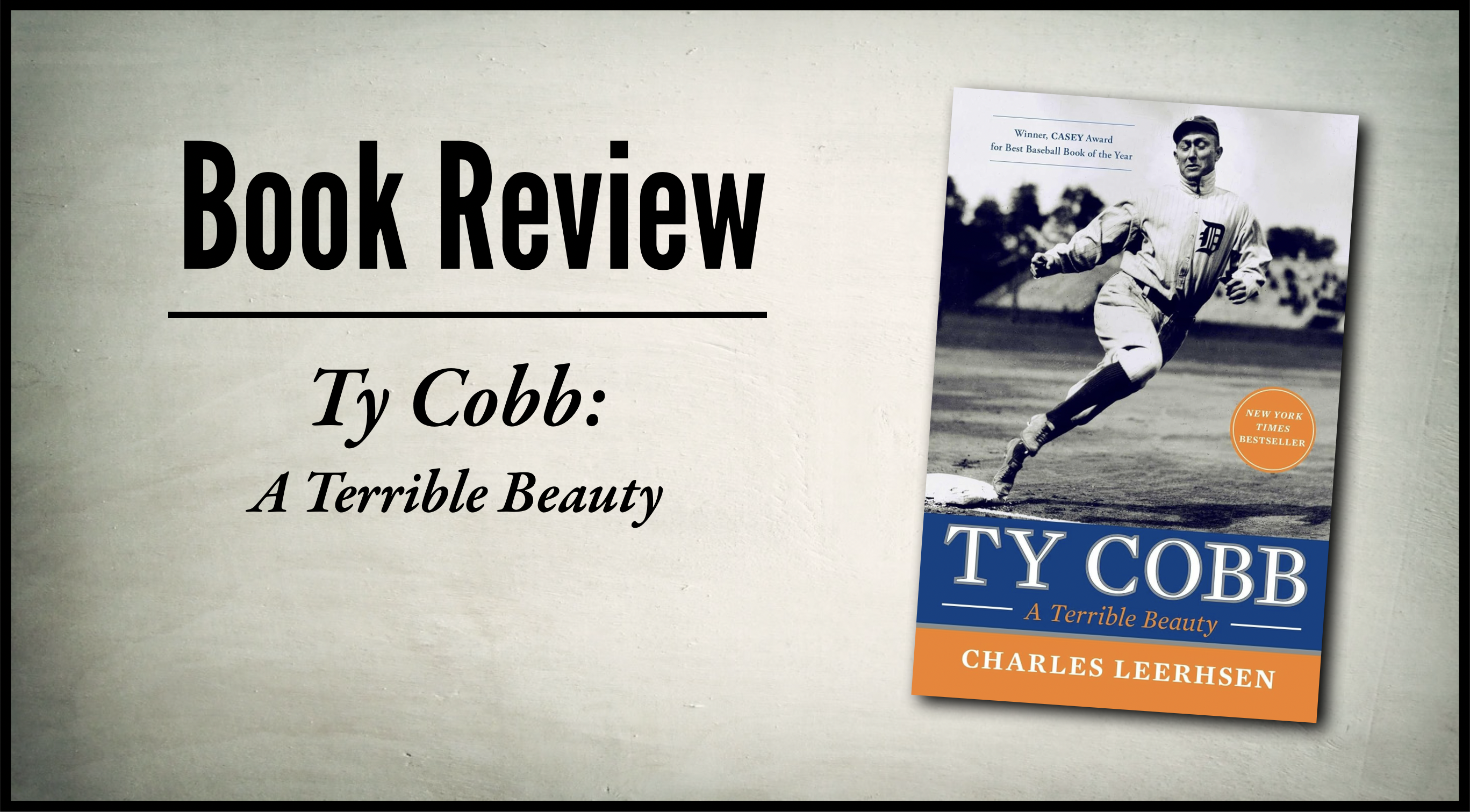
Book Review: Ty Cobb: A Terrible Beauty

One of my favorite reads of 2023 was Charles Leerhsen’s Ty Cobb: A Terrible Beauty.

If you know much about baseball history, you know that Ty Cobb is regarded as one of the great villains—perhaps the greatest villain—in the history of baseball. As the story goes, he was vicious and violent, a bigoted racist who famously assaulted a handicapped man and was hated by all the men who played with him. He was also a profoundly brilliant player—the best player in baseball history until Babe Ruth came along, and his record for the highest career batting average still stands today, almost 100 years after his retirement. But for all his skills, there tends to be a general understanding that baseball would have been better off without him. Noted baseball historian Daniel Okrent, commenting in Ken Burns’s outstanding PBS documentary Baseball, referred to Cobb as the “great black mark on the history of baseball.”

Imagine my great surprise, then, to read Joe Posnanski’s essay on Ty Cobb in The Baseball 100 (another of my favorite reads in 2023), where he made the shocking suggestion that perhaps Cobb was not quite the villain he had been made out to be. Posnanksi pointed to this biography of Cobb by Charles Leerhsen, and I knew I had to read it.

Leerhsen’s biography on Cobb was well-researched and compellingly told, and the truth, it seems, is more complicated than the popular legend. Cobb did fight on the baseball diamond, but so did many other players—baseball was a very different and more violent game in the early 1900s. He did have feuds with some of his teammates, but he also had friends across the league. And, while Cobb’s racial attitudes would surely be out of place in 2024, for someone who grew up in Georgia in the late 1800s, there is precious little evidence for any particular racial hatred on his part, and he advocated for the integration of major league baseball before it happened, and supported players like Jackie Robinson once they broke through the color barrier.

How, then, did the story of Cobb’s villainy become so prevalent? According to Leerhsen, the fault lies at the feet of Al Stump, Cobb’s original biographer who wrote multiple books that birthed the urban legend that has entered the public consciousness. Leerhsen focuses on Stump quite a bit, effectively establishing how shoddy his research was and how he often played fast and loose with the truth.

Having said all of that, Leerhsen’s goal is not to turn Cobb into a saint; the man certainly had problems and did many things that he regretted. Rather, Leerhsen wants us to see Cobb as he was: a complicated mix of good and bad. In some ways, it is an uncomfortable realization: it can be comforting to label someone as a villain because then we can write them off as evil and wholly different than we are. But the truth is less comforting: the dividing line between good and evil is not between ourselves (who, of course, we classify as good) and those we deem to be evil; rather, to paraphrase a famous line from the great Russian writer and Soviet dissident Aleksandr Solzhenitsyn, the line between good and evil runs through every human heart.

It was a line that Ty Cobb danced around throughout his life. It is a line I am more familiar with than I would like to admit.

Ty Cobb: A Terrible Beauty was the best kind of sports book: it told a good story, it taught me new and interesting things, and it prompted me to take a good hard look at myself.

Legacy, Cap Anson, and Enoch

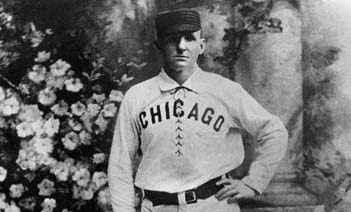
Cap Anson was Major League Baseball’s first superstar. Anson spent the majority of his career as a player/coach for the Chicago White Stockings, and was the first professional player to amass 3,000 hits.  Some of the many records he set during his career lasted for decades.

Anson was a fierce competitor, and his accomplishments in baseball were so important to him that he left instructions that his tombstone read, “Here lies a man who batted .300.”

I’m a huge baseball fan and I think it would be neat to play it at the same level as someone like Cap Anson, but to choose to sum up your entire life with a baseball statistic? Even I think that’s a little sad, and it reveals a perspective on life that is more than a little skewed.

If you could write your own epitaph, or choose just a few words to sum up your life, what words would you use? Perhaps a better question would be, if others were to sum up your life based on what they saw—how you spent your time and money, the things that seemed important to you—what words would they use?

  • Always looking for a promotion…
  • Had the largest house on the block…
  • Biggest gossip in town…
  • Obsessed with cars…
  • Lived vicariously through his children…

Closely related to all of this is the idea of legacy. In legal terms, a legacy is a gift of property or money, usually by means of a will. In a more general sense, your legacy is whatever you leave behind for those who come after you—in some ways it is a token or a synopsis of your life.

If we had the benefit of hearing the epitaphs that others would write for us, it might reveal how skewed our perspectives can be at times (not unlike Cap Anson’s), and let us see that the legacies we leave are often shallow and insignificant.

In Genesis 5, in the midst of a list of Adam’s descendants, we are introduced to a man named Enoch. Enoch lived for 365 years, but his life was summed up in just a few brief words:

“Enoch walked with God, and he was not, for God took him.”

“Walked with God.” That’s an epitaph that I could be happy with, and a legacy that I would be proud to have. But legacies like that don’t come about by accident; rather, they come from a stubborn, persistent lifestyle of discipleship. So all that leads to this question: What will your legacy be? Put in another way, if you were to pass from this life today, what would your tombstone say?

If you would like it to read differently, then it’s up to you to live differently.

Designed to Break Your Heart: Tom Barlow

Hartford Dark Blues, 1875

This is a first post in a series introduced here. 

In the early days of professional baseball, in the 1870s and 1880s and even on into the 20th century, baseball was a hard game for hard men.

Protective equipment was rare, the travel was difficult, the wages were decent but by no means extravagant, and job security didn’t exist. College-educated professional ballplayers were rare; for many, a job in the big leagues was a ticket out of the coal mines. Players tended to brawl and misbehave, both on and off the field.

Tom Barlow was a catcher and sometime shortstop for the Brooklyn Atlantics and Hartford Dark Blues in the early 1870s. He is credited as being the originator of the bunt, and had his best season in 1872, when he hit .310, and caught all of his team’s games, a feat which has only been accomplished eight times (and not since 1945).

In 1874, while playing for Hartford, Barlow sustained an injury while catching for Cherokee Fisher, renowned as a devastating fastball pitcher. In a letter to the Boston Times on September 16, 1877, Barlow described the incident:

“It was on the 10th of August, 1874, that there was a match game of baseball in Chicago between the White Stockings of that city and the Hartfords of Hartford, now of Brooklyn. 

I was catcher for the Hartfords, and Fisher was pitching. He is a lightning pitcher, and very few could catch for him. On that occasion he delivered as wicked a ball as ever left his hands, and it went through my grasp like an express train, striking me with full force in the side. 

I fell insensible to the ground, but was quickly picked up, placed in a carriage, and driven to my hotel. The doctor who attended me gave a hypodermic injection of morphine, but I had rather died behind the bat then [sic] have had that first dose. 

My injury was only temporary, but from taking prescriptions of morphine during my illness, the habit grew on me, and I am now powerless in its grasp. My morphine pleasure has cost me eight dollars a day, at least. 

I was once catcher for the Mutuals, also for the Atlantics, but no one would think it to look at me now.”

Barlow was 22 years old the day he was injured behind the plate. He disappears from historical records after 1880; details of his later life and date of death are unknown.

I first became aware of the story of Tom Barlow through Ken Burns’ PBS documentary Baseball. Other details for this post were gleaned from Wikipedia and Bleacher Report.

Baseball: Designed to Break Your Heart

A. Bart Giamatti, Major League Baseball’s seventh Commissioner and a formidable scholar (having previously served as the President of Yale University), once famously said about baseball:

It breaks your heart. It is designed to break your heart. The game begins in the spring, when everything else begins again, and it blossoms in the summer, filling the afternoons and evenings, and then as soon as the chill rains come, it stops and leaves you to face the fall alone.

Giamatti knew what he was talking about. A lifelong Red Sox fan, he had the unenviable task of overseeing Pete Rose’s lifetime ban from baseball, and then suffered a fatal heart attack eight days later.
I find Giamatti’s words to be true in my own experience as a baseball player, fan, and amateur historian. As a player, the joys of fielding ground balls and taking batting practice were gradually overshadowed by the political squabbles of battling for playing time with coaches’ sons and the increasing awareness that I was never going to get a shot at the Big Leagues. As a fan, the majority of my childhood was spent rooting for Atlanta Braves, the winningest team of the 1990s, and yet, looking back, it is not the hundreds and hundreds of victories that I remember but the failures in the playoffs year after year. And as an amateur historian, the stories that most readily spring to mind tend to be the saddest ones.
It is some of these stories that I would like to share, on an intermittent basis, as part of a new series. Designed to break your heart or not, I love baseball, in large part because of the poignancy of its illustrious history.
Hope you enjoy them.

Preacher Roe (1915-2008)

I discovered yesterday that Preacher Roe had passed away on Sunday at the age of 92.

Roe was a left-handed pitcher who played in the Major Leagues in the 1940s and 50s, making five All-Star teams, leading the league in strikeouts once, and had a personal best record of 22-3 in 1951 with the Brooklyn Dodgers.

For his career, Roe accumulated 127 wins against 84 losses, a good record that likely would have been more impressive had he not missed time for service in World War II.

But the reason I know about Preacher Roe and the reason I thought all of this would be interesting to the majority of my readership is that Preacher Roe is the only Harding student to play in the Major Leagues. When I was at Harding, his old Dodgers jersey was on display in the Ganus Athletic Center, and I bet it’s still there.

Roe seems to have been an interesting character.

Born Elwin Charles Roe, he got his lifelong nickname at the age of 3 when his uncle returned from the first World War and asked his little nephew what his name was. Roe responded that his name was “Preacher” (apparently because he liked the local preacher who would take him on horse and buggy rides), and the nickname stuck.

He suffered a major setback early in his career when he was still with the Pittsburgh Pirates. In the 1945 off-season, while coaching a high school basketball game (baseball players didn’t make as much then as they do now), he suffered a skull fracture after getting into a fight with the referee. He struggled through the next few seasons.

He turned his career around in Brooklyn, however, where he began throwing the (illegal) spitball as his signature pitch, and played alongside Jackie Robinson.

In an interview later in life, Roe expressed his pride in getting to play with Robinson: “I just felt if Jackie hit a home run while I was pitching, it counted just as much for me as if Pee Wee Reese hit it or some of the other guys that were white…I’d say, ‘You never have seen a good ballplayer until you’ve seen him.’ He was that good.”

If you look closely at the picture below, the setting might be familiar to some of you…it was taken at Camp Tahkodah.

« Older posts

© 2026 The Doc File

Theme by Anders Noren — Up ↑







