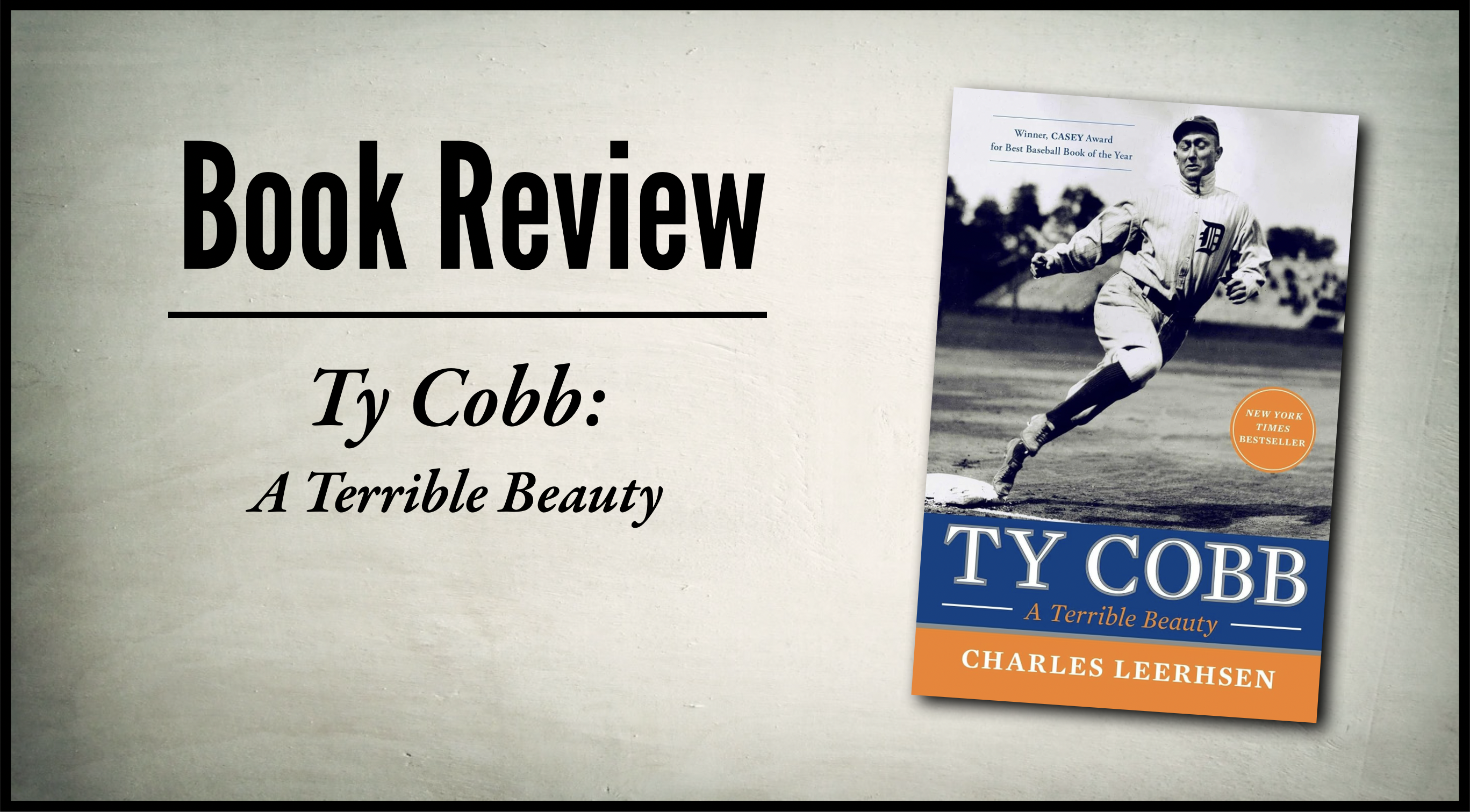
One of my favorite reads of 2023 was Charles Leerhsen’s Ty Cobb: A Terrible Beauty.
If you know much about baseball history, you know that Ty Cobb is regarded as one of the great villains—perhaps the greatest villain—in the history of baseball. As the story goes, he was vicious and violent, a bigoted racist who famously assaulted a handicapped man and was hated by all the men who played with him. He was also a profoundly brilliant player—the best player in baseball history until Babe Ruth came along, and his record for the highest career batting average still stands today, almost 100 years after his retirement. But for all his skills, there tends to be a general understanding that baseball would have been better off without him. Noted baseball historian Daniel Okrent, commenting in Ken Burns’s outstanding PBS documentary Baseball, referred to Cobb as the “great black mark on the history of baseball.”
Imagine my great surprise, then, to read Joe Posnanski’s essay on Ty Cobb in The Baseball 100 (another of my favorite reads in 2023), where he made the shocking suggestion that perhaps Cobb was not quite the villain he had been made out to be. Posnanksi pointed to this biography of Cobb by Charles Leerhsen, and I knew I had to read it.
Leerhsen’s biography on Cobb was well-researched and compellingly told, and the truth, it seems, is more complicated than the popular legend. Cobb did fight on the baseball diamond, but so did many other players—baseball was a very different and more violent game in the early 1900s. He did have feuds with some of his teammates, but he also had friends across the league. And, while Cobb’s racial attitudes would surely be out of place in 2024, for someone who grew up in Georgia in the late 1800s, there is precious little evidence for any particular racial hatred on his part, and he advocated for the integration of major league baseball before it happened, and supported players like Jackie Robinson once they broke through the color barrier.
How, then, did the story of Cobb’s villainy become so prevalent? According to Leerhsen, the fault lies at the feet of Al Stump, Cobb’s original biographer who wrote multiple books that birthed the urban legend that has entered the public consciousness. Leerhsen focuses on Stump quite a bit, effectively establishing how shoddy his research was and how he often played fast and loose with the truth.
Having said all of that, Leerhsen’s goal is not to turn Cobb into a saint; the man certainly had problems and did many things that he regretted. Rather, Leerhsen wants us to see Cobb as he was: a complicated mix of good and bad. In some ways, it is an uncomfortable realization: it can be comforting to label someone as a villain because then we can write them off as evil and wholly different than we are. But the truth is less comforting: the dividing line between good and evil is not between ourselves (who, of course, we classify as good) and those we deem to be evil; rather, to paraphrase a famous line from the great Russian writer and Soviet dissident Aleksandr Solzhenitsyn, the line between good and evil runs through every human heart.
It was a line that Ty Cobb danced around throughout his life. It is a line I am more familiar with than I would like to admit.
Ty Cobb: A Terrible Beauty was the best kind of sports book: it told a good story, it taught me new and interesting things, and it prompted me to take a good hard look at myself.







