The online journal of Luke Dockery

Tag: Bible Class (Page 1 of 2)

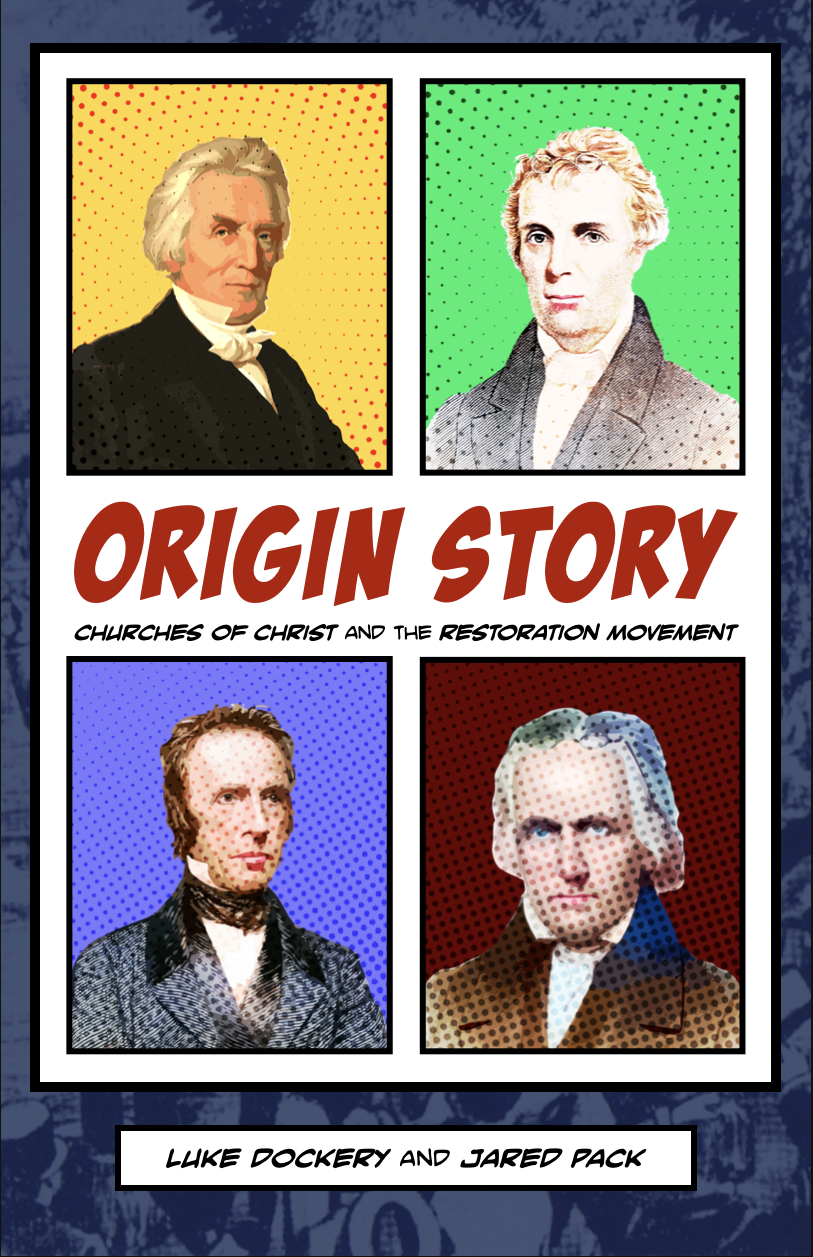
Origin Story: Churches of Christ and the Restoration Movement

I wrote a while back that I had taught a series of lessons to the students in my youth group regarding the Stone-Campbell Restoration Movement and how it affects our heritage and identity in Churches of Christ. I am pleased to announce that this study has now been compiled and formatted as a book that is now available in print and digitally. I won’t go into detail here why I think a study like this is need (I did that in the previous post), but I do want to say a couple of things and share some more detail about the book, before concluding with the summary information from the back cover.

First, this is a special project to me because it was done in conjunction with my good friend Jared Pack, and in many ways represents our friendship and the fruitful years of ministry we shared together. Jared is a historian by training and serves as Associate Professor of History and Chair of the History Department at York University in York, NE. I am a youth minister by trade and am decidedly not a trained historian, but I am an amateur enthusiast of Restoration History. Early in our friendship, Jared and I discovered a similar interest in the Restoration Movement and how it affects us today, and we co-taught a class together with our young adults group at the Farmington Church of Christ. Later, after I had moved to work with my current congregation, Jared taught the class again and added and expanded it. When I taught the material to my own students last year, I refined it further.

What all of that means is that this current product truly represents our combined work over a decade. Jared and I work so well together and think so similarly in many ways that with much of this book, at this point we are not sure who wrote which part! In many ways, this book is a perfect representation of and tribute to our friendship.

Second, this was a challenging project because I really was trying to push my creativity. Sadly, most teenagers do not find history to be an enthralling subject, and so I worked hard to make these lessons engaging. One way I sought to do this was by providing relevant discussion questions throughout the lessons to break up the lecture portions, but also, as the title suggests, I tried to tap into the notion of the origin story, a motif that has become very well understood in our society over the last twenty years with the proliferation of various movie franchises that center characters with remarkable abilities and comparing backstories (think MCU, the Harry Potter series, Star Wars, etc.). With this idea being central, Origin Story very much has the feeling of a comic book, completed with AI-generated images of the authors as superheroes!


Here is the Table of Contents, to give you an idea of the layout of the series:

Series Introduction

(1) Why Study the Restoration Movement?

(2) Background: Early Church to Reformation

(3) Background: European and American Influences

(4) The Big Four

(5) Unity and Division

(6) Churches of Christ after the Split

(7) Restoration Movement Slogans and Theology

(8) The Restoration Plea and Legacy

Appendix A: A Brief Overview of Calvinism

Appendix B: A Brief Overview of Millennialism


Purchase the Book

Paperback: Amazon $12.99

Digital: Deeper Youth Ministry $10


You can see the cover below, as well as some sample pages to give you a feel for the book (including the silly image of me as a superhero!).

From the back of the book:

Origin stories provide the background narrative that explains why characters are the way they are. When you know a character’s origin story, you also know important things about their feelings and motivations for why they do what they do. Churches of Christ have historical roots in the Stone-Campbell Restoration Movement, but teens in Churches of Christ tend to be largely ignorant about any of this history. This is a problem, because in a real sense, if we don’t know our history, we don’t know who we are.

The early Restoration leaders desired to bring about unity among God’s people by adhering to the clear teachings of Jesus and the apostles and the practices of the early church. In a world of bitter division and incredibly shaky notions of truth, that is a compelling idea, and one that is worth communicating to teenagers.

Origin Story is an eight-lesson series written specifically for teens.

“Teaching Restoration Movement history is tricky business, especially in church contexts. How best can we communicate the ups and downs, the successes and shortcomings, of our religious predecessors in a way that deepens rather than destroys faith? A lack of accessible educational resources for young Christians only compounds the problem. Fortunately, Luke Dockery and Jared Pack demonstrate both ministerial concern and scholarly acumen in this short volume which will help anchor the youth of the Churches of Christ more fully in their religious heritage and, even more importantly, point them back to the cross.”

—John Young, Associate Professor in the Turner School of Theology at Amridge University and historian of the Stone-Campbell Movement


New Projects

I have not written as much recently here on The Doc File as I would like, largely because I have been busy with other things:

To this list, most recently I have added a new project: my good friend Kevin Burr and I launched Regnum Media, a publishing house that will produce scholarly-yet-accessible Bible studies that are primarily intended for use in adult Bible classes as well as personal study. Regnum Media will be operating in partnership with the Center for Christian Studies, and will serve as the publishing imprint for CCS. CCS seeks to provide “scholarship for the church,” and has been doing this in excellent fashion already through video teaching modules and a scholarly journal that is released three times per year. We are excited to partner with CCS in this good work.
From the CCS press release about our partnership, here is a quotation from yours truly:

In our years of congregational ministry, both Kevin and I have become keenly aware of the need for quality Bible class resources that are trustworthy, scholarly, and engaging, and it was with this need in mind that Regnum Media was formed.

Regnum is the Latin word for ‘reign’ or ‘rule,’ and from the beginning it has been our goal to work for the good of the Kingdom, using our humble efforts to help the reign of God come more fully on earth as it is in heaven. We believe that quality biblical teaching that leads to discipleship in the local church is a key ingredient of that, and we are thrilled with the opportunity to partner with the good work that CCS is already doing in this regard.

We are planning to release four titles in 2023, including a version of my Ecclesiastes material specifically geared toward adults. You can follow our Facebook page to keep up to date on news and releases.

I still remain fully committed to all of the various roles and projects listed above, and intend to keep writing in this space as well. There are busy days ahead, but my hope is that God can use my humble efforts in the advancement of His kingdom.

Reimagining the Birth of Jesus

The birth of Jesus is one of those Bible stories that has been told and retold so often and in so many forms that I think we often fail to pay close attention to what the Bible actually teaches. Indeed, there are actually two accounts of the birth of Jesus (one in Matthew and the other in Luke), and while the two can be combined to give us a fuller picture of what occurred, they also have their own unique points of emphases. For example, the Gospel of Luke emphasizes the different ways that Zechariah and Mary responded when Gabriel appeared to them to inform them about the miraculous births they would soon experience.

Although it is a good thing that this story has seeped into our collective consciousness, there are certainly downsides to letting our understanding of biblical reality be informed primarily by children’s pageants, nativity scenes, and sentimental Christmas cards: we can miss what the Bible actually teaches, along with some of the full implications of those teachings.

That’s one of the things I love about this illustration by Everett Patterson. It is a creative reimagining of the nativity story, recast in modern times, and I think it is both beautiful and brilliant.

Image Credit: Everett Patterson

I used this image in a recent Bible class, having my students first read the birth narratives in Matthew and Luke, and then view the image and seek to interpret it in light of what they had read, and highlight all of the biblical allusions that they observed.

For me, this biggest takeaway is this: with 2,000 years of hindsight, I think it is so easy for us to think of the pregnant Mary and her betrothed  Joseph, seeking a place for Jesus to be born and to think to ourselves, “I would totally let them come into my house so the Savior could be born in comfort.” But what about this: young, poor, brown-skinned people from out of town, unmarried, with the teenage girl very obviously pregnant? If you were to pull up to the convenience store in this image, how likely would you be to invite these folks into your home?

Suddenly, this becomes an uncomfortable story rather than a sentimental one: we are made aware of the messiness of the birth of the Messiah as it is re-contextualized with modern, complicated notions of poverty, immigration, and teenage pregnancy. And I love that, because it is much more faithful to the biblical reality: the birth of Jesus was messy, in all sorts of ways. It’s really not the source material for children’s pageants.

How many biblical allusions or hidden signs can you find in the picture above? Here is a list that we came up with in class (you may want to stop and look first before reading the “spoilers” below):

  • Dave’s City = Bethlehem, the City of David
  • No Vacancy = No room at the Inn (although the “Inn” was likely a guest room)
  • New Man ger = manger
  • Weisman Cigarettes = the magi
  • Good News candy bar = gospel
  • Starr Beer = the star that guided the shepherds and magi
  • Dove = the Holy Spirit at Jesus’ baptism
  • Joseph and Mary both have “halos” around their heads
  • Joseph calls around looking for a place to stay
  • Elect Herod Antipas = a reference to the evil ruler who will seek Baby Jesus’s life
  • Jose = Joseph’s name
  • Mary on the horse = the journey from Nazareth to Bethlehem
  • Nazareth high school = Mary is young and from out of town
  • Word and Flesh graffiti = the Word became flesh and dwelt among us (John 1.14)
  • Zeke 34.15-16 = Ezekiel 34.15-16, which talks about God shepherding His people
  • Shepherd Watches = the shepherds watching their flocks
  • Glad Tide = Gabriel to Mary, “I bring you glad tidings of great joy”
  • The plant = Isaiah 53.1-2, which speaks of the Messiah as a growing tender shoot
  • Save M = the partially obscured sign behind Mary’s head suggests “Ave Maria”
  • Gloria on the telephone box pole

There are a few we may have missed or that I am unsure about (Out of Order on the horse? Fre HBO?), but the list above shows how thoughtful this piece of artwork is. I am thankful for it, and the way it encourages us to think again about the rough edges of the birth of Jesus of Nazareth and gives a fresh perspective on the young parents who accepted a challenging calling from the Father and proved faithful in stewarding His Son.

Are Your Teens Actually Learning in Bible Class?

If your church is like mine, you probably spend quite a bit of time and effort teaching the Bible to teenagers. I think this is a very important task, but there are some important questions related to teaching teens. First, although you may be teaching, are your students actually learning about the Bible and Christianity? Second, how do you know if they are learning or not?

Incredibly Inarticulate

The National Study of Youth and Religion (NSYR) was a massive research study conducted from 2002-2005. More than 3,300 American teenagers between the ages of 13-17 were included in the study. Of that number, 267 sat down for follow-up face-to-face interviews, and 2,500 of the 3,300 were revisited a couple of years later to see how their religious lives changed as they aged. The study included teens from all different religious backgrounds: Christian, Muslim, Jewish, Hindu, Agnostic, etc.

The results of the study were illuminating, but also, from a Christian perspective, concerning: the NSYR found that three out of four American teenagers claim to be Christian, but only about half consider their faith to be important, and less than half practice their faith as a part of their daily lives.[1] Furthermore, the report showed that “the vast majority” of U.S. teens are “incredibly inarticulate about their faith.”[2] In other words, even those teens who claim to be Christians are unable to explain what it means to be a Christian or what they actually believe.

When asked questions about what they believed religiously, here were some of the actual responses:[3]

  • “Uh, I haven’t really thought about that [pause]. I don’t know.”
  • “I believe in the [pause], I, ohhh [pause], I don’t think I’d really like to talk about that.”
  • “Hm, I don’t know, I’d have to like ask somebody or something, I don’t know.”
  • “Um, I guess I believe…[laughs], um, I don’t know. I don’t really know how to answer it.”

Now, if you were to ask young people in your congregation questions like, “What does it mean to you to be a Christian?” or “What is the Gospel?” or “What does God want for your life?”, I’m sure that some could come up with some pretty good answers. At the same time, I know that some would struggle as well, and I know this not just because of what the NSYR says, but also because I have worked with lots of teenagers over the years and have asked these exact questions and witnessed firsthand the difficulties that teens have articulating their faith.

Assessment in Bible Class

With all of this in mind, I have become convicted that it is not enough for us to teach teens at church; we also need to assess what they have learned and do that in such a way that they are given the opportunity to put what they have learned into words.

In other words, I believe that assessment should be a major part of what we do in Bible class. To be sure, this can be done in a variety of ways:

  • Class discussions where students verbalize their beliefs or their understanding of what has been taught
  • Presentations where students share material they have learned with other students
  • Objective tests and quizzes where students demonstrate their learning (matching, multiple-choice, fill-in-the-blank, etc.)
  • Short answer and essay tests where students write out what they have learned in their own words

As an example, we recently spent a quarter in our Sunday Morning High School Bible Class studying the Sermon on the Mount. At the end of that time, I wanted to evaluate how effective the class had been, and what the students had learned. Below are some questions from the short answer test I gave my students, along with some of their actual answers:

We talked a lot in this series about how in the Sermon on the Mount (SOTM), Jesus was describing what His kingdom looked like, and that it is an alternative community. What do we mean by that term?

–We don’t live how the world lives. We stand out.

–A community that is set apart with a different set of standards than the world.

At the beginning of the SOTM, Jesus described what citizens of the kingdom look like with the beatitudes. In general, how are these characteristics that Jesus values different from what the world values?

–What He values seems very weak and powerless, while the world values riches and power.

–In general, the values of Jesus are much different than the ones of the world. The values of Jesus are sometimes viewed as weaknesses by the world, like being meek, being poor, and being persecuted.

What does it mean to live as salt and light in the world?

–We have to season the Earth and preserve it and show the good in an evil world.

–Salt makes things taste better and light helps us to see. We need to make the world a better place by being the salt in how we act and we need to be the light that leads and shows people the way to Christ.

–Salt helps preserve food and also make it better, we as Christians should strive to preserve and save lost souls. The light shines in the dark. We are supposed to live like Christ, thus shining our light, in the world, which is the darkness.

Explain Matthew 5.43-48 in your own words.

–We need to strive to treat everyone the way we want to be treated or better because God gives good to everyone and we are told to strive to be like Him.

–Loving those who love you is a normal basic thing that takes no effort, but loving those who hurt you is a challenge. Jesus died for all of us and that show His love even for those who put Him to death.

–Matthew 5.43-48 is saying it’s easy to love those who are good to you and that even the people of the world do that. But it is much harder to love those who do you wrong and mistreat you. As an Alternative Community we must be different from the world and show love to everyone, especially those who do us wrong.

Explain the following quote and how it relates to Matthew 6.1-4: “There is a significant difference in being seen doing good works and in doing good works to be seen.”

–It’s all about motives. If the only reason you are doing a good deed is to be seen doing that good deed, then your motives are wrong. We should do good deeds with the thought of actually helping someone.

–When we do good we should do it out of the goodness of our hearts to help others, not to get recognition for it.

–If you do something to be seen, you want someone to reward you, but if you do something and happen to be seen doing it, you’re doing it because you know it’s right.

Matthew 6.25-34 talks about worry, and in class, we said that in a sense, when we worry, we are declaring that we are atheists. How is that true?

–When we worry we’re essentially saying no one will take care of us and we’re going to have to do it on our own.

–We should not worry because God is in control of everything. If we worry, in a sense we are saying that we don’t trust God and that we think He can’t do for us what we think we need Him to do.

–God tells us not to worry and if we have worries, He tells us to give them to Him, but if we don’t give our worries to Him, we essentially are doubting God and His ability to handle our problems.

What parable does Jesus use in Matthew 7.24-27 to end the SOTM? How does this parable function as the “Invitation” to the Sermon? What response is Jesus seeking from His audience?

–Building on the sand vs. solid foundation. It warns them of the dangers of not taking the invitation and not following Him.

–He used the parable of the man who built his house on the rock and it stood firm and the other man who built his house on sand and it fell apart. We should strive to build our faith on Jesus where it won’t fall apart.

–The wise and foolish builders. It is an “Invitation” because he is making them evaluate themselves. He is expecting them to really think about their foundation and whether or not it’s with Christ instead of the world.

What was something new that you learned in this study?

–It helped me to grow stronger in my faith. It has helped me in my attitude toward others by treating everyone as good as possible.

Conclusion

Now, as you read through the answers above, you may have had some quibbles here or there, but for the most part, I was very pleased with these responses, because they showed that the students paid attention in class and also grasped significant concepts from Jesus’ Sermon.[4]

But the point of this post isn’t that my students are brilliant—I love them, but trust me, they’re not! 🙂 The point is that in the face of research which states that teenagers generally lack the ability to put their faith into words, we as teachers need to give them the opportunity to practice doing just that.

You can do that through a test as I did above, through a less formal method of assessment like a class discussion, or a host of other ways, but it is imperative that we help teenagers be articulate about what they believe. After all, how can young people share the Gospel if they don’t know how to put it into words?


[1]Christian Smith with Melinda Lundquist Denton, Soul Searching: The Religious and Spiritual Lives of American Teenagers (Oxford: Oxford University Press, 2005): 31; Kenda Creasy Dean, Almost Christian: What the Faith of Our Teenagers Is Telling the American Church (Oxford: Oxford University Press, 2010), 10.

[2]Smith, 131.

[3]Smith, Ibid.

[4]In the interests of full disclosure, I had some students give answers that were not nearly as good as the ones I shared above. At the same time, three of my best students were not in class that day, so their answers (which likely would have been very good) are not reflected either.

Bible Class: Bringing Teens and Parents Together

A couple of weeks ago I published a review of the book Sticky Faith, and described how much I liked it and how influential it has been in my thoughts about youth ministry. In that post, I mentioned that I had been teaching a Bible class on that book, and I wanted to briefly share some thoughts and information about that class.

What We Did

For a quarter (roughly the beginning of January to the end of March), we had our teens and their parents combined in one class together. Each family received a copy of Sticky Faith, and was encouraged to read one chapter each week in preparation for class.

When we met together each week, the class would be divided into smaller groups—sometimes we had parent groups and student groups, and sometimes we grouped families together. Each week we would review that week’s chapter and try to cover the main points which the book had presented, and then give discussion question to our small groups to talk about.

Our small groups would then share what they had discussed with the entire class.

What Was Good About It

At times I felt that our class struggled with continuity and momentum because we missed a few weeks because of bad weather, but on the whole, I felt that the class was very beneficial for our youth group and our parents. I am glad that we did it for at least a few reasons.

First, it helped our parents become much more informed about what was going on in our youth ministry. I spend a significant amount of time trying to communicate and publicize the things we are doing as a youth group (trips, devotionals, youth rallies, etc.):

  • Every week I write an article in our church bulletin which announces and emphasizes these events.
  • A calendar of upcoming events is posted on our youth group bulletin board.
  • Events are announced publicly in our worship assemblies.
  • I tell the students over and over and over again about upcoming events.
  • On a fairly regular basis, I send out text reminders to students and parents about certain events.
  • Less regularly, I post information on our youth group Facebook page.

Despite all of these efforts, I routinely have students and parents act like they have no idea what is going on. It is a frustrating thing. But those concerns were largely eliminated, at least for one quarter. It was nice each week to be able to mention upcoming events directly to parents when I had their attention, and I noticed increased participation as a result.

This was certainly not the purpose of the class and it’s not something that I can do every week, but it was a nice side effect.

Secondly, it was good for our parents and teens to learn practical ways to build a lifelong faith. That is what Sticky Faith is all about—practical things that parents and families can do each day that help to build a faith that lasts for a lifetime instead of getting shelved after high school.

As I mentioned in my book review, there is a ton of helpful information in Sticky Faith, and a class like this was a very helpful way to ensure that our teens and especially their parents were exposed to this material.

Third, it was good for our parents to hear from their kids. It’s no secret that it can be hard for parents and their teenage children to communicate with one another. One of the nice things about this class was that it provided an environment for that to happen. As our student small groups reported out the results of their discussion, parents got to hear about things that were important to their kids and learn more about how they think.

Fourth, it was good for our kids to hear from their parents. The reverse was also true. Teens do get to hear from their parents, but a lot of times it is in the form of a lecture after they’ve messed up somehow. Getting to hear their parents publicly express their love, concern, faults, and ideas was a powerful thing for our students.

Overall, this was a class model that I enjoyed, and I plan on using it again. It won’t become our primary educational model (there’s a lot to be said for developmentally appropriate, age-based instruction), but having our students and their parents learning side by side and learning from one another is an important thing, and one that we want to continue to develop as part of our educational program.

One final, but important note: lest you think that I came up with all of this on my own, I want to give full credit to my friend Joseph, who taught a similar class at his church and was gracious enough to give me pointers and share his (excellent) class notes and resources with me. Joseph is a great youth minister, and his thoughts have been helpful and influential for me.

« Older posts

© 2026 The Doc File

Theme by Anders Noren — Up ↑