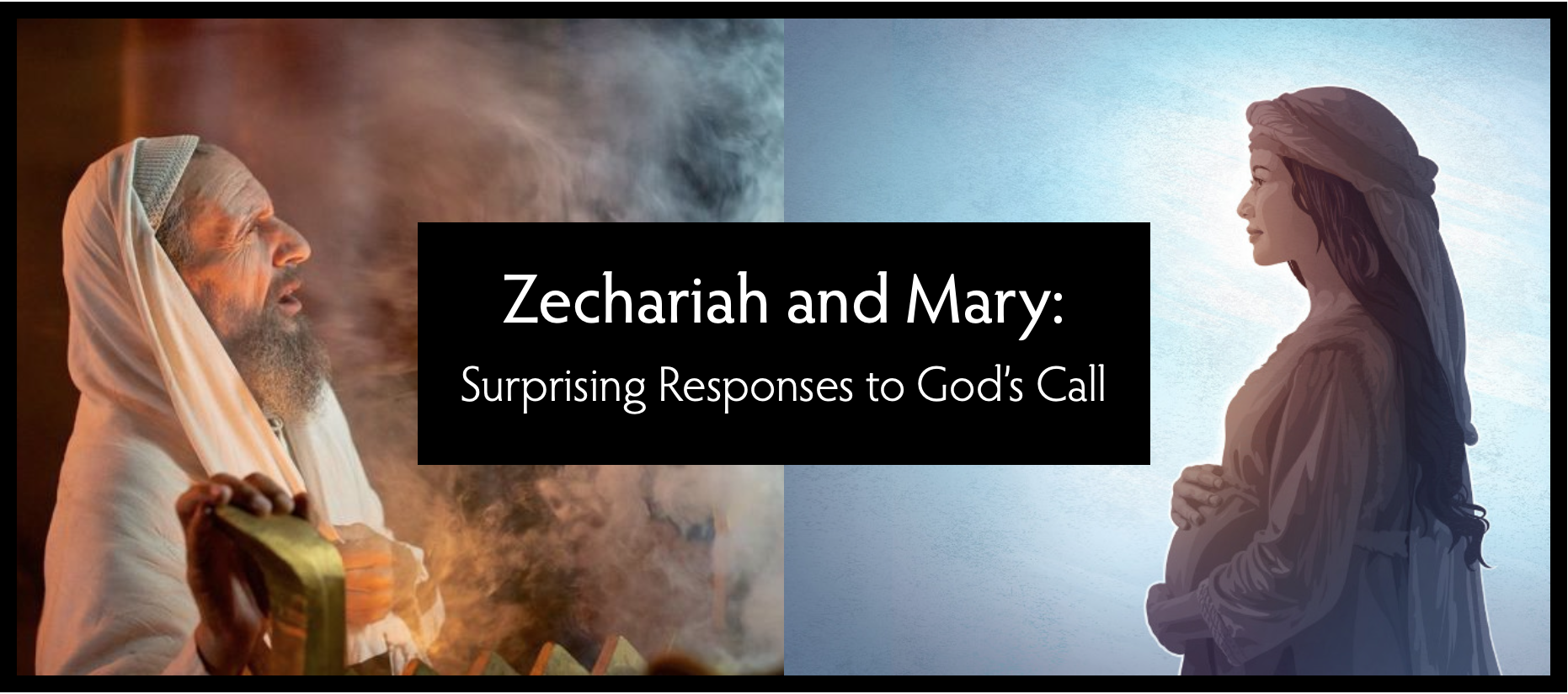
As is likely true for many, at this time of year my thoughts naturally turn to the early chapters of Matthew and Luke and the narratives surrounding the birth of Jesus. This year, I found myself reflecting on the way that Luke portrays the revelations of Gabriel the angel to Zechariah and Mary about the surprising births of their respective sons.
As I have written before, Scripture comes to us as brilliant literature, and we read Scripture better and more faithfully when we are attentive to the literary designs of its authors. In Luke 1, Luke intentionally sets the stories of Zechariah and Mary alongside each other as parallel accounts, and wants his readers to draw conclusions by comparing the two. A quick Google search will reveal that I am hardly the only person to point this out, and you can likely find much better and more detailed analyses than what I offer below. Nevertheless, here are my own brief thoughts.
Zechariah
We are introduced to Zechariah in Luke 1.5. Both he and his wife Elizabeth are from the tribe of Levi, and Zechariah serves as a priest. Both of them are “righteous before God, walking blamelessly in all the commandments and statues of the Lord” (Luke 1.6). Priests and especially chief priests will not always be portrayed positively in Luke’s gospel, but Zechariah is certainly introduced in positive terms. However, he and Elizabeth have lived a life characterized by wanting and heartache: they have no children because Elizabeth is barren, and it is now too late, because they are very old.
While serving in the temple as a priest, an angel appears to him: “Zechariah was troubled when he saw him, and fear fell upon him” (Luke 1.12). The angel tells him not to be afraid, that his prayer had been heard, and that Elizabeth would bear a son who would be named John, who would be great before the Lord, and who, in the spirit of Elijah, would help prepare people to make ready for the Lord.
Zechariah responds in disbelief: “How shall I know this? For I am an old man, and my wife is advanced in years?”[1] To be sure, this is surprising news, but a Priest of Israel could perhaps be expected to be better prepared to accept it, considering that Father Abraham, the progenitor of the Israelite people, experienced a very similar situation. Gabriel at least seemed to expect so, and he tells Zechariah that, as a result of his lack of belief, he will be unable to speak until the day of his son’s birth.[2]
Luke’s narrative diverges at this point to introduce us to Mary (see below). Zechariah’s story resumes later: just as Gabriel had predicted, Elizabeth became pregnant, and Zechariah remains mute until baby John is born. At that point, Zechariah’s tongue is loosened and he blesses God. He then goes on to prophesy about the salvation of God, His faithfulness to the descendants of Abraham, and the special role that John will play in God’s salvific plan.
Mary
We are introduced to Mary in Luke 1.26. She is described as a virgin betrothed to a man named Joseph from the house of David. Gabriel appears to her: “Greetings, O favored one, the Lord is with you!” (Luke 1.28.) She, like Zechariah, is greatly troubled, and is similarly reassured by Gabriel, who tells her not to be afraid, and then lets her know that she will bear a son named Jesus who will be called the Son of the Most High, and who will sit on the throne of David.
Mary responds with confusion: “How will this be, since I am a virgin?” It is likely that Mary is not very old at this point (probably still a teenager), but she is old enough to know that there is no natural way that she can be pregnant. Unlike Zechariah, Gabriel does not respond to Mary with any sort of punishment; rather, he gives her an explanation: it is by the power of the Holy Spirit that she will conceive, the child she bears will be called holy, and as evidence that God is capable of bringing all of this about, her own relative Elizabeth is pregnant as well, despite her age and barrenness. “For nothing will be impossible with God” (Luke 1.37).
Mary responds with humility: “Behold, I am the servant of the Lord; let it be to me according to your word” (Luke 1.37).
Mary then goes to visit her cousin Elizabeth, and stays with her for about three months. When Elizabeth hears Mary’s initial greeting, the baby leaps within her womb,[3] and Elizabeth talks about how blessed she is to be hosting the “mother of my Lord.” She then praises Mary: “blessed is she who believed that there would be fulfillment of what was spoken to her from the Lord” (Luke 1.45). This seems to underscore a fundamental difference in Mary’s response to Gabriel compared to Zechariah despite the superficial similarities: Zechariah was disbelieving; Mary was confused, but faithful.
Zechariah was disbelieving; Mary was confused, but faithful. Share on XMary then goes on to speak the beautiful words of the Magnificat, praising the God who looks down on the humble to raise them up, and who shows faithfulness to the descendants of Abraham.
Similarities and Differences
Luke has written these narratives in parallel fashion, and we are meant to compare them. Notice some of the following similarities and dissimilarities:
- Zechariah is old; the indication is that Mary, unwed and still a virgin, is quite young.
- Zechariah and Mary are both faithful believers in YHWH, the God of Abraham, Isaac, and Jacob.
- Zechariah may or may not have been wealthy, but as an aged priest, he would have been a respected member of Jewish society and a religious expert. We have multiple indications that Mary was decidedly not wealthy, and that, combined with her age, marital status, and gender, would indicate that she certainly would not have been a highly respected member of Jewish society.
- Gabriel the angel appears to both to give them surprising news about impending miraculous pregnancies.[4]
- Zechariah and Mary are both greatly troubled by Gabriel’s appearance, and have to be reassured to not be afraid.
- Although both pregnancies are unnatural and miraculous, that of Elizabeth (and Zechariah) has been heard of before: the famous ancestors of the Israelite people, Abraham and Sarah, had a similar story. Mary’s pregnancy is unprecedented.
- In both of his announcements to Zechariah and Mary, Gabriel mentions the special role that both promised sons will grow up to play: John will prepare people for Jesus (indeed, just as in some ways, Elizabeth’s pregnancy will prepare for Mary’s pregnancy), and Jesus will sit upon the throne of David as the Son of God and promised Messiah.
- The respected religious leader balks at the message; he seeks proof, is rebuked, and receives the sign of silence for his disbelief. The lowly teenage girl is confused by the message; she humbly submits to what she is told and is praised for her faithfulness…by the wife of the doubting religious leader!
- Both Mary and Zechariah offer words of praise and prophecy, centering on the God who works in surprising ways in faithfulness to His promises to Abraham.
I’m confident that much more could be said, but these are immediate points of comparison that came to my attention.
So what are we to make of this? Again, I am sure much could be said, but I think that perhaps one of the main points is simply this: often, God does not work as we might expect. The incarnation of Jesus is a multi-faceted, many-layered example of shattered expectations:
- The basic idea that the omnipotent God of the universe would become mortal and limited flesh at all is shocking.
- That God would choose to become flesh among an oppressed and disempowered people group is shocking.
- That God would choose to become flesh not in the circles of the religious elite, but through an unwed teenage girl is shocking.
I do not believe we should be too hard on Zechariah. Remember, he is praised as a righteous man, and despite his hesitating belief, God honors the faithfulness of this aged priest, and gives Zechariah and Elizabeth the honor of birthing and raising the Forerunner of the Messiah. But the greatest honor is reserved for the unwed, pregnant teenager who humbly offers her life in service to the Lord. Mary’s soul “magnified the Lord” (Luke 1.46), but, indeed, He has magnified her as well.
May we follow Mary’s example and say, “Behold, I am the servant of the Lord; let it be to me according to your word.”
May we, like Mary, say, “Behold, I am the servant of the Lord; let it be to me according to your word.” Share on X[1]In Greek, Zechariah’s question is something like, “By what [thing? sign?] shall I know this?”—there is an implied object that is left unspecified, but Zechariah may be asking Gabriel for proof that what he has said will actually come to be.
[2]It seems that Zechariah gets the sign he is asking for, though it is unlikely that it is the sign that he would have preferred!
[3]John’s prenatal recognition of Jesus (or the mother of Jesus) seems to me to have striking theological significance in current debates regarding the personhood of infants prior to birth.
[4]Let this serve as your periodic reminder that biblical angels are not cute or cuddly; they are terrifying to behold.








0 Comments
1 Pingback