The online journal of Luke Dockery

Tag: Mary (Page 1 of 2)

Reimagining the Birth of Jesus

The birth of Jesus is one of those Bible stories that has been told and retold so often and in so many forms that I think we often fail to pay close attention to what the Bible actually teaches. Indeed, there are actually two accounts of the birth of Jesus (one in Matthew and the other in Luke), and while the two can be combined to give us a fuller picture of what occurred, they also have their own unique points of emphases. For example, the Gospel of Luke emphasizes the different ways that Zechariah and Mary responded when Gabriel appeared to them to inform them about the miraculous births they would soon experience.

Although it is a good thing that this story has seeped into our collective consciousness, there are certainly downsides to letting our understanding of biblical reality be informed primarily by children’s pageants, nativity scenes, and sentimental Christmas cards: we can miss what the Bible actually teaches, along with some of the full implications of those teachings.

That’s one of the things I love about this illustration by Everett Patterson. It is a creative reimagining of the nativity story, recast in modern times, and I think it is both beautiful and brilliant.

Image Credit: Everett Patterson

I used this image in a recent Bible class, having my students first read the birth narratives in Matthew and Luke, and then view the image and seek to interpret it in light of what they had read, and highlight all of the biblical allusions that they observed.

For me, this biggest takeaway is this: with 2,000 years of hindsight, I think it is so easy for us to think of the pregnant Mary and her betrothed  Joseph, seeking a place for Jesus to be born and to think to ourselves, “I would totally let them come into my house so the Savior could be born in comfort.” But what about this: young, poor, brown-skinned people from out of town, unmarried, with the teenage girl very obviously pregnant? If you were to pull up to the convenience store in this image, how likely would you be to invite these folks into your home?

Suddenly, this becomes an uncomfortable story rather than a sentimental one: we are made aware of the messiness of the birth of the Messiah as it is re-contextualized with modern, complicated notions of poverty, immigration, and teenage pregnancy. And I love that, because it is much more faithful to the biblical reality: the birth of Jesus was messy, in all sorts of ways. It’s really not the source material for children’s pageants.

How many biblical allusions or hidden signs can you find in the picture above? Here is a list that we came up with in class (you may want to stop and look first before reading the “spoilers” below):

  • Dave’s City = Bethlehem, the City of David
  • No Vacancy = No room at the Inn (although the “Inn” was likely a guest room)
  • New Man ger = manger
  • Weisman Cigarettes = the magi
  • Good News candy bar = gospel
  • Starr Beer = the star that guided the shepherds and magi
  • Dove = the Holy Spirit at Jesus’ baptism
  • Joseph and Mary both have “halos” around their heads
  • Joseph calls around looking for a place to stay
  • Elect Herod Antipas = a reference to the evil ruler who will seek Baby Jesus’s life
  • Jose = Joseph’s name
  • Mary on the horse = the journey from Nazareth to Bethlehem
  • Nazareth high school = Mary is young and from out of town
  • Word and Flesh graffiti = the Word became flesh and dwelt among us (John 1.14)
  • Zeke 34.15-16 = Ezekiel 34.15-16, which talks about God shepherding His people
  • Shepherd Watches = the shepherds watching their flocks
  • Glad Tide = Gabriel to Mary, “I bring you glad tidings of great joy”
  • The plant = Isaiah 53.1-2, which speaks of the Messiah as a growing tender shoot
  • Save M = the partially obscured sign behind Mary’s head suggests “Ave Maria”
  • Gloria on the telephone box pole

There are a few we may have missed or that I am unsure about (Out of Order on the horse? Fre HBO?), but the list above shows how thoughtful this piece of artwork is. I am thankful for it, and the way it encourages us to think again about the rough edges of the birth of Jesus of Nazareth and gives a fresh perspective on the young parents who accepted a challenging calling from the Father and proved faithful in stewarding His Son.
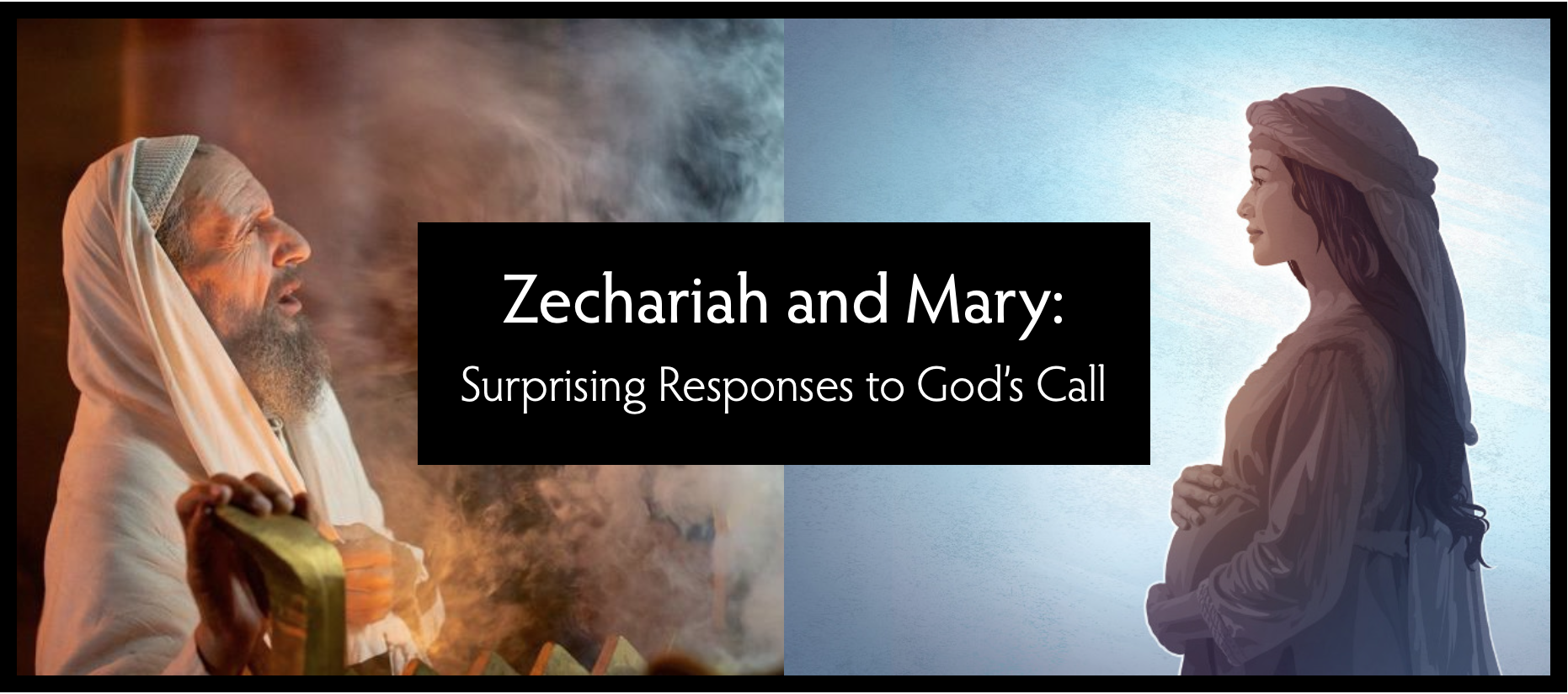
Zechariah and Mary: Surprising Responses to God’s Call

As is likely true for many, at this time of year my thoughts naturally turn to the early chapters of Matthew and Luke and the narratives surrounding the birth of Jesus. This year, I found myself reflecting on the way that Luke portrays the revelations of Gabriel the angel to Zechariah and Mary about the surprising births of their respective sons.

As I have written before, Scripture comes to us as brilliant literature, and we read Scripture better and more faithfully when we are attentive to the literary designs of its authors. In Luke 1, Luke intentionally sets the stories of Zechariah and Mary alongside each other as parallel accounts, and wants his readers to draw conclusions by comparing the two. A quick Google search will reveal that I am hardly the only person to point this out, and you can likely find much better and more detailed analyses than what I offer below. Nevertheless, here are my own brief thoughts.


Zechariah

We are introduced to Zechariah in Luke 1.5. Both he and his wife Elizabeth are from the tribe of Levi, and Zechariah serves as a priest. Both of them are “righteous before God, walking blamelessly in all the commandments and statues of the Lord” (Luke 1.6). Priests and especially chief priests will not always be portrayed positively in Luke’s gospel, but Zechariah is certainly introduced in positive terms. However, he and Elizabeth have lived a life characterized by wanting and heartache: they have no children because Elizabeth is barren, and it is now too late, because they are very old.

While serving in the temple as a priest, an angel appears to him: “Zechariah was troubled when he saw him, and fear fell upon him” (Luke 1.12). The angel tells him not to be afraid, that his prayer had been heard, and that Elizabeth would bear a son who would be named John, who would be great before the Lord, and who, in the spirit of Elijah, would help prepare people to make ready for the Lord.

Zechariah responds in disbelief: “How shall I know this? For I am an old man, and my wife is advanced in years?”[1] To be sure, this is surprising news, but a Priest of Israel could perhaps be expected to be better prepared to accept it, considering that Father Abraham, the progenitor of the Israelite people, experienced a very similar situation. Gabriel at least seemed to expect so, and he tells Zechariah that, as a result of his lack of belief, he will be unable to speak until the day of his son’s birth.[2]

Luke’s narrative diverges at this point to introduce us to Mary (see below). Zechariah’s story resumes later: just as Gabriel had predicted, Elizabeth became pregnant, and Zechariah remains mute until baby John is born. At that point, Zechariah’s tongue is loosened and he blesses God. He then goes on to prophesy about the salvation of God, His faithfulness to the descendants of Abraham, and the special role that John will play in God’s salvific plan.

Mary

We are introduced to Mary in Luke 1.26. She is described as a virgin betrothed to a man named Joseph from the house of David. Gabriel appears to her: “Greetings, O favored one, the Lord is with you!” (Luke 1.28.) She, like Zechariah, is greatly troubled, and is similarly reassured by Gabriel, who tells her not to be afraid, and then lets her know that she will bear a son named Jesus who will be called the Son of the Most High, and who will sit on the throne of David.

Mary responds with confusion: “How will this be, since I am a virgin?” It is likely that Mary is not very old at this point (probably still a teenager), but she is old enough to know that there is no natural way that she can be pregnant. Unlike Zechariah, Gabriel does not respond to Mary with any sort of punishment; rather, he gives her an explanation: it is by the power of the Holy Spirit that she will conceive, the child she bears will be called holy, and as evidence that God is capable of bringing all of this about, her own relative Elizabeth is pregnant as well, despite her age and barrenness. “For nothing will be impossible with God” (Luke 1.37).

Mary responds with humility: “Behold, I am the servant of the Lord; let it be to me according to your word” (Luke 1.37).

Mary then goes to visit her cousin Elizabeth, and stays with her for about three months. When Elizabeth hears Mary’s initial greeting, the baby leaps within her womb,[3] and Elizabeth talks about how blessed she is to be hosting the “mother of my Lord.” She then praises Mary: “blessed is she who believed that there would be fulfillment of what was spoken to her from the Lord” (Luke 1.45). This seems to underscore a fundamental difference in Mary’s response to Gabriel compared to Zechariah despite the superficial similarities: Zechariah was disbelieving; Mary was confused, but faithful.

Zechariah was disbelieving; Mary was confused, but faithful. Share on X

Mary then goes on to speak the beautiful words of the Magnificat, praising the God who looks down on the humble to raise them up, and who shows faithfulness to the descendants of Abraham.

Similarities and Differences

Luke has written these narratives in parallel fashion, and we are meant to compare them. Notice some of the following similarities and dissimilarities:

  • Zechariah is old; the indication is that Mary, unwed and still a virgin, is quite young.
  • Zechariah and Mary are both faithful believers in YHWH, the God of Abraham, Isaac, and Jacob.
  • Zechariah may or may not have been wealthy, but as an aged priest, he would have been a respected member of Jewish society and a religious expert. We have multiple indications that Mary was decidedly not wealthy, and that, combined with her age, marital status, and gender, would indicate that she certainly would not have been a highly respected member of Jewish society.
  • Gabriel the angel appears to both to give them surprising news about impending miraculous pregnancies.[4]
  • Zechariah and Mary are both greatly troubled by Gabriel’s appearance, and have to be reassured to not be afraid.
  • Although both pregnancies are unnatural and miraculous, that of Elizabeth (and Zechariah) has been heard of before: the famous ancestors of the Israelite people, Abraham and Sarah, had a similar story. Mary’s pregnancy is unprecedented.
  • In both of his announcements to Zechariah and Mary, Gabriel mentions the special role that both promised sons will grow up to play: John will prepare people for Jesus (indeed, just as in some ways, Elizabeth’s pregnancy will prepare for Mary’s pregnancy), and Jesus will sit upon the throne of David as the Son of God and promised Messiah.
  • The respected religious leader balks at the message; he seeks proof, is rebuked, and receives the sign of silence for his disbelief. The lowly teenage girl is confused by the message; she humbly submits to what she is told and is praised for her faithfulness…by the wife of the doubting religious leader!
  • Both Mary and Zechariah offer words of praise and prophecy, centering on the God who works in surprising ways in faithfulness to His promises to Abraham.

I’m confident that much more could be said, but these are immediate points of comparison that came to my attention.


So what are we to make of this? Again, I am sure much could be said, but I think that perhaps one of the main points is simply this: often, God does not work as we might expect. The incarnation of Jesus is a multi-faceted, many-layered example of shattered expectations:

  • The basic idea that the omnipotent God of the universe would become mortal and limited flesh at all is shocking.
  • That God would choose to become flesh among an oppressed and disempowered people group is shocking.
  • That God would choose to become flesh not in the circles of the religious elite, but through an unwed teenage girl is shocking.

I do not believe we should be too hard on Zechariah. Remember, he is praised as a righteous man, and despite his hesitating belief, God honors the faithfulness of this aged priest, and gives Zechariah and Elizabeth the honor of birthing and raising the Forerunner of the Messiah. But the greatest honor is reserved for the unwed, pregnant teenager who humbly offers her life in service to the Lord. Mary’s soul “magnified the Lord” (Luke 1.46), but, indeed, He has magnified her as well.

May we follow Mary’s example and say, “Behold, I am the servant of the Lord; let it be to me according to your word.”

May we, like Mary, say, “Behold, I am the servant of the Lord; let it be to me according to your word.” Share on X

[1]In Greek, Zechariah’s question is something like, “By what [thing? sign?] shall I know this?”—there is an implied object that is left unspecified, but Zechariah may be asking Gabriel for proof that what he has said will actually come to be.

[2]It seems that Zechariah gets the sign he is asking for, though it is unlikely that it is the sign that he would have preferred!

[3]John’s prenatal recognition of Jesus (or the mother of Jesus) seems to me to have striking theological significance in current debates regarding the personhood of infants prior to birth.

[4]Let this serve as your periodic reminder that biblical angels are not cute or cuddly; they are terrifying to behold.

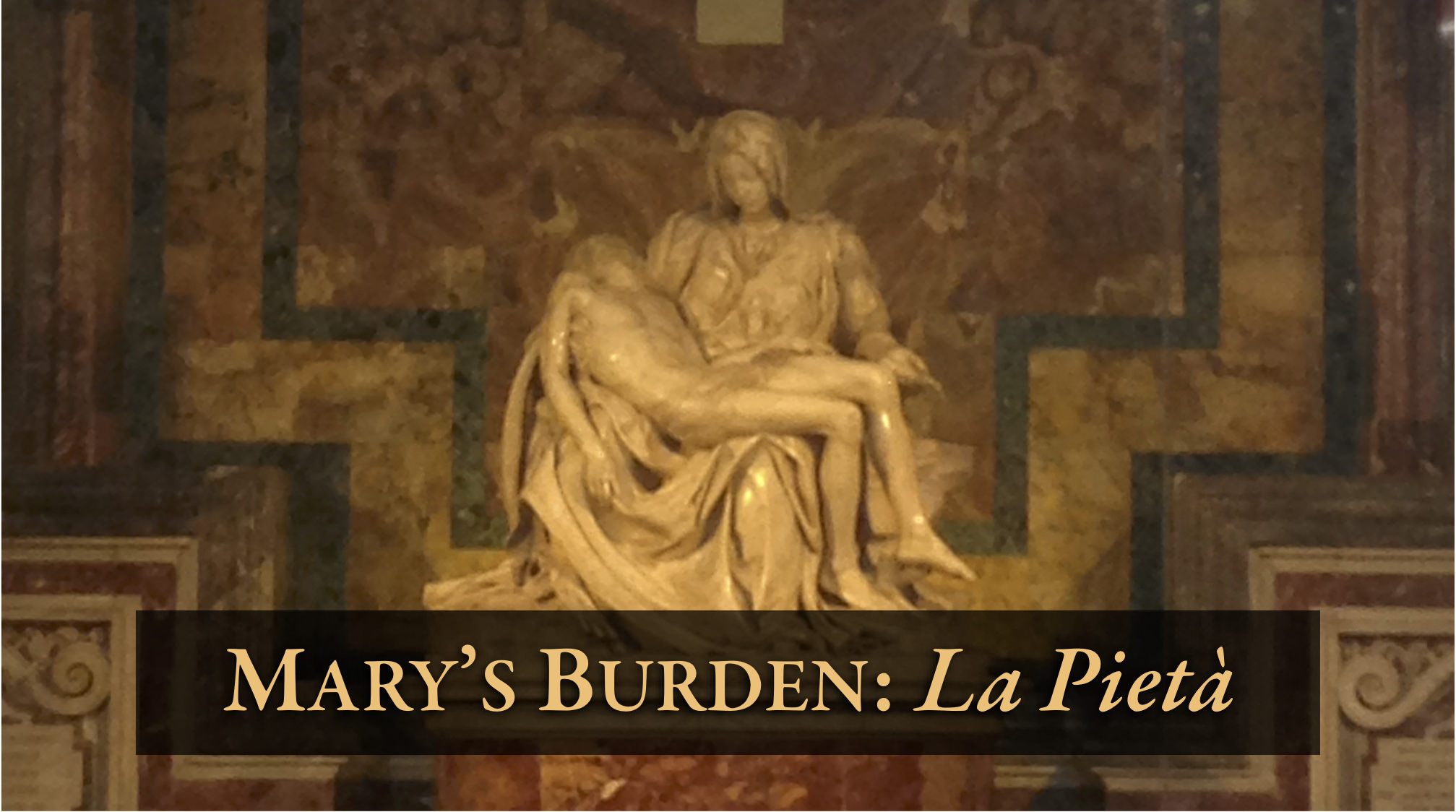
Mary’s Burden: La Pietà

Last fall, I had the incredible blessing of spending the better part of a week in Rome with Caroline in (belated) celebration of our tenth anniversary. We got to see a lot of wonderful sights (see pictures here), and I had many favorites, but without doubt the most moving thing I saw was Michelangelo’s La Pietà. 

The French Cardinal Jean de Bilheres commissioned Michelangelo to create the sculpture for his funeral monument, and it was completed in 1499. Later, in the 18th century, it was moved to St. Peter’s Basilica in the Vatican, where it remains today. The marble statue depicts the body of Jesus on His mother’s lap following the crucifixion.

It is a marvelous statue, revealing the tremendous talents of the master sculptor of the Renaissance: the all-too-human body of Jesus hangs lifeless, the folds of Mary’s dress reveal the great weight she carries, literally and physically, the outstretched palm reflects the great sacrifice that she, too, has made.

I feel confident in saying that Roman Catholicism places too much emphasis on the role of Mary, and there are undoubtedly doctrines that have been assembled and developed over the years that are not found in Scripture. 

At the same time, I wonder if those of us from a Protestant background have at times been guilty of emphasizing her too little. She must have been a special young lady to be chosen to be the vessel in which the Word would become Flesh, and I think close attention to the text and the way young Mary responds to the news of her unexpected pregnancy reveals just that.

And oh, what a weight that she carried! To watch her innocent Son die, bearing the sins of the world…and hers too. As the Roman spear pierced the side of Jesus, so a sword pierced Mary’s own soul as she watched it happen (just as was prophesied by Simeon in Luke 7.35).

And for me, seeing La Pietà helped drive that reality home more powerfully than I had ever felt before.

A Difficult Birth, Part 3: The Danger of Christmas

This week I’ve been discussing why the Birth of Jesus was a difficult one, and how we tend to smooth out the rough edges of the Christmas story. But ultimately, it’s a good thing for us that it was a difficult birth, because it helps us to see how to better live our difficult lives.

The first post addressed the element of scandal in Christ’s birth, and yesterday’s post focused on the discomfort of Christmas.

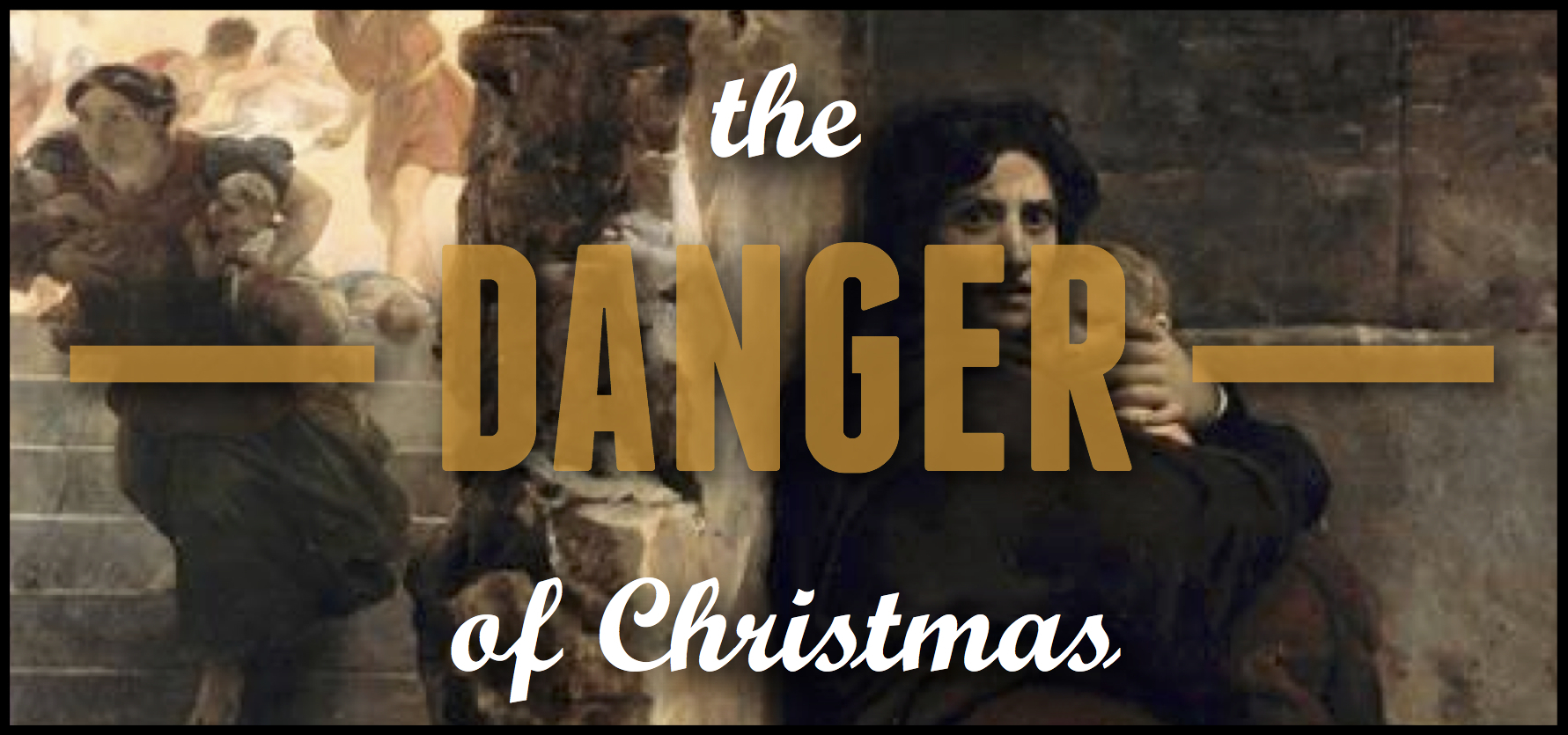
The Danger of Christmas

In those nice Hallmark cards it sure seems like Jesus is plenty safe, but Matthew 2 shows us the danger that was involved in this story. There we learn about the visit of the wise men and there is a lot about the wise men that we don’t know, a lot of things we commonly think of that might not have been true.

Were there three wise men? We don’t know; we often assume that there were three because there were three gifts mentioned, but the Bible doesn’t actually give us the number. Also, if you read carefully, the wise men weren’t there with Jesus right when he was born. Matthew 2.11 says “And going into the house they saw the child with Mary his mother…”, so by the time the wise men saw Jesus, he was no longer in the manger and was instead in a house.

The wise men were from “the east”, probably Babylon or Persia; they would have been astrologers, followers of the stars.

These men come to King Herod in Jerusalem and they ask him, “Where is he who has been born king of the Jews?”

And Herod is troubled by this, because he kinda thought that he was the king of the Jews, and he certainly didn’t want to have any rivals for the throne. In fact we know from history, Herod was actually a pretty terrible guy, and to protect his power, he murdered his own wife, several of his sons, and some other relatives as well. And so it’s no surprise that he wants to eliminate this baby king that had been born.

So Herod brings the chief priests and scribes together in order to learn where the Christ, the Messiah, was supposed to be born, and they point him to Micah 5.2 and say that he’s supposed to be born in Bethlehem.

Then Herod calls the wise men back, encourages them to search for Jesus, and then to return and let him know where He is when they find Him. And the wise men do find Jesus, but they’re warned in a dream not to tell Herod anything, and so they go home a different way. At the same time, an angel of the Lord appears to Joseph in a dream in Matthew 2.13 and warns him that Herod wants to kill Jesus, so in the middle of the night, Joseph scoops up his wife and infant son, and they flee to Egypt. They leave the country.

At some point, Herod realizes that the wise men aren’t coming back and that they’ve tricked him. Enraged, he decides to kill all the male children in Bethlehem and in the whole surrounding region who are 2 years of age and under, just to make sure.

And so tragedy and heartbreak enters homes all over, as mothers have their baby boys torn from their arms, fathers watch helplessly, and soldiers draw their weapons, carrying out the orders of a murderous madman.

You don’t see all this in the Christmas cards, but the birth of Jesus was a dangerous time.

Danger in Our Lives

Just like we try to smooth over the danger in the Birth of Jesus, a lot of times we try to do that in our lives as well.

To be honest, most of us don’t actually face a lot of danger in our lives. It might be different if you are in the military or serve as a policeman or fireman, but those are careers; rarely do we face danger in the world today for the cause of Christ, unless you’re a missionary (where danger can be a very real thing).

What we do face though, is the reality of living in what is called a post-Christian society. Living in a society like this doesn’t put us in the path of the same kind of life-and-death danger we talked about in conjunction with the birth of Jesus, but it does mean that Christians can face social and perhaps economic fallout for trying to live according to the teachings of the Bible and sharing those teachings with others.

If you’ve followed the Duck Dynasty saga this past week you know exactly what I’m talking about. I don’t want to get off topic here by addressing that issue in detail, but I don’t think there’s any denying that some of teachings of the Bible cause a great deal of backlash with our society today. At times in can be easy for us to feel like we get picked on just for believing what the Bible says.

But I think Christians of the first century would look at the “persecutions” we go through in our country today and kind of chuckle, because it’s nothing like what they had to deal with. At least for now, no one here is in danger of being fed to lions in the Colosseum or being beheaded and having their heads used as lanterns in the emperor’s garden.

And to those Christians, our brothers and sisters of two millennia ago, the writers of the New Testament didn’t tell them to smooth over the dangers of the Christian life:

They didn’t tell them to avoid persecution at all cost…

They didn’t tell them to fight against it…

They didn’t tell them to run to Facebook in protest…

They told them to be ready for it, to be prepared, because it was coming…

These early Christians were reminded that Jesus was persecuted and killed, and that if that happened to Him, then surely His followers could expect to face trials and persecutions as well. And the same goes for us. But if we do face trials and persecutions for the cause of Christ, that’s okay: it’s a sign that we’re doing it right.

Don’t try to avoid the dangers of the Christian life. Don’t run from the persecutions. Be prepared for them, and glorify God when they come. Be a living sacrifice for Him.

Conclusion—A Difficult Birth Indeed

The birth of Jesus—as it really was—was a difficult birth. It doesn’t really fit in a children’s story or on a Christmas card. But for us, that’s good news! It shows us how to live our difficult lives!

The scandal of Jesus’ birth reminds us that we don’t have to fear the scandal in our lives or the sin in the world. Jesus has overcome sin! He wants to take it away from you if you’ll let Him! His blood can cleanse the sin of the world, if we’ll share it!

The discomfort of Jesus’ birth reminds us that comfort is not all it’s cracked up to be. It’s not God’s goal for your life. Seek to live a life that is uncomfortably devoted to God!

The danger of Jesus’ birth reminds us of the possibility—nay, the likelihood—that we’ll face trials and persecutions as we strive to follow Jesus. Don’t try to avoid them, don’t fret about them; glorify God through them.

Praise be to God for the oh-so-difficult birth of His Son!

A Difficult Birth, Part 2: The Discomfort of Christmas

In case you missed it, yesterday’s post introduced the idea of why the Birth of Jesus was a difficult one, and how we tend to smooth out the rough edges of the Christmas story. But ultimately, it’s a good thing for us that it was a difficult birth, because it helps us to see how to better live our difficult lives.

Yesterday’s post specifically addressed the element of scandal in Christ’s birth.

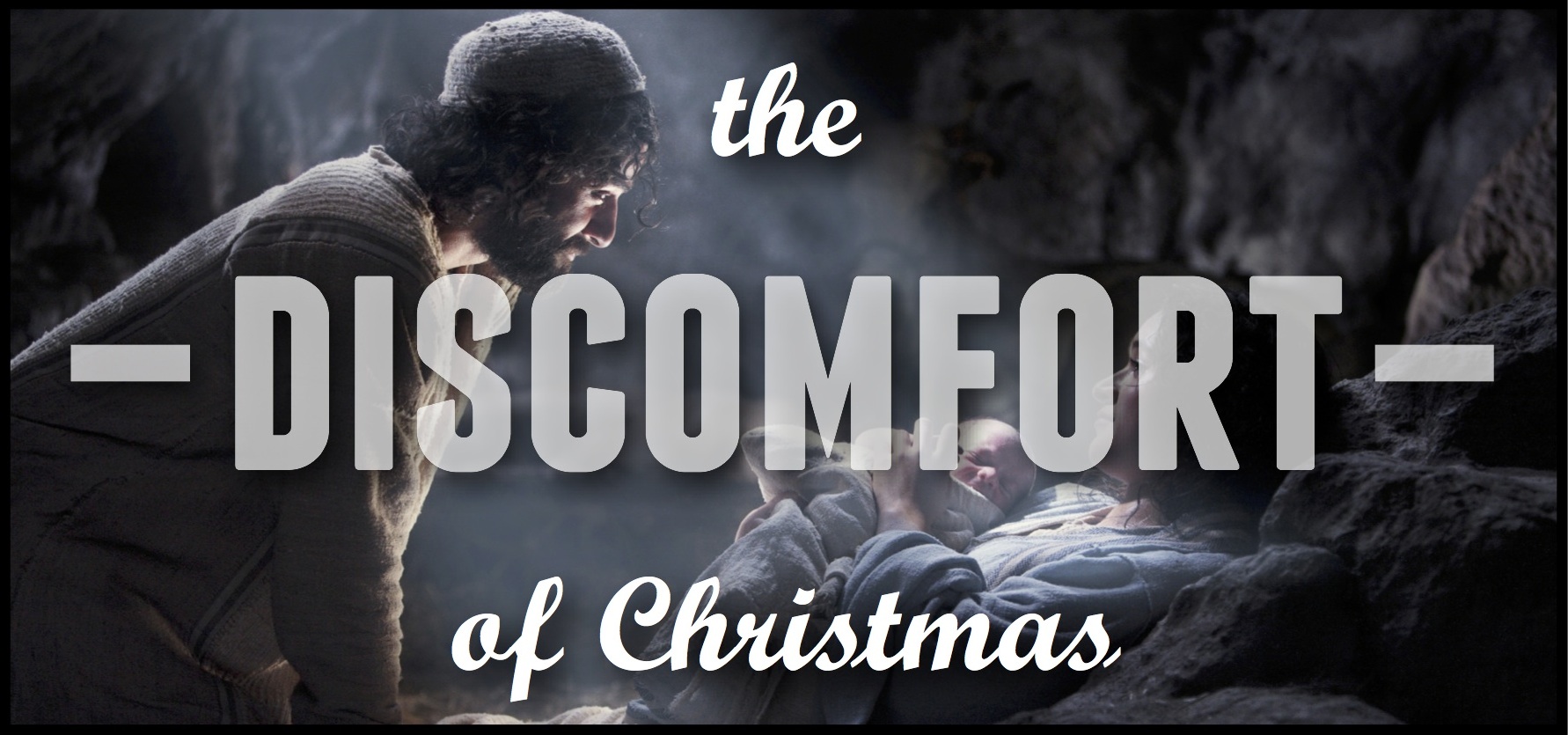
The Discomfort of Christmas

We know from Luke 2.1-7 that Joseph and Mary had traveled to Bethlehem because a census was being taken. Joseph had to return there because it was the city of his ancestors, and so that’s where they were when it was time for Jesus to be born.

As travelers, and especially as travelers expecting a birth, they needed a place to stay. It would have been ideal to stay with relatives, and considering that they were traveling to Joseph’s ancestral home, this is almost certainly what the young couple sought to do. 

Famously, we know that there was “no room at the inn” but it is unlikely that this is a reference to the first century equivalent to the Hilton; rather, the Greek word kataluma generally refers to a small upper room in a private dwelling that was used for showing hospitality to guests. In addition to this guest room, the main portion of the house would be divided into the living area and a separate compartment where animals might be kept, especially overnight.[1]

In the Nativity story, there was no room for Joseph and Mary to stay in their relatives’ guest room (perhaps because other family members were already there), and so they stayed in the main portion of the house instead with the host family and also likely with animals as well.

This perhaps seems nicer than being born in a barn, but make no mistake: the King of kings was born in humble circumstances, in a crowded cottage in a backwater village, surrounded by the smells of livestock. Not a comfortable place.

Discomfort in Our Lives

Just like we try to smooth over the discomfort in the Birth of Jesus, a lot of times we try to do that in our lives as well.

I believe the Bible teaches that God wants a lot of things for your life. He wants you to be saved, he wants you to holy, he wants you to be joyful (which is different than you being “happy”, but that’s a post for a different day); I don’t think that God wants you to be comfortable.

Comfort is a big part of what we want—a nice warm house, nice things, the latest technology to make life easier, relationships with our friends and families that make us feel good, nice vacations and lots of money set aside for retirement, sermons that put a smile on our face and don’t call us to sacrifice—we like comfort, but God doesn’t call us to be comfortable.

If you take the teachings of Jesus seriously, they don’t lead to a comfortable life. A fulfilling life? Yes. A purposeful life? Sure. A blessed life? Absolutely! But not a comfortable one.

Love your enemies…

Seek first the kingdom…

Care for the poor…

Preach the gospel…

Deny yourself, take up your cross and follow Me…

If you take them seriously, the teachings of Jesus will turn your life upside down—they will disrupt your goals, re-arrange your priorities, and change the very lenses through which you view life.

Don’t shy away from discomfort!

Give of your means (to the church, to those in need, to charities) to the point that it hurts, that it makes you less comfortable.

Study the parts of Scripture that are difficult and unsettling.

Force yourself to be around that Christian brother or sister who drives you crazy and figure out how to love them.

Share your faith, even if—especially if— it makes you nervous and makes your heart race.

Don’t shy away from the discomfort of life.


[1] This post has been updated from its original form as I have learned more about the meaning of kataluma and the nature of first-century dwellings. See more at https://www.psephizo.com/biblical-studies/once-more-jesus-was-not-born-in-a-stable/?fbclid=IwAR3WvFDTJw_5SSSCPMjk_T9ZDp4OrSlRC2gSjhs-o3kgGs0IhNPlsO0d6BU

« Older posts

© 2026 The Doc File

Theme by Anders Noren — Up ↑