The online journal of Luke Dockery

Tag: Christmas (Page 2 of 4)

The Hero(ine) of It’s A Wonderful Life

Every year at this time, I make sure to watch It’s A Wonderful Life. In addition to being (easily) the best Christmas movie of all time, it is also in my Top 5 of all movies.

Last year after viewing the film, I wrote a series of tweets that I am now compiling into this short post.

Here is my hot take (or, absolutely obvious observation). While George Bailey, the self-sacrificing Everyman that we root for and admire, is the main character of It’s A Wonderful Life, the hero of the film is actually a heroine: his wife Mary.

  • It is Mary who gives George the courage to give up his dreams (doing big exciting things all over the world) and instead accept his calling (a grueling, grinding life of service to his community).
  • It is Mary who gives George the idea of how to save the Building & Loan during the Depression (foregoing a honeymoon to meet the financial needs of a frantic mob).
  • It is Mary who creatively turns an old abandoned house into a well-kept home for her family (where George, the forward-thinking, would-be engineer could see nothing but a ruin).
  • It is Mary who mobilizes the massive prayer effort that drives the plot of the movie, bringing Clarence Odbody onto the scene and helping George to see how meaningful his life has been.
  • It is Mary who raises the necessary funds to solve the financial crisis that had driven George to the brink of suicide.

In the end, George had a Wonderful Life and was a blessing to so many people, but it was the quiet support of Mary in the background that empowered him to be so. This, I believe, is one of life’s great realities and a central truth of Christianity as well: the most heroic people in life are not necessarily those with wealth, fame, or influence, but those who quietly spend their lives in sacrificial service to others. Isn’t that truly the meaning of Christmas?

The most heroic people in life are not necessarily those with wealth, fame, or influence, but those who quietly spend their lives in sacrificial service to others. Isn’t that truly the meaning of Christmas? Share on X

Reimagining the Birth of Jesus

The birth of Jesus is one of those Bible stories that has been told and retold so often and in so many forms that I think we often fail to pay close attention to what the Bible actually teaches. Indeed, there are actually two accounts of the birth of Jesus (one in Matthew and the other in Luke), and while the two can be combined to give us a fuller picture of what occurred, they also have their own unique points of emphases. For example, the Gospel of Luke emphasizes the different ways that Zechariah and Mary responded when Gabriel appeared to them to inform them about the miraculous births they would soon experience.

Although it is a good thing that this story has seeped into our collective consciousness, there are certainly downsides to letting our understanding of biblical reality be informed primarily by children’s pageants, nativity scenes, and sentimental Christmas cards: we can miss what the Bible actually teaches, along with some of the full implications of those teachings.

That’s one of the things I love about this illustration by Everett Patterson. It is a creative reimagining of the nativity story, recast in modern times, and I think it is both beautiful and brilliant.

Image Credit: Everett Patterson

I used this image in a recent Bible class, having my students first read the birth narratives in Matthew and Luke, and then view the image and seek to interpret it in light of what they had read, and highlight all of the biblical allusions that they observed.

For me, this biggest takeaway is this: with 2,000 years of hindsight, I think it is so easy for us to think of the pregnant Mary and her betrothed  Joseph, seeking a place for Jesus to be born and to think to ourselves, “I would totally let them come into my house so the Savior could be born in comfort.” But what about this: young, poor, brown-skinned people from out of town, unmarried, with the teenage girl very obviously pregnant? If you were to pull up to the convenience store in this image, how likely would you be to invite these folks into your home?

Suddenly, this becomes an uncomfortable story rather than a sentimental one: we are made aware of the messiness of the birth of the Messiah as it is re-contextualized with modern, complicated notions of poverty, immigration, and teenage pregnancy. And I love that, because it is much more faithful to the biblical reality: the birth of Jesus was messy, in all sorts of ways. It’s really not the source material for children’s pageants.

How many biblical allusions or hidden signs can you find in the picture above? Here is a list that we came up with in class (you may want to stop and look first before reading the “spoilers” below):

  • Dave’s City = Bethlehem, the City of David
  • No Vacancy = No room at the Inn (although the “Inn” was likely a guest room)
  • New Man ger = manger
  • Weisman Cigarettes = the magi
  • Good News candy bar = gospel
  • Starr Beer = the star that guided the shepherds and magi
  • Dove = the Holy Spirit at Jesus’ baptism
  • Joseph and Mary both have “halos” around their heads
  • Joseph calls around looking for a place to stay
  • Elect Herod Antipas = a reference to the evil ruler who will seek Baby Jesus’s life
  • Jose = Joseph’s name
  • Mary on the horse = the journey from Nazareth to Bethlehem
  • Nazareth high school = Mary is young and from out of town
  • Word and Flesh graffiti = the Word became flesh and dwelt among us (John 1.14)
  • Zeke 34.15-16 = Ezekiel 34.15-16, which talks about God shepherding His people
  • Shepherd Watches = the shepherds watching their flocks
  • Glad Tide = Gabriel to Mary, “I bring you glad tidings of great joy”
  • The plant = Isaiah 53.1-2, which speaks of the Messiah as a growing tender shoot
  • Save M = the partially obscured sign behind Mary’s head suggests “Ave Maria”
  • Gloria on the telephone box pole

There are a few we may have missed or that I am unsure about (Out of Order on the horse? Fre HBO?), but the list above shows how thoughtful this piece of artwork is. I am thankful for it, and the way it encourages us to think again about the rough edges of the birth of Jesus of Nazareth and gives a fresh perspective on the young parents who accepted a challenging calling from the Father and proved faithful in stewarding His Son.

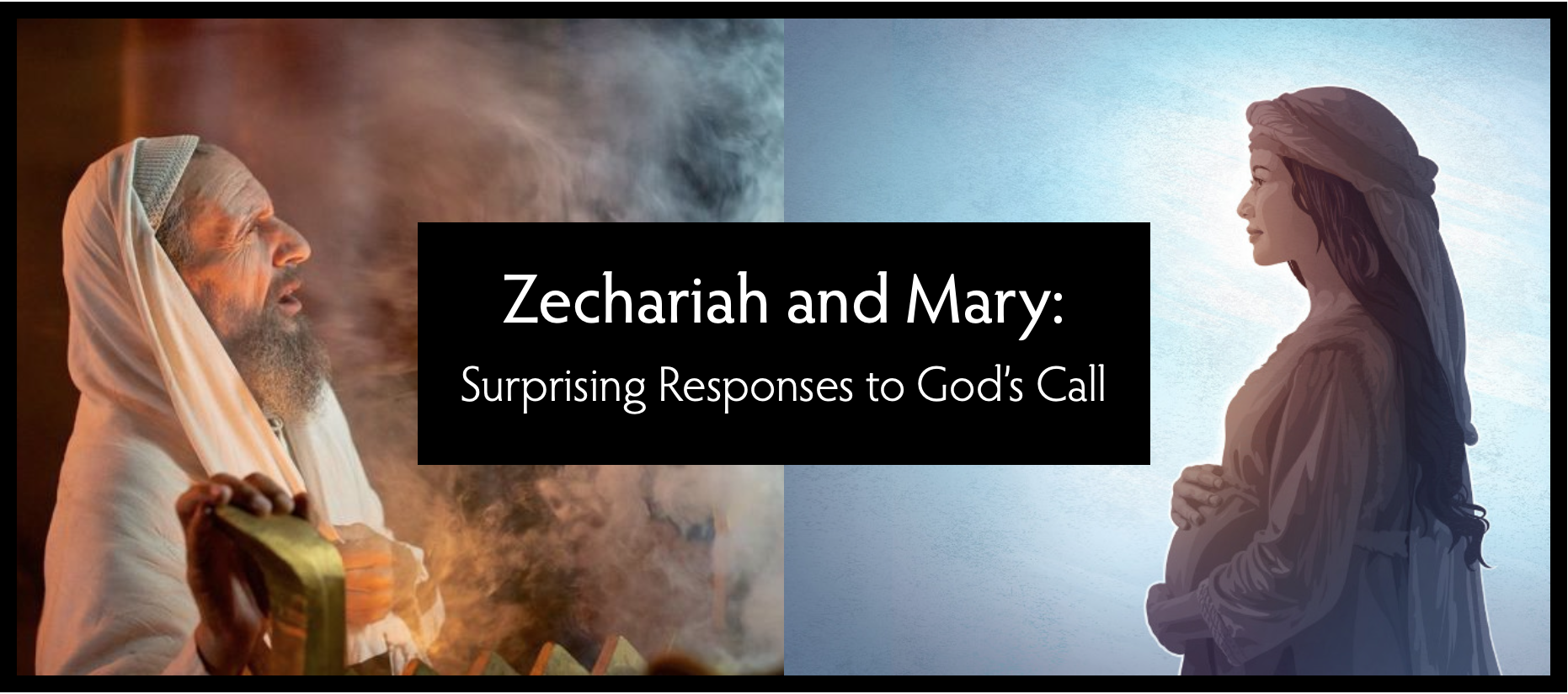
Zechariah and Mary: Surprising Responses to God’s Call

As is likely true for many, at this time of year my thoughts naturally turn to the early chapters of Matthew and Luke and the narratives surrounding the birth of Jesus. This year, I found myself reflecting on the way that Luke portrays the revelations of Gabriel the angel to Zechariah and Mary about the surprising births of their respective sons.

As I have written before, Scripture comes to us as brilliant literature, and we read Scripture better and more faithfully when we are attentive to the literary designs of its authors. In Luke 1, Luke intentionally sets the stories of Zechariah and Mary alongside each other as parallel accounts, and wants his readers to draw conclusions by comparing the two. A quick Google search will reveal that I am hardly the only person to point this out, and you can likely find much better and more detailed analyses than what I offer below. Nevertheless, here are my own brief thoughts.


Zechariah

We are introduced to Zechariah in Luke 1.5. Both he and his wife Elizabeth are from the tribe of Levi, and Zechariah serves as a priest. Both of them are “righteous before God, walking blamelessly in all the commandments and statues of the Lord” (Luke 1.6). Priests and especially chief priests will not always be portrayed positively in Luke’s gospel, but Zechariah is certainly introduced in positive terms. However, he and Elizabeth have lived a life characterized by wanting and heartache: they have no children because Elizabeth is barren, and it is now too late, because they are very old.

While serving in the temple as a priest, an angel appears to him: “Zechariah was troubled when he saw him, and fear fell upon him” (Luke 1.12). The angel tells him not to be afraid, that his prayer had been heard, and that Elizabeth would bear a son who would be named John, who would be great before the Lord, and who, in the spirit of Elijah, would help prepare people to make ready for the Lord.

Zechariah responds in disbelief: “How shall I know this? For I am an old man, and my wife is advanced in years?”[1] To be sure, this is surprising news, but a Priest of Israel could perhaps be expected to be better prepared to accept it, considering that Father Abraham, the progenitor of the Israelite people, experienced a very similar situation. Gabriel at least seemed to expect so, and he tells Zechariah that, as a result of his lack of belief, he will be unable to speak until the day of his son’s birth.[2]

Luke’s narrative diverges at this point to introduce us to Mary (see below). Zechariah’s story resumes later: just as Gabriel had predicted, Elizabeth became pregnant, and Zechariah remains mute until baby John is born. At that point, Zechariah’s tongue is loosened and he blesses God. He then goes on to prophesy about the salvation of God, His faithfulness to the descendants of Abraham, and the special role that John will play in God’s salvific plan.

Mary

We are introduced to Mary in Luke 1.26. She is described as a virgin betrothed to a man named Joseph from the house of David. Gabriel appears to her: “Greetings, O favored one, the Lord is with you!” (Luke 1.28.) She, like Zechariah, is greatly troubled, and is similarly reassured by Gabriel, who tells her not to be afraid, and then lets her know that she will bear a son named Jesus who will be called the Son of the Most High, and who will sit on the throne of David.

Mary responds with confusion: “How will this be, since I am a virgin?” It is likely that Mary is not very old at this point (probably still a teenager), but she is old enough to know that there is no natural way that she can be pregnant. Unlike Zechariah, Gabriel does not respond to Mary with any sort of punishment; rather, he gives her an explanation: it is by the power of the Holy Spirit that she will conceive, the child she bears will be called holy, and as evidence that God is capable of bringing all of this about, her own relative Elizabeth is pregnant as well, despite her age and barrenness. “For nothing will be impossible with God” (Luke 1.37).

Mary responds with humility: “Behold, I am the servant of the Lord; let it be to me according to your word” (Luke 1.37).

Mary then goes to visit her cousin Elizabeth, and stays with her for about three months. When Elizabeth hears Mary’s initial greeting, the baby leaps within her womb,[3] and Elizabeth talks about how blessed she is to be hosting the “mother of my Lord.” She then praises Mary: “blessed is she who believed that there would be fulfillment of what was spoken to her from the Lord” (Luke 1.45). This seems to underscore a fundamental difference in Mary’s response to Gabriel compared to Zechariah despite the superficial similarities: Zechariah was disbelieving; Mary was confused, but faithful.

Zechariah was disbelieving; Mary was confused, but faithful. Share on X

Mary then goes on to speak the beautiful words of the Magnificat, praising the God who looks down on the humble to raise them up, and who shows faithfulness to the descendants of Abraham.

Similarities and Differences

Luke has written these narratives in parallel fashion, and we are meant to compare them. Notice some of the following similarities and dissimilarities:

  • Zechariah is old; the indication is that Mary, unwed and still a virgin, is quite young.
  • Zechariah and Mary are both faithful believers in YHWH, the God of Abraham, Isaac, and Jacob.
  • Zechariah may or may not have been wealthy, but as an aged priest, he would have been a respected member of Jewish society and a religious expert. We have multiple indications that Mary was decidedly not wealthy, and that, combined with her age, marital status, and gender, would indicate that she certainly would not have been a highly respected member of Jewish society.
  • Gabriel the angel appears to both to give them surprising news about impending miraculous pregnancies.[4]
  • Zechariah and Mary are both greatly troubled by Gabriel’s appearance, and have to be reassured to not be afraid.
  • Although both pregnancies are unnatural and miraculous, that of Elizabeth (and Zechariah) has been heard of before: the famous ancestors of the Israelite people, Abraham and Sarah, had a similar story. Mary’s pregnancy is unprecedented.
  • In both of his announcements to Zechariah and Mary, Gabriel mentions the special role that both promised sons will grow up to play: John will prepare people for Jesus (indeed, just as in some ways, Elizabeth’s pregnancy will prepare for Mary’s pregnancy), and Jesus will sit upon the throne of David as the Son of God and promised Messiah.
  • The respected religious leader balks at the message; he seeks proof, is rebuked, and receives the sign of silence for his disbelief. The lowly teenage girl is confused by the message; she humbly submits to what she is told and is praised for her faithfulness…by the wife of the doubting religious leader!
  • Both Mary and Zechariah offer words of praise and prophecy, centering on the God who works in surprising ways in faithfulness to His promises to Abraham.

I’m confident that much more could be said, but these are immediate points of comparison that came to my attention.


So what are we to make of this? Again, I am sure much could be said, but I think that perhaps one of the main points is simply this: often, God does not work as we might expect. The incarnation of Jesus is a multi-faceted, many-layered example of shattered expectations:

  • The basic idea that the omnipotent God of the universe would become mortal and limited flesh at all is shocking.
  • That God would choose to become flesh among an oppressed and disempowered people group is shocking.
  • That God would choose to become flesh not in the circles of the religious elite, but through an unwed teenage girl is shocking.

I do not believe we should be too hard on Zechariah. Remember, he is praised as a righteous man, and despite his hesitating belief, God honors the faithfulness of this aged priest, and gives Zechariah and Elizabeth the honor of birthing and raising the Forerunner of the Messiah. But the greatest honor is reserved for the unwed, pregnant teenager who humbly offers her life in service to the Lord. Mary’s soul “magnified the Lord” (Luke 1.46), but, indeed, He has magnified her as well.

May we follow Mary’s example and say, “Behold, I am the servant of the Lord; let it be to me according to your word.”

May we, like Mary, say, “Behold, I am the servant of the Lord; let it be to me according to your word.” Share on X

[1]In Greek, Zechariah’s question is something like, “By what [thing? sign?] shall I know this?”—there is an implied object that is left unspecified, but Zechariah may be asking Gabriel for proof that what he has said will actually come to be.

[2]It seems that Zechariah gets the sign he is asking for, though it is unlikely that it is the sign that he would have preferred!

[3]John’s prenatal recognition of Jesus (or the mother of Jesus) seems to me to have striking theological significance in current debates regarding the personhood of infants prior to birth.

[4]Let this serve as your periodic reminder that biblical angels are not cute or cuddly; they are terrifying to behold.

Incarnation & Human Involvement In God’s Transformative Work

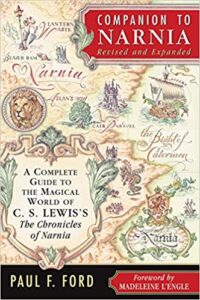
Several weeks back, I finished my series on The Chronicles of Narnia, and now I am thoroughly enjoying reading through Paul Ford’s Companion To Narnia: Revised and Expanded. It is basically a reference work that discusses the process of C.S. Lewis writing the Chronicles, analyzes how they relate to the rest of his works, and provides encyclopedic entries for everything imaginable in the world of Narnia. I am just now in the Es, so I have a long way to go, but it has been a lot of fun to read.

A while back I read through the entry for Aslan, which, as you might expect, is incredibly lengthy, with the Great Lion being the central character of the Narnia series and Lewis’s imagined Christ Figure in the world of Narnia. In that entry, Ford makes an insightful comment on Lewis’s effort to point his readers to the implications of the incarnation:

[Aslan’s] encouragement of the now-revived lion with the phrase “us-lions” and his employment of the giant to break down the castle walls and the sheepdog to organize the creatures into a force that will be helpful in what will later be called the First Battle of Beruna are all instances of Lewis’s profound belief that one of the consequences of the incarnation (God’s desire to identify with us by becoming one of us) is that he wants our help in the process of transforming the world.[1]

In the Incarnation, God identifies Himself with humanity through Jesus of Nazareth entering the world stage in the form of a baby. In so doing, God affirms the goodness of creation and also His intention to partner with humanity in bringing about His purposes for that creation.


This is, in large part, what it means to be created in God’s Image; we are God’s representatives, bearing His authority to carry out the task He has given us. This is the picture we have of Adam and Eve in the garden: God giving them the task to steward and cultivate His creation, partnering with Him, under His authority, to take care of it and develop it.

Tragically, Adam and Eve fail to live up to their vocation. In the bitterest of ironies, they clutch after the forbidden fruit hoping to become like God, failing to realize that they already were! And humans have similarly failed ever since then.

In the bitterest of ironies, Adam and Eve clutch after the forbidden fruit hoping to become like God, failing to realize that they already were! Share on X

In the Incarnation, Jesus comes to show us a different way. He perfectly reflects the divine image, obeying the Father’s will in all things. Rather than seeking after power or God-likeness, He willingly lays it down and lives as a servant, even to the point of dying on the cross.

Those of us who would follow Jesus are called to imitate His example. The vocation that God bestowed upon humanity in the garden has not changed: still, we are encouraged to take up our crosses and join in God’s mission. In The Lion, the Witch and the Wardrobe, the resurrected Aslan could have defeated all evil, established his reign and rule, and brought about the transformation of the world all on his own, but he chose not to. And this, as Ford points out, is no accident: Lewis was simply reflecting the biblical teaching that the all-powerful God chooses to bring about the redemption of all things in collaboration with human agents of new creation.

One of the great truths of the incarnation is that God brings about the transformation of the world—new creation—through His partnership with humanity.


[1]  Paul Ford, Companion to Narnia: Revised Edition (San Franciso: HarperCollins, 2005): 60.

Jesus, Christmas, and Hanukkah

Christmas can be a controversial subject in Christian circles.

In our modern climate of culture wars, the battle of Christmas creeps up every year. You know what I’m talking about: the debate between “Merry Christmas” and “Happy Holidays” as the appropriate seasonal greeting. Secular extremists claim that being wished “Merry Christmas” forces Christianity upon them, and Christian extremists claim to be persecuted by political correctness if any other greeting is used. As I have written before, I refuse to take offense about such things, so this particular controversy is not a great concern to me. I sympathize with the “Keep Christ in Christmas” crowd, but it is not a banner I regularly wave. I cheerfully wish “Merry Christmas” to people without a second thought or any ulterior motive.

If you are not part of the fellowship of Churches of Christ, you might be unaware that some Christians actually have the opposite concern: they want to keep Christ out of Christmas. At first glance this may seem unbelievable, but traditionally, members of Churches of Christ have been uncomfortable with celebrating Christmas as a religious holiday (i.e. the birth of Jesus). To my knowledge, there are three reasons for this.

First, historically, Jesus was almost certainly not born on December 25. The Bible does not tell us exactly when Jesus was born. He was born at a time when shepherds were out in the fields with their sheep, and although it is possible that sheep would be grazing in the outskirts of Bethlehem in the middle of winter, it is not prime sheep-grazing time. Since we don’t know when Jesus was born but do know that he most likely was not born on December 25, some people are uncomfortable with seeming to support a factual error. I understand that concern, but I think it is possible to observe the holiday while also maintaining historical accuracy.

Second, many people claim that Christmas has pagan origins. This is a common and generally-accepted claim, but it is also historically inaccurate. As far as I can tell, there may be specific aspects of the ways that people celebrate Christmas that have some pagan connections, but the origins of the holiday itself are not pagan. And even if they were, the reality is that there are a lot of things in our culture that have roots in paganism that don’t bother us today. For example, the names of many of our months and days have roots in paganism, but I don’t ever remember anyone rising up in arms about how terrible it is that we celebrate the god Thor every Thursday. Regardless, the historical reality that Christmas was not co-opted from pagan celebrations should render this argument irrelevant.

Third, and perhaps most important, is the argument that the Scriptures do not command us to celebrate the birth of Jesus and thus, do not authorize us to do so. We do celebrate the death and the resurrection of Jesus through the Lord’s Supper and are commanded to do so, but we have no similar command to observe Jesus’ birth, so the argument goes.

Here’s the problem with that third argument: Jesus’ own behavior illustrates that it is permissible to observe religious holidays that are not prescribed in Scripture.

In the Gospel of John, one of the recurring themes that John uses to describe the life of Jesus is Jewish religious feasts. Frequently he will describe how Jesus went up to Jerusalem to attend one feast or another, and when He does, exciting things tend to happen:

  • In John 2.13ff., Jesus goes to Jerusalem to attend the Passover and cleanses the temple.
  • In John 5, Jesus goes up to Jerusalem to observe an (unnamed) “feast of the Jews” and heals an invalid on the Sabbath.
  • In John 6, while the Passover is at hand, Jesus feeds the 5,000.
  • In John 7, Jesus goes up to Jerusalem to for the Feast of Tabernacles and begins teaching in the temple, leading to sharp arguments about who He is and where He comes from.

In this list of feasts that Jesus attends, we should also include John 10.22-23:

“At that time the Feast of Dedication took place at Jerusalem. It was winter, and Jesus was walking in the temple, in the colonnade of Solomon.”

Again, His appearance at a Jewish religious feast leads to excitement: Jesus tells the Jews who gather around Him, “I and the Father are one,” and as a result, they want to stone Him to death. But what I really want to emphasize is the part about the “Feast of Dedication”. You won’t find that feast described and commanded in the Old Testament along with Passover, Tabernacles, and Pentecost.

The Feast of Dedication came about many years later, and we know it better by a different name: Hanukkah, or the Festival of Lights. It was instituted during the Maccabean revolt in 164/163 B.C. and celebrates the rededication of the temple after it had been defiled under Antiochus IV Epiphanes of the Seleucid Empire.

So John 10 tells us that Jesus was in Jerusalem, walking in the temple, during a holiday celebrating the rededication of the temple. In other words, Jesus was celebrating a religious holiday that was not commanded by the Hebrew Bible. Based on His example, I think we are on safe grounds to do the same thing today. 

I am certainly not arguing that the birth of Jesus is more important than His death or resurrection, but it is significant: it was God putting on flesh and becoming a human, and fully identifying with the trials and temptation of the human experience. It was the beginning stage of the prerequisite process that enabled Jesus to be the perfect sacrifice for our sins. It was God establishing a beachhead in the realm of Satan and beginning the frontal assault that would ultimately result in the defeat of sin and death.

And thus, it is worth celebrating. The Bible doesn’t command that we do so, but the example of Jesus certainly shows that the Bible doesn’t forbid us from doing so, either. Besides, as Christians, we should celebrate Jesus—His birth, life, teachings, miracles, death, resurrection, ascension—each and every day of the year, Christmas included.

Ultimately, I think this whole discussion falls squarely into Romans 14.1-12, where Paul talks about how Christian brothers and sisters should avoid passing judgment on one another over disputable matters.

At the end of the day, if a Christian brother or sister wants to celebrate the birth of Jesus and what it represents as a part of Christmas, you are not to pass judgment that person. And if a Christian brother or sister decides that it is inappropriate to celebrate Christmas in a religious fashion, you are not to pass judgment on that person either. In matters such as these, Paul says that we are to respect the beliefs of one another, rather than forcing our beliefs on others in a way that causes them to stumble.

« Older posts Newer posts »

© 2026 The Doc File

Theme by Anders Noren — Up ↑