The online journal of Luke Dockery

Tag: Grace

God’s Provision, Not Our Power

At the end of the book of Joshua, the people of Israel find themselves in the promised land of Canaan, and their mission has been largely successful. Joshua, knowing that his time as Israel’s leader is growing short, renews the covenant with the people:

1 Joshua gathered all the tribes of Israel to Shechem and summoned the elders, the heads, the judges, and the officers of Israel. And they presented themselves before God. 2 And Joshua said to all the people, “Thus says the LORD, the God of Israel, ‘Long ago, your fathers lived beyond the Euphrates, Terah, the father of Abraham and of Nahor; and they served other gods. 3 Then I took your father Abraham from beyond the River and led him through all the land of Canaan, and made his offspring many. I gave him Isaac. 4 And to Isaac I gave Jacob and Esau. And I gave Esau the hill country of Seir to possess, but Jacob and his children went down to Egypt. 5 And I sent Moses and Aaron, and I plagued Egypt with what I did in the midst of it, and afterward I brought you out.

6 “‘Then I brought your fathers out of Egypt, and you came to the sea. And the Egyptians pursued your fathers with chariots and horsemen to the Red Sea. 7 And when they cried to the LORD, he put darkness between you and the Egyptians and made the sea come upon them and cover them; and your eyes saw what I did in Egypt. And you lived in the wilderness a long time. 8 Then I brought you to the land of the Amorites, who lived on the other side of the Jordan. They fought with you, and I gave them into your hand, and you took possession of their land, and I destroyed them before you. 9 Then Balak the son of Zippor, king of Moab, arose and fought against Israel. And he sent and invited Balaam the son of Beor to curse you, 10 but I would not listen to Balaam. Indeed, he blessed you. So I delivered you out of his hand. 11 And you went over the Jordan and came to Jericho, and the leaders of Jericho fought against you, and also the Amorites, the Perizzites, the Canaanites, the Hittites, the Girgashites, the Hivites, and the Jebusites. And I gave them into your hand. 12 And I sent the hornet before you, which drove them out before you, the two kings of the Amorites; it was not by your sword or by your bow. 13 I gave you a land on which you had not labored and cities that you had not built, and you dwell in them. You eat the fruit of vineyards and olive orchards that you did not plant.’

(Joshua 24.1-13)

Joshua recounts for the people their story since God had called their ancestor Abraham, a pagan, and guided him to Canaan where He blessed him with land and offspring. Abraham begets Isaac, and Isaac begets Jacob. Jacob and his children end up down in Egypt where they are eventually oppressed, but God provides for them by raising up Moses and Aaron, bringing plagues upon Egypt and freeing His people. He parts the Red Sea and saves them from the Egyptian army. The people live in the wilderness for a long time, where God takes care of them and helps them overcome their enemies. Then, God leads them into the promised land, and God drives out their enemies before them—it is not by their sword or bow that they have success, but God’s provision for them.

Joshua rehearses this story to remind the people that it is God’s provision, not their power, that has led them to the blessings they currently enjoy. It was not something they did; it was not based on some remarkable quality within the people of Israel themselves.

Joshua knows that his time as their leader is drawing to a close, and he wants to motivate them to faithfulness after he is gone. It is essential that the people realize their dependence on God—their welfare as a nation depends on their faithfulness to a God who provides for them.

This idea—that it is not our power, but God’s provision, that leads to our well-being—is not unique to Joshua or this particular time period. Rather, it is a consistent theme of Scripture that comes to its fulfillment in Jesus. As Paul famously states:

8 For by grace you have been saved through faith. And this is not your own doing; it is the gift of God, 9 not a result of works, so that no one may boast.

(Ephesians 2.8-9)

Our salvation is God’s gift, made possible by the work of Jesus Christ. It is not our own doing. There is no cause for us to boast, because we have done nothing. It is all about God’s provision; not our own power.


In this loose series of Scripture Reflections, I am sharing brief thoughts spurred on by my Bible reading. By way of reminder, my goal for these brief posts is two-fold:

(1) To remark on aspects of the biblical text that I find to be of interest that the reader may or may not have thought about previously.

(2) When possible, to point to the work and person of Jesus Christ. I believe the Bible is a unified story that points to Jesus, which means that He is frequently alluded to or foreshadowed in some way throughout the biblical canon.
“He Remembers that We Are Dust”

Psalm 103 is one of my favorites. It speaks forcefully of God’s mercy and steadfast love:

8 The LORD is merciful and gracious,
slow to anger and abounding in steadfast love.
9 He will not always chide,
nor will he keep his anger forever.
10 He does not deal with us according to our sins,
nor repay us according to our iniquities.
11 For as high as the heavens are above the earth,
so great is his steadfast love toward those who fear him;
12 as far as the east is from the west,
so far does he remove our transgressions from us.
13 As a father shows compassion to his children,
so the LORD shows compassion to those who fear him.
14 For he knows our frame;
he remembers that we are dust.
15 As for man, his days are like grass;
he flourishes like a flower of the field;
16 for the wind passes over it, and it is gone,
and its place knows it no more.
17 But the steadfast love of the LORD is from everlasting to everlasting on those who fear him,
and his righteousness to children’s children,
18 to those who keep his covenant
and remember to do his commandments.
19 The LORD has established his throne in the heavens,
and his kingdom rules over all.
(Psalm 103.8-19)

Fundamental to God’s nature is His mercy and grace. This is stated in Psalm 103.8 and is repeated in some form multiple times throughout the Old Testament (cf. Exodus 34.6; Numbers 14.18; Nehemiah 9.31; Psalm 86.15; Joel 2.13; Jonah 4.2). Because of His nature, God does not deal with us according to our sins, but instead removes them far from us: as far as the East is from the West.

This is beautiful and profound, but there is more. In addition to God’s inherent predisposition toward mercy and forgiveness, the Psalmist also tells us this in v. 14:

14 For he knows our frame;
he remembers that we are dust.

(Psalm 103.14)

God, as our Creator, knows us intimately. He remembers that we are dust.

In one sense, this has a literal meaning. Genesis 2.7 speaks of Yahweh forming “the man of dust from the ground” and breathing into his nostrils the breath of life. Later on, after the humans fail at the Tree of Knowledge of Good and Evil, as part of the curse that God pronounces, He tells Adam, “For you are dust, and to dust you shall return” (Genesis 3.19b).

We are formed of the same stuff as the rest of creation, and when we die, our bodies wither away and eventually decompose into dust.

But there is surely a metaphorical meaning here as well: God remembers our inherent frailty. While humankind is created in God’s image (Genesis 1.26-27) and given the significant vocation of bearing the divine image in creation, we are, ultimately, dusty creatures: we fall short and fail to live up to the potential that God has placed within us.

God knows this well. He knows, better than anyone, that we are “just human”, and it motivates His compassion and mercy toward us.

God knows we are dust. He knows, better than anyone, that we are “just human”, and it motivates His compassion and mercy toward us. Share on X

The reality is that ever since our original Dusty Ancestors, the sons and daughters of men have failed in the vocation that has been given to us, fallen victim to the siren call of sin, and found ourselves in desperate need of God’s compassion and mercy. And this, of course, is why God Himself became dust, and the Son of Man embodied human existence. Finally, there was one who, while still dust, perfectly bore the divine image, lived a sinless life, and effected God’s gracious desire to remove our sins as far as the East is from the West through His crucifixion and victory over death.

I am routinely frustrated that I am dust, both literally and metaphorically. But thanks to these words from Scripture, I can take comfort: God knows this about me better than I know it myself. When I fall short, He understands and personally makes up for my deficit.

God knows that I am dust, and when I fall short, He understands and personally makes up for my deficit. Share on X

In this loose series of Scripture Reflections, I am sharing brief thoughts spurred on by my Bible reading. By way of reminder, my goal for these brief posts is two-fold:

(1) To remark on aspects of the biblical text that I find to be of interest that the reader may or may not have thought about previously.

(2) When possible, to point to the work and person of Jesus Christ. I believe the Bible is a unified story that points to Jesus, which means that He is frequently alluded to or foreshadowed in some way throughout the biblical canon.

Two Graduations: What My Special Needs Daughter Taught Me About Following Jesus

It’s June, which means that we have just completed another graduation season. As a youth minister, I go to a lot of graduations, but this year there were a couple of graduation ceremonies that were more significant to me.

First was my own graduation from Harding School of Theology. This one was a long time coming. It was an extensive program (a 78-hour degree, which is more coursework than many master’s and doctorate programs combined), and add to that the fact that I completed it while working full time, figuring out how to be a dad, and living hundreds of miles away, and I can say with only minimal chagrin that I started the program way back in 2010. Finishing a program that you have been engaged in for so long is certainly an accomplishment of sorts, and I’ve had a lot of people ask me how it feels to be done. I definitely feel grateful for all that I have learned and for all who made it possible (HST faculty and staff, my wife, my elders at church, etc.). I am also pleased to be done. But my overwhelming emotion is a little more difficult to explain, and that’s what this post is about.

About 10 days after my graduation, I went to another graduation ceremony—Kinsley’s Kindergarten graduation. I have written in different places about how the last 18 months or so have been very difficult for my little girl. Increased seizure activity has been hard to control and has led to several regressions (i.e., she has lost abilities that she once had). Nevertheless, during this past school year, she started Kindergarten in a self-contained class. Kinsley’s academic goals were made with her special needs in mind and were very modest by the standards of “typical” children, but still, due to the regressions, she didn’t hit those goals. In some sense, you could even say that her graduation from Kindergarten was something of a formality. But I can tell you this: I am far prouder of her graduation than my own.


I have always been a high achiever. I have always gotten good grades and done well in school. I was involved in a bunch of extracurricular activities to beef up my college résumé. I was a good (not great) athlete who worked hard and was, at times, pretty successful.

When I started grad school, I began to work even harder. I had become convinced that doing my best was a spiritual requirement (I still believe this, by the way), but “doing my best” easily became a justification for obsessive perfectionism. In school, I wanted every research paper to be perfect. In ministry, I wanted every teenager to be faithful and every sermon to be excellent. In my personal faith and theology, I wanted to be right on every issue and know the answer to every question. Some of this obsessive perfectionism I come by naturally (it runs in my family), but also, it was a core component of my faith. To be clear, I was never taught works righteousness growing up, or that God’s love for me was tied to my achievements and accomplishments, but somewhere along the way this became a big part of what following Jesus was for me.

When Kinsley came into my life (and more specifically, when she began to miss developmental milestones and we received her diagnosis), everything began to change for me. The reality is that I have a beautiful, wonderful daughter who, from a worldly perspective, will never achieve much of anything. And while I lament the ways in which her horrible disease has placed limitations upon her life, the reality is this: I don’t care about her achievements. I love her because she is my daughter, and I delight in her.

This realization and the implications of it have significantly affected my life. I don’t really care about achievement anymore. I don’t care about intelligence or talent. When parents talk about how clever their children are, or when friends speak of their accomplishments, I smile and try to be affirming, but it simply doesn’t matter much to me. And from that perspective, my own graduation doesn’t matter much to me either.

I still work hard, because I believe it is a spiritual imperative to do so—in all things I work as if I am working for Jesus because, really, I am. But I don’t work hard so God will love me more, or because my value is tied to my achievements. God loves me because I am His child, and that is enough.


I grew up in the church, have been a Christian for 20 years, a minister for 12, and I have a graduate degree in theology. But it was my daughter who taught me about grace simply by being her perfect, disabled self.

On second thought, that’s quite an achievement.


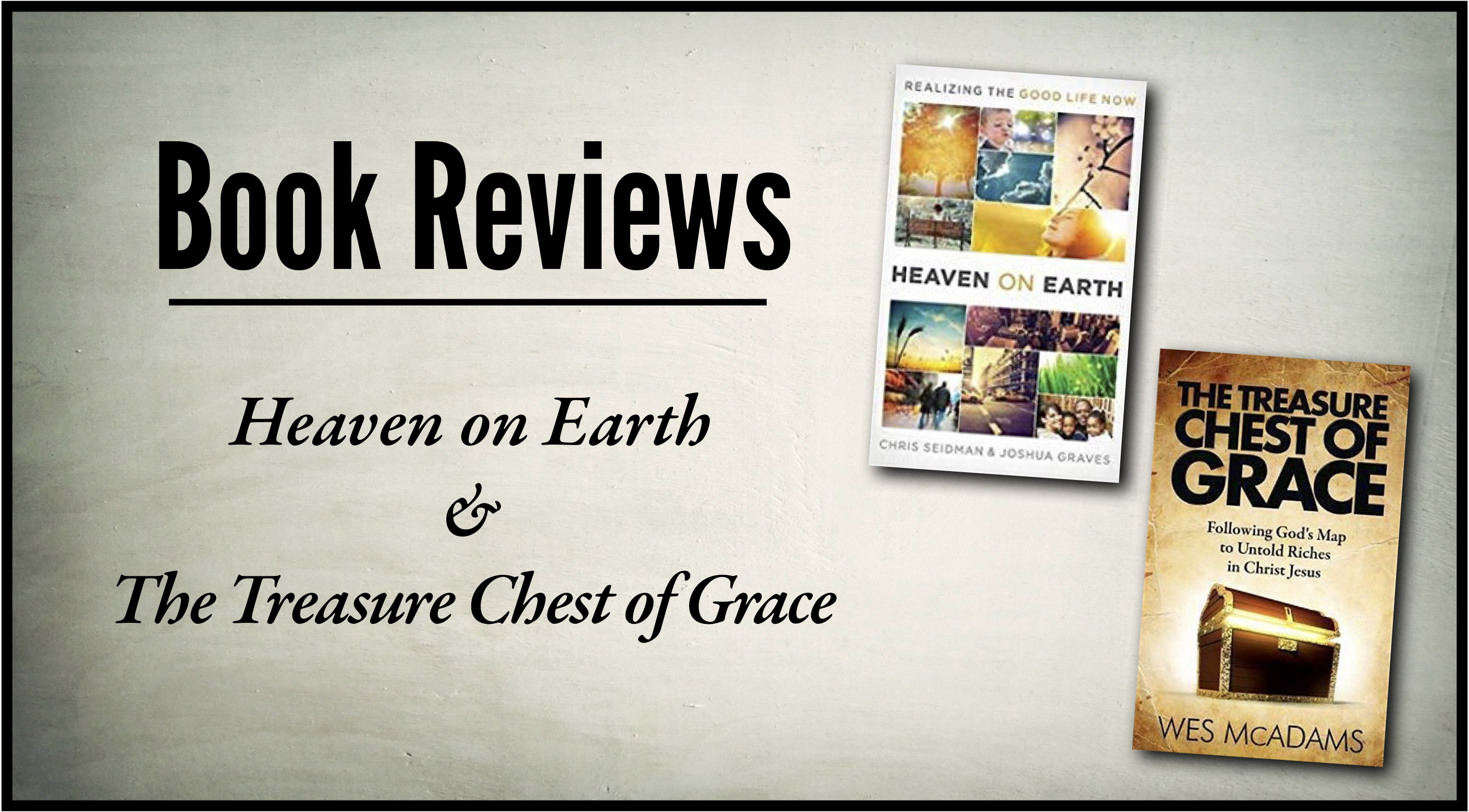
Two for One Book Reviews: Heaven on Earth and The Treasure Chest of Grace

I enjoy reading and sharing helpful things that I read with others. I like to read lots of different kinds of books, but as a minister and a theology students, a lot of what I read tends to focus on those areas.

As a part of my schooling, I read widely across the spectrum of Christianity. This invariably means that I read a lot of things I disagree with, but also that I am challenged to think about what the Bible teaches and what I believe frequently. That’s a good thing, I think.

Over the last several years, I have noticed a marked increase in the number of books being put out by ministers and thinkers within Churches of Christ. This is also a good thing, I think, and I have made an effort to read some of those books when I get the chance (and in the process, have come across some very good material). Having said all that, I wanted to offer some quick reviews of a couple of those books: Heaven on Earth: Realizing the Good Life Now, by Chris Seidman and Joshua Graves, and The Treasure Chest of Grace: Following God’s Map to Untold Riches in Christ Jesus, by Wes McAdams.

Heaven on Earth

Heaven on Earth was good, although it was not what I expected. The book is actually a careful examination of Jesus’ Beatitudes at the beginning of the Sermon on the Mount, and how living those out makes a difference in the here and now (while also identifying us as the kind of people who will be with Jesus eternally).

The subtitle, “Realizing the Good Life Now”, could potentially mean a lot of things, but basically, the authors assert that living this way (according to the Beatitudes) constitutes living the “good life”, and helps us to establish the ideals of God’s Kingdom on earth (to be clear, there are no hints of prosperity gospel nonsense in this book about how God wants us to be happy and therefore will shower us with material blessings if we are faithful to Him).

Each chapter covers a Beatitude, and discusses what it means as well as illustrating it with an abundance of real-life examples, mostly from modern day. The two authors do not write together, and instead, take turns writing different chapters. This is probably my main criticism of the book, as I think it gives it a choppiness in thought and style that wouldn’t be present if either writer was working entirely on his own.

Here are some good quotes:

“The good life is only possible in so far as God is involved. Experiencing the good life is more about what God has done and is doing that what we have done or are doing.” (xi)

“For Jesus, the kingdom of heaven had everything to do with life on this side of the grave while many of us are inclined to think it mostly has something to do with life on the other side. Consequently , we think of Jesus’ proclamation of the kingdom of heaven coming near as meaning through Jesus we now have access to the pace of heaven after we die. Even though this is one aspect of the context, it is not the entire context.” (3)

“The longer Paul dwelled in the kingdom of light the more aware he became of the darkness in his own life.” (16)

“Mourning is a pure vision of the large gulf between how things could be versus how things actually are.” (28)

“How do we respond to the pain and suffering that haunts us? Something’s amiss. Is life beautiful? Yes. But just on the horizon of its inherent beauty is a wild storm, waiting to tear everything to pieces, total destruction. Life is beautiful. But life is also deadly, depressing, and full of pain.” (33)

“Doing the right thing—whether individually (righteousness) or collectively (justice)—is always a primary interest of God in the prophets, because a life is the totality of choices made for the individual and the community.” (57)

“The person you are setting free when you reconcile is yourself.” (99)

“The most dangerous believers in the world to the kingdom of darkness are the ones who live as though they have nothing to lose.” (109)

“Faith is about seeing the world as God sees it. Not simply seeing the world for what it is—in all its paradox of beauty and death—but also seeing the world for what it will one day become.” (131)

The Treasure Chest of Grace

The Treasure Chest of Grace focuses on the fact that we have been saved by grace—nothing we have done or can do on our own has any bearing on salvation apart of the gracious acts of God on our behalf—and then sets about determining what conditions we must meet in order to become recipients of that grace. This is where the “map” of the subtitle comes in: the pages of Scripture reveal to us what we must do in order to come into contact with God’s grace.

This book differs significantly from Heaven on Earth in that McAdams uses no stories or modern-day examples to prove his points; he only uses Scripture. This is by design: “I have made every effort in this book to prove every point with Scripture, and only Scripture. No quotations of man are used to prove any point, only words inspired by God” (8). I understand his reasoning and certainly agree with him at the core (we should base our religious beliefs on Scripture, not something else), but I think the writing suffered somewhat as a result: a short book peppered with hundreds of Scripture references and no other illustrations or examples is harder to read. My other gentle critique is a subjective one: I don’t like really short chapters. The main body of the book is 144 pages long, and those pages are divided into 25 chapters, rendering the average chapter as a little less than six pages long. Constantly shifting from chapter to chapter gives the reader the impression that some thoughts haven’t been well developed (which I don’t think is true, I just think that many of the “chapters” would function better as sections within longer chapters).

Anyway, on to the quotes:

“Man is utterly incapable of earning the things we receive from God. This does not mean, of course, that we are incapable of obeying Him, pleasing Him, honoring Him, glorifying Him; but we must remember that by doing so, we have earned nothing.” (16)

“When people try to save themselves, they are communicating to God that they have no need for His grace.” (25)

“If there were nothing man had to do to receive salvation, there would be none who were lost.” (46)

“Too often people have assumed that because God freely gives grace, He gives it without conditions.” (78)

“Unfortunately many in the religious world have tried to sever the biblical ties between salvation and baptism” (97)

“Man is not saved because he obeys the gospel; he is saved when he obeys the gospel. The gospel itself, not the obedience of man, is the reason man is saved.” (106)

“Your salvation lies at the lace where His “amazing grace” meets your “trust and obey”.” (152)

“Do not mistake the emphasis on baptism to mean that it is more significant than it really is. Nor should you make the mistake of assuming baptism is meaningless or insignificant. Because it is a part of God’s plan to redeem man, it has great importance. But without the blood of Christ, baptism is nothing more than a glorified bath.” (155)

I thought both of these books were short, easy-to-read, helpful treatments of two very biblical ideas: what living the Beatitudes means for us as citizens of God’s Kingdom, and how God’s grace and our obedient faith work together in the act of salvation. I was thankful to have read both.

God Wants Sons, Not Slaves

In Will God Run?, Charles Hodge writes some powerful words on salvation, grace, and the restoration of relationship with the Father (emphasis is mine throughout):

The father gave the prodigal a ring. When the son met the father he said, “I have sinned against heaven and in thy sight, and I am no more worthy to be called thy son. I wish to be recognized as a servant, a slave.” The father’s first impulse is to get that notion from his system. He said, “Son, you are my son. I don’t want slaves. I want sons.” Salvation is restoration![1]

Salvation is more than penalty remitted; it is basically relationship restored!…May we suggest again, he is forgiven because he was a son. He didn’t buy salvation because he was penitent. He didn’t earn restoration because he came home. His fondest hope was to be given a decent job as that of a servant. Beloved, we are saved by grace and must never forget it.[2]

Religion’s advice is “try a little bit harder, work at it just a little bit more.” Christianity is not advanced humanism, not just simply a few good morals! If Christianity were only morals, Socrates could be our savior. But Christianity is the restoration of a father-son relationship.[3]

Salvation…is the placing of God’s best robe on the worst sinner! We strive to place ourselves not to need the robe when that is our basic need! God’s answer is not “clean up, son.” It’s not “try a little bit harder.’ God’s answer is, “Come home, son. Come home.”[4]

There is so much to weigh in on in these few quotations, but I’ll just briefly touch on one issue. So often, people seem to think (and maybe they think this because it is implied in preaching), that they just need to “get their lives right” and then in some sense they will be worthy of being God’s children.

This thinking is completely backwards. First, we are at no point worthy of being God’s children, and secondly, while moral living is important, it proceeds from a right relationship with the father; it does not precede that relationship.


[1] Charles B. Hodge, Jr., Will God Run? (Searcy, AR: Resource Publications, 2002), 50.

[2] Ibid.

[3] Ibid, 52.

[4] Ibid.

© 2026 The Doc File

Theme by Anders Noren — Up ↑