The online journal of Luke Dockery

Tag: Peace (Page 1 of 2)

The Beatitudes: Blessed Are the Peacemakers

As discussed in the introductory post of this series, Jesus’s Beatitudes in the Sermon on the Mount are basically a description of what a good life really looks like from God’s perspective. Jesus redefines what blessedness is, and provides an alternative set of values for His followers, those who desire to be a part of His alternative community. Here are the Beatitudes we have discussed thus far:


Blessed Are the Peacemakers

“Blessed are the peacemakers, for they shall be called sons of God.”

(Matthew 5.9)

Jesus says that God’s favor rests upon those who make peace.

God cares deeply about peace.

“Peace” is something that is talked about a lot, but it is important for us to realize that this word is used to convey different ideas at times, and we need to make sure that we have a clear picture of what Jesus is talking about in this context.

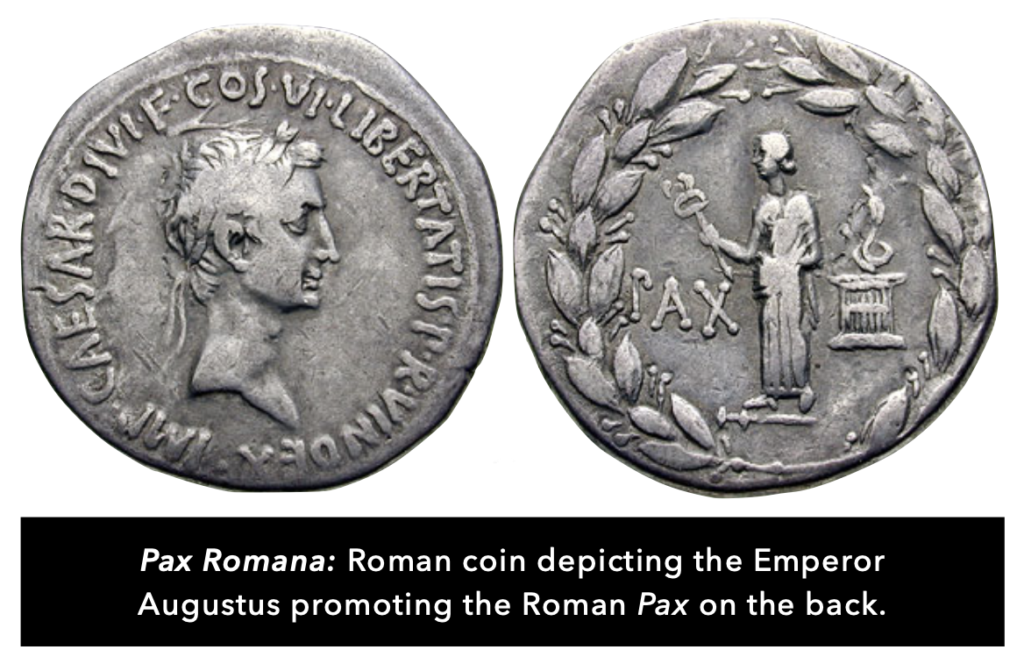
During the time that Jesus lived, peace was greatly emphasized, because the Roman Empire was enjoying the Pax Romana, or “Roman Peace.” The Pax Romana lasted for several decades and was a time of stability and prosperity in the Empire in which there was relative peace and no major wars. This peace came at a high price, however, as it was made possible only through brutal military conquest, the forced subjugation of conquered peoples, and the confiscation of their land.[1]
Of course, this is not the kind of peace that Jesus is talking about. Jesus does not call for His followers to make peace through military might. Furthermore, in the Bible, “peace” is not simply the absence of war; peace suggests wholeness and well-being, and healthy and just relationships with one another.[2] Related to that, biblical peace—wholeness, justice, healthy relationships—does not come from pretending problems don’t exist. Jesus is the Prince of Peace, and He came to make reconciliation with God possible, but He didn’t gloss over the reality of sin; He confronted people with it, and was killed as a result.

Peace-making is not pretending that problems don’t exist. Share on X

A good modern-day example is Rosa Parks, who in 1955 refused to give up her bus seat to a white passenger. That act had far-reaching consequences (Parks was arrested, and it was a key early event in the American Civil Rights Movement), and some people called her a troublemaker because she didn’t just do what she was told to “keep the peace.” But peace doesn’t come from pretending that there is no problem. As long as African-Americans were forced to sit at the back of busses or give up their seats to white people, true peace was not possible. Refusing to give up a seat on the bus was actually a part of peacemaking because it was an effort to bring about wholeness and justice in society.

Jesus wants His followers to be people who actively work to make peace in their relationships and in their communities. Of course, we should try to get along with others and we should not go around trying to stir up strife for the fun of it, but we do need to be people who work to bring about real reconciliation in situations where people are at disharmony with one another.[3]

Jesus wants His followers to be people who actively work to make peace in their relationships and in their communities. Share on X

Peacemakers are called children of God because they are like God. After all, God’s supreme mission is to bring about reconciliation in the world. As William Barclay says, “The man who divides men is doing the devil’s work; the man who unites men is doing God’s work.”[4]
If you enjoyed this post, you might enjoy my book on the Sermon on the Mount, Counter Culture: A Study of the Sermon on the Mount. 

Although this book was written specifically as an aid to teaching the Sermon on the Mount to junior high and high school students, it is also useful for personal Bible study, and the depth of the material makes it a great resource for adult Bible classes.


[1] Warren Carter, “Power and Identities: The Contexts of Matthew’s Sermon on the Mount,” in Preaching the Sermon on the Mount: The World It Imagines, ed. David Fleer and Dave Bland (St. Louis: Chalice Press, 2007), 21.

[2] William Barclay, The Gospel of Matthew Volume 1, The Daily Study Bible (Philadelphia, Westminster Press, 1956), 103: “In the Bible peace means not only freedom from all trouble; it means enjoyment of all good.”

[3] Albert Barnes, Matthew and Mark, Notes on the New Testament (Grand Rapids, MI: Baker Book House, 1949), 45.

[4] Barclay, 105.
Life’s Busyness and God’s Peace

Yesterday and today have been a couple of particularly busy days in what seems like an unending stream of busy days.

In addition to my regular Friday duties (working on getting the bulletin published, preparing for Bible class on Sunday), there is a lot going on right now which is combining to stress me out:

  • This weekend I have the opportunity to teach and speak at a youth rally. That’s great, but it means preparing two lessons and the accompanying presentations to go with them.
  • Since I’m taking my youth group to the aforementioned youth rally, that also means making all the preparations necessary before leaving on a trip.
  • I have a lot of reading to do for my grad school class. I always seem to have a lot of reading for grad school, and it is one of the first things that gets squeezed out when I have other tasks to accomplish.
  • Next weekend is the Ark Retreat, a combined youth retreat with several area churches, and one of our big spring events. It’s always a lot of fun, but demands a lot of planning ahead of time.
  • The weekend after the Ark is our church’s Day of Service and Friends & Family Day—a great weekend, but a busy one that requires a lot of work beforehand from me.
  • The weekend after that is our youth group Camping & Canoe Trip—more fun, and more planning as well.
  • The weekend after that will be our Graduation Banquet at church for our High School kids. More fun and fellowship, more busyness.
  • Somewhere during the time span I have just referred to, I have two papers due for grad school and a final exam to take as well!
  • What about the stuff going on in our broken world? Bombs and shootouts in Boston? Deadly explosions at fertilizer factories in Texas?
  • And, to be honest, all of this is overshadowed somewhat by the constant concern I have for my little girl, who continues to have seizures and deal with the daily realities of congenital muscular dystrophy. Daily realities that are physically and emotionally draining.

Sometimes, when I’m really, really busy, I remember the benefits of taking a deep breath, slowing down, and remembering that God does not call me to a life of frantic, breathless activity.

I love the words from the hymn penned by Edward H. Bickersteth:

Peace, perfect peace, in this dark word of sin:

The blood of Jesus whispers peace within.

Peace, perfect peace, by thronging duties pressed:

To do the will of Jesus this is rest.

Peace, perfect peace, with sorrows surging round:

On Jesus’ bosom naught but calm is found.

It is enough: earth’s struggles soon shall cease,

And Jesus calls us to heav’n’s perfect peace.

Perspective is a wonderful thing. I am seeking perfect peace today, and wishing it for you as well.

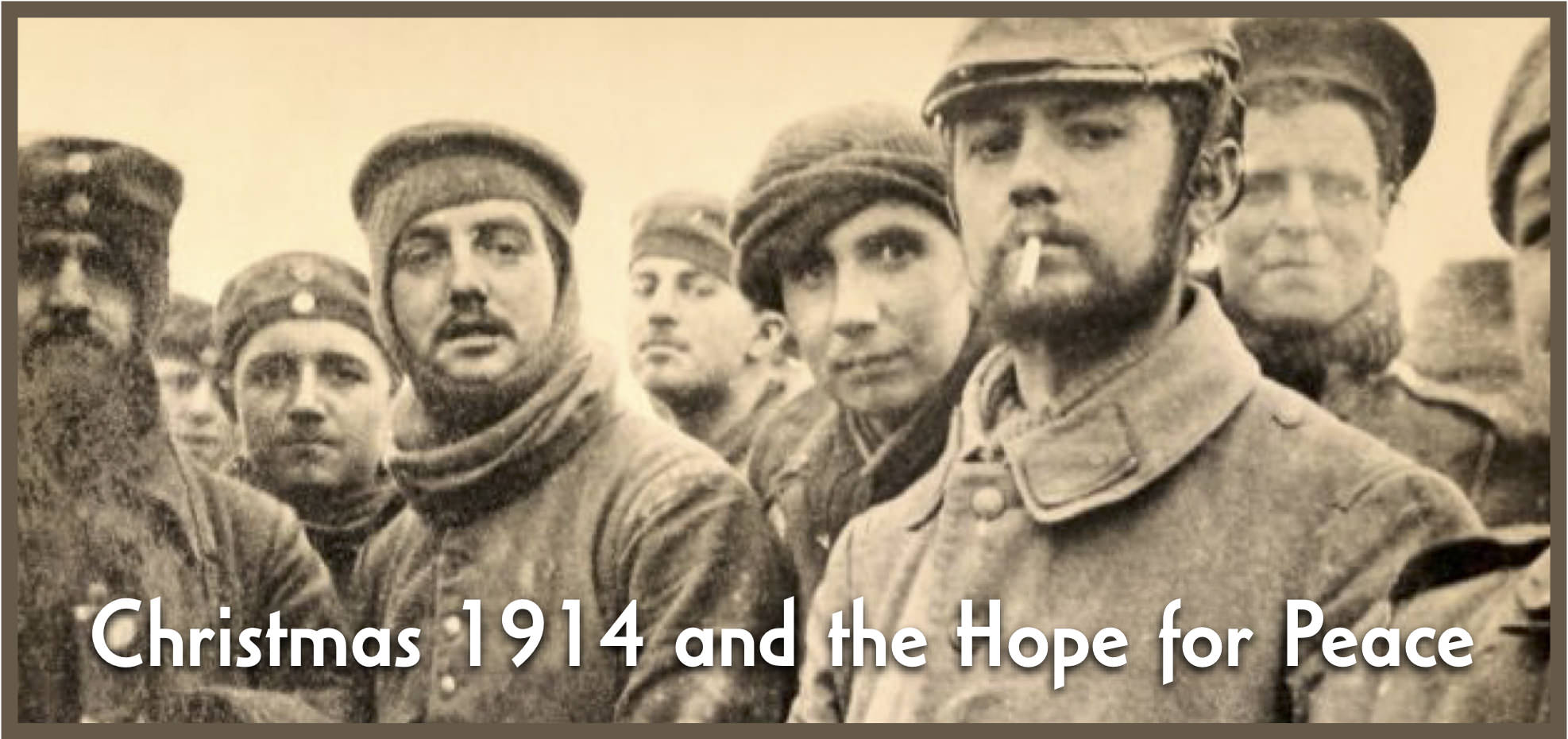
Christmas 1914 and the Hope for Peace

The Christmas Truce of 1914 is fairly well-known; my brother once wrote about it here:

“The First World War broke out in August of 1914. Many rushed to war almost gleefully, confident in victory for their particular side. Many thought the war would be over by Christmas. But when Christmas came the war was still young. It would last another four years and claim the lives of some 8 million soldiers before it was through.

In the midst of this bloodshed, though, a remarkable thing happened. In many places along the Western Front, particularly where the British and the Germans faced each other, unofficial Christmas truces were made in 1914. And here, for a brief few hours, the killing ceased.

Instead of firing bullets at each other, the mortal enemies sang Christmas carols to one another on Christmas Eve. German soldiers even decorated their trenches with candles and with Christmas Trees—tannebaum, they called them. On Christmas morning, soldiers from both sides met in no man’s land and exchanged what gifts they had: buttons and medals, candy and tobacco and liquor. Soldiers who had once been barbers gave free haircuts. One German soldier who had been a juggler in happier times gave a performance in no man’s land.

The goodwill between enemies was only temporary. In a matter of days they were back to the grim business of trying to blow one another apart. But for a few brief hours, the influence of the Prince of Peace had been felt.”

Moments like these where the Kingdom of God breaks into the twisted and fallen world in which we live don’t seem to come often enough. But they are made possible by the fact that 2000 years ago, the Word became Flesh and the Son of God came to earth. The baby Jesus grew to be a man, lived a perfect life, and then died on our behalf, and for Christians, that is a source of great hope.

A lot of times we don’t understand the concept of biblical hope very well, because in everyday usage, the word hope means something very different than what it means in the Bible. We use hope as a synonym for wish, as in “I hope I win the lottery”, or “I hope our economy gets better soon”—both of these are things that people wish would happen, but they don’t actually expect either of them to happen.

Biblical hope is something different though—it is a confident expectation of something that will happen because it has been promised by God. And the entrance of Jesus into the world and His subsequent death and resurrection are a source of great hope for Christians because they make possible a Day of Peace—a day when there will be no more suffering, no more disease, no more school shootings, and no more war. For those who have made peace with God, it is a day to look forward to—an everlasting day which will find the faithful in the presence of the Heavenly Father. That’s the hope—the confident expectation— that Christians have.

And in the meantime, as we wait for that day to come, Christians have a lot to do to keep busy:

  • We gather together to remind one another of that hope and to pledge our devotion to the cause of Christ…
  • We work to instill the values of the heavenly Kingdom into our earthly surroundings, so that our friends and neighbors can taste the peace of God for themselves…
  • And we celebrate the small down payments on the promise of peace that God has given us…such as the few blessed hours when the armies of the world ceased their strife and remembered the Baby of Bethlehem.

Merry Christmas to you and your family this holiday season! Glory to God in the highest, and on earth peace and good will toward men!

Six Years


It’s hard for me to believe that 9/11 was six years ago today.

I can still remember the events of that morning clearly. I got up and went to class at 8:00, just like any other day, and it wasn’t until right before chapel that I bumped into a friend who told me what had happened. Incidentally, that friend joined the military after the fall semester, and last I heard, was on his way to Iraq.

His life, and those of many others in similar situations, has changed greatly over the last six years.

But what about regular people? People who aren’t in the military? Has your life changed substantially since 9/11/2001? I know mine hasn’t—not like it should have.

Sure, some things have changed. Flying on an airplane is more of an ordeal these days with security being a lot tighter. I certainly know a lot more about Islam than I did six years ago. And any desire I had to visit the Holy Lands has decreased considerably. But really, my life hasn’t changed so much.

For example, I still read these words of Jesus in Matthew 5.43-44 and know that I don’t live them any better than I did before:

“You have heard that it was said, ‘You shall love your neighbor and hate your enemy.’ But I say to you, love your enemies and pray for those who persecute you…”

Nor these words of the Apostle Paul in Romans 12.17-18:

“Never pay back evil for evil to anyone. Respect what is right in the sight of all men. If possible, so far as it depends on you, be at peace with all men.”

Is your life any different than it was? If not, then maybe you’re like me, and it’s time for a change.

True Peace

Wars with no end in sight are unpopular, and currently, the United States finds itself embroiled in such a war.

Because of this, it has become increasingly popular to trumpet the cause of peace, and among Christians (especially those of the blogging variety), I have observed the growing belief that all war is wrong and that it is, inherently and fundamentally, un-Christian.

I disagree with this viewpoint. Don’t get me wrong. I hate war. I think it is a terrible thing which should be avoided whenever possible, and should only be considered as a last resort, but I do believe that sometimes, war is the only option (World War II would be the classic support of this viewpoint).

Christians are called to be peacemakers, and it should always be our goal, in whatever circumstance we find ourselves, to reconcile rather than to incite.

But sometimes, I think the peace that Christ came to bring about is misunderstood.

My friend Robb Hadley wrote a very good article on peace the other day that I really appreciated, and he put it better than I could:

When Jesus was born, “Peace on earth” was proclaimed by angels (Luke 2.14). If you define peace as all people on earth holding hands with flowers in their hair singing, “I’d like to buy the world a Coke,” Jesus failed completely. If you understand that Jesus came to make peace with God and with each other available, then real peace is possible (Ephesians 2.15–16).

How would things be different if people would strive after the eternal peace of Christ as eagerly as they seek the uncertainty provided by man-made treaties?

« Older posts

© 2026 The Doc File

Theme by Anders Noren — Up ↑