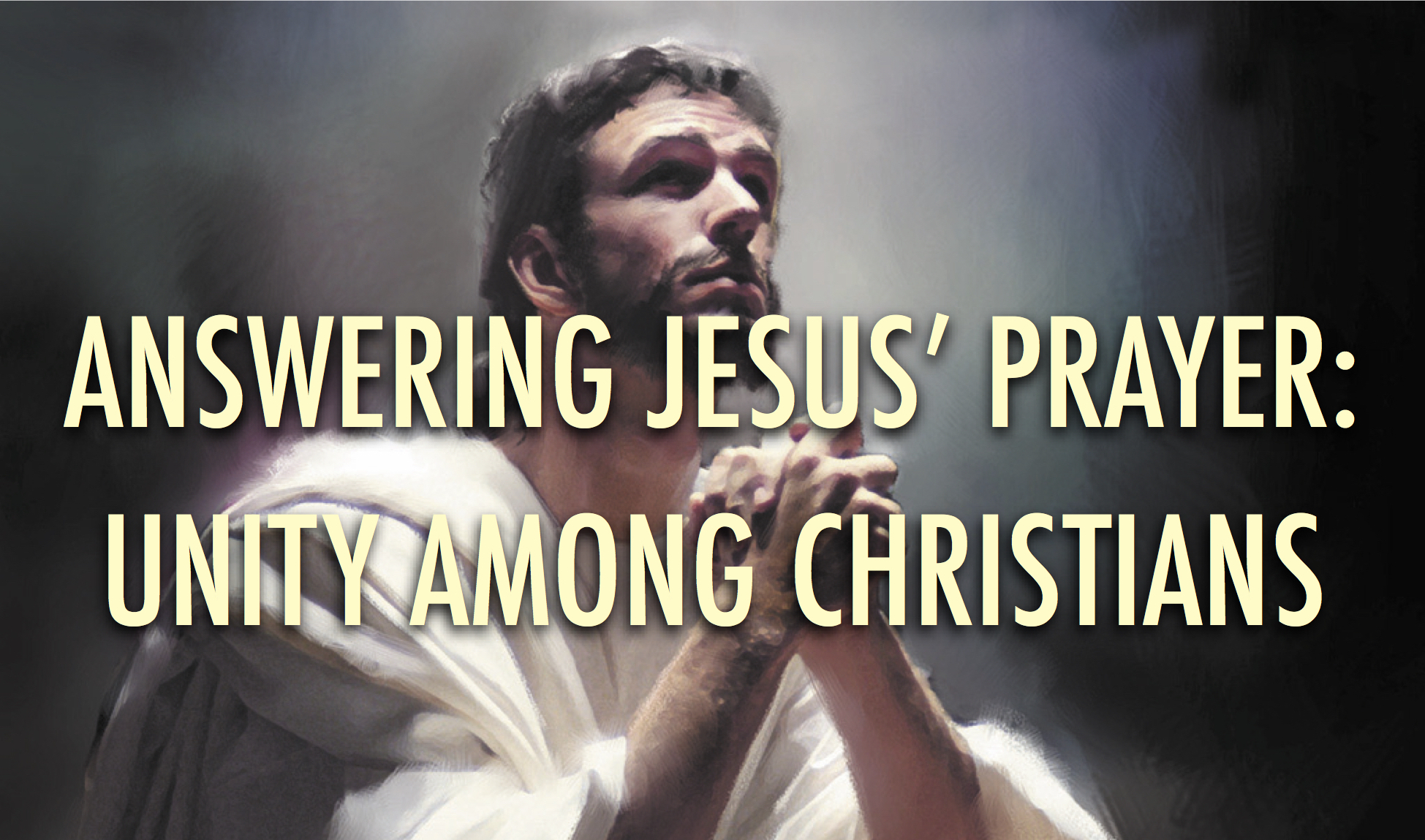
When you write a blog that is primarily about ministry, biblical studies, and theology, you know from the beginning that you are really writing for a niche audience, as a lot of people are simply not interested in these topics. Today’s post perhaps may seem to be of even narrower focus, because I am going to address my own religious fellowship, but I would like to think that there are some worthy principles here whether you are a part of Churches of Christ or not.
In John 13-17, we have what is typically called the “Farewell Discourse” of Jesus. Knowing that He will soon be betrayed, arrested, and crucified, Jesus lays out some central teachings that He wants His disciples to hold onto after He is gone.
In one section in John 17, Jesus emphasizes the importance of unity among His followers, and prays to that effect:
“I do not ask for these only, but also for those who will believe in me through their word, that they may all be one, just as you, Father, are in me, and I in you, that they also may be in us, so that the world may believe that you have sent me. The glory that you have given me I have given to them, that they may be one even as we are one, I in them and you in me, that they may become perfectly one, so that the world may know that you sent me and loved them even as you loved me.”
(John 17.20-23)
It is worth pointing out that in this section, Jesus suggests that unity among His followers is a key ingredient in the world believing that Jesus is who He says He is. The reality is that there is considerable disunity in the world today among those who claim to be followers of Jesus, and that, in fact, this is one reason that many nonbelievers do not believe.
As I have written about many times in this space, I work and worship within the context of Churches of Christ, which have historical roots in the Stone-Campbell Restoration Movement of the early 1800s. I will not digress too far into history right now, but I will note that the Restoration Movement came about as a means to achieve unity amongst believers in Jesus, and that it sought to do so by emphasizing the beliefs and practices of the early church as revealed in the pages of the New Testament. I think this is a laudable effort, and it resonates strongly with me.
What saddens me deeply, though, is how little I see the desire for unity in my religious fellowship today. I dislike using labels, but for the sake of ease, from the most conservative branch of our fellowship, I see little desire for unity at all. I see a great amount of concern for doctrinal accuracy (which is important and praiseworthy), but virtually no concern at all for working for unity with those who disagree. The basic attitude seems to be, “We can have unity if you change everything you believe and agree with me.” This is a problem.
On the other hand, from the most progressive branch of our fellowship, I see a great desire for unity with believers of other religious fellowships* (sometimes with very little regard for the beliefs and practices of those groups), but at the same time, from those same people, I see little desire for unity with their own brothers and sisters who are more conservative. Instead, what I frequently witness (in online discussion groups and blogs, primarily) is a thinly veiled disdain and condescension toward people whom they consider to be too stupid or too ignorant to really understand what Christianity is all about. The basic attitude seems to be, “We can have unity if you become more enlightened like me and shed your backward and childish beliefs.” This, too, is a problem.
As I have written before, I find myself somewhere in the middle: frustrated and uncomfortable with both extremes, and increasingly, feeling isolated from both. At times, it feels like a very lonely place to be.
 Tweet This
But here is the deal: if Jesus prayed for unity among His followers, it must be pretty important, right? At many times and in many ways, we want God to answer our prayers; it seems remarkable to me that, here, we have the opportunity to answer His. Could it be any more clear that this is something we should give greater attention to?
I am not claiming that this is an easy process, but it at least has to start with my own desire to carry out Jesus’ prayer, and in my own life, to seek unity with other believers with whom I disagree, whether they are theologically to my right or to my left.
*I keep using the word “fellowship” to tacitly acknowledge the debate that continues to rage within Churches of Christ about whether or not “we” are a denomination, or simply the church that belongs to Christ. I do not intend to wade into that debate here; I will just acknowledge that “we” do a lot of things that look and sound very denominational, but that at the same time, most of “us” do not desire to be a man-made denomination, and are simply wanting to be the church we read about in the Bible.








I believe some Christians either do not know the difference between fellowship and friendship, maybe they just ignore it. Christians may be friends to the world and other religious people, but fellowship only belongs to those “in Christ”.
Appreciate your thoughts Luke.
I think Smith’s Who Is My Brother? has some helpful thoughts on not looking at fellowship as a one-size-fits-all. Still, your distinction is good, and perhaps friendship can be a foundation upon which we can build toward fellowship. Unfortunately, I think a lot of people are not even interested in being friendly.
You opened a can of worms and left it there! Maybe that’s the intent of a blog?
I think that everyone sees themselves in the ‘middle’. And if you don’t see yourself in the middle, it’s because you take pride in being on the left or the right side of the fence. I wish we could just get away the fence entirely. Our fellowship should really consider this passage more often.
Jon,
Woo Pig Sooie! Not Roll Tide! 🙂
Thanks for the comment. I guess I am guilty of opening a can of worms, but I guess that was the point: I may not have the solution to our problem of disunity, but I know that it has to begin with the desire to achieve unity. For too many of us, I don’t even think we desire it. But Jesus did, so we should.
Until we can get that first crucial step down, I don’t think we have much of a chance.