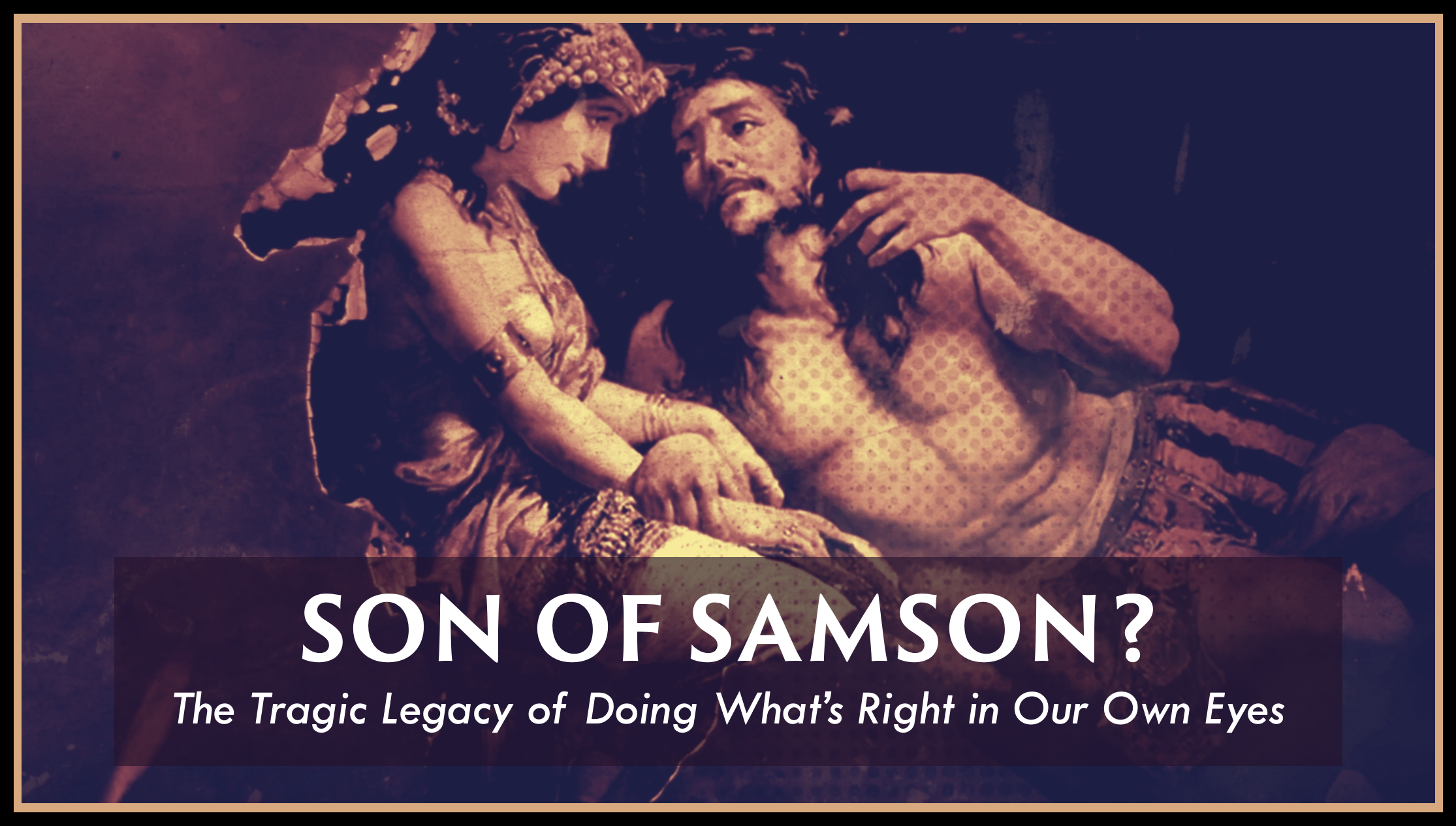
Samson is a tragic Old Testament figure. Far from being the hero that children’s storybooks often make him out to be, he is more of a cautionary tale of what happens when we give in to our own selfish desires rather listen to God’s call and direction for our life.
Samson was specially chosen by God: a miraculous offspring to a barren woman, set apart as a Nazirite all his days, with the mission of beginning to save the people of Israel from the Philistines (Judges 13.3-5). Famously, he is blessed with great strength by God, but he mainly uses it to pursue personal vengeance or evade consequences for his actions rather than any sort of concerted effort on behalf of the people of Israel. Further, he apparently despises his Nazirite vow, violating every element of it, from touching a lion corpse, to participating in drunken parties, to ultimately letting his hair be cut (Judges 14–16).
This latter event occurs while he is in the clutches of the femme fatale Delilah, and is the direct cause of his downfall. Samson is blinded and enslaved by the Philistines, but even in this lowly state, God works through him to bring about a final act of judgment on the Philistines (Judges 16.23-31).
And thus, the tragic tale of Samson comes to an end…or does it? I’ve read through the book of Judges numerous times, but on my last reading, I discovered something that I had never seen before.
Judges 17–21 are different from the rest of the book. Rather than providing narratives of different judges, these chapters relate stories to indicate the lawlessness of Israel in a time when “there was no king” and “everyone did what was right in their own eyes.”[1] Judges 17–18 might be described as religious lawlessness, while chapters 19–21 are indicative of moral lawlessness. The point is that things have thoroughly gotten really bad in Israel, in all aspects of life.
But, are these chapters more directly connected with what has come before? Judges 17 introduces the character of Micah:
1 There was a man of the hill country of Ephraim, whose name was Micah. 2 And he said to his mother, “The 1,100 pieces of silver that were taken from you, about which you uttered a curse, and also spoke it in my ears, behold, the silver is with me; I took it.” And his mother said, “Blessed be my son by the LORD.” (Judges 17.1-2a)
The lawlessness of Israel is on immediate display here, as Micah steals from his own mother, but the interesting detail that should catch our attention is the amount that he stole: 1,100 pieces of silver. This same number appeared in the last chapter, as it was the amount that each of the “lords of the Philistines” promised to pay Delilah for delivering Samson into their hands.
So, is this a mere coincidence, or is the narrator deliberately linking Micah’s unnamed mother with the character of Delilah? Furthermore, is it possible that Samson himself could be the father of Micah? Scholars have suggested so:
“The Philistine lords each give Delilah eleven hundred pieces of silver, the same amount Micah steals. The question immediately arises as to why the amounts are the same. The easiest answer is that the narrator attempts to establish a connection between the two stories: that Samson is Micah’s father and Delilah, his mother.”[2]
In addition to the link of the amount of silver pieces, there are other points of connection:
- The story is told directly after the Samson cycle in Judges 13–16.
- Both Delilah and Micah’s mother are portrayed as unattached, and interfere with God’s religious activity among His people—Delilah compromises an Israelite judge, and Micah’s mother compromises Israelite religion by encouraging Micah to create an idol.[3]
- There is a geographical link: the “hill country of Ephraim” is close to the Valley of Sorek where Samson meets Delilah.[4]
- Micah has no named father; this would be the first case in Judges where a main male character did not have a named father. [5]
- In the story, Micah will have significant dealings with the tribe of Dan, Samson’s own tribe.[6]
Micah himself is a shady character: after confessing to stealing from his mother, she returns some of the silver to him so he can make an idol from it. He then goes on to create a shrine in his house, and ordains one of his sons to become a priest. Later, when a Levite travels through town, Micah offers him a job as a priest in his heretical shrine, and thinks that somehow this will manipulate the LORD into blessing him (Judges 17.13). Blessing does not come, however, as a group of thuggish Danites arrive in Judges 18, and steal Micah’s new Levite priest from him and threaten him with violence. Again, it is a sad story that points to the lawlessness and depravity of Israel.
Connecting this story to Samson isn’t necessary to interpret it well, but is there anything gained from this connection? I think so. Part of the theme of the book of Judges is that Israel experiences a downward spiral of unfaithfulness—things get worse and worse as time goes on, and Israel’s spiritual dysfunction is intergenerational. We already have an example of one judge with a mixed record whose offspring is a villain (Gideon and Abimelech), and Samson and Micah could be a recapitulation of this theme. And perhaps, this is the big point: when even the leaders of God’s people do “what is right in their own eyes,” what hope is there for the next generation?
May God, in His grace, save us from such leaders, and for those of us who are leaders, may we seek what is right in God’s eyes rather than our own!
[1] Regardless of the inclinations of postmodern culture where everyone is encouraged to “live out their own truth,” the biblical narrative is clear: when everyone does what is right in their own eyes, the result is lawlessness and depravity.
[2] Rob Fleenor and Mark S. Ziese, Judges & Ruth, The College Press NIV Commentary (Joplin, MO: College Press, 2008), 249.
[3] Fleenor and Ziese, Judges & Ruth, 249.
[4] Ibid.
[5] Tammi Schneider, Judges, Berit Olam (Collegeville, MN: Liturgical Press, 1999), 232.
[6] Schneider, Judges, 232.
You may be an ambassador to England or France


 In this loose series of








