The online journal of Luke Dockery

Category: Discipleship (Page 7 of 23)

Church is Good for Your Kids

I recently finished reading Rebecca McLaughlin’s 10 Questions Every Teen Should Ask (and Answer) about Christianity. I thought it was a great book, an I plan to use it in our youth ministry moving forward. I may write a review at a later date.

For now though, I just wanted to briefly discuss a provocative point that McLaughlin makes early in the book. In our increasingly secular society, it has become popular in some circles to argue that religion is actually bad for us. Parents who take their kids to church are brainwashing their kids, encouraging them to be bigots, and setting them up for a lifetime of therapy (or so the argument goes). This would be a compelling argument for any loving parent to consider…except that it isn’t true. As McLaughlin points out:

“There is a growing body of evidence that regular religious practice is measurably good for the health, happiness, and pro-social behavior of our kids.”[1]


Here is some of the specific evidence:[2]

  • Children raised in religious environments were better protected from depression, drugs, and risky sexual behaviors.
  • Those who attended religious services regularly were 12% less likely to have high depressive symptoms and 33% less likely to use illegal drugs.
  • Those who prayed or meditated frequently were 30% less likely to be sexually active at a young age and 40% less likely to have an STD.
  • Children with a religious upbringing were also more likely to go on to have higher levels of happiness, a sense of purpose, volunteering, and forgiveness of others.

Now, none of this proves that belief in God is correct or that Christianity is true, but it should give us serious pause about buying into popular cultural narratives about the harmfulness of religion. McLaughlin quotes therapist Erika Komisar as follows:

“As a therapist, I’m often asked to explain why depression and anxiety are so common among children and adolescents. One of the most important explanations—and perhaps the most neglected—is declining interest in religion.”[3]

Komisar evens goes further, provocatively advising parents that if they don’t believe in God, they should fake it for the sake of their children! I certainly wouldn’t encourage parents to lie to their kids, but for those parents who are believers but question the value of regular religious practice, or perhaps are wondering about the whispers (or sometimes, loud shouts) they hear from culture at large, take courage: church is good for your kids![4]


[1] Rebecca McLaughlin, 10 Questions Every Teen Should Ask (and Answer) about Christianity (Wheaton, IL: Crossway, 2021), 14. To be clear, the research supports the benefits of religious practice for kids. This includes kids who grow up going to mosque or synagogue, not just those who grow up in Christian homes and attend church. But the research certainly applies to church as well, and that is obviously my context, as well as being the target for most of the disdain in our current cultural moment.

[2] McLaughlin, 14.

[3] McLaughlin, 15. Of course, that’s not to say that there are not many faithful religious people who still struggle with depression and anxiety. Religion is not a cure-all. McLaughlin’s point, and what the research states, is that it helps.

[4] It would be prudent to point out here that not just any church is good for your kids. The infamous Westboro Baptist Church, for example, isn’t good for anyone. So, yes, generally speaking, church is good for your kids! But find a church that seeks to teach what Scripture teaches and encourages you to love God and other people.

The Beatitudes: Blessed Are the Peacemakers

As discussed in the introductory post of this series, Jesus’s Beatitudes in the Sermon on the Mount are basically a description of what a good life really looks like from God’s perspective. Jesus redefines what blessedness is, and provides an alternative set of values for His followers, those who desire to be a part of His alternative community. Here are the Beatitudes we have discussed thus far:


Blessed Are the Peacemakers

“Blessed are the peacemakers, for they shall be called sons of God.”

(Matthew 5.9)

Jesus says that God’s favor rests upon those who make peace.

God cares deeply about peace.

“Peace” is something that is talked about a lot, but it is important for us to realize that this word is used to convey different ideas at times, and we need to make sure that we have a clear picture of what Jesus is talking about in this context.

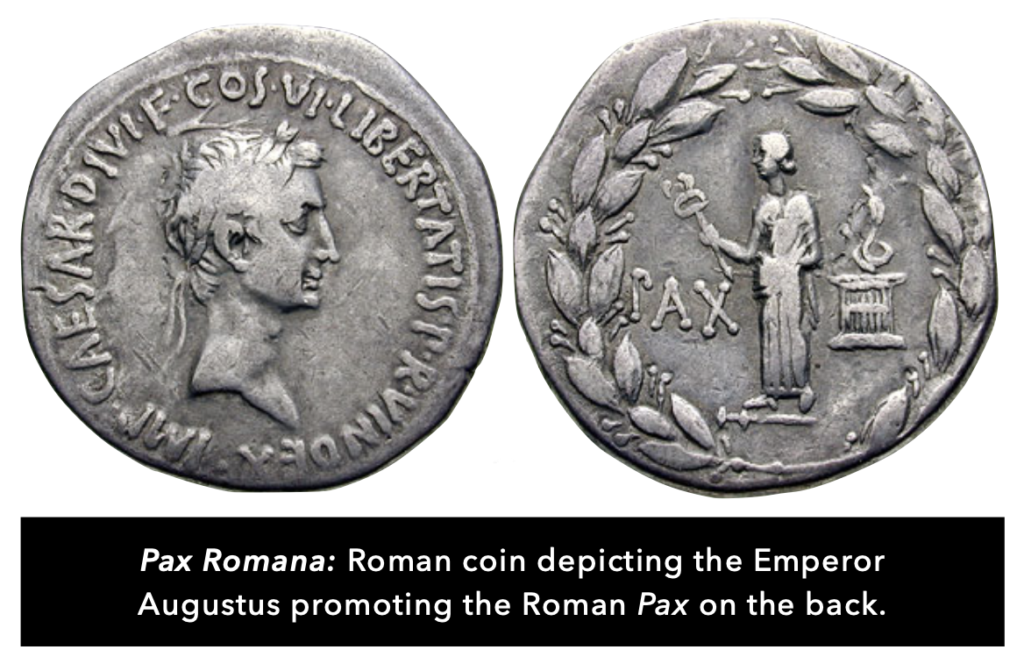
During the time that Jesus lived, peace was greatly emphasized, because the Roman Empire was enjoying the Pax Romana, or “Roman Peace.” The Pax Romana lasted for several decades and was a time of stability and prosperity in the Empire in which there was relative peace and no major wars. This peace came at a high price, however, as it was made possible only through brutal military conquest, the forced subjugation of conquered peoples, and the confiscation of their land.[1]

Of course, this is not the kind of peace that Jesus is talking about. Jesus does not call for His followers to make peace through military might. Furthermore, in the Bible, “peace” is not simply the absence of war; peace suggests wholeness and well-being, and healthy and just relationships with one another.[2] Related to that, biblical peace—wholeness, justice, healthy relationships—does not come from pretending problems don’t exist. Jesus is the Prince of Peace, and He came to make reconciliation with God possible, but He didn’t gloss over the reality of sin; He confronted people with it, and was killed as a result.

Peace-making is not pretending that problems don’t exist. Share on X

A good modern-day example is Rosa Parks, who in 1955 refused to give up her bus seat to a white passenger. That act had far-reaching consequences (Parks was arrested, and it was a key early event in the American Civil Rights Movement), and some people called her a troublemaker because she didn’t just do what she was told to “keep the peace.” But peace doesn’t come from pretending that there is no problem. As long as African-Americans were forced to sit at the back of busses or give up their seats to white people, true peace was not possible. Refusing to give up a seat on the bus was actually a part of peacemaking because it was an effort to bring about wholeness and justice in society.

Jesus wants His followers to be people who actively work to make peace in their relationships and in their communities. Of course, we should try to get along with others and we should not go around trying to stir up strife for the fun of it, but we do need to be people who work to bring about real reconciliation in situations where people are at disharmony with one another.[3]

Jesus wants His followers to be people who actively work to make peace in their relationships and in their communities. Share on X

Peacemakers are called children of God because they are like God. After all, God’s supreme mission is to bring about reconciliation in the world. As William Barclay says, “The man who divides men is doing the devil’s work; the man who unites men is doing God’s work.”[4]


If you enjoyed this post, you might enjoy my book on the Sermon on the Mount, Counter Culture: A Study of the Sermon on the Mount. 

Although this book was written specifically as an aid to teaching the Sermon on the Mount to junior high and high school students, it is also useful for personal Bible study, and the depth of the material makes it a great resource for adult Bible classes.


[1] Warren Carter, “Power and Identities: The Contexts of Matthew’s Sermon on the Mount,” in Preaching the Sermon on the Mount: The World It Imagines, ed. David Fleer and Dave Bland (St. Louis: Chalice Press, 2007), 21.

[2] William Barclay, The Gospel of Matthew Volume 1, The Daily Study Bible (Philadelphia, Westminster Press, 1956), 103: “In the Bible peace means not only freedom from all trouble; it means enjoyment of all good.”

[3] Albert Barnes, Matthew and Mark, Notes on the New Testament (Grand Rapids, MI: Baker Book House, 1949), 45.

[4] Barclay, 105.

The Beatitudes: Blessed Are the Pure in Heart

As discussed in the introductory post of this series, Jesus’s Beatitudes in the Sermon on the Mount are basically a description of what a good life really looks like from God’s perspective. Jesus redefines what blessedness is, and provides an alternative set of values for His followers, those who desire to be a part of His alternative community. Here are the Beatitudes we have discussed thus far:


Blessed Are the Pure in Heart

“Blessed are the pure in heart, for they shall see God.”

(Matthew 5.8)

In the sixth Beatitude, Jesus addresses those who are “pure in heart.” Often when we see terms like this in Scripture, we assume it is talking about something like moral perfection. This phrase does not suggest someone who is sinless, but rather, refers to those who act with loyalty, integrity, and from pure motives.[1] Psalm 24 talks about the man with a pure heart being someone who does not devote himself to what is false and does not swear deceitfully. A person who is pure in heart is someone whose entire life, “public and private, is transparent before God and men. Their very heart—including their thoughts and motives—is pure, unmixed with anything devious.”[2]

Being “pure in heart” doesn’t refer to moral perfection, but to those who act with loyalty, integrity, and from pure motives. Share on X

Have you ever known someone who was supposedly your friend, but you weren’t sure that you could really trust them? Or maybe someone who did something nice for you, but you weren’t sure that you could trust their motives because perhaps they were doing it in order to get something in return? This is the opposite of being “pure in heart.” The reality is that being pure in heart is not a common trait in today’s world; there are not that many people that we would describe without hesitation as having loyalty, integrity, and pure motives.

To help us get a better picture of what it looks like to be pure in heart, it might help to think of children with special needs.[3] My daughter Kinsley has a genetic condition that causes her to have a lot of disabilities, and it can be easy to focus on the negatives of her condition. At the same time, she is also “disabled” from being deceitful, dishonest, or acting from impure motives: if she is happy, or if she loves you, she’ll show you that. If she’s upset about something, she’ll let you know. She won’t secretly or deviously do anything, because that’s simply not in her nature. The label “disabled” gets applied to her frequently, but when it comes to being pure in heart, she is much more able than her father is! This is not to suggest, of course, that only people with disabilities can be pure in heart, but rather that children with special needs help us to see the purity and single-mindedness that Jesus talks about.

From experience, we know that when we act in a double-minded way, are manipulative, or behave deceitfully, misery tends to follow. On the other hand, those who are pure in heart are blessed, and Jesus says that such people will see God. This is not meant to imply some sort of visionary experience, but rather, is another way of stating that the kingdom of heaven belongs to people such as this.[4]


If you enjoyed this post, you might enjoy my book on the Sermon on the Mount, Counter Culture: A Study of the Sermon on the Mount. 

Although this book was written specifically as an aid to teaching the Sermon on the Mount to junior high and high school students, it is also useful for personal Bible study, and the depth of the material makes it a great resource for adult Bible classes.


[1] Larry Chouinard, Matthew, The College Press NIV Commentary (Joplin, MO, College Press, 1997), 99. See also Jack P. Lewis, The Gospel According to Matthew, Part I, The Living Word Commentary (Austin, TX: Sweet Publishing, 1976), 82; Herschel H. Hobbs, An Exposition of the Gospel of Matthew (Grand Rapids, Baker Book House, 1965), 61.

[2] John R.W. Stott, Christian Counter-Culture: The Message of the Sermon on the Mount (Downers Grove, IL, InterVarsity Press, 1978), 49.

[3] Chris Seidman and Joshua Graves, Heaven on Earth: Realizing the Good Life Now (Nashville, TN, Abingdon Press, 2012), 81-85.

[4] Francis Wright Beare, The Gospel According to Matthew: A Commentary (Oxford: Basil Blackwell, 1981), 133.

The Beatitudes: Blessed Are the Merciful

As discussed in the introductory post of this series, Jesus’s Beatitudes in the Sermon on the Mount are basically a description of what a good life really looks like from God’s perspective. Jesus redefines what blessedness is, and provides an alternative set of values for His followers, those who desire to be a part of His alternative community. Here are the Beatitudes we have discussed thus far:


Blessed Are the Merciful

“Blessed are the merciful, for they shall receive mercy.”

(Matthew 5.7)

Having already pronounced blessing on the poor in spirit, those who mourn, the meek, and those who hunger and thirst for righteousness, next, Jesus proclaims that God’s favor is found in being merciful. Mercy is an idea that is likely more familiar to us than some of the other beatitudes; it involves offering kindness, goodwill, and forgiveness to others.

This is another reminder of how different the standards of God’s kingdom are from the standards of the world. The world of the first century was a harsh, unforgiving place, and mercy was not always considered to be a virtue, because it involved showing favor to someone who had done nothing to deserve what was being given.[1] In some ways, our world is not so different today. While people often give lip service to the ideas of tolerance and giving people a second chance, the explosive growth of cancel culture (on the socio-political right and left) reveals how very unmerciful we are often inclined to be.

In contrast to this, what God does in our world through Jesus Christ “creates a world marked by mercy rather than revenge, meanness, selfishness, or exploitative power over others.”[2] Thus, as we look around and see other people who are struggling or suffering in some way, our response as followers of Jesus should be mercy: we are so affected by the sufferings of others that we don’t just feel bad for them; we do what we can to help them (cf. Luke 10.25-37).[3]

One of the major reasons that mercy is a characteristic of citizens of God’s kingdom is because it is a characteristic of God Himself. God shows kindness to us in the blessings He showers upon us each day, in His desire to have a relationship with us, and in His preparation of an eternal home for us. He extends good will to us in that even though we commit sin and separate ourselves from Him, He is always willing to take us back and reestablish the relationship (cf. Luke 15). And made possible by the sacrifice of Jesus on the cross, God offers us forgiveness for the sins we commit. When we are people of mercy who show mercy to others, we imitate the nature of God. We don’t show mercy because people deserve it—mercy is a gift, not a wage—we show mercy because that’s what God does, and as His children, we want to be like Him.[4]

When we are people of mercy who show mercy to others, we imitate the nature of God. Share on X Christians don’t show mercy because people deserve it—mercy is a gift, not a wage—we show mercy because that’s what God does, and as His children, we want to be like Him. Share on X

Jesus’ words here prohibit any sort of unmerciful behavior from those who would be His followers, and His promise that the merciful will receive mercy foreshadows what He will say later in Matthew 6, that those who forgive others will themselves receive forgiveness from the Father.[5]

Indeed, the stakes couldn’t be higher: if we want to be recipients of God’s mercy, we must dispense mercy when we have the opportunity.


If you enjoyed this post, you might enjoy my book on the Sermon on the Mount, Counter Culture: A Study of the Sermon on the Mount. 

Although this book was written specifically as an aid to teaching the Sermon on the Mount to junior high and high school students, it is also useful for personal Bible study, and the depth of the material makes it a great resource for adult Bible classes.


[1] Chris Seidman and Joshua Graves, Heaven on Earth: Realizing the Good Life Now (Nashville, TN, Abingdon Press, 2012), 64.

[2] Warren Carter, “Power and Identities: The Contexts of Matthew’s Sermon on the Mount,” in Preaching the Sermon on the Mount: The World It Imagines, ed. David Fleer and Dave Bland (St. Louis: Chalice Press, 2007), 19.

[3] Albert Barnes, Matthew and Mark, Notes on the New Testament (Grand Rapids, MI: Baker Book House, 1949), 45; Rubel Shelly, The Beatitudes: Jesus’ Formula for Happiness (Nashville, TN, 20th Century Christian, 1982), 54.

[4] Seidman and Graves, 68.

[5] James Burton Coffman, Commentary on the Gospel of Matthew, (Austin, TX: Firm Foundation Publishing House, 1968), 53; Francis Wright Beare, The Gospel According to Matthew: A Commentary (Oxford: Basil Blackwell, 1981), 133.

The Beatitudes: Blessed Are Those Who Hunger and Thirst for Righteousness

As discussed in the introductory post of this series, Jesus’s Beatitudes in the Sermon on the Mount are basically a description of what a good life really looks like from God’s perspective. Jesus redefines what blessedness is, and provides an alternative set of values for His followers, those who desire to be a part of His alternative community. Here are the Beatitudes we have discussed thus far:


Blessed Are Those Who Hunger and Thirst for Righteousness

“Blessed are those who hunger and thirst for righteousness, for they shall be satisfied.”

(Matthew 5.6)

When we think of “righteousness,” we primarily think of it as a spiritual or religious word that refers to our moral condition and our relationship with God. That is not incorrect, but in both Hebrew and Greek, the words translated as “righteousness” in our Bibles also convey the meaning “justice.” Those two ideas—righteousness and justice—seem fairly distinct to us, but it is significant that in both of the primary original languages of Scripture, they are closely connected.[1]

Righteousness and justice seem fairly distinct to us, but it is significant that in both of the primary original languages of Scripture, they are closely connected. Share on X

So when Jesus discusses hungering and thirsting for “righteousness,” He is most likely referring to those who are seeking to live in a way that results in right relationship with both God (righteousness) and other people (justice). This also makes a lot of sense in the context of Jesus saying that the two greatest commandments are loving God with everything we have and loving our neighbors as ourselves (Matthew 22.37-39). When we place these two commandments at the center of our lives, then we are pursuing righteousness. Or, put differently, a good way to think of righteousness is that Jesus is “calling for any and all action that attempt[s] to make things right in the world.”[2]

When we place the two greatest commandments at the center of our lives, then we are pursuing righteousness. Share on X

Another key idea to this beatitude is the idea of having “hunger and thirst” for righteousness. Living in the financially-blessed conditions of the United States, most of us really know very little about what it means to be hungry or thirsty. The hunger of the ancient world was not a gentle growling of the stomach reminding us that we haven’t eaten for a few hours. Indeed, most people barely had enough to eat to get by, and meals of more than enough (like what I get any time I go to a fast food restaurant) were very rare indeed. Similarly, whenever I am thirsty, I can generally get access to clean drinking water within a matter of minutes. Again, this was not the case in the ancient world.[3] So the idea here is not someone who has a mild desire for righteousness, but rather, someone who desperately craves it.

There’s an old story about a young man who went to see a wise old man to ask him about the right way to live.[4] The wise man led him down to a river, and together they walked out into it. When the water was deep enough, the wise man suddenly grabbed the young man, pushed him under the water and held his head submerged! Naturally, the young man began to struggle with all his might to escape and get his head above water again. He finally managed to get free, and broke the surface of the water, gasping for breath. As he gulped down the precious air, the wise man said, “When you thought you were about to drown, what did you want more than anything else?” “Air!” the young man responded. The old man replied: “When you want righteousness as much as you wanted air just now, it will become a possibility for you. But not before.”

How much do you desire to be right with God and other people? As much as a starving person wants food? As much as a drowning person wants air? Because that is the characteristic of citizens of the kingdom that Jesus is describing here.

Undoubtedly, that is a high standard to set, but there should also be some comfort to us in this verse because it affirms the virtue of the pursuit of righteousness rather than simply attaining it. Because of our imperfect natures, we often fall short of what we desire to achieve, but it is important to notice here that Jesus pronounces blessing on those who seek righteousness.[5] In other words, don’t beat yourself up over your failings; instead, pick yourself up and continue the pursuit for righteousness, because it is that pursuit that Jesus calls “blessed.” Hunger and thirst for it.

God promises that if you do, you will be satisfied.


If you enjoyed this post, you might enjoy my book on the Sermon on the Mount, Counter Culture: A Study of the Sermon on the Mount. 

Although this book was written specifically as an aid to teaching the Sermon on the Mount to junior high and high school students, it is also useful for personal Bible study, and the depth of the material makes it a great resource for adult Bible classes.


[1] Larry Chouinard, Matthew, The College Press NIV Commentary (Joplin, MO, College Press, 1997), 98, suggests that justice is more on Jesus’ mind in this instance, but I am not sure that there is anything to suggest that both (closely-related) ideas could not be what He was communicating.

[2] Chris Seidman and Joshua Graves, Heaven on Earth: Realizing the Good Life Now (Nashville, TN, Abingdon Press, 2012), 58.

[3] William Barclay, The Gospel of Matthew Volume 1, The Daily Study Bible (Philadelphia, Westminster Press, 1956), 94.

[4] See Rubel Shelly, The Beatitudes: Jesus’ Formula for Happiness (Nashville, TN, 20th Century Christian, 1982), 47-48.

[5] Ibid., 96.

« Older posts Newer posts »

© 2026 The Doc File

Theme by Anders Noren — Up ↑