The online journal of Luke Dockery

Category: Christianity (Page 4 of 64)

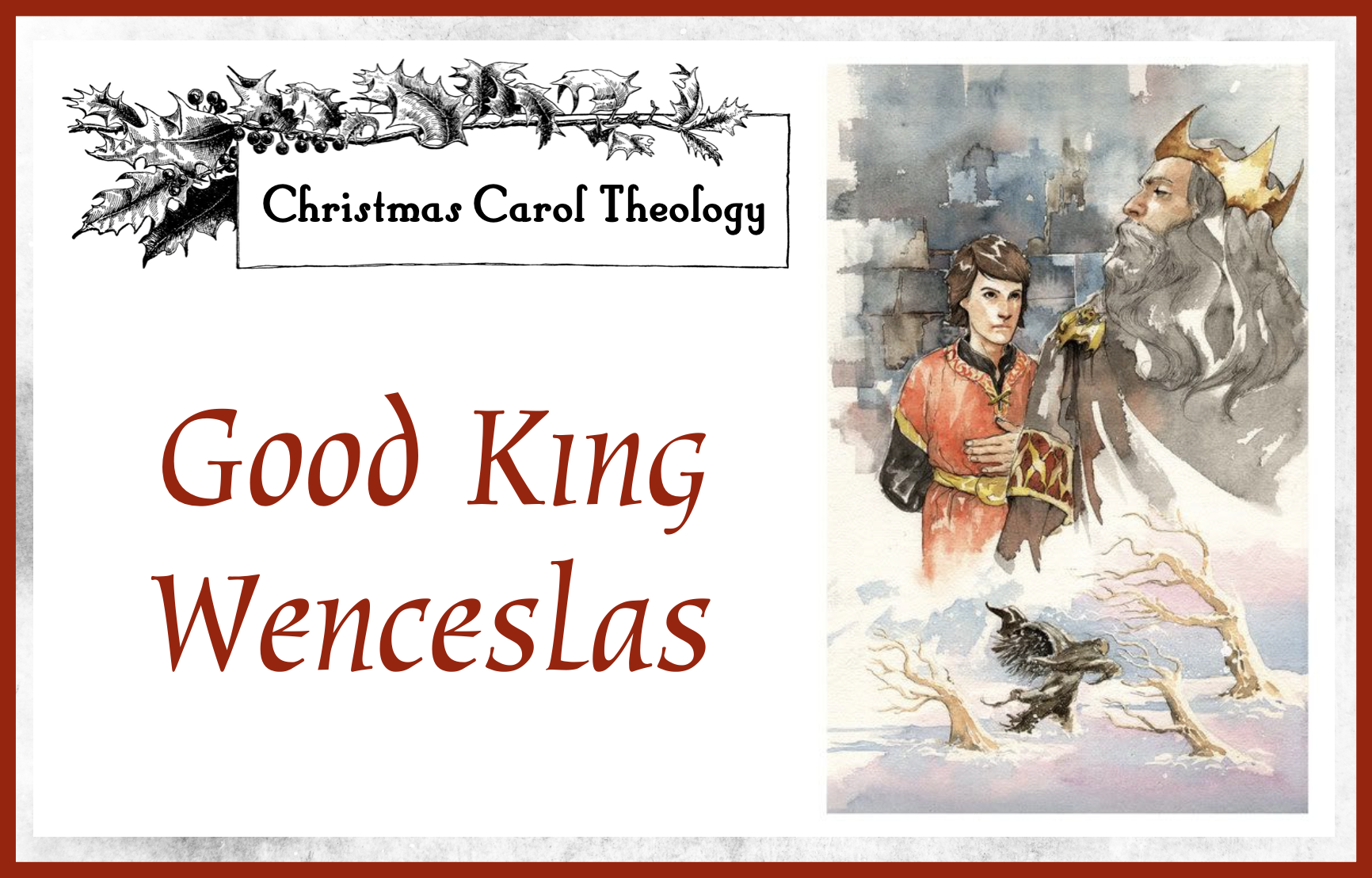
Christmas Carol Theology: “Good King Wenceslas”

I’m a big fan of Christmas music. I’ve enjoyed it for as long as I can remember, and I tend to start listening to it in early November each year. I like the children’s classics, the traditional mid-century standards, and even some of the more recent additions. But my favorite Christmas music is in the form of carols or those songs that are religious in nature, teach theology, and focus on the coming of Christ into the world.

I remember from when I was a kid that my dad’s favorite Christmas carol was “Good King Wenceslas,” which he would sing sometimes. I have one particular memory of him singing it outside while we were working, and I thought it was a silly song because of the hard-to-pronounce name of the king and some of the cadence of the song. It is with some regret that I inform you that it was not until 30+ years later (i.e. now) that I actually looked up the lyrics to the song and read them all for the first time. I enjoyed them so much that I decided to actually kick off a series on Christmas Carol Theology, and let this carol bat leadoff, so to speak.

The good king in the song is based on the 10th-century Wenceslaus I of Bohemia, and tells of his journey through harsh winter weather to give alms to a poor peasant on the Feast of Stephen, which falls on the second day of Christmas (December 26).

In 1853, John Mason Neale wrote the lyrics:

Good King Wenceslas looked out
on the feast of Stephen,
when the snow lay round about,
deep and crisp and even.

Brightly shone the moon that night,
though the frost was cruel,
when a poor man came in sight,
gathering winter fuel.

Hither, page, and stand by me.
If thou know it telling.
yonder peasant, who is he?
Where and what his dwelling?

Sire, he lives a good league hence,
underneath the mountain,
right against the forest fence
by Saint Agnes fountain.

Bring me flesh, and bring me wine.
Bring me pine logs hither.
Thou and I will see him dine
when we bear the thither.

Page and monarch, forth they went,
forth they went together
through the rude wind’s wild lament
and the bitter weather.

Sire, the night is darker now,
and the wind blows stronger.
Fails my heart, I know not how.
I can go no longer.

Mark my footsteps my good page,
tread thou in them boldly.
Thou shalt find the winter’s rage
freeze thy blood less coldly.

In his master’s step he trod,
where the snow lay dented.
Heat was in the very sod
which the saint had printed.

Therefore, Christian men, be sure,
wealth or rank possessing,
ye who now will bless the poor
shall yourselves find blessing.


The king sees a poor man illuminated by the bright moon, and calls a page to ask if he knows who the peasant is and where he stays. When the page tells the king that he recognizes and knows where he lives, Wenceslas has the page gather food and firewood so they can take it to the poor man.

The boy and his king, “page and monarch”, venture out into the cold night, but with the deep snow, howling wind, and bitter cold, the young page is soon overwhelmed. The kind king encourages him to follow in his footsteps so the going will be easier, and indeed, it is: “heat was in the very sod which the saint had printed.” And then the final stanza offers a word of exhortation: those who bless the poor will find themselves blessed in the process.

This is a good song! It tells a story, setting the scene, describes a problem, it has rising and falling action, a resolution, and then a moral at the end. And from a theological perspective, it has much to teach us:

(1) The Blessedness of Giving

This lesson is fairly obvious in the song, as it is told in the concluding stanza (but I suspect many never make it that far into the song!). This is a bedrock Christian value, based on the teaching of Jesus Himself (Acts 20.35), and exemplified by His life and actions. Christians believe that we are blessed by God not some we can store up and hoard those blessings, but so that we can share them with others, and that we are ourselves blessed when we do so.

(2) The kenosis of Good King Wenceslas

The Greek word kenosis (κένωσις) refers to the willing self-emptying of the Son, who left His lofty position in heaven to come and live as Jesus of Nazareth, fully experiencing the lows of human existence and taking the form of a servant for the sake of humanity (Philippians 2.6-11). Good King Wenceslas experiences a kenosis of a sort, as he leaves his palace on a feast day and undergoes suffering in the bitter cold to seek out a poor man so that he, too, can join in the feast, which has strong echoes of Jesus’s parables emphasizing His desire to invite others to join him at great feasts or wedding banquets (Matthew 22; Luke 14).

(3) The Safety of the King’s Footsteps

The page, seeking to follow his king on the mission of mercy, finds himself overwhelmed by the difficulties of the journey. His heart fails him, and he wants to give up! But the good king reassures the boy: he knows the way, and will make a way that the page can follow. What would be impossible on his own is doable if he follows in the steps of the king. As Christians, we often find ourselves buffeted by the winds and difficulties of life, and left to our own devices, it can seem impossible to go on. But the remedy is close at hand: we are to fix our eyes on our Good King, Jesus, the “pioneer and perfecter of faith” (Hebrews 12.2, NIV). What is impossible on our own is achievable if we just follow His footsteps.[1]

As you can see, this is a song with good theology to share! I regret that I neglected it for so much of my life, but I will seek to remedy that moving forward. May you be blessed by the story of a good king, who points us to the Good King!


[1] The “pioneer” language calls to mind a sort of trailblazer, who braves the harsh conditions and makes it easier for those who follow, as Wenceslas did in the snow.

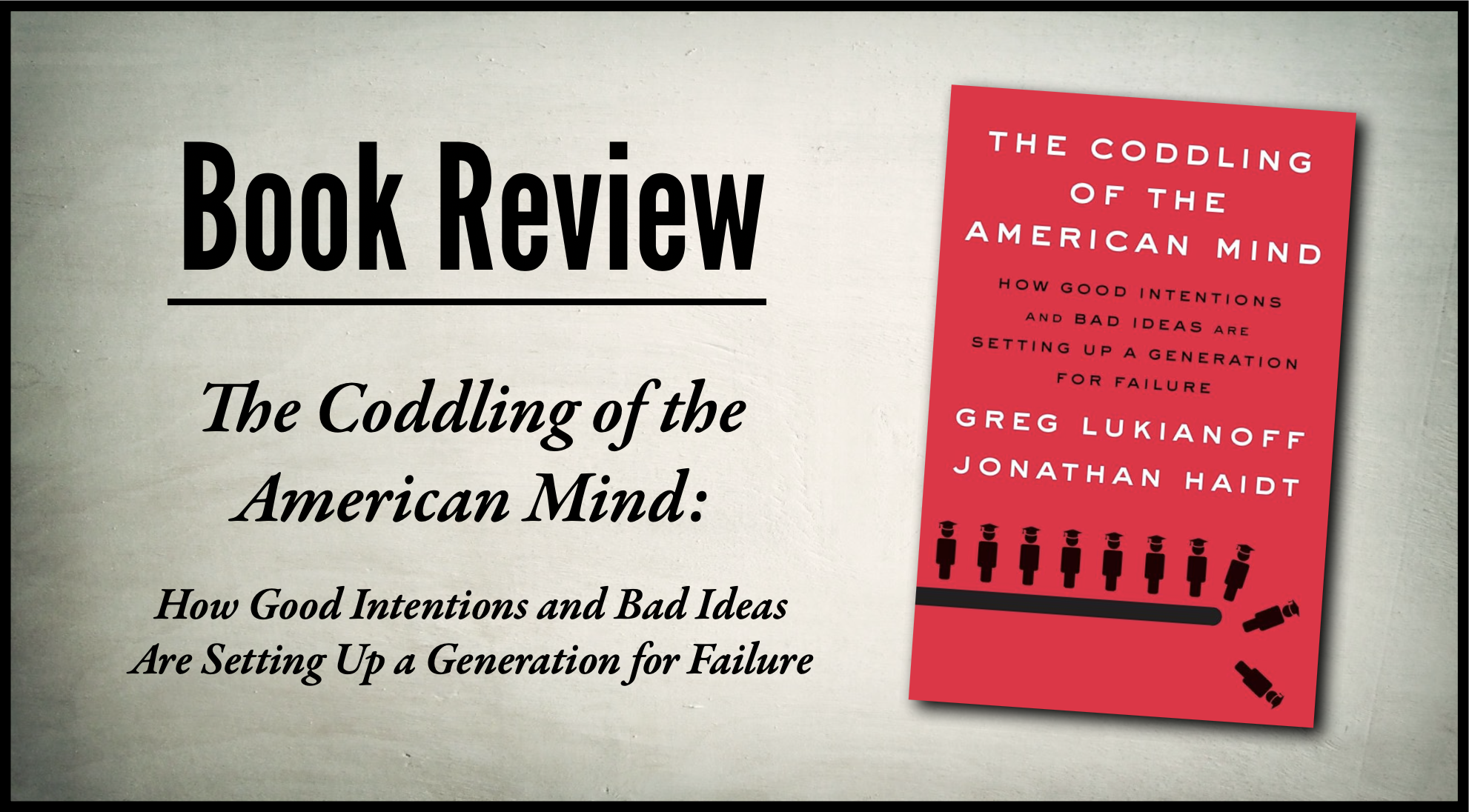
Book Review: The Coddling of the American Mind

Recently in my college youth ministry class, I was sharing research on current teenagers and college students, and while sharing some main ideas from The Coddling of the American Mind by Greg Lukianoff and Jonathan Haidt, I realized that I had never reviewed the book here on The Doc File. Earlier this year, I wrote a review of Haidt’s The Anxious Generation, and I shared how much I have benefitted from Haidt’s work, and how The Coddling of the American Mind was one of my top books in 2021.

But I want to share more about it, here. The Coddling of the American Mind is, I believe, a really helpful book. It is based on extensive research of the two authors, who come from different professional backgrounds (Lukianoff is an attorney and Haidt is a social psychologist). Politically, they would likely be described as moderate liberals, or centrists or something like that, and they do not write from a religious perspective (I am unsure about Lukianoff, but Haidt is an atheist). I mention that, because some of the central claims of their book resonate with conservative Christians like myself, but they are distinctly not writing from that perspective.

Their research is focused particularly on the culture of college campuses and the characteristics of Gen Z students. The basic premise of the book is that there are three widely-held false beliefs—Lukianoff and Haidt call them untruths—among this generation. To be clear, they are not blaming this generation for holding these beliefs; rather, they are “proposing that today’s college students were raised by parents and teachers who had children’s best interests at heart” but who ultimately raised them in some unhelpful ways.[1]

Part I, which I consider to be the best part of the book, examines these three untruths in great detail:

(1) The Untruth of Fragility: What Doesn’t Kill You Makes You Weaker

This is the basic idea that people are fragile and need to be protected from things that harm them. Not just actual, physical dangers, but also the perception of danger or ideas that they disagree with. Lukianoff and Haidt have major issues with this, however.[2]

First, children are antifragile. Their brains require a wide range of inputs from their environments in order to configure themselves for those environments. Similar to an immune system, children must be exposed to challenges and stressors (within limits, in age-appropriate ways), or they will fail to mature into strong and capable adults, able to productively engage with people and ideas that challenge their beliefs and moral convictions.

Second, concepts like “trauma” and “safety” have expanded so far since the 1980s that they are often employed in ways that are no longer grounded in legitimate psychological research. Grossly expanded conceptions of trauma and safety are now used to justify the overprotection of children of all ages—even college students, who are sometimes said to need safe spaces and trigger warnings lest words and ideas put them in danger. 

Finally, L&H discuss safetyism, or the cult of safety, an obsession with eliminating threats (both real and imagined) to the point where people become unwilling to make reasonable trade-offs demanded by other practical and moral concerns. Safetyism deprives young people of the experiences that their antifragile minds need, thereby making them more fragile, anxious and prone to seeing themselves as victims.[3]

To be clear, the three untruths discussed in Coddling of the American Mind are based on research from the social sciences rather than biblical teaching or some sort of Christian worldview. However, part of the reason this resonates with me so deeply and I teach this material in a college Bible class is because it coheres so well with biblical teaching:

[1] Therefore, since we have been justified by faith, we have peace with God through our Lord Jesus Christ. [2] Through him we have also obtained access by faith into this grace in which we stand, and we rejoice in hope of the glory of God. [3] Not only that, but we rejoice in our sufferings, knowing that suffering produces endurance, [4] and endurance produces character, and character produces hope, [5] and hope does not put us to shame, because God’s love has been poured into our hearts through the Holy Spirit who has been given to us.

(Romans 5.1-5)

Scripture doesn’t teach that hard times in life are tragedies to be avoided at all costs; on the contrary, God works through the suffering in our life to help us grow and mature.

(2) The Untruth of Emotional Reasoning: Always Trust Your Feelings

The basic idea here is that we that we often allow our emotions to be the ultimate interpreter of reality for us. This is problematic for several reasons, though:[4]

One of the most universal insights in the world’s wisdom traditions across time and culture is that what really frightens and dismays us is not external events themselves as much as the way in which we think about them. Put in other words, the things that we worry about tend to be less damaging than the fact that we worry about them!

L&H discuss Cognitive Behavior Therapy at some length, which is a very effective form of therapy that basically involves identifying common cognitive distortions (inaccurate, unhealthy thoughts) and then changing patterns of thinking. I am not a psychologist and this is not a book primarily about psychology, but the point here is that there is an entire branch of psychotherapy based on the understand that our thoughts and emotions can mislead us.

Finally, they discuss the practice of disinviting speakers from giving talks on college campuses due to the claim that these speakers will cause harm to students with their words. The Coddling of the American Mind was written back in 2018 when this practice was increasingly spreading to ridiculous proportions. In some of the fallout and cultural reaction to overreach from the left in the last few years, this practice of disinviting speakers is probably less than it was, but it is still a reality. Here’s the problem, though: feeling a negative emotional response because you disagree with someone is not the same as being harmed by them, and it actually diminishes and disregards real, actual harm when we pretend like it does (this also goes back to fragility).

Of course, none of this means that our emotions are bad or that we should ignore them. Indeed, our emotions are a gift from God. At the same time, our own emotional perceptions of things should not be final judge of reality. Again, this is a very biblical idea:

[12] There is a way that seems right to a man, but its end is the way to death.

(Proverbs 14.12)

[26] Whoever trusts in his own mind is a fool, but he who walks in wisdom will be delivered.

(Proverbs 28.26)

We should be skeptical of our emotions, and it is foolish to base our understanding of the world solely on our own thoughts and feelings.

(3) The Untruth of Us Versus Them: Life Is a Battle Between Good People and Evil People

The basic idea here is that our current cultural context emphasizes Common-Enemy Identity Politics: we identify a person or group that we classify as “evil” and then unite with others in opposition to that “evil” person or group. This should be readily apparent to anyone who pays any attention to public discourse—just think of the labels we use to vilify groups of people with whom we disagree: Trump-supporters, Marxists, Racists, Leftists, Anti-Vaxxers, etc. Again, this is problematic.[5]

It does seem to be true that the human mind functions in such a way that it readily divides the world into us/them categories. Haidt’s earlier work, The Righteous Mind, delves into this more, but if you spend much time with kids, you know how easily and naturally they divide into groups and teams to compete with each other (boys vs. girls, cops and robbers, etc.). L&H are not championing this reality and are not saying it’s something we should seek to amplify, but are simply acknowledging that it is a reality.

It becomes concerning, though, when it naturally leads to Common-Enemy Identity Politics (used both by those on the far right and the far left), which tries to unite a coalition against the “other” group. We determine our identity by what distinguishes us from those other people, who are, of course, inferior to us and quite likely evil to the core. This idea is quite different from Common-Humanity Identity Politics, which was used by people like Dr. Martin Luther King, Jr. MLK humanized his opponents and appealed to their common humanity, rather than demonizing them and emphasizing their differences as enemies.

Common-Enemy Identity Politics produces a call-out culture where almost anything can result in public shaming, which causes people to engage in self-censorship because they are afraid of what will happen if they say what they think (think: cancel culture). In a college context, call-out cultures are detrimental to students’ education and bad for their mental health. Additionally, call-out cultures and us-versus-them thinking are incompatible with the educational and research missions of universities, which require free inquiry, dissent, evidence-based argument, and intellectual honesty. 

And, again, this notion that life is a battle between good people and evil people is not a biblical idea, either. The Bible teaches that all humans are created good, in God’s image, but that all of us are tainted by sin and susceptible to its influence:

[10] Finally, be strong in the Lord and in the strength of his might. [11] Put on the whole armor of God, that you may be able to stand against the schemes of the devil. [12] For we do not wrestle against flesh and blood, but against the rulers, against the authorities, against the cosmic powers over this present darkness, against the spiritual forces of evil in the heavenly places.

(Ephesians 6.10-12)

It’s not that I am good and you are evil, or vice versa—it’s that the battle between good and evil is being waged within our own hearts, as we seek to resist evil spiritual influences

To be clear, what I have shared so far is not the entire book—it’s just Part I! This is the part that I found most helpful in terms of its cultural analysis and bringing clarity to some of what seems to have gone so wrong in our current context, but there are three other sections:

  • Part II looks at what these bad ideas actually look like in action, detailing various recent examples and case studies of events that show the negative effects of living out these ideas in the real world. This is very helpful in establishing that the untruths from Part I truly are widespread and damaging.
  • Part III provides an historical overview of how we go to this point, touching on topics of polarization, anxiety and depression, paranoid parenting, decline of free play, the problems of safetyism, and the quest for justice. Readers of Haidt’s The Anxious Generation and The Righteous Mind will find a lot of familiar territory here. This section is really helpful from an orientation perspective, especially for those who look at the untruths and how they are impacting our society and are scratching their heads: “How did we get here?”
  • Part IV seeks to offer some suggestions for a better way forward, and focuses those suggestions in three areas, helping to form Wiser Kids, Wiser Universities, and Wiser Societies. This section is practical, and provides some ideas for improvement for pretty much anyone, regardless of your context or influence.

I think this is a really helpful book, and I strongly recommend it. It has been overshadowed by the overwhelming popularity of The Anxious Generation (which is great and a must-read), but if you enjoyed that book, there’s likely a lot here for you as well.


[1] Greg Lukianoff and Jonathan Haidt, The Coddling of the American Mind: How Good Intentions and Bad Ideas Are Setting Up a Generation for Failure (New York: Penguin Press, 2018), 31.

[2] Lukianoff and Haidt, 19-32.

[3] Haidt further develops this idea significantly in The Anxious Generation.

[4] Lukianoff and Haidt, 33-51.

[5] Ibid., 53-77.

Christmas Carol Theology Index

I enjoy Christmas music, but I am especially fond of Christmas carols, because they serve as a rich source of theological reflection. And so, this series, “Christmas Carol Theology,” will seek to do just that: examine some Christmas carols to see how they can better inform our understanding of the Christian faith, and encourage us to follow Jesus more faithfully.

I anticipate that this will be an ongoing series where I add a few posts each year, so this post will function as an index of the different songs I have written about:

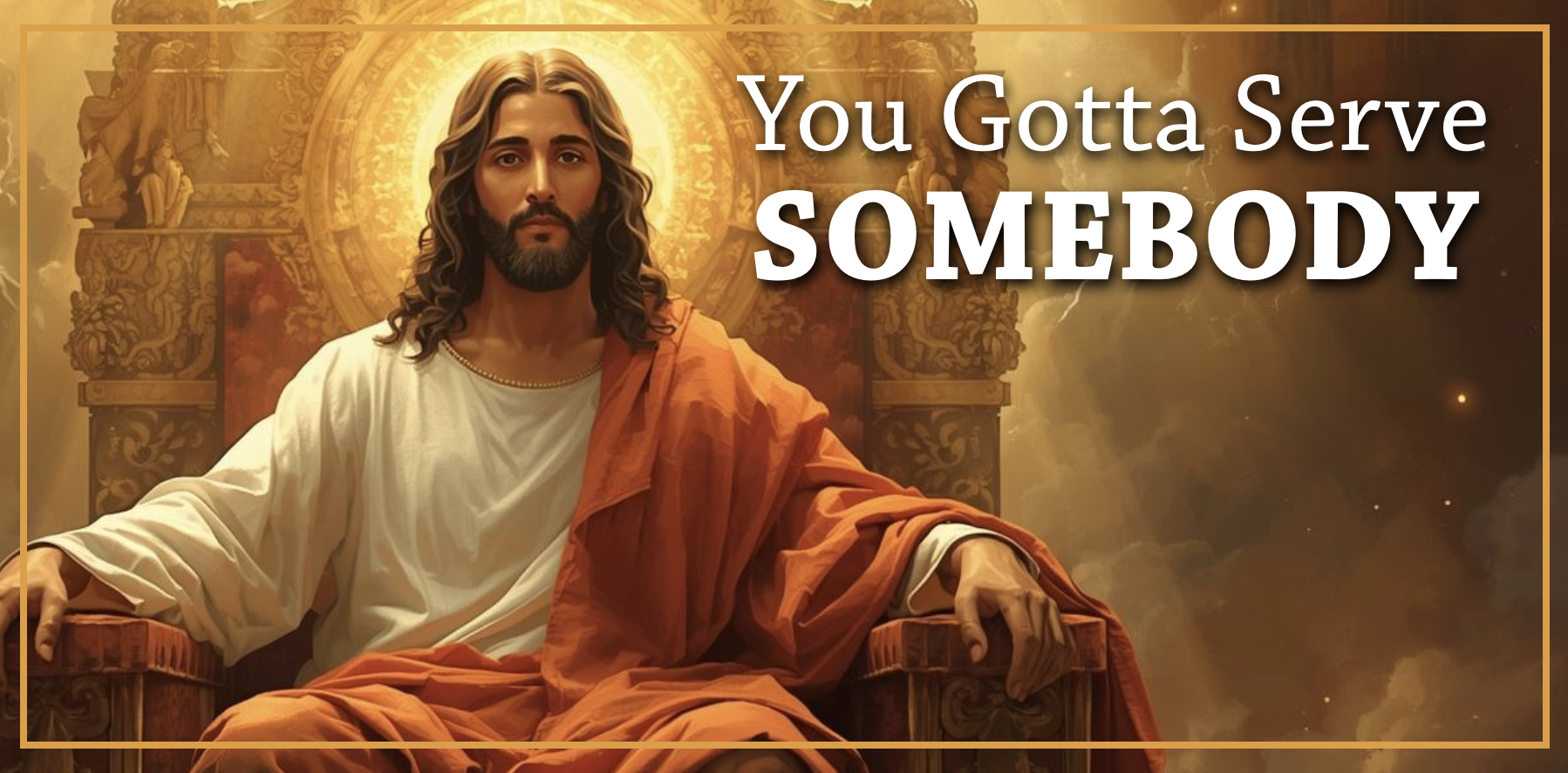
You Gotta Serve Somebody

Be true to yourself…Follow your heart…Live your best life…Do what makes you happy…

One of the great lies of modern society is that freedom comes from throwing off all restraints and being our own masters. This is a lie, because when we pursue our own desires, rather than finding freedom, we inevitably find ourselves enslaved to them: ego, wealth, sex, power, etc.

As I was reading recently in the Word on Fire Bible:

At the heart of the Gospel is our acceptance that we need Jesus Christ. We cannot be our own gods and go our own way. If we refuse to be servants of the true King, we will not be our own masters; we will merely be enslaved to a false king. True freedom comes when our will is completely aligned with that of Jesus Christ. This is the life that we are designed for and that God made possible for us through the cross.[1]

We were designed to live in submission to King Jesus. Because of our tendency toward sinful rebellion, we bristle at the notion of such submission, thinking that really, we would make better masters of our lives, and we seek to climb onto a throne that rightly belongs to God alone. But it’s not freedom that follows; it’s disaster.

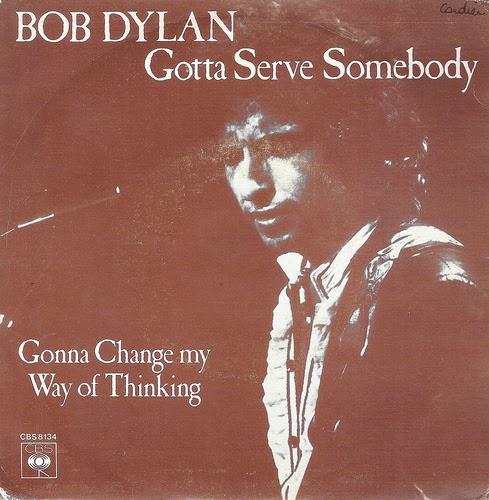
This brought to mind the words of that great theologian, Bob Dylan:

You may be an ambassador to England or France
You may like to gamble, you might like to dance
You may be the heavyweight champion of the world
You might be a socialite with a long string of pearls
But you’re gonna have to serve somebody, yes indeed
You’re gonna have to serve somebody
Well, it may be the Devil or it may be the Lord
But you’re gonna have to serve somebody

Control of our lives is the ultimate illusion. Regardless of our efforts to grasp for autonomy, we will end up serving somebody. You do not get to choose whether or not you have a master, but you do get to choose who your master will be. Choose wisely: submit yourself to the Master who created, sustains, and will redeem you. This is the life that we are designed for.

You do not get to choose whether or not you have a master, but you do get to choose who your Master will be. Share on X

[1] Haley Stewart, “Introduction to Galatians,” in The Word on Fire Bible: Acts, Letters, and Revelation (Park Ridge, IL: Word on Fire Catholic Ministries, 2022), 346

2025 Harding University Lectureship Recap

Every year, I write a post recapping Harding’s annual Bible Lectureship, which occurs in late September–early October. Since I am writing this post in November, I am a little behind, but it is still a helpful practice for me, and perhaps others will find something of interest here as well.

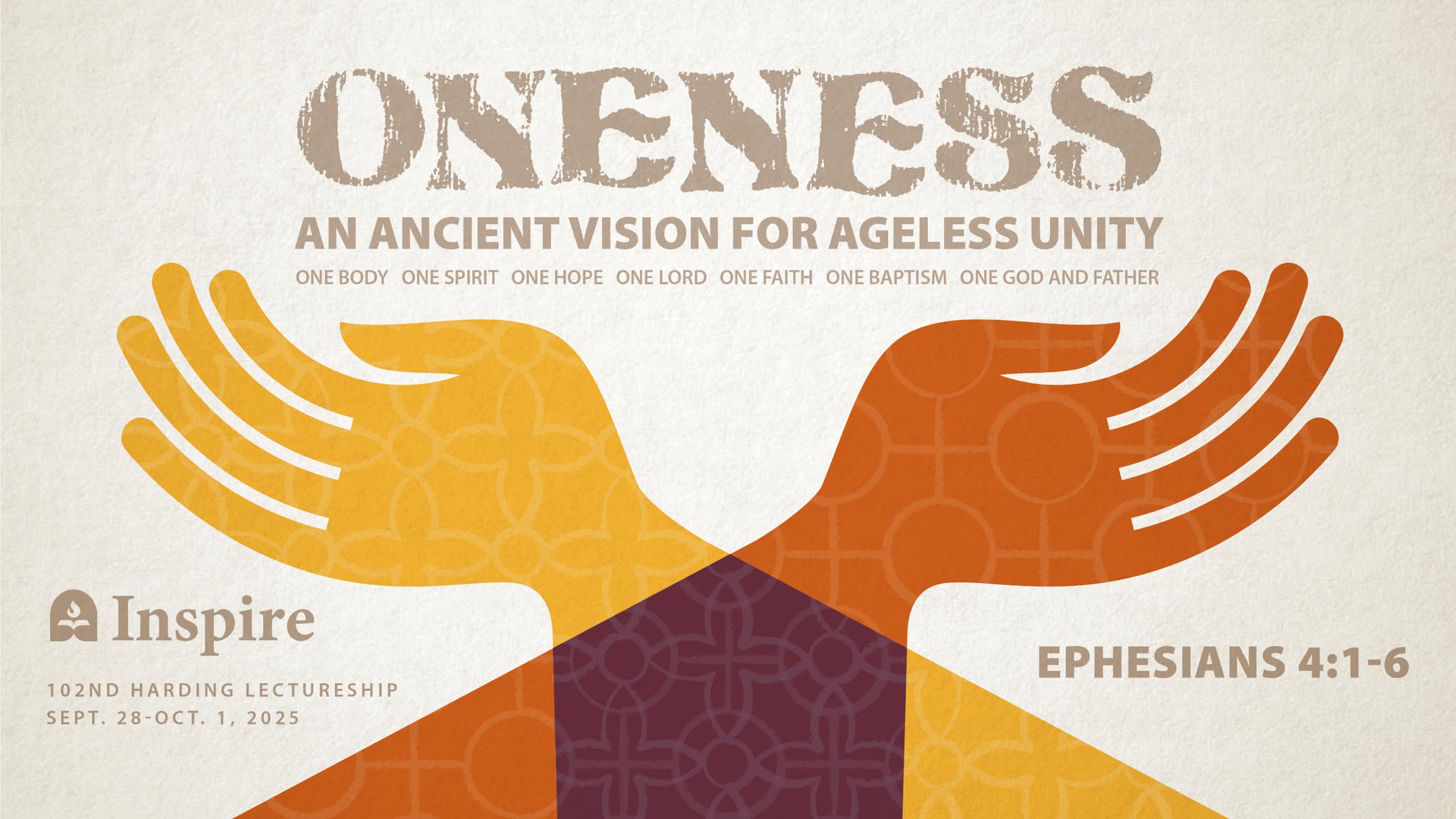
The theme of the Inspire Lectureship this year was Oneness: An Ancient Vision for Ageless Unity, and focused on the 7 Ones of Ephesians 4 as a source of unity among God’s people. As part of that emphasis on unity, the Lectureship Committee seemed to make a concerted effort to cross some traditional divides, inviting a large number of ethnically diverse presenters (African American, Latino, and Native American, among others), as well as some speakers from outside the fellowship of Churches of Christ (albeit, ones with broad theological kinship, like the Independent Christian Churches or a local nondenominational church). This latter move generated great controversy on social media, which I thought was unfortunate. Focusing on that controversy is not the main point of this post, but I feel I would be remiss if I ignored it and pretended it didn’t happen, so here are some brief thoughts:[1] 

  1. I coauthored a book earlier this year on the history of Churches of Christ and the American Restoration Movement, and how unity was an early and driving goal of that movement. I have written before how unity itself is a doctrine, a teaching of Jesus, and how we must take it seriously if we desire to follow Him. With that in mind, it is more than a little ironic that those purporting to be faithful caused an online uproar in response to a concerted effort to seriously reflect on the doctrine of unity.
  2. Many of the critics hold the opinion that only members of Churches of Christ should be allowed to speak at Harding’s Lectureship (and, to be more accurate, only members of the right kind of Churches of Christ). They are certainly entitled to that perspective, but objectively, it is a sectarian one.
  3. Some of the critics suggested that this Lectureship reflected a dangerous slide down the slippery slope to liberalism for Harding, and that they were not sure if they could continue to support the school. These warnings could be taken more seriously if the same critics had not been saying the same things for years; as it is, it comes across as disingenuous.
  4. For all of the controversy, I found this year’s Lectureship to be remarkably similar to previous ones. It did not seem to be edgy, and when I spoke to others in attendance, they agreed. Furthermore, for a school purportedly sliding into liberalism, it was surprising on the first night to hear the school president share Harding’s new Statement of Faith that requires alignment from faculty and staff on a historically Christian sexual ethic (Harding has never done this in the past, so this represents a markedly theological conservative move), the president affirm a continued commitment to a cappella worship and male spiritual leadership, and the keynote speaker reject theological progressivism as an exit to non-faith (see below).

Now, on to the main thing!


With the new format that was adopted last year, there is a greater emphasis on multi-session tracks than standalone lectures. For a variety of reasons (sometimes I wanted to be sure to stop in for a session to greet a presenter I knew; other times I had meetings that interrupted my schedule), I ended up often hopping around and catching bits and pieces of different tracks. I still heard good content, but overall I lament my haphazard approach because I know I would have gotten more out of the week if I would have stayed with a few of the tracks for their entirety.

I got to attend a variety of lectures and classes, and here is a brief recap of what I went to, along with some takeaway quotes:

One Body, Rubel Shelly: Shelly has been a longtime preacher and academic within Churches of Christ, and as you will see, I heard from him multiple times at this year’s lectureship. He offered the opening keynote and I thought did a great job at challenging us to appreciate the very notion of unity:

“Few topics in the Churches of Christ are as divisive as unity.”

“We are one body whether we like it or not.”

“The greater concern than accepting someone Jesus rejected is rejecting someone Jesus accepted.”

“It’s not about us being right and everyone else being wrong, but Christ being right and all of us being wrong.”

I thought one of the best parts of Rubel’s presentation was his warning against theological progressivism, which he referred to as the opening of the door for people to exit to non-faith. This warning might come as a surprise to many within Churches of Christ who consider Shelly himself to be a progressive, but this is kind of the point: there is a desperate need in our churches to be able to distinguish between orthodoxy and progressivism. For a variety of reasons, most within our churches are not well equipped see the difference between practices that go against our traditions and convictions (that we often label as “progressivism”) and true progressivism, which is faith-destroying. Maybe I’ll write more on this sometime, but I thought this was a valuable admonition.

S.R. Cassius and the Fight against Racism in America, Edward Robinson: Dr. Robinson is the preeminent historian of African American Churches of Christ, and did a three-part series on noted African American leaders in Churches of Christ. He was also a former professor of mine in grad school, and I loved his class on the American Restoration Movement.

I was only able to attend one of Robinson’s sessions, which was on S.R. Cassius, a bi-racial preacher in Churches of Christ in the late 1800s and early 1900s. Unlike the more famous Marshal Keeble who came after him, Cassius openly and consistently criticized racism, and worked more diligently than anyone else in Churches of Christ to lift up his race.

One Baptism, Scott Adair: Scott teaches in the College of Bible and Ministry at Harding, and offered the Monday morning keynote. Scott talked about how in the ancient world, the way you walked revealed something about who you were. Paul uses “walk” thirty times in the New Testament, and in Ephesians, addresses the idea of walking a lot. Unfortunately, after receiving our commission at baptism, we often walk like the world.

In Ephesians, Paul is not trying to baptize people; he’s talking to baptized people. And as baptized people, we should know that baptism is supposed to remind us of who we are:

  • At baptism, we make a confession of Jesus as one Lord. We are loyal servants of the crucified and risen Savior, so we should act accordingly.
  • We are baptized in the name of the Father, Son, and Holy Spirit—the one God. This reminds us that we are beloved children, and the one Spirit seals us with the one hope.
  • Baptism is a reenactment of the death, burial, and resurrection of Jesus, the core historical event the one faith rests upon.
  • We are baptized by someone else; someone else re-presents the church, the one body to us. The church is the presence of God in the world.

“Our calling: we are washed, resurrected sons and daughters of God who are empowered by the Spirit to re-present Christ to the world.”

The Future of Churches of Christ: Proposals for Unity, Keith Stanglin, Scott Adair, Rubel Shelly: This was a three-part series over the course of three days where each day one speaker would present his ideas and the other two would respond. Unfortunately, it was a popular series in a too-small room, and I wasn’t able to attend one of the presentations (Adair’s).

Keith Stanglin went first, and presented the common argument that the Restoration goal of achieving unity through restoration has not worked. Churches of Christ today represent significant diversity, but the tension between unity and restoration is still present. Furthermore, Stanglin argued that it wasn’t the Bible that united first-century Christians, because the New Testament wasn’t completed yet. Instead, it was the common belief in the core content of Christian proclamation, the common confession of the apostolic faith. Ultimately, Stanglin’s argument is that unity should be based on something like the Apostle’s Creed, which sums up the earliest proclamations of the gospel.

“The faith confessed at baptism should be a sufficient test of unity.”

“Everyone including God recognizes the difference between ignorance and willful disobedience.”

“Is there room for a category that is not essential but still worth defending?”

In Shelly’s session, what stood out to me was his suggestions that we need to start with Ephesians 4.1-3 before skipping ahead to the “seven ones” of Ephesians 4.4. Unity begins not with doctrine, but with a spirit of humility, gentleness, patience, and bearing with one another in love. The reality is that we can agree about the seven ones, but still violate Ephesians 4.1-3.

“We would do well to pray the prayer that Jesus prayed in John 17. It must be possible or Jesus wouldn’t pray for it.”

One Lord, Rodney Dulin: Rodney serves as the Senior Minister for the Central Pointé Church of Christ in Dallas and delivered the Monday evening keynote. Dulin emphasized that our salvation is centered on the person and work of the one Lord, Jesus Christ.

The early Christian confession that Jesus is Lord was significant and controversial no matter who you were—for Gentiles, it meant that Caesar was not Lord, and for Jews, it identified Jesus with the God of the Hebrew Scriptures. We reference Jesus as Lord and Savior; Him being Savior is what He did for us; Him being Lord is what we do for Him—we must respond to the rule and reign of our Lord.

“It doesn’t matter if you went to Penn State or the state pen, if you’ve been baptized…you belong to the one church.”

Where on Earth is Heaven? Rubel Shelly: This was a three-part series of which I was only able to catch the first session. Much of this was introduction where Shelly was laying the groundwork for what he was going to say next (which I missed), but he did a good job of showing how Plato’s views significantly affected Christian thought in a way that departed from biblical teaching:

  • The material world is deficient and negative to spirituality (in extreme forms, matter is evil)
  • The human soul is immortal (a necessary conclusion for Plato because of the transmigration of souls)
  • Our new bodies will be “ethereal” and escape the flesh (envisioned the world of “forms” beyond matter)
  • The goal of life is to escape Earth/flesh/matter (the biblical goal is quite the opposite!)

I wish I would have been able to take in more of this track, but ultimately, Rubel affirms what I argue for in this series (see especially this post on our resurrection bodies).

One Faith, Olu Shabazz: Shabazz serves as the Senior Minister and Evangelist for the Harlem Church of Christ in New York City, and delivered the Tuesday morning keynote. He emphasized how the “7 Ones” speak to the exclusivity of apostolic Christianity, which distinctly contrasts with the subjectivity of our own time. It is simply not possible to look at the “one faith” of Ephesians 4 and come away thinking that just any path will lead to God; when man rejects the one faith, he establishes his own religion instead.

“If your truth is not God’s truth, then it is no truth at all.”

The Anxious Generation: The Challenge of Collective Action, Monte Cox and Rachel Wisdom: Monte serves as the Dean of the College of Bible and Ministry at Harding, and Rachel, his daughter, is a school counselor in a nearby town. Their track focused on big ideas from Jonathan Haidt’s The Anxious Generation, a book I love and reviewed here.

Because I had already read the book and am very familiar with Haidt’s ideas, I decided not to attend this entire track, but just went to one session (so I could be with my wife, who attended this track). The session I went to, “The Challenge of Collective Action,” was great, and it made me regret missing the other sessions. Cox and Wisdom were a brilliant combination, and clearly enjoyed presenting together. They were witty and knew the material well. The material itself was not new for those who had read the book, but Wisdom’s insights from her school context were helpful, and it is always good to be reminded of important things that you already know.

One helpful reminder from Haidt is the metaphor of parenting as carpentry or gardening. Carpenters follow detailed plans with precise measurements, and if they follow the plans precisely, they get the result they desire. Gardeners realize that they are not ultimately in control of producing growth, but that instead their job is to create an environment where healthy growth can occur. Many people try to parent as carpenters, following the right plan and controlling all the variables to produce the perfect, ideal children, but parenting is more like gardening than carpentry: as parents, our job is to provide a healthy environment where children can thrive, and not try to micromanage the outcome. Though Haidt is not a person of faith, I think there is deep biblical wisdom in this admonition, as we know that we are ultimately in control of very little, and that our task to is to be faithful in our opportunities and trust God to yield the results that honor Him, including with our children! As a parent who is often inclined toward carpentry, this is a very helpful metaphor and reminder.

The Restoration of Israel, the Kingdom of God, and the Church in Luke–Acts, Mark Black: Mark Black is a long-time professor at Lipscomb University (His older brother Allen was one of my professors at HST). Black shared a ton of information, but ultimately was reflecting the work of Jacob Jervell, a Norwegian theologian who argued that the church in Acts is the beginning of the fulfillment of promises made to Israel. His views have largely won the day in the academy, but are not necessarily as widely understood in the church.

I couldn’t even begin to write down all that Dr. Black shared, but here were some concluding remarks (some of which are fairly provocative for a variety of reasons). If the church is essentially restored Israel…

  1. We shouldn’t call ourselves the New Israel.
  2. The Old Testament has not been abolished.
  3. God didn’t change His ways with the Messiah; His interactions with humanity have always been based on grace.
  4. The church does not replace Israel.
  5. The are no Christians outside of the church anymore than there are Jews outside of the people of Israel.
  6. The mission of the church remains the same mission of Israel—bless all the nations and bring them into God’s people.
  7. We should take kingdom language literally—the land itself will be restored.
  8. There is no “right” proscribed method of church leadership.

Some of these conclusions seem evident to me, and others less so; I wish there would have been more time for all of these to be unpacked! But this was a rich session with lots of important ideas that would help the average church member to better understand the story of Scripture and the implications of it.

Who Are You Really? Accepted and Secure in Christ (Eph. 1.3-14), Evan Todachine: Evan preaches at the Kayenta church of Christ on the Navajo Reservation in Northeast Arizona. I first met Evan when my former church began to support his work in Arizona, and I wanted to reconnect with him and support him as he spoke as part of the Youth Ministry track.

Evan talked about the idea of identity and what that looks like in a Navajo context (you introduce yourselves through your clan identity), and how we live in a world that is obsessed with identity, but according to the Bible, identity is God-declared rather than self-defined.

“Until we know who Christ is, we will always struggle with identity.”

Does a Man’s Color Matter? Olu Shabazz: I went to a couple sessions from this track, and it was fascinating—Bro. Shabazz shared his experience growing up in a family in the Nation of Islam and also discussed Black Hebrew Israelites. This was part of a larger discussion about ethnic identity and whether or how a person’s skin color matters. God created humans as “trichotomy beings,” or, in the words of Shabazz, “You are a spirit that has a soul that lives in a body.”

This is another session where I would have enjoyed being able to sit down and have a follow-up discussion with the speaker. I believe Bro. Shabazz would argue that our embodied experiences matter and that we should seek to understand one another based on those experiences, but that one’s skin color doesn’t give particular insight into spiritual truth or special access to God.

Does God Predestine Individuals to Salvation or Condemnation? Kevin Burr: Kevin is one of my best friends, and is now a Bible professor at Harding. He tackled a historically controversial question regarding predestination, and did a great job. His basic thesis is not particularly controversial to me: the Bible teaches predestination and free will. Here are some key points:

  • Scripture repeatedly affirms God’s election of Israel, and Paul knows this—He believes God’s election of those in Christ is based on this.
  • Choice and love are essential, necessary actions in establishing and continuing a relationship.
  • Paul understands a “corporate election” model for Israel, and preserves corporate election for the church. I have held to a model of corporate election for a long time, but it was new to me that Paul bases his understanding of this in God’s relationship with Israel. It seems obvious to me now!
  • God’s predestination has room for human agency; if your view of predestination rejects human agency, then Paul’s words are nonsense.

One Hope, Matt Love: Matt preaches for the Beebe Church of Christ and also teaches at Harding School of Theology, and wrapped up the Lectureship with the Wednesday evening keynote. Matt offered some poignant thoughts on hope as an essential element of the Christian faith that we are perhaps in danger of losing. Noting the increasing move toward happy funerals that avoid the heaviness of death:

“We have a big problem and it is death…but Jesus rose and we will too. Your entire life was supposed to point people to Jesus, and your final gift is to point people to Jesus one last time.”

Perhaps, one of our problems is that we have hoped in the wrong things…hoping that “our team” (Churches of Christ) would win, hoping that this Christian life would be easy, hoping that death wasn’t waiting for us at the end of this:

“When the time comes, will we let go of our other hopes for the sake of one hope?”

“When it comes to our faith, there is only one basket to put our eggs in…. Our hope is not in the idea of God, but God. Not church, doctrines, or religious systems; our hope is in a single person—the Lord Jesus Christ.”
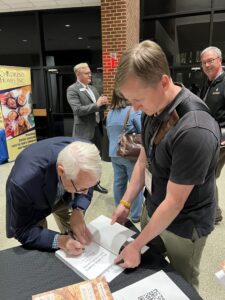

Dr. Black signing my copy of the new book in his honor.

In addition to attending all of the lectures described above, a highlight of Lectureship was a presentation of a festschrift (a book of essays in honor of someone) to Dr. Allen Black. Dr. Black, as mentioned above, was one of my professors at Harding School of Theology. He had a profound impact on my life, faith, and ministry, and several of his former students banded together to write and produce Teaching God’s Sons and Daughters: Essays in Honor of Allen Black. 

This was presented during one of the evening keynotes, and when prompted, dozens of Dr. Black’s former students stood up. Dr. Black was overjoyed and overwhelmed, and it was a touching moment.

As mentioned previously, I wish I would have done a better job planning out my week, but I still got to hear a lot of good sessions at Inspire this year, and it was a blessing to see so many old friends and professors. For me, autumn is a season of blessing, and the Harding Lectureship is one of the many great blessings I enjoy in my life.


[1] I am employed (albeit, in a very part-time fashion) by Harding University, so I should note that I am in no way speaking on behalf of the school in an official capacity. Furthermore, I had nothing to do with the planning of the Lectureship, so I was not responsible for anything that happened, and nor am I automatically defensive of it. My thoughts here are my own.
« Older posts Newer posts »

© 2026 The Doc File

Theme by Anders Noren — Up ↑