The online journal of Luke Dockery

Category: Theology (Page 7 of 58)

The Beatitudes: Blessed Are the Meek

As discussed in the introductory post of this series, Jesus’s Beatitudes in the Sermon on the Mount are basically a description of what a good life really looks like from God’s perspective. Jesus redefines what blessedness is, and provides an alternative set of values for His followers, those who desire to be a part of His alternative community. Here are the Beatitudes we have discussed thus far:


Blessed Are The Meek

“Blessed are the meek, for they shall inherit the earth.”

(Matthew 5.5)

This beatitude is challenging for us to understand because the word “meek” is not one that we commonly use or understand very well. A lot of times when we think of meekness, we associate it with people who are quiet, mild-mannered, and weak-willed, but meekness, at least in the Bible, does not mean weakness or cowardice.[1] To better understand the meaning here, it would help us to look at the word itself, and the Old Testament context from which Jesus borrows it.

In Greek, the word translated “meek” (πραυς/praus) is also used to describe a wild horse that has been tamed.[2] So the idea is not people of weak character or no backbone, but rather, those who, “having been tamed by God, are the masters of their spirits.”[3] Also, Jesus was a Jewish teacher instructing a Jewish audience, and when He talks about the meek inheriting the earth, He is actually quoting from Psalm 37.11, a text His audience would have known well. In that context, the psalm refers to the righteous poor, who are being threatened and oppressed by the wicked wealthy. In the face of such oppression, the meek do not worry about evildoers, but instead trust in God, knowing that He will root out the wicked.[4] In many ways, this beatitude seems to parallel the first one, with meekness and being poor in spirit essentially referring to the same characteristic of those who radically trust in God, and both are promised an inheritance from God.[5]

Meekness describes those who, in the face of insult and injury, are able to remain patient and composed rather than flying off the handle. Share on X

In light of all this, meekness actually suggests strength of character, not weakness. It describes those who, in the face of insult and provocation, are able to remain calm and composed rather than flying off the handle. Meekness is not the surrender of our rights, but it is the ability to overlook slights, knowing that God is in charge and will ultimately vindicate us. As one commentator states:

“[Meekness] is proof of true greatness of soul. It comes from a heart too great to be moved by little insults. It looks upon those who offer them with pity. He that is constantly ruffled; that suffers every little insult or injury to throw him off his guard and to raise a storm of passion within, is at the mercy of every mortal that choose to disturb him.”[6]

Again, we can see how the characteristics that Jesus describes in the Beatitudes are radically counter-cultural. We live in a highly anxious society where so many people seem to be constantly offended by everything. In such a climate, it may seem a brave thing to constantly complain about how everyone is annoying and offending you, but when you think about it, this is actually a very weak position to be in: you are admitting that other people have constant control over your emotions and responses. Those who are meek, on the other hand, boldly refuse to give others control over their emotions and responses. Instead, empowered by the knowledge that God is in control and will ultimately vindicate them, the meek are strong enough in character to shake off the slights and insults of others, even from those who, from a worldly perspective, might be in a position of superiority over them.

Those who are meek boldly refuse to give others control over their emotional responses. Share on X

In God’s eyes, those who are meek are living the good life, and they are promised an inheritance from the Father.


If you enjoyed this post, you might enjoy my book on the Sermon on the Mount, Counter Culture: A Study of the Sermon on the Mount. 

Although this book was written specifically as an aid to teaching the Sermon on the Mount to junior high and high school students, it is also useful for personal Bible study, and the depth of the material makes it a great resource for adult Bible classes.


[1] Larry Chouinard, Matthew, The College Press NIV Commentary (Joplin, MO, College Press, 1997), 97.

[2] Jack P. Lewis, The Gospel According to Matthew, Part I, The Living Word Commentary (Austin, TX: Sweet Publishing, 1976), 81.

[3] Lewis, 81.

[4] Ibid., 81; Warren Carter, “Power and Identities: The Contexts of Matthew’s Sermon on the Mount,“ in Preaching the Sermon on the Mount: The World It Imagines, ed. David Fleer and Dave Bland (St. Louis: Chalice Press, 2007), 18.

[5] Chouinard, 96; Francis Wright Beare, The Gospel According to Matthew: A Commentary (Oxford: Basil Blackwell, 1981), 130.

[6] Albert Barnes, Matthew and Mark, Notes on the New Testament (Grand Rapids, MI: Baker Book House, 1949), 44.

The Beatitudes: Blessed Are Those Who Mourn

As discussed in the introductory post of this series, Jesus’s Beatitudes in the Sermon on the Mount are basically a description of what a good life really looks like from God’s perspective. Jesus redefines what blessedness is, and provides an alternative set of values for His followers, those who desire to be a part of His alternative community:


Blessed Are Those Who Mourn

“Blessed are those who mourn, for they shall be comforted.”

(Matthew 5.4)

This seems like one of the most paradoxical statements of the Beatitudes: in what sense can those who mourn somehow be happy? What kind of mourning is Jesus talking about here? There are multiple aspects of life about which we could mourn:

  • Mourning for the general sorrows of life. Sad and heartbreaking things occur in life, and citizens of God’s kingdom are not immune from these tragedies. There is a sense in which we can learn a lot from sorrow in our lives:

  • Mourning for the sin in our lives. Sin grieves the Father and cost the Son His life. As citizens of the kingdom, an appropriate view of sin will cause us to grieve over its presence in our lives and seek to repent of it.
  • Mourning for the suffering of others in our broken world. Scripture presents our world as being a place where Satan, sin, and death currently reign, and because of that, people suffer in a variety of ways. “Participants in the kingdom of God are genuinely grieved by the general tyranny of sin characteristic of this present evil age.”[1]

So, which of these different types of mourning is Jesus actually talking about here? Probably all of them.[2] For citizens of God’s kingdom, there are many things in this present life worth mourning about. We are not spared from the sorrows that others face, but we experience additional sources of mourning because we grieve the sin in our lives and are aware of and lament the deep brokenness of the world in which we live.

Jesus promises, however, that those who mourn will be comforted.

I think that God is especially near when we mourn, even though at those times it might not seem like He is close at all. We see over and over again in Scripture that God Himself mourns. Jesus was prophesied to be a Man of sorrows who was acquainted with grief (Isaiah 53.3), and He was also supposed to be the Comforter of Israel who would bind up the brokenhearted (Isaiah 61.1; cf. Luke 2.25). God is close to those who mourn, and seeks to comfort us when we do. Currently, I believe this comfort comes from the presence of His Spirit in our lives, the balm of Christian community, and the hope of resurrection.

Ultimately, though, this comfort will come when Jesus returns, God’s kingdom is fully established, and sin and death are abolished. When that happens, we will find comfort because the causes of our mourning will be no more.


If you enjoyed this post, you might enjoy my book on the Sermon on the Mount, Counter Culture: A Study of the Sermon on the Mount. 

Although this book was written specifically as an aid to teaching the Sermon on the Mount to junior high and high school students, it is also useful for personal Bible study, and the depth of the material makes it a great resource for adult Bible classes.


[1] Larry Chouinard, Matthew, The College Press NIV Commentary (Joplin, MO, College Press, 1997), 96.

[2] William Barclay, The Gospel of Matthew Volume 1, The Daily Study Bible (Philadelphia, Westminster Press, 1956), 88-90; J.W. McGarvey, Matthew and Mark, The New Testament Commentary (Delight, AR: Gospel Light Publishing Company, 1875), 49; Jack P. Lewis, The Gospel According to Matthew, Part I, The Living Word Commentary (Austin, TX: Sweet Publishing, 1976), 80. James Burton Coffman, Commentary on the Gospel of Matthew, (Austin, TX: Firm Foundation Publishing House, 1968), 51.

Celebrating Resurrection With My Youth Group

This past weekend (Friday evening through Saturday night) was our youth ministry’s Spring Retreat. Spring Retreat is our biggest event of the semester and, from my perspective, perhaps our most important event of the year, because of the cohesion and togetherness it gives to our group.

You may be thinking that Easter weekend is not the ideal time to schedule a youth retreat, and I would agree with you, but this was the only weekend we could make it work with my seniors’ schedules, and we still managed to have a really good turnout. And, since we happened to be meeting together on Easter weekend, I decided to theme the retreat around the resurrection of Jesus.

Really, the timing almost seemed providential. Currently, on Wednesday nights we are doing a series on doubt. A common misconception is that having doubts or questions in our faith is somehow sinful or shows that our faith is deficient, when the reality is that doubt is simply a part of the journey of faith. According to research, though, teenage Christians typically don’t have a space where they feel comfortable talking about their doubts, and they try to ignore them hoping they will go away. This is actually really detrimental to faith, though, as openly discussing doubts and questions during teenage years is correlated with long-term faithfulness.

Having said all that, while we want to be able to discuss our doubts and not be threatened by them, even more we want to trust God in our doubts, and also be confident in our faith.

Enter the resurrection.


Our theme for the weekend was “Out of the Grave,” and we examined the resurrection in three different sessions:

(1) Resurrection on Trial

Occasionally you will hear from people who consider themselves to be Christians, but reject the idea that Jesus physically rose from the grave. They believe that Jesus was a good man, a great teacher, that He had some great ideas,  that in some sense He spiritually “saves” us and mystically “lives through us” but that whether or not He rose from the grave doesn’t really matter.

That’s not what Paul says, though. After describing the resurrection as “of first importance” in 1 Corinthians 15, Paul goes on to get even more specific. He says:

 “…If Christ has not been raised, then our preaching is in vain, your faith also is vain…if Christ has not been raised, your faith is worthless; you are still in your sins…if we have hoped in Christ in this life only, we are of all men most to be pitied.”

(1 Corinthians 15.14,17,19).

What Paul is saying here is that you can’t have it both ways. You can’t hedge your bets. When it comes to the resurrection, there are only two choices:

  1. Jesus was not raised from the dead. If this is true, then all of us are, according to Paul, pathetic people who are wasting our time—we’re following someone who won’t lead us anywhere. If this is true then Jesus was a man, just like us, not unique in any way. He may have been a good man with great insight who people like to quote, but He is also someone who doesn’t have the answers to life’s questions and has no right to tell people how to live.
  2. Jesus was raised from the dead. If this is true, then it is the single most important fact in history. It means that Jesus was different; He was unique. He has power over life and death, He has the answers to life’s questions, He has the right to tell us how to live, and nothing in life is more important than following Him.

It is important, then, that we get this right, because the stakes are really high. Fortunately, though, there’s actually an abundance of evidence for the resurrection, and we put the resurrection “on trial” in our first session. We discussed the Physical Evidence of the empty tomb and the grave clothes of Jesus, we talked about the Eyewitness Accounts and reasons why the eyewitnesses could be considered reliable, and we discussed the Circumstantial Evidence of the sudden spread of Christianity and the change in the lives of both disciples and skeptics.

These different types of evidence all agree: after being crucified, Jesus of Nazareth was raised from the dead on the third day. And this is good, good news. The best news of all: it means that Jesus has power over life and death, the answer to life’s questions, and nothing in life is more important than following Him! Jesus Christ is the foundation of the Christian faith, and we shouldn’t build our faith or our lives on anything less than Him!

(2) Sharing in Resurrection

In our second session, we focused on the words of Paul in Romans 6.1-14, where he says that baptism is the time when we participate in the death and resurrection of Jesus. Jesus died, was then buried, and rose again, and Paul says here that, as Christians, we are buried in the act of baptism—we go under the water—and when that happens, our old self dies, and we are raised to walk a new life.

In the act of baptism, we unite our history and our destiny with Christ. Paul says that if we have been united with Christ in a death like His (by being buried in baptism), then we will also be united in a resurrection like His (v. 5). 

In the act of baptism, we unite our history and our destiny with Christ. Share on X

Of course, Jesus died a literal death, and then was raised, bodily, to a new life, and would then never die again, because death no longer had dominion over him (v.9). Our death at baptism is not a literal death, but rather a death to sin. Baptism represents a fresh start and a new life. No longer are we enslaved to the power of Satan, sin, and death; now, we have received God’s grace and God’s Spirit, and sin no longer is our master:

“So you also must consider yourselves dead to sin and alive to God in Christ Jesus.”

(Romans 6.11)

Of course, this doesn’t just happen automatically. Sin can continue to be a problem in our lives, and we must fight against it:

“Let not sin therefore reign in your mortal body, to make you obey its passions. Do not present your members to sin as instruments for unrighteousness, but present yourselves to God as those who have been brought from death to life, and your members to God as instruments for righteousness.”

(Romans 6.12-13)

Christ’s death and resurrection, and our sharing in His death and resurrection through baptism, provide us with the opportunity for a new life and a fresh start, but we still have to determine to live that way. It’s a fight and a struggle; we must present our bodies and our lives not to sin, but to God, not as instruments of righteousness. We are never going to be able to live the Christian life without effort. It’s going to require determination, struggle, and sacrifice.

But here’s the really important thing: what was once an impossible task—because sin was our master—is now possible! Because, through baptism, we have been united with Christ in His death and resurrection, we are now new creations. We have received God’s grace and His Spirit, and now, it’s actually possible for us to resist the temptation of sin. 

We won’t do this perfectly, but we are given this promise:

For sin will have no dominion over you, since you are not under law but under grace.

(Romans 6.14)

Sin no longer has dominion; it is no longer our master. And in those times, when we struggle with sin and we fail, God’s grace is there, amazingly, to wash away that sin. We are new creations. We have died to sin, and been raised to a new life, like Jesus.

(3) Resurrection Hope

Finally, we looked at the rest of 1 Corinthians 15 and talked about the Christian hope that when Jesus returns, we will experience bodily resurrection.

It is clear from 1 Corinthians that the church in Corinth had a lot of problems, and one of the things they seemed to be struggling with was the idea of resurrection from the dead. Why did they struggle with this? Well, for the same reason people today struggle with it! People in the ancient world were not stupid or gullible, and they were much more familiar with death than we are today (where we do everything we can to distance and insulate ourselves from the reality of death). All sorts of illnesses and medical conditions that we can treat today were death sentences in the ancient world, so people saw a lot of death, and they knew that dead people stay dead and that dead bodies rotted.

This is what was so controversial about the claims of Christianity. It wasn’t controversial to say that people continue to exist in some way after death, or that our spirits leave the body at death and have an eternal existence somewhere—Greeks and Romans believed that already! But the Christian claim that Jesus rose from the dead and that His followers would be raised from the dead as well in their bodies was a shocking claim. 

Paul taught about the resurrection in Athens, and people thought he was crazy (Acts 17). Apparently some of the Christians in Corinth did too.

But Paul emphasized that this matters—if Jesus was not raised from the dead, then our faith is useless, and we are still in our sins. But…

“But in fact Christ has been raised from the dead, the firstfruits of those who have fallen asleep.”

(1 Corinthians 15.20)

We can be confident in the resurrection of Jesus (see above), and Paul says that His resurrection is the “firstfruits” of our own. Firstfruits are the beginnings of a crop that point to a larger harvest later. What Paul is saying here is clear: If Jesus Christ was not raised from the dead, then our faith is useless, but if Jesus Christ was raised from the dead, then we will be raised too.

If Jesus Christ was not raised from the dead, then our faith is useless, but if Jesus Christ WAS raised from the dead, then we will be raised too. Share on X

Later, Paul anticipates the question that he will get in response to teaching that our bodies will be raised: “How are the dead raised? With what kind of body will they come?” How can these dead, decaying bodies come back to life? Because they will be changed.

In this passage, Paul compares our physical bodies to a seed that is sown. This highlights a connection between our current bodies and our resurrection bodies, but also a change. Seeds are not the same as the wheat they produce, but they are closely related: they are made of the same “stuff”, and one has the necessary DNA for the production of the other. 

Paul says that those who are in Christ will be raised with “spiritual bodies.” We need to think about both of these words. The Christian hope is not to be disembodied spirits floating around in a non-material existence, but neither is the Christian hope to have the same old bodies that we have right now, which are “natural” or “fleshly”.

Paul is clear in these verses that there are some major differences between our current bodies, and our future, resurrection bodies (15.42-44):

  • Our current bodies are perishable, while our future bodies will be imperishable
  • Our current bodies are dishonorable, while our future bodies will be glorious
  • Our current bodies are weak, while our future bodies will be powerful
  • Our current bodies are natural, while our future bodies will be spiritual

When Paul says “spiritual body,” the emphasis is on what provides the driving force for the body—it is powered by God’s Spirit. Just as the Holy Spirit raised Jesus from the dead, it will be God’s Spirit that raises us up from the dead and gives power and life to our resurrection bodies. The resurrection is not about us being freed from our bodies to live as spirits; it is about our bodies being transformed into something glorious that is both similar to and different from our current bodies, like seeds are both similar to and different from the plants that they produce.

This is the Christian hope: Just like Jesus, we too will come out of the grave!

Our bodies will be changed. They will be sown perishable, but raised imperishable; sown dishonorable, but raised glorious; sown in weakness, but raised in power; sown natural, but raised spiritual. Our resurrection bodies will be suited for an eternal existence with God.


We had a great weekend! We studied, discussed, worshiped, meditated, played, laughed, ate and even slept.

Most importantly, though, we thought about and celebrated the central claim of the Christian faith. The reality is that there are things that I struggle with and have questions about, but at the end of the day, I believe that Jesus was dead…and then He wasn’t. And if the resurrection is true, then that’s something that I can build my life on, and even though there are things that I don’t understand, those things don’t unsettle my faith because the truth is…Jesus came out of the grave.

The reality is that there are things that I struggle with and have questions about, but at the end of the day, I believe that Jesus was dead…and then He wasn’t. Share on X

The Beatitudes: Blessed Are the Poor in Spirit

As discussed in the introductory post of this series, Jesus’s Beatitudes in the Sermon on the Mount are basically a description of what a good life really looks like from God’s perspective. Jesus redefines what blessedness is, and provides an alternative set of values for His followers, those who desire to be a part of His alternative community.


Blessed Are the Poor in Spirit

“Blessed are the poor in spirit, for theirs is the kingdom of heaven.”

(Matthew 5.3)

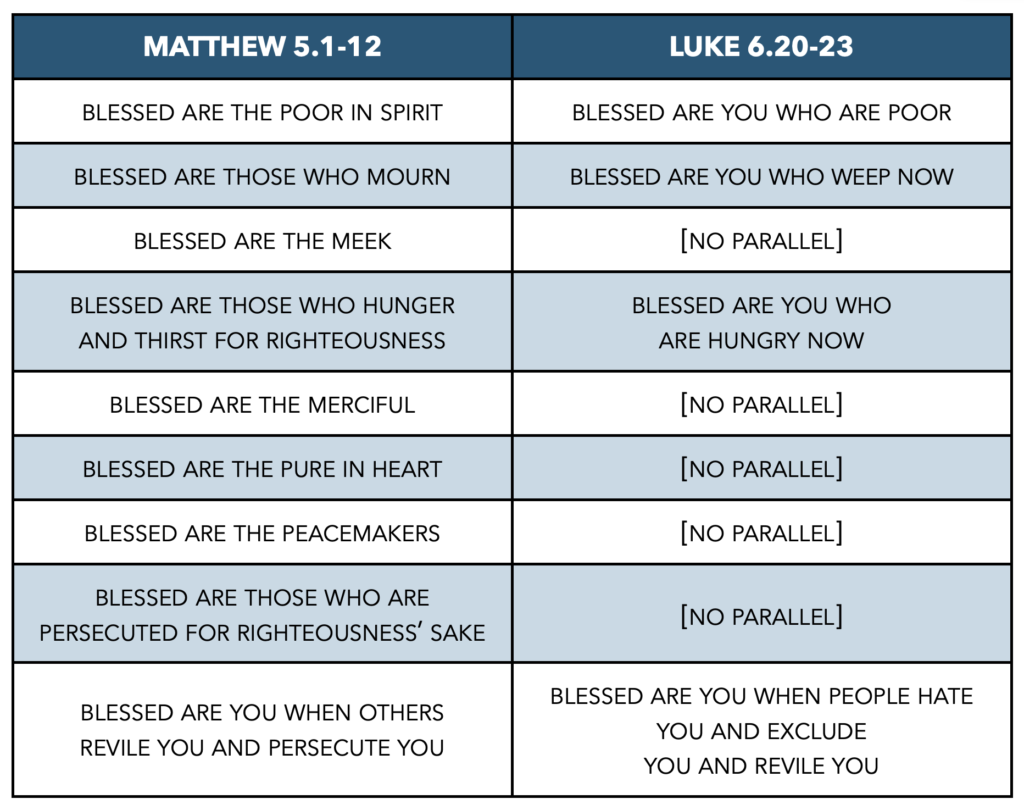
This first beatitude is a good example of something we discussed in the previous post, the “over-spiritualizing” of Jesus’s statements. In this instance, some people try to interpret “poor in spirit” to be a spiritual condition having nothing to do with literal poverty.[1] But, in his version of the Beatitudes, Luke simply refers to “the poor” (see chart), and there is no reason to assume that Matthew is talking about something completely different.

Instead, I think what is going on here is that Matthew focuses on the spiritual or psychological condition of those who are physically poor: being “poor in spirit” is the internal frame of mind of those who suffer from oppression and economic hardship.[2] The Hebrew Bible discusses the same idea in numerous places (Psalm 9.18, 34.6, 37.14, 69.29; Isaiah 57.15, 61.1, 66.2), and the equivalent term in Hebrew conveys the idea of a lack of status and social rights in addition to financial poverty.[3]

Jesus lived (and Matthew wrote) at a time when Judea was a backwater province of Rome, and approximately 97% of the population of the Roman Empire suffered from literal poverty, relegated to varying degrees of hunger and poor health.[4] The vast majority of people had little money, low status, and limited rights. Also, while the New Testament does mention some followers of Jesus who were wealthy, the early church overwhelmingly consisted of the poor and socially outcast.

As a Christian living in the United States of America, I have to acknowledge that this is a very different context from what I am familiar with. In the United States (the location of most of the readers of this blog), for the most part, Christians are a pretty middle-class crowd, and to be honest, don’t we like it that way? Speaking for myself, I will readily admit that I am in no hurry to be financially destitute, oppressed in some way, or a social outcast.

Still, just because we are financially better off than the original audience for Jesus’s teaching here doesn’t mean that we cannot relate to the idea of “poor in spirit.” All of us have, at one time or another, felt like we were the lowest of the low, completely beaten down by the circumstances of life, and that feeling of helplessness and powerlessness is closely tied to the idea of being poor in spirit.

And here is the shocking claim: Jesus says that people who feel like this are blessed!

Roman society viewed the wealthy elite who lived in ease and had all the power as the ones who live the blessed life, and our culture aligns itself closely with Roman values in this regard. American culture places great value on wealth, prosperity, and power, and even in the church and the individual lives of Christians, wealth can at times be pursued as an unqualified good, and power as something that should be sought after rather than laid aside.

But Jesus challenges this pursuit and presents a very counter-cultural idea: God’s favor extends to all people, including the poor in spirit, those that are beaten down and cast aside by society at large. And more than that, these people are specifically blessed: since they have no earthly resources, they know they can’t rely on themselves, and can therefore more easily put their trust in God and depend entirely upon Him.[5]

Jesus challenges the pursuit of wealth and power and presents the counter-cultural idea that God’s favor extends to all people, including those that are beaten down and cast aside by society at large. Share on X

The kingdom of heaven belongs to people like this. They are right at home in Jesus’s alternative community, the different sort of world that He invites us to imagine and be a part of.


If you enjoyed this post, you might enjoy my book on the Sermon on the Mount, Counter Culture: A Study of the Sermon on the Mount. 

Although this book was written specifically as an aid to teaching the Sermon on the Mount to junior high and high school students, it is also useful for personal Bible study, and the depth of the material makes it a great resource for adult Bible classes.


[1] See, for example, Francis Wright Beare, The Gospel According to Matthew: A Commentary (Oxford: Basil Blackwell, 1981), 128; Rubel Shelly, The Beatitudes: Jesus’ Formula for Happiness (Nashville, TN, 20th Century Christian, 1982), 12.

[2] Larry Chouinard, Matthew, The College Press NIV Commentary (Joplin, MO, College Press, 1997), 95.

[3] Chouinard, 95-96; Jack P. Lewis, The Gospel According to Matthew, Part I, The Living Word Commentary (Austin, TX: Sweet Publishing, 1976), 80. Though our own society is different in many ways from the cultures of the biblical narratives, it remains very similar at least in this regard: the financially poor also tend to be disadvantaged socially, politically, medically, educationally, and in other ways as well.

[4] Warren Carter, “Power and Identities: The Contexts of Matthew’s Sermon on the Mount,“ in Preaching the Sermon on the Mount: The World It Imagines, ed. David Fleer and Dave Bland (St. Louis: Chalice Press, 2007), 14-15.

[5] Chouinard, 95; William Barclay, The Gospel of Matthew Volume 1, The Daily Study Bible (Philadelphia, Westminster Press, 1956), 85-86.

Known to Them in the Breaking of the Bread

Luke 24.13-35 recounts the story of Jesus appearing to two disciples on the road to Emmaus following His resurrection.

These two disciples were downcast and dejected. Jesus appears to them and begins walking with them, but they are kept from recognizing Him. When He asks them what is wrong, they respond by explaining the events that had recently occurred in Jerusalem: the Jesus who they had believed to be the Messiah and in whom they had placed their hopes had been killed. Adding to their confusion, there was now a report from some of the women in their group that Jesus’ tomb was empty, and an angel had reported that He had risen from the dead. 

The unrecognized Jesus chides them, and then begins to explain how all of the Hebrew scriptures pointed to Himself, and revealed that He must suffer, die, and be raised. The disciples are blown away by the teaching, and invite this mysterious stranger to stay with them once they reach their destination.

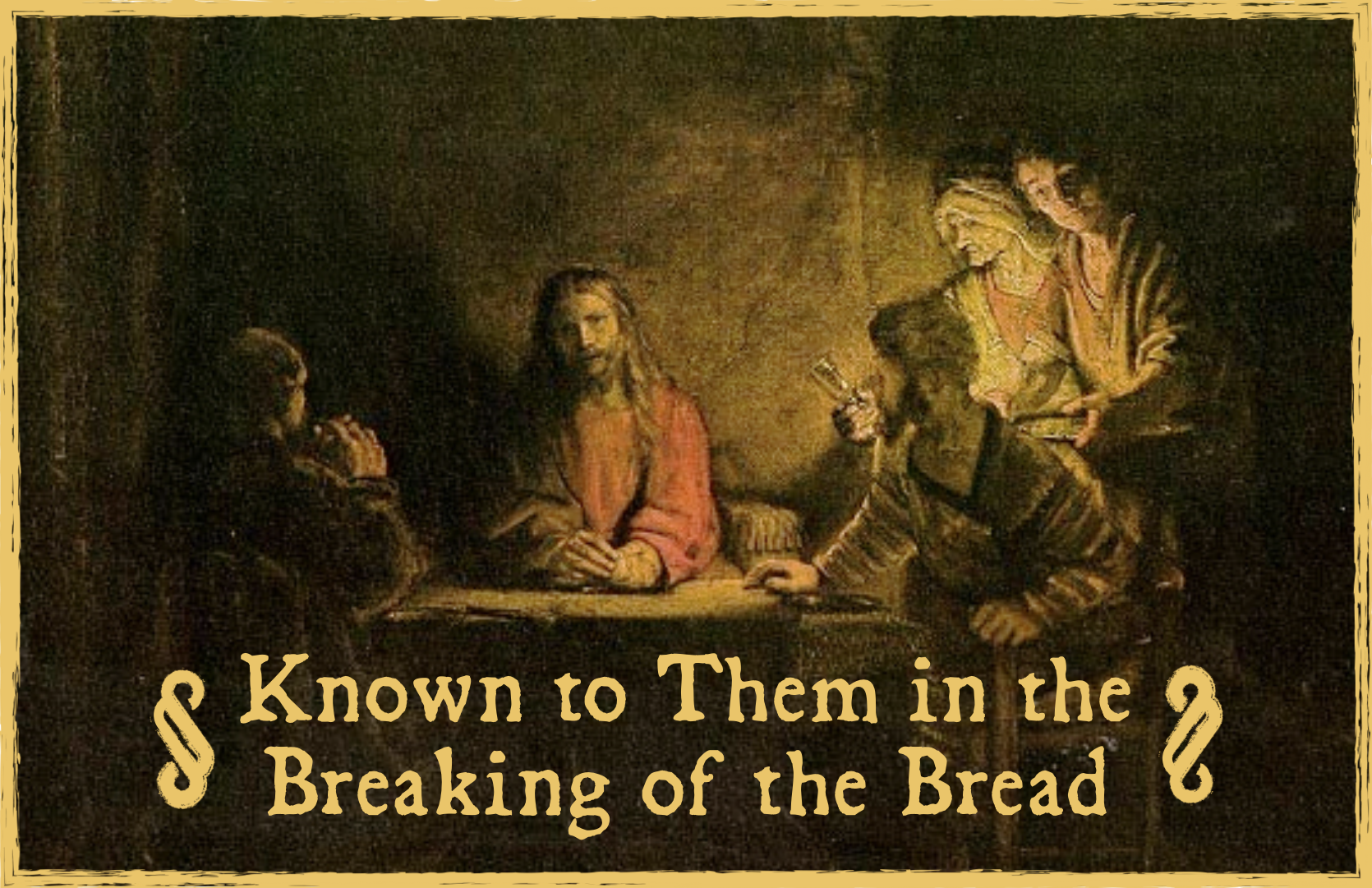
Jesus does so, and when they gather around the table, he takes the bread, blesses it, breaks it, and gives it to them. And suddenly they recognize Him. Jesus vanishes, and the two disciples return to Jerusalem to tell the apostles that Jesus is risen and had appeared to them:

Then they told what had happened on the road, and how he was known to them in the breaking of the bread.

(Luke 24.35)

The post-resurrection appearances of Jesus are interesting. It is clear that Jesus is different than He previously was, but also, He is…the same. He still has holes in His hands and sides. He is recognizable at times. He eats, and has flesh and bones.

But at other times, He is not recognizable. He suddenly appears in the midst of His disciples despite locked doors, and and at other times, He disappears. In Luke 24, He walks with two of His disciples for a long time and teaches them, but it is only in the breaking of the bread that they recognize Him.

Jesus is a multi-faceted character who did and accomplished much, and if we are not careful, we can focus on some of those characteristics and accomplishments and miss out on really knowing Jesus.

Jesus was certainly a wise teacher, but He was more than that. He was a miracle worker, but He was more than that. He was a religious leader and a brilliant theologian, but He was more than that. He was a leader of men, but He was more than that. He was a political theorist (though not in the way we would use that term), but He was more than that. 

Jesus was the Son of God, who emptied Himself, and came to live as a servant. He was obedient to the Father’s will and was willing to suffer on the cross, and on the cross, overcame the dark power of sin. Through His resurrection, He defeated the power of death. 

Sometimes, we don’t recognize Jesus. Sometimes, we look at the world around us, and we fail to see Him. Sometimes, we do not see Him in our circumstances; indeed, God feels very distant at times. Sometimes, we may catch glimpses of God in the beauty of Creation, but we don’t really know Him through that. 

At the table, though, Jesus is made known to us. As we eat of the bread and drink of the cup, we are reminded that God’s Son came into this world and lived as one of us. He stepped into our suffering and experienced it for Himself. We remember that, through the cross, Jesus set us free from sin’s bondage and condemnation, and through His resurrection, He offers us victory over death. 

When we pause our hectic lives and come together to take of the bread and the cup, we are able to see Jesus most clearly, and to recognize what He has done, and what He will do.

Sometimes we don’t recognize Jesus in the circumstances of our lives, but at the table, we are able to see Him clearly and to recognize what He has done and what He will do. Share on X

In this loose series of Scripture Reflections, I am sharing brief thoughts spurred on by my Bible reading. By way of reminder, my goal for these brief posts is two-fold:

(1) To remark on aspects of the biblical text that I find to be of interest that the reader may or may not have thought about previously.

(2) When possible, to point to the work and person of Jesus Christ. I believe the Bible is a unified story that points to Jesus, which means that He is frequently alluded to or foreshadowed in some way throughout the biblical canon.

« Older posts Newer posts »

© 2026 The Doc File

Theme by Anders Noren — Up ↑