I don’t remember what the driving force was at the time, but about seven years ago, I got into the Sermon on the Mount. I mean, really got into it. I taught it to my teenagers. I taught an adult Bible class on it. I spoke in a summer series on it. I published a book on it. I directed a youth conference on it. It was pretty much an obsession—I had come to realize that this was Jesus’s Kingdom Manifesto, where He declared what living in His kingdom is all about, to those who desire to be a part of that kingdom.[1] As someone who desired to be a part of that kingdom, it seemed really important to me that I take Jesus’s words very seriously.
What I found was that, as I really got into the Sermon on the Mount, it actually really got into me. Not overnight, but gradually, as I read it and taught it more and more, it began to change me from the inside out. I began to pray the Lord’s Prayer more. The way I interacted with people online began to change—I was not as quick to rush in to straighten someone out, or as defensive when someone was critical of me. I tried to be more generous in my judgments of other people. My views on how Christians are to interact with and influence the world changed significantly. It’s not an overstatement to say that the Sermon on the Mount gradually became the default lens through which I viewed the world.[2]
What I found was that, as I really got into the Sermon on the Mount, it actually really got into me. Share on XWith all that in mind, I’d like to do a series on the first part of the Sermon on the Mount, the sayings that Jesus presents known as the Beatitudes.
Our English word “beatitude” comes from beatitudo, which is the Latin equivalent of the Greek word μακαριος/makarios, a word that means “happy” or “blessed,” and this is how all of the Beatitudes start: “Blessed are the _________.”[3] We live in a world where people desperately do anything they can think of in order to be happy, but what Jesus is talking about here is not a pleasant emotional response that comes to us based on outward circumstances. Instead, the sense of this word is something like, “God is pleased with” or “God’s favor rests upon” the people who possess the characteristics that Jesus goes on to describe.[4] Jesus is telling us what a good life really looks like from God’s perspective.
In the Sermon on the Mount, Jesus is setting up an alternative community, where people live by values and principles that are dramatically different from those of the world, and we clearly see this in the Beatitudes. First, the people who Jesus describes as being happy or blessed are not the people who the world would describe in that way.[5] Jesus redefines what blessedness is and provides an alternative set of values for His followers. Also, the word μακαριοι/makarioi that we have already discussed that Jesus uses repeatedly here is plural. This means that Jesus’ beatitudes are not directed at individuals, but are to be the practices of the community that Jesus is establishing.[6] So Jesus’s beatitudes will describe the same group of people in multiple ways: God’s kingdom, an alternative community made up of His disciples.
Matthew’s record of these beatitudes bears some similarity to the shorter beatitudes recorded in Luke’s Sermon on the Plain:
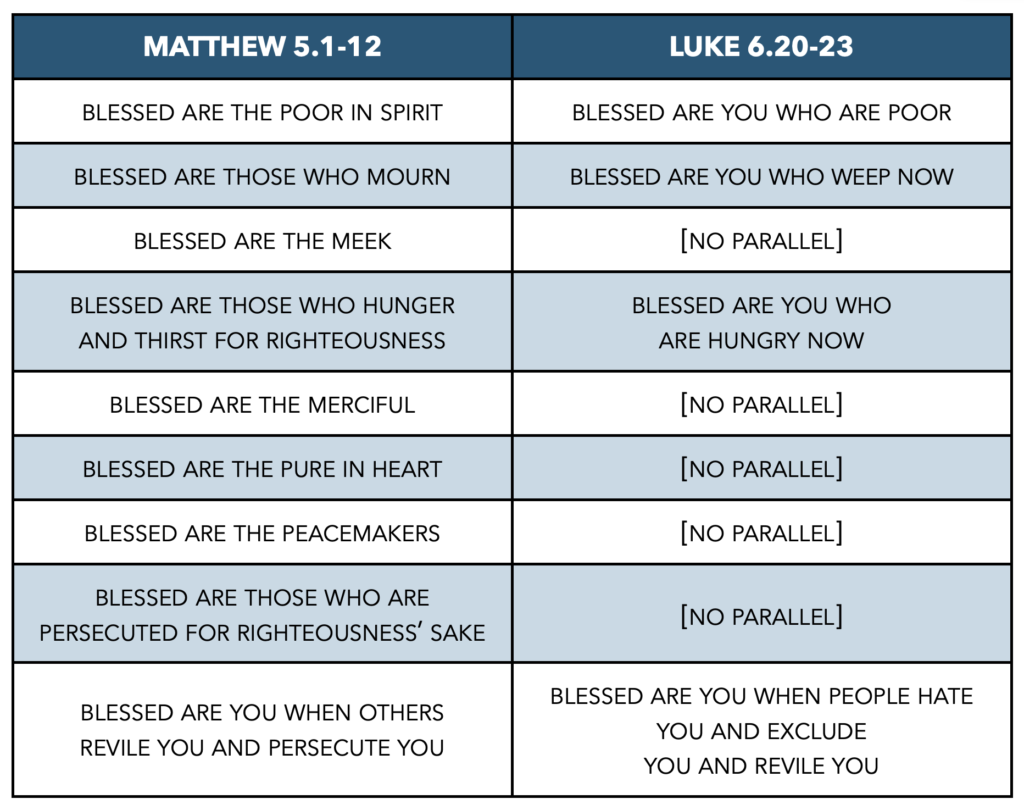
Some biblical scholars have made a big deal about the differences between Luke’s beatitudes and Matthew’s, suggesting that Luke focuses on physical characteristics (poor, hungry, etc.), while Matthew emphasizes spiritual characteristics instead (poor in spirit, hunger for righteousness, etc.). These interpreters sometimes “spiritualize” Matthew’s beatitudes so much that they no longer have any connection to the historical context in which Jesus is speaking.[7]
I don’t think it is necessary to make such a sharp distinction, though. It seems unlikely that Jesus would present two different, unconnected sets of beatitudes, one focused on physical characteristics and the other on spiritual characteristics. What makes more sense is that in both places Jesus presents characteristics of those who God calls “blessed”, but in Matthew, He emphasizes that certain physical characteristics have spiritual implications.
With that in mind, we want to be balanced as we look at these traits. While it is true that the Sermon on the Mount doesn’t portray Jesus as a political revolutionary who is advocating for social or economic upheaval, He does address social and economic problems that are a result of the political realities of His day. In a real sense, Jesus invites His audience (including us) to imagine a different sort of world: the kingdom of God. And God’s kingdom is an upside-down kingdom, which reverses the conditions of people where the poor, hungry, and persecuted are called “blessed.”[8]
I hope you’ll read along as we examine the Beatitudes one by one.
Jesus invites His audience—including us—to imagine a different sort of world: the kingdom of God. Share on X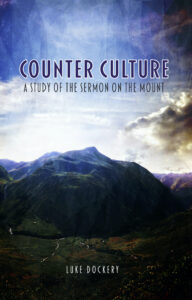 If you enjoyed this post, you might enjoy my book on the Sermon on the Mount, Counter Culture: A Study of the Sermon on the Mount.
Although this book was written specifically as an aid to teaching the Sermon on the Mount to junior high and high school students, it is also useful for personal Bible study, and the depth of the material makes it a great resource for adult Bible classes.
[1] J. Oswald Dykes, The Manifesto of the King: An Exposition of the Sermon on the Mount (London, J. Lisbet, 1881).
[2] In many ways, this seems providential to me, in light of all that has gone on in the world over the last several years: the rise of Trump, the COVID-19 pandemic, Black Lives Matter and racial unrest, QAnon, the January 6 uprising, increased political polarization; the list goes on and on. I cannot pretend that I responded perfectly to all of these developments, but I truly believe that my deep immersion in the Sermon on the Mount helped me to have a kingdom perspective on these events that saved me from a lot of unhealthy responses.
[3] Jack P. Lewis, The Gospel According to Matthew, Part I, The Living Word Commentary (Austin, TX: Sweet Publishing, 1976), 79.
[4] Warren Carter, “Power and Identities: The Contexts of Matthew’s Sermon on the Mount,” in Preaching the Sermon on the Mount: The World It Imagines, ed. David Fleer and Dave Bland (St. Louis: Chalice Press, 2007), 17.
[5] J.W. McGarvey, Matthew and Mark, The New Testament Commentary (Delight, AR: Gospel Light Publishing Company, 1875), 51: “The world’s conception of the man who is superlatively blessed has always been the reverse of what is here taught.” Randy Harris, Living Jesus: Doing What Jesus Says in the Sermon on the Mount (Abilene, TX, Leafwood, 2012), 31: “Jesus’ idea of the blessed life and our idea of the blessed life have almost nothing in common.”
[6] Carter, 17.
[7] Francis Wright Beare, The Gospel According to Matthew: A Commentary (Oxford: Basil Blackwell, 1981), 133, is a good example of someone who emphasizes the supposed distinctions between Matthew and Luke in the Beatitudes. McGarvey, 51, spiritualizes Matthew’s Beatitudes, to where, for example, “poor in spirit” has nothing to do with actual poverty.
[8] Beare, 127; Larry Chouinard, Matthew, The College Press NIV Commentary (Joplin, MO, College Press, 1997), 94.

 In this loose series of