The online journal of Luke Dockery

Tag: Churches of Christ (Page 2 of 7)

2023 Blog Review

I like to end the year by looking back and reviewing my year of blogging here at The Doc File (Here are some previous reviews from 2022, 2021, 2020, 2019, 2018, 2016, 2015, and 2012).

Overview

There were a lot of topics that I intended to write about in 2023, but time got away from me and I wrote less than I hoped. Nevertheless, I wrote 30 posts this past year, which is more than I managed in 2022 (20) or 2021 (28). Baby steps in the right direction still count as progress, I guess.

Top Posts

By traffic totals, here are my most-read posts during 2023:

  1. Jesus, Christmas, and Hanukkah, December 18, 2015
  2. Raising Up Ministers: Six Unhelpful Trends in Churches of Christ, March 2, 2023
  3. A New Heaven & A New Earth Series, April 29, 2020
  4. A New Heaven & A New Earth: What the Bible Teaches about Eternity, April 9, 2020
  5. Youth Ministry & Gen Z,, May 16, 2023
  6. Reading in 2022, January 3, 2023
  7. Church Is Good for Your Kids, August 23, 2023
  8. Reading and Walking in 2022, January 6, 2023
  9. Forty., August 2, 2023
  10. A New Heaven & A New Earth Part 2: Distractions, April 16, 2020

Six of the top posts from 2023 were actually written this year, and it is always good to see new content get some traction:

  • Raising Up Ministers: Six Unhelpful Trends in Churches of Christ reflected on the minister shortage within Churches of Christ. This topic has been written about and discussed a lot (too much?), but one aspect of the conversation that I hadn’t seen emphasized as much was the raising up of young people to go into ministry. I am confident that we are not doing this as well as we once did, and I offered several reasons for why that is.
  • Youth Ministry & Gen Z looked at some research from the Barna Group that describes characteristics of Gen Z students (the generational cohort that is currently present in our youth groups). The basic premise here is that the better we understand these students, the better we can minister to them. Broadly speaking, Gen Z students have several challenging characteristics that clash with Christianity, but they also resonate with Christianity in important ways.
  • I have developed certain traditions of posts that I write each year, and these have developed somewhat of a following over time. Reading in 2022 and Reading and Walking in 2022 were both popular (the 2023 versions are right around the corner!).
  • Church Is Good for Your Kids is a brief post that reflected on research that indicates that, well, church is good for your kids! As one author states, “There is a growing body of evidence that regular religious practice is measurably good for the health, happiness, and pro-social behavior of our kids.”[1]
  • Forty. I had a milestone birthday in 2023, which naturally prompted me to some reflection.

At the same time, part of the reason for preserving over 15 years of posts on this site is for people to be able to go back and read things they missed, and I am always gratified when older posts are read by new people. The series I wrote in 2020 on renewed eschatology continues to get a lot of views, but I was blown away by the response to Jesus, Christmas, and Hanukkah. This is a post I actually wrote about eight years ago, but I shared it again this year and it got a surprising amount of attention.

Blog Series

In 2023, I completed one series and contributed multiple times to another, ongoing one:

The Beatitudes: Kingdom Character: This nine-part series was a close look at the Beatitudes in the Sermon on the Mount, which is Jesus’s description of what it looks like to be a citizen in His kingdom.

Studying the Sermon on the Mount in detail was transformative for me several years ago, and it is always beneficial for me to come back and reflect on Jesus’s teaching here. This series was not very popular and didn’t have a wide readership. This was disappointing to me, but I think is also reflective of the time in which we live: living according to the Sermon on the Mount isn’t very exciting for most people.

Scripture Reflections: I added five more posts to this ongoing series in 2023 (The Poor You Always Have with You, Three Gardens, Known to Them in the Breaking of the Bread, “Your Labor Is Not in Vain”, and “He Remembers that We Are Dust”) bringing the total to 20 posts. I plan to continue adding to this indefinitely.


So, that was The Doc File in 2023! It is my plan to continue writing in this space in 2024 (hopefully more often, but I never know what the new year will bring). It has become a formative spiritual discipline for me to process my thoughts here over the years, and as many readers have told me, it is helpful to you too! I am honored and humbled by those sorts of comments, and am thankful for your readership and support!


[1] Rebecca McLaughlin, 10 Questions Every Teen Should Ask (and Answer) about Christianity (Wheaton, IL: Crossway, 2021), 14.

Raising Up Ministers: Six Unhelpful Trends in Churches of Christ

If you pay any attention to these sorts of things, by now you are well aware that there is a ministry crisis in churches: there are far more churches seeking ministers than there are ministers seeking churches. This is a widespread phenomenon in churches (of various groups and denominations) within the United States, as indicated by a much-discussed Barna study. Looking more specifically at Churches of Christ, The Christian Chronicle has covered this multiple times. I even blogged about it myself in a roundabout way last year.

Despite all of the attention given to this very real problem, much of the focus has been on reasons why people leave ministry. An examination of those reasons is really important, but I think we also need to examine reasons why we are not training nearly as many ministers as we once did. There are groups out there that are working hard to encourage and train young people who have an interest in ministry (Harding’s Kerusso Experience is a great example of that; Lads to Leaders/Leaderettes and Leadership Training for Christ ostensibly do this as well), but I think a key aspect in this discussion—at least within the context of Churches of Christ—is for us to acknowledge some trends that have developed over several decades that are working against us when it comes to instilling interest in ministry in people at a young age.

So, why is it that we don’t train as many ministers as we once did? I’m sure there are lots of reasons, and what I am about to suggest is not intended to be an exhaustive list, but it is a start. For each trend I discuss, I’ll offer a question to prompt reflection on how we might respond, in light of these trends.

To be clear, I am not suggesting that these trends are inherently negative in and of themselves. They have had the effect, however, of making the practice of raising up ministers within the local congregation more difficult. 


1. Transitioning Away from a Small Church Fellowship

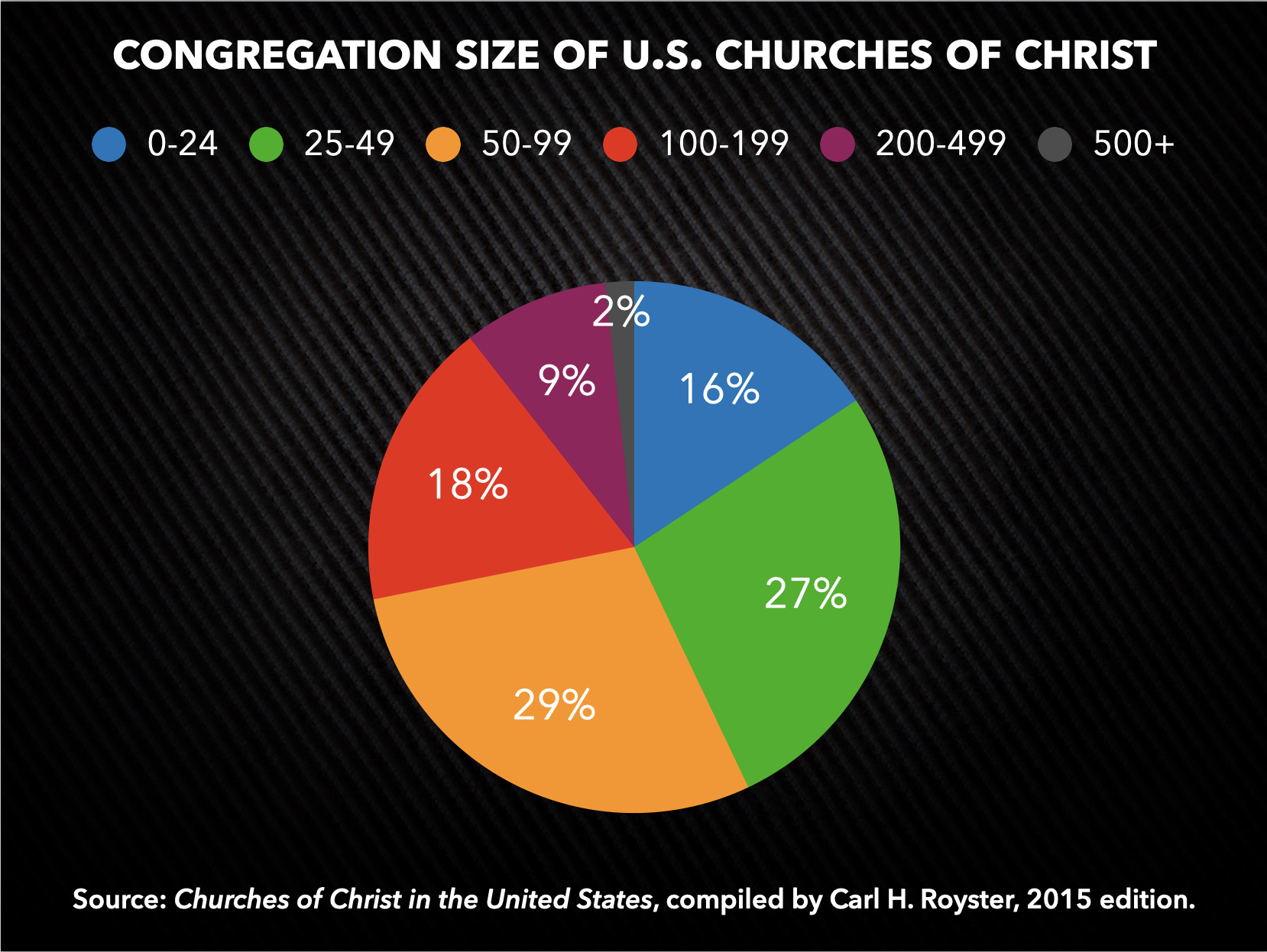
Historically, Churches of Christ have been a small church fellowship. As of 2015, nearly 90% of congregations within Churches of Christ had less than 200 members (see chart below).
Over time, though, this trend is slowly changing. The United States is becoming increasingly urbanized, where small towns shrink and dry up as people move off for other opportunities, and as this happens, the small churches in those small towns dwindle as well. You probably hear statistics about “X number of churches close their doors every week/month/year….” Well, those churches are overwhelmingly small churches. It’s not that all of the Christians are disappearing and it’s certainly not that all of our churches are growing larger, but there is a shift that is occurring of members from smaller churches consolidating with larger ones as they move to cities, or as their previous congregations shrink beyond the point of sustainability.

Why does trend matter? Because small churches produce a disproportionate amount of preachers. This occurs because it is in small churches where young men receive opportunity to serve and lead. This comes out of necessity—there are jobs to be done and tasks to be performed, and no one else to do them. On the other hand, at larger churches, there are many more people willing to serve and lead, and you actually have to look for opportunities to get young people involved.[1]

In a context where more of our churches are larger, how can we create spaces for young people to have opportunities to lead in worship?

2. The Transformation (or Elimination) of Sunday Nights

I do not know the full history of the traditional Sunday night worship services in Churches of Christ. I know that for many years, it was essentially a carbon copy of what we did on Sunday mornings, but that they also tended to be less formal: men were less likely to wear suits, women were less likely to wear dresses, men who didn’t normally make it into the Sunday morning rotation got to lead singing, and in many churches, you would have occasional singing nights or youth worship nights where young men would have opportunity to serve. At the previous congregation where I worked, we had a monthly Youth-Led Worship where we would meet early to help young men practice and prepare, and then kids and teens would lead the entire service (prayers, songs, Lord’s Table, lesson, etc.).

Over the course of my lifetime, though, I have increasingly become aware of churches moving away from a traditional Sunday night service. Some churches have moved from a combined worship service to a small group model, and meet in members’ homes. Other churches have moved from a worship service to a Bible class format. Others have canceled evening services and replaced them with service projects. Others have canceled them and replaced them with nothing.

And, anecdotally, I would say that larger churches (i.e. the ones that already struggle to give young people a place to lead and be trained in leading worship) tend to be the most likely to abandon the traditional Sunday night service (removing yet another opportunity for training).

These Sunday night changes might be quite beneficial on the whole for the congregations in which they are occurring, but realistically, it still represents a lost venue for young people to have opportunity to lead.

In a context where the Sunday night service is disappearing, when and where can young people have opportunities to lead in worship?

3. Transition from Sect to Denomination: the Loss of Confidence and Importance

These next two trends have been developing for decades, but are helpful, I believe, in understanding so many things about Churches of Christ, especially in the 20th century and beyond.[2] First, a couple of definitions:

Sect: A religious organization that insists that it—and it alone—constitutes the entirety of the kingdom of God. Typically, a sect stands in judgment both on other religious organizations and on the larger culture in which it exists.

Denomination: In the American context, a church that recognizes it is only a part of the universal body of Christ. A denomination has typically made its peace with the dominant culture in which it exists.[3]

In other words, a sect is a group that emphasizes distinction: the call is to be radically different from the world, and to view other religious groups somewhat antagonistically. A denomination, on the other hand, tends to emphasize (or at least accept), being part of a larger whole: one “type” of Christianity amongst others, living in the context of the world.

This is a sociological description rather than a theological prescription: I’m not making the claim that this is a good development, but rather, that it is an accurate description of what has largely (not universally) happened within Churches of Christ over the last 100 years.[4] There was a time that Churches of Christ largely believed that “they were the only ones going to heaven” and that other believers, while they may be sincere, were sincerely mistaken, and not “true Christians.”[5] That still exists, but is much less prevalent than it once was. There are many in Churches of Christ today who have little to no appreciation of Restoration history or theology and would broadly claim that one church is as good as another. Others would hold strongly to certain doctrinal teachings, but still show a greater degree of both self-critique and approval of other groups than was true in the past. All of this reflects the shift from sect to denomination described above.

This is relevant to the issue at hand, I think, because this transition reflects a shakiness in our self-understanding: at one point, we were convinced that we taught the truth, while others were in error. This gives confidence in the importance of the preaching task: not only do we need to let the unchurched know about Jesus; but we also need to let the incorrectly churched know the truth about the importance of baptism, acceptable worship, and proper church governance. Virtually everyone is in error and, thus, in trouble, and we know the answer. This confidence and importance provide great motivation for dedicating a life to preaching.

On the other hand, if we are less confident in the rightness of our belief, and maybe many of our neighbors in other Christian groups don’t really need us to straighten them out, a life of preaching seems less important and less desirable.

In a context where we are less certain of our exclusive access to the truth, how can we still convey the value of preaching and other forms of ministry?

4. Transition from Sect to Denomination: at Home in the World

The other part of this transition is a feeling of comfort and belonging the world. In the early 20th century, this did not describe Churches of Christ. The early 1900s witnessed the growing split between the less educated, lower class, and theologically conservative Churches of Christ and the more educated, higher class, theologically liberal Disciples of Christ. As the split spread and then formalized, the Disciples often found themselves with the nice church buildings (now adorned with pianos) and standing in society, while the Churches of Christ were left with little in capital, real estate, and social standing.

Most members of Churches of Christ were not wealthy, and had no expectation of being so. This began to change in the economic boom following World War II, as wealth increased across virtually all demographics in the United States. Economic blessings led to nice, new church buildings, prestige in society, and changing expectations.

Those in ministry will tell you that a common barrier to young people entering ministry is discouragement from their parents because of financial concerns. The feeling is that ministry does not pay well (often true), and parents will often emphasize financial security over God’s call. My suspicion is that this parental discouragement stems from this broader transition to affluence: back when all of us were poor, being poor as a preacher was no worse than anything else. As our bank accounts have swelled, the desirability of preaching has diminished.

In a context where we value and respect financial security, how can we better compensate those in ministry so it is a more desirable option? How can we disciple all of our people to place less value upon financial security?

5. Secularization and the Loss of the Minister’s Prestige

Another major transition that has been going on in our society for a long time is increasing secularization. We have increasingly carved out spaces where God is not allowed (physically and metaphorically), a higher percentage of people no longer claim faith of any kind, and even people who are Christians increasingly view the world through secular lenses.[6]

In our increasingly post-Christian society, being a preacher (or some other type of minister) doesn’t bring the same sort of respect and prestige that it once did. In frontier America, where formal education was sparse, people tended to be self-taught, and many were illiterate, the preacher was often the most educated person in the community. It was naturally assumed that this was a person who had done some serious learning, and had something to say that was worth listening to.

This is no longer widely assumed. Many people are highly educated, and have access to tools that allow them to study Scripture in sophisticated ways. More than that, in a highly-secularized society, a minister may be well-educated, but the assumption may be that his or her education is fundamentally not valuable: if the Christian faith is ultimately a fairy tale, why should we be impressed that you are well-versed in it?[7]

In a context where ministers are not respected within society, how can we raise the level of respect they are shown in our churches? How can we disciple all of our people to place less value on the opinions of others?

6. Disquiet around Gender Roles

You are likely aware that the debate about gender roles is raging in Churches of Christ. This is certainly not unique to us, but what is relatively distinct is our practice of congregational autonomy: there is no denominational hierarchy dealing out an official position on female inclusion in church leadership, so individual churches have the task of interpreting the teachings of Scripture and applying them in their own contexts. In practice, this means that Churches of Christ are kind of like the wild west, where different churches have their own rules and understanding. Thus, you can find a variety of practices within Churches of Christ, ranging from full egalitarianism to full patriarchalism to all sorts of shades and variations in between.

Historically, this was not the case. Until fairly recently, for a long time, the broad consensus was that church leadership was for men, and the concept of “church leadership” was defined in such a way that it included any sort of up-in-front role during the worship assembly. Things are much different now: you really can’t assume where a given church is on this issue without doing some research, and honestly, a lot of churches themselves aren’t sure where they are on the issue.

My goal here is not to adjudicate this issue or tell you what you should think about it; rather, I am simply acknowleding that the landscape of Churches of Christ is much more confusing in this area than it once was, and I think it has ramifications for our actual topic at hand, helping to plant the seed of ministry within young people in our churches.

For churches that are clear about their positions on this (at one end of the spectrum or the other), it’s not really a problem, but for the large (and growing) number of churches that are somewhere in the middle and are trying to figure out what is permissable and what isn’t, it becomes a lot more complicated, and special worship services led by young people tend to bring a controversial issue front and center.[8]

In a context where gender roles are such a controversial topic, how can we seek to train young people in a way that doesn’t foster division and strife?


[1]This is easier said than done: we get nervous in front of people, and the larger the group of people, the more nervous we tend to get. So a young man who might be willing to present a lesson in front of 50 people will likely be less willing to do the same lesson in front of 500 people. Expectations of quality and professionalism tend to increase in larger congregations as well, placing a greater burden and barrier on young people who are inherently inexperienced and less skilled.

[2]What I present here will naturally be simplified and reductive. For fuller expositions on this topic, see David Edwin Harrell, “Emergence of the “Church of Christ” Denomination” (1972), and Richard T. Hughes, Reviving the Ancient Faith: The Story of Churches of Christ in America (Abilene, TX: ACU Press, 1996). Harrell and Hughes are two of the most respected historians within the Stone-Campbell Restoration Movement. Theologically, they were at different ends of the theological spectrum of Churches of Christ, but their sociological analyses of the transition of Churches of Christ from sect to denomination are closely in sync.

[3]These definitions come from Hughes, Reviving the Ancient Faith, xii-xiii.

[4]Indeed, I would argue that both of these categories fall short of how Jesus would have citizens of His kingdom envision themselves.

[5]There is good reason to argue that this sort of sectarianism betrayed the unifying vision of the early leaders of the Stone-Campbell Restoration Movement, but that is beyond the scope of this article. The point is simply that there was a time when this was a widespread and common belief amongst those in Churches of Christ.

[6]As famously argued in Charles Taylor’s A Secular Age.

[7]It should be added that some of the loss of respect felt toward those in ministry is self-inflicted: the constant drumbeat of those in various forms of ministry, across denominational affiliation and the theological spectrum, who abuse that position through sexual sin, financial dishonesty, or other types of abusive behavior have greatly diminished the public trust in those in ministry.

[8]This may seem counterintuitive to some readers: why would it be problematic to have a youth-led worship service that reflected the same gender roles that a regular worship service would have in that context? I understand the question, but it does seem to make a difference, for at least three reasons. First, young people, especially teens, tend to be more rebellious and push the envelope more than those of older generations. So, you might have lots of women who are very comfortable in traditional gender roles in the church, but that doesn’t mean that teenage girls are. Second, you may have parents who are generally okay with the ways things are for themselves, but feel the need to advocate for greater opportunities for their daughters. Third, there are some people who are fine listening to a sermon from a well-trained male preacher but start to ask questions when listening to a 12-year-old boy offer a fairly shallow (and sometimes theologically heterodox) lesson.


Church Camp Baptisms and Mountaintop Christianity

Note: this post is a little more disjointed than much of what I write, but it accurately reflects the way in which I have been wrestling with this topic back-and-forth for some time.

Church camp is a significant part of the yearly youth ministry calendar, and a pretty standard feature of church camp (at least in my experience) are camp baptisms. The next statement I make may be jarring to some of you, and I want to clearly state that if you were baptized at church camp and had your sins washed away and hold to that moment as the time when you committed your life to Jesus, that is great, and I applaud you. Having said that, here comes the (perhaps) jarring statement: I am not a huge fan of camp baptisms.

There are several reasons for this:

  1. Camp baptisms usually happen away from the presence of the camper’s parents, and since parents are the primary spiritual influencers of their children, not having them present for such a major step is not ideal.
  2. Camp is an emotionally-charged environment, and it can be easy to get caught up in the camp experience and make a decision that no longer seems so pressing or important a few weeks later when camp is over and the emotional experience has faded.
  3. Many times camp baptisms happen in clusters: several kids from one cabin or one friend group will all decide to get baptized together or within a couple of days of one another and the question arises: do these students really want to give their lives to Christ, or are they just doing what all of their friends are doing?
  4. The purely pragmatic reason: personal experience shows that a lot of time these baptisms don’t really “stick” in the sense that they are often false starts that don’t lead to a life of faithfulness (probably because of some combination of reasons 1-3).

At this point, youth ministry veterans are likely reflecting on these reasons and nodding in agreement—they have seen it all before, too many times to count!

Having acknowledged all this, I now want to push back against what I have just said.


A few years ago, I was talking to a young man (out of college, in his 20s) who was questioning his baptism largely for the reasons mentioned above. He did it at church camp when he was young and he didn’t know a lot at the time—what if he was just caught up in the emotions of the moment and decided to get baptized because other people were?

And, of course, these are some of my own concerns.


Churches of Christ are spiritual descendants of the Stone-Campbell Restoration Movement, a primitivist, back-to-the-Bible movement whose aim was to bring about unity among followers of Jesus by simply trying to be the church that we read about in the Bible. At the same time, that Movement developed in a specific time and place, and was certainly influenced by that historical context. For the sake of this post, that influence can be seen in at least two ways.

First, it was a movement that prized logic and reason. Intellectually and philosophically, the early leaders of the Stone-Campbell Movement were greatly influenced by the Enlightenment. This doesn’t mean that they universally condemned emotion, but rationality and clear thinking were highly valued.

Second, as a product of the American frontier, the Stone-Campbell Movement also valued the rugged individualism that was so characteristic of American society. People were free to read the Bible and interpret it for themselves, and should base their beliefs on Scripture rather than the teachings of some priest or state church.

Against such a backdrop, is it any wonder that I am immediately suspicious of decisions to follow Jesus that seem to be largely influenced by emotion and the influence of what other people are doing?


My favorite thing about my spiritual heritage is that the Stone-Campbell Movement is, fundamentally, a back-to-the-Bible movement, so as I was talking to my friend who was questioning his own baptism, I immediately thought of Scripture, and specifically, the Book of Acts, where we have so many accounts of people giving their lives to following Jesus.

One of the prime examples is in Acts 2, where Peter preaches to a large crowd on Pentecost, basically telling them that the Jesus they had crucified was the Messiah and Son of God, and that He had been raised from the dead and was sitting at the right hand of God:

37 Now when they heard this they were cut to the heart, and said to Peter and the rest of the apostles, “Brothers, what shall we do?” 38 And Peter said to them, “Repent and be baptized every one of you in the name of Jesus Christ for the forgiveness of your sins, and you will receive the gift of the Holy Spirit. 39 For the promise is for you and for your children and for all who are far off, everyone whom the Lord our God calls to himself.” 40 And with many other words he bore witness and continued to exhort them, saying, “Save yourselves from this crooked generation.” 41 So those who received his word were baptized, and there were added that day about three thousand souls.

(Acts 2.37-41)

Two details pertaining to our present conversation that jump out of this text: (1) Peter’s audience was cut to the heart, and (2) 3,000 responded and were baptized. In other words, in this biblical example of conversion, those who made the decision to be baptized were clearly influenced by emotion and almost certainly by the example of others as well.


The issue of church camp baptisms is clearly tied to what might generally be referred to as “Mountaintop Christianity”, the idea that we have mountaintop experiences—intense, emotional events where we encounter God in a powerful way.

Traditionally, youth ministry has largely been structured around mountaintop experiences and scheduling these sorts of events—mission trips, youth rallies, spiritual retreats, and, yes, church camp—throughout the year. The idea is to provide meaningful spiritual experiences and hope that they will contribute to lifelong discipleship. For example, just last week, I spent a week camping, hiking, and climbing a literal mountain with some of my students. It was a wonderful week characterized by deepened relationships with one another and with God.

The problem, of course, is that you cannot live on the mountain. At some point, you have to come back down to real life, and just like the fading glory of Moses’s face after he spent time with God on Sinai, over time, the spiritual clarity and closeness experienced at church camp or on the mission trip begins to fade. Students are left to limp along until their next spiritual fix at the next mountaintop experience—unless, of course, they have graduated and had their last such experience. It seems likely to me that this is another reason that teens struggle with faithfulness after high school.


So what should we do? The experience you get on the mountaintop clearly isn’t sustainable; should we eliminate such emotional experiences altogether? When kids want to get baptized at church camp, should we prevent them from doing so?

I don’t think so.

Let’s remember, God is the Originator of the mountaintop experience! His encounters with Moses left him fundamentally changed. In the New Testament, Peter, James, and John were blown away by their own mountaintop experience when Jesus was transfigured before them.

And perhaps most fundamentally of all, God mandated mountaintop experiences in the communal life and yearly rhythms of the people of Israel with the pilgrimage feasts of Passover, Pentecost, and Tabernacles. Three times per year, they were to travel to Jerusalem; you think traveling with thousands of your fellow Israelites to visit the Temple in Jerusalem and commemorate great events in your national history would constitute a mountaintop experience? Would it stir up your spiritual devotion and strengthen your identity as part of God’s people? Surely it would.

But, when you returned home, would the feeling fade away after a while? Would it be difficult to go back to normal life?


So, what are we to make of all this? Sometimes, church camp baptisms seem to be decisions made on the spur of the moment, driven by emotion and the influence of others. All too often, the conviction behind the decision fades away once camp is over. And yet, we undoubtedly have biblical conversion accounts driven by emotion and the influence of others.

Similarly, a spiritual diet of mountaintop binges offset by long periods of famine seems to be unsustainable and, likely, spiritually damaging. And yet, we see the principle of spiritual highs in Scripture, even established by God Himself.

I am not sure what to make of it all, but here are a few ideas:

  1. We should emphasize discipleship over conversion. I truly believe that a large part of our struggle is that we have focused too much on converting people and not enough on discipling them. Conversion may occur in hyper-emotional mountaintop experiences, but discipleship occurs every day, on the mountains, in the valleys, and in the monotony of the plateaus as well. In the example of 3,000 being baptized on the Day of Pentecost (Acts 2.41), that mountaintop experience was followed by the habitual practices of teaching, fellowship, the breaking of bread, praising God, and prayers (Acts 2.42, 46-47). These are practices of discipleship. When I talk to young people who are considering baptism, increasingly, I focus on the cost of discipleship and the demands of following Jesus long term, after the water has dried and the emotions have faded.
  2. We don’t want to manipulate people, but we should seek to minister to the whole person, including the emotions. In other words, I don’t believe that we should always be carefully crafting events and experiences in order to trigger an emotional response, but neither should we ignore the emotional aspect of people or dismiss it as irrelevant. God created us as whole persons, emotions included.
  3. We should rejoice when people are influenced for good by the community of faith. When you stop to think about it, this is kind of a no-brainer. As parents, we want our kids to be surrounded by good influences who will point them to Jesus. As a dad, minister, and Christian in general, I am very mindful of the influence I have on others and want to point them to Jesus. Of course I don’t want to coerce people into becoming followers of Jesus, but I absolutely want to influence others in that direction. When that occurs, it should be cause for rejoicing, not for questioning the motives of the convert.
  4. We shouldn’t eliminate the mountains in life, but should use those experiences to enlighten the valleys. Spiritual mountaintop experiences are not the problem; indeed, as we saw, they are biblical. The problem is the expectation that all of life will be a mountaintop. Rather than eliminate these experiences, we should embrace them, but we should also prepare students for the times when things are not as easy or inspiring. The spiritual truths and spiritual vibrancy that we learn and experience on the mountain can give us clarity for the more difficult times in life.
  5. We should provide mountaintop experiences for adults too. If going from a regular diet of mountaintop experiences in youth group to never having them as adults is jarring (it is), but mountaintop experiences themselves are biblical and beneficial (they are), then the solution isn’t to get rid of them; it is to include them in adult life as well. One of the great personal blessings of youth ministry is that, as an adult, I still regularly get to participate in things like this. Whether it is participating in church-wide retreats, mission trips, attending lectureships, or volunteering to serve at a summer camp, these experiences provide needed spiritual encouragement for adults just as they do with teenagers.

Restorationism and the Very Flawed Church at Corinth

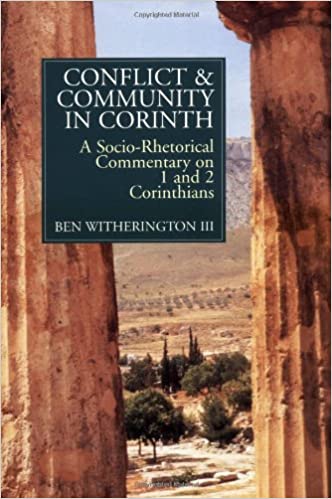
A few years ago, I had the opportunity to take a graduate school class on 1-2 Corinthians, and as part of that class, read several commentaries and lots of articles. One of my favorite reads was Conflict & Community in Corinth: A Socio-Rhetorical Commentary on 1 and 2 Corinthians by Ben Witherington III.
Here is one particularly insightful quotation from Witherington:

Careful attention to the historical and social matrix of the Pauline communities makes it clear that the early ekklesia [church] was far from perfect. As often as not, Paul was busy exhorting Christians to change their ways. If we believe that the Christian community of today should in some sense be biblically shaped and if we hold up the example of the Pauline communities, then we must say “go and do otherwise” at least as often as we say “go and do likewise.”

One reason we tend to commit the fallacy of idealism when we reflect on the early ekklesia is that we have assumed that the “determining factors of the historical process are ideas and nothing else, and that all developments, conflicts and influences are at bottom developments of, and conflicts and influences between, ideas.” Such a premise too often leads to the false conclusion that if we get our ideas about the faith right or if we emulate “the pattern” of the early ekklesia, then our Christian community will be what it ought to be.

But if we read Paul’s letters carefully, they reveal that right living and proper social interaction both within the Christian community and with the larger world were at least as much of a concern as right thinking, and evidently the early Christians had difficulties with all these matters.

Ben Witherington III, Conflict & Community in Corinth, p. xv

As many readers know already, and as I have written about before, I am a spiritual descendant of the American Restoration Movement, which is based on the premise that Christians should seek unity in God’s church by emulating the teachings of the New Testament and following the example of the early church. I believe that such an approach is fundamentally valid, but I think Witherington provides some important words of caution.

When we read about different congregations of the early church in the pages of Scripture, we come across some like the church at Corinth or some of the seven churches of Asia in the Book of Revelation that serve better as negative examples of what not to do rather than examples that we should try to follow today. So, when we say that we want to be like the church of the New Testament, we need to understand that we don’t exactly mean that, because the various New Testament congregations of which we are aware varied greatly in practice, and not all of them are worth emulating. Because of that, sometimes we might clarify our restorationist goals by saying that we want to be the church of the New Testament as conceptualized and instructed by apostolic teaching. But Witherington provides a caution here too, since having the right ideas and beliefs does not necessarily lead to right practices. And after all, what does it matter what we think if we don’t live right?

To me, none of this discredits the validity of the Restoration principle, but it does mean that we should be careful when we talk about it and as we seek to apply it. For example, rather than seeking to emulate the practices of the early church in wholesale fashion, we should examine biblical texts carefully to see where and how first century congregations were affirmed or reproved for their beliefs and practices, and choose to emulate them accordingly. Furthermore, we need to realize that faithful Christianity is about more than simply believing the right things; it also entails living in a certain way. As Witherington points out, the latter does not necessarily follow the former. At the same time, while it is true that right ideas do not guarantee right practices, it’s also true that wrong ideas make right practices nearly impossible.

While it’s true that right ideas don’t guarantee right practices, wrong ideas make right practices nearly impossible. Share on X

God is concerned with both: He wants us to believe certain things, which in turn empower us to live a certain way. And from this perspective, the positive and negative examples of the early church, along with apostolic teachings preserved in the New Testament, are incredibly helpful.

Preparing for Ministry in Small Churches


Several days ago, I had the opportunity to speak to a class of ministry students at Harding University who are near the completion of their degrees. While my primary task was to speak to them about youth ministry, I was also supposed to give them some practical tips for doing ministry in a congregational setting.

I offered several tips, some of which were likely more helpful than others, but some of my advice was focused on the reality that Churches of Christ represent a fellowship of small churches.

Consider some of the following information from the 2015 edition of Churches of Christ in the United States, compiled by Carl H. Royster. Of 12,303 congregations of Churches of Christ in the United States:

  • 1,932, or 15.7%, are congregations of 0-24 people
  • 3,351, or 27.2%, are congregations of 25-49 people
  • 3,556, or 28.9%, are congregations of 50-99 people
  • 2,159, or 17.5%, are congregations of 100-199 people
  • Combined, this means that roughly 89% of congregations are less than 200 people in size

The congregation where I currently serve doesn’t seem overly large to me, but at 230, it is in the top ten percent of congregations in our fellowship by size.

Again, Churches of Christ represent a fellowship of small churches. With this reality in mind, I offered a couple of suggestions to the Harding students I talked to who were about to graduate and head into ministry roles in Churches of Christ.

First, it is important to develop a diversified skill set. If you want to work in a church of Christ, and what you really, really want to do is be an adult education minister and do only that, there just aren’t that many jobs like that out there. The reality is that in smaller churches (i.e., the vast majority of churches of Christ), you have to wear a lot of hats, and you need to have a diversified skill set to be able to do that.

In my current position (and remember, we are over 200 in size, so we are larger than 9/10 churches in our fellowship), in a given week I might find myself planning a youth retreat, writing adult Bible class lessons, designing our church website, preaching, and negotiating a new contract with our copier company—and that’s not an unusual week!

Out of necessity, you have to wear a lot of different hats. You might have a specialized skill or skills that you are really good at, and that’s great, but you need to develop general skills as well.

Second, it is important to develop humility about your role. I was speaking that day to Christian college-trained ministry students, which means that in many ways, they are the upper echelon, the elite. They have spent lots of money and countless hours receiving training in biblical languages, intensive Bible study, ministerial skills, etc. Simply put, there are things that they have been trained to do that a lot of people in the congregations where they serve won’t be able to do, and it’s important that they prioritize and do those things.

But at the same time, that doesn’t mean they are too good to do less glamorous, more menial things. I cannot begin to count the number of hours I have spent straightening up chairs, taking out the trash, or putting things away in storage closets while at work. I didn’t need an M.Div to do that work, but it was still a vital part of my job. A couple of years ago, we had a major problem with the sewage line at our church building. Toilets backed up, and foul water flooded the hallway. And our preaching minister got out the mop and went to work. Ultimately, ministers are servants, and they step up to serve where it is needed; they are not too good to do the “small” things.

I am sure there are many more ideas that could be added, and again, this is coming from a guy who isn’t really at a small church. But if these lessons are true for me, how much more they must apply to even smaller congregational contexts. There are some real blessings that come with working with small churches, but it requires a certain type of minister as well.

Judging by demographic realities, many of the ministry students I spoke to will find themselves (at least at some point) working in smaller congregations. I hope what I shared with them will prove to be helpful.

« Older posts Newer posts »

© 2026 The Doc File

Theme by Anders Noren — Up ↑